Kirtan Kriya · Sa Ta Na Ma · SPECT · n=14

Kirtan Kriya: Newberg 2010, fourteen SPECT scans, twelve minutes

JM Thomas · 17 August 2026

Four syllables plus four finger taps write a 12-minute loop. Newberg, Wintering, Khalsa, Roggenkamp, and Waldman put 14 people with memory complaints on SPECT. Eight weeks of daily Kirtan Kriya. Right dorsolateral prefrontal baseline blood-flow ratio rose from 1.10 to 1.20. Category fluency rose 14 percent.

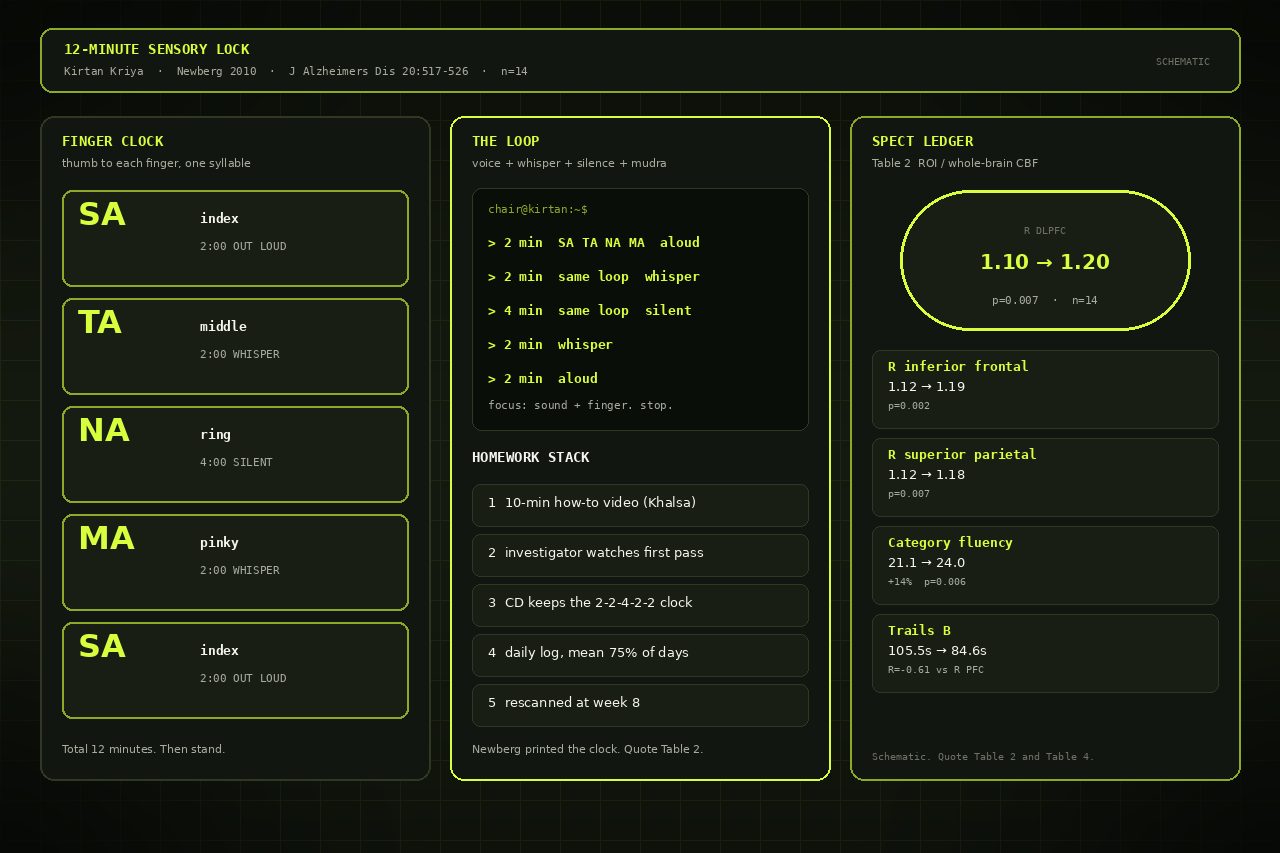
Dark lime schematic of Sa Ta Na Ma finger taps feeding a 12-minute loop into a labeled frontal cortex ledger. Newberg 2010 n=14.
Sa Ta Na Ma, finger clock, frontal ledger. Schematic. Quote Table 2, not the drawing.

The practice is older than the scanner. The scanner is why this page exists. Sa. Ta. Na. Ma. Thumb to index, then middle, then ring, then pinky. Two minutes out loud. Two whispered. Four silent. Two whispered. Two out loud. Twelve minutes. Then you stand up.

I've run loops like this in a chair. The hunger is for a brain that still retrieves a name. Buyers type Kirtan Kriya, sa ta na ma, 12-minute meditation, Alzheimer's mantra. Happy Days in Grand Junction put a brain-longevity workshop on the calendar for 22 August 2026. Amen talked the same 12 minutes on a podcast clip. This page stays with the SPECT file.

Four sounds, four fingers, twelve minutes

Kirtan Kriya, in the protocol Newberg printed, is a timed sensory lock. Voice, whisper, silence, whisper, voice. Each syllable gets a finger. The whole pass is 12 minutes. That clock is the intervention.

Newberg wrote the sequence in the methods, Journal of Alzheimer's Disease 20 (2010) 517-526, DOI 10.3233/JAD-2010-1391, PMID 20164557. SA TA NA MA. Thumb to index on SA, middle on TA, ring on NA, pinky on MA. Out loud 2 minutes. Whisper 2. Silence 4. Whisper 2. Out loud 2. Total 12.

Subjects watched a 10-minute how-to video with Dharma Singh Khalsa. An investigator answered questions, then watched the first pass. After that, a CD kept the rhythm at home. A log sat next to the chair. Mean compliance: 75 percent of the days in the study. Range 41 to 100.

They were told to focus on the sounds and the finger movements. No extra state-of-mind lecture. No mindfulness add-on. No preparatory yoga. The task was the task. That is a gift. A 12-minute homework you can fail on a calendar is a protocol. A weekend that demands a guru is a different machine.

The Library already keeps this loop as Spell 15, Synaptic Seal. Sa-Ta-Na-Ma plus finger taps. Posterior cingulate blood flow. Sensory lock for memory and emotion. This page is the SPECT ledger that spell sits on.

Fourteen SPECT scans after eight weeks

Fifteen people walked in. One AD patient with MMSE 16 could not run the loop. n=14 finished. Ages 52 to 77, mean 64, SD 8. Seven age-associated memory complaints. Five MCI. Two AD in the analyzed set. Six men and nine women at intake. Penn Nuclear Medicine. Alzheimer's Research and Prevention Foundation paid the work.

Day one: an IV, a 12-minute neutral information CD, 250 MBq of Tc-99m ECD, a baseline SPECT. Then the first Kirtan Kriya on a guided CD, 925 MBq, a meditation scan. Eight weeks of daily homework. Then the same pair again. Same order, so the meditation pass could not dirty the rest scan.

Table 2 is the lock. Baseline CBF as ROI over whole-brain. After the program, the KK group sat higher in frontal and right superior parietal cortex, still after false-discovery correction.

Structure Pre baseline Post baseline p
R DLPFC 1.10 ± 0.15 1.20 ± 0.15 0.007
R inferior frontal 1.12 ± 0.10 1.19 ± 0.09 0.002
R superior frontal 1.12 ± 0.09 1.16 ± 0.08 0.007
R superior parietal 1.12 ± 0.07 1.18 ± 0.06 0.007
L superior frontal 1.11 ± 0.08 1.15 ± 0.10 0.006

Right posterior cingulate went the other way, 1.36 to 1.28, p=0.02. Left thalamus 1.26 to 1.18, p=0.03. Those two sit in Table 2. Keep them. A page that only prints the rises is a brochure.

Neuropsychology, Table 4. Category fluency, animals in 60 seconds: 21.1 to 24.0, plus 14 percent, p=0.006, still up after correction. Trails B: 105.5 seconds to 84.6, plus 20 percent, p=0.05. Logical memory delayed: 10.6 to 12.4, plus 17 percent, p=0.05. WAIS digit symbol: 63.7 to 67.6, plus 6 percent, p=0.05. Right prefrontal CBF tracked Trails B, R=−0.61, p=0.02, still after correction.

During the later meditation pass, right DLPFC activation flipped. First session: plus 0.9 percent versus rest. After training: minus 6.3 percent, p=0.001. The rest scan rose. The work scan quieted. Practice made the loop cheaper to run.

Five people listened to Mozart

Newberg recruited a music comparison. n=5. Two MCI, three age-associated. All women. Mean age 65, SD 10. Twelve minutes of two Mozart violin concertos a day. Same SPECT days. Same test battery.

That group is small. Say it. After multiple-comparison correction, their baseline CBF shifts dropped out. Raw, the rises sat in right amygdala and a drop in right precuneus. Different map. Different task.

On the tests, music moved some of the same columns. Trails B and logical memory trended up. Those p values stayed above 0.05. Category fluency is the split Newberg printed: KK beat music, p less than 0.05. Animals named in a minute. A cheap test. The one that survived correction in the KK set.

Newberg called the music arm a hard control on purpose. Music already has a cognition literature. A rest-only arm would have been softer. He still asked for a larger, cleaner MCI-only trial. So does this page.

Thirty-nine caregivers and a telomerase assay

Lavretsky, Epel, Siddarth, Nazarian, St Cyr, Khalsa, Lin, Blackburn, Irwin. International Journal of Geriatric Psychiatry 28(1):57-65, 2013. DOI 10.1002/gps.3790. PMID 22407663. Family dementia caregivers with mild depressive symptoms. Randomized. Kirtan Kriya versus relaxation music. 12 minutes a day. 8 weeks. n=39. Mean age 60.3, SD 10.2.

Hamilton Depression: 65.2 percent of the meditation arm hit a 50 percent drop. Music: 31.2 percent. SF-36 mental health composite: 52 percent versus 19 percent hit a 50 percent rise. Both p less than 0.05.

Telomerase in peripheral blood mononuclear cells: plus 43 percent in the KK arm, plus 3.7 percent in music, p=0.05. Blackburn is on the author line. That is the enzyme paper people quote when they say the 12 minutes "lengthens telomeres." The file says telomerase activity in PBMCs, a pilot, p sitting on the line. Keep the noun honest.

Same 12-minute clock. Same Khalsa protocol. A different population. Stressed caregivers, mild depression, a music control that already relaxes. The SPECT page and the caregiver page share a homework. They do not share a scanner.

Sixty-eight genes in the same blood

Black, Cole, Irwin, Breen, St Cyr, Nazarian, Khalsa, Lavretsky. Psychoneuroendocrinology 38(3):348-355, 2013. DOI 10.1016/j.psyneuen.2012.06.011. PMID 22795617. Forty-five caregivers randomized. Thirty-nine finished. Genome-wide leukocyte transcripts at week 0 and week 8.

KK versus relaxing music. After sex, illness burden, and BMI: 68 genes moved. 19 up. 49 down. Up: immunoglobulin-related transcripts. Down: pro-inflammatory cytokines and activation immediate-early genes. Promoter analysis pointed at reduced NF-κB and increased IRF1, both p less than 0.05. Transcript origin: plasmacytoid dendritic cells and B lymphocytes, both p less than .001.

That is a stress-gene reverse, the pattern Cole already printed in caregivers. A 12-minute loop sat on that pattern for eight weeks. The paper does not hand you a percent drop in "inflammation" you can paste on a thumbnail. It hands you a gene list and a pathway call.

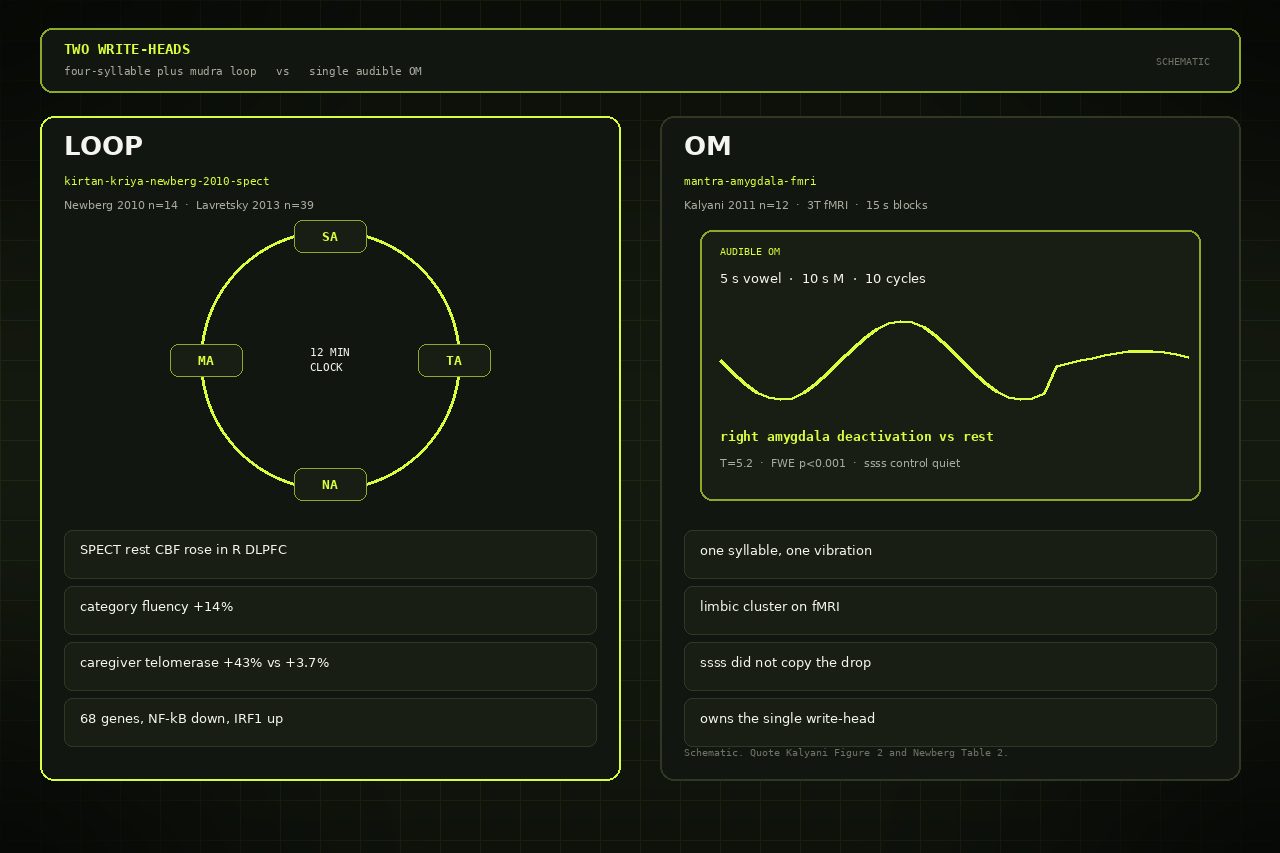
Two-panel schematic. Left: four-syllable plus finger-tap loop with SPECT ledger. Right: single OM waveform into an amygdala. Schematic, not a scan.
Four-syllable loop on the left. Single OM on the right. Schematic. Quote the papers.

Fourteen yoga, eleven memory class

Eyre, Acevedo, Yang, Siddarth, Van Dyk, Ercoli, Leaver, St Cyr, Narr, Baune, Khalsa, Lavretsky. Journal of Alzheimer's Disease 52 (2016) 673-684. DOI 10.3233/JAD-150653. PMID 27060939. MCI, age 55 and up. Twelve weeks. Daily 12-minute Kirtan Kriya plus a weekly 60-minute Kundalini class, versus memory enhancement training. Resting-state fMRI. 14 yoga finishers, 11 MET finishers.

Yoga moved depression and visuospatial memory. Verbal memory gains tracked higher connectivity between the default-mode network and frontal medial cortex, pregenual ACC, right middle frontal, posterior cingulate, and left lateral occipital cortex. Language-network coupling to left inferior frontal gyrus rose with verbal memory. Visuospatial memory ran inverse to superior-parietal / medial-parietal coupling.

Eyre's line: yoga may match MET on functional connectivity tied to verbal memory. Confirm in a larger trial. The weekly class is extra hardware Newberg did not use. If you want the SPECT finding, the homework is the 12-minute loop. If you want Eyre's connectivity map, you also sat a 60-minute class each week.

A single OM already has a page

One contrast. Kalyani 2011 put audible OM on a 3T fMRI in 12 people and saw right-amygdala deactivation versus rest. That page is one syllable, one vibration, one limbic cluster. This page is four syllables, four fingers, a SPECT rest-scan that rose after eight weeks, then a caregiver RCT.

Keep them apart. An OM you can hum on an exhale is a write-head. Sa Ta Na Ma plus mudra is a timed multi-channel lock. Both can live in a week. Mixing them in one sitting is fine. Calling the mix a published n is how a lab number gets invented.

Kundalini as a trunk already has a translation: raising Kundalini is recruiting the vagus. Kirtan Kriya is one homework from that lineage. The SPECT file does not need the full rising. It needs the 12-minute clock.

Run the loop. Keep a number.

Twelve minutes. Sa Ta Na Ma. Thumb through the four fingers. 2-2-4-2-2. Write a 1-to-10 on name-finding or chair-noise before you start, and again when you stand. Eight weeks is the scanner's clock. Tonight is yours.

If you want a daily number before you add syllables, the free seven-minute brake is already posted. Inhale four counts. Leave on eight. Mark 1 to 10. Then add the loop if the chair still wants it.

Educational mechanism page by JM Thomas. A clinician owns diagnosis and treatment of any disease. Newberg 2010 is a SPECT pilot in 14 people with memory complaints. Lavretsky 2013 is a caregiver RCT in 39. Black 2013 is a gene-expression RCT in 45 randomized, 39 finished. Eyre 2016 is an MCI connectivity pilot, 14 yoga and 11 MET. Talk to a clinician if unusual distress, dissociation, or a psychiatric history is on the table.

FAQ

Do I need a full Kundalini yoga class for the SPECT finding?

Newberg 2010 used the 12-minute Kirtan Kriya homework alone. A 10-minute how-to video, then a CD, then a log. Eyre 2016 added a weekly 60-minute Kundalini class on top of the same daily loop. Two protocols. Two n.

Did they treat Alzheimer's disease?

They scanned people who already complained about memory. Seven age-associated, five MCI, three AD. One AD patient with MMSE 16 could not run the loop. That scan left the analysis. n=14 finished. This is a pilot, not a disease cure.

Can a YouTube track replace the CD?

The lab used a guided CD that kept the 2-2-4-2-2 timing. A track that keeps that clock is closer to the protocol than a 30-minute kirtan mix. The paper measured the 12-minute loop, not a concert.

How long before a number moves?

Newberg rescanned at eight weeks. Lavretsky drew blood at eight weeks. Eyre imaged at twelve. Nobody printed a day-one SPECT win. The chair can give you a 1-to-10 tonight. The scanner waited.

Is this the same as OM chanting?

Kalyani 2011 used one audible OM on a 3T fMRI in 12 people. This page is Sa Ta Na Ma plus finger taps on SPECT, then a caregiver RCT. One contrast. Two write-heads.

Is this medical advice?

Educational mechanism page by JM Thomas. A clinician owns diagnosis and treatment. Newberg 2010 is a SPECT pilot. Lavretsky 2013 is a caregiver RCT. Black 2013 is a gene-expression RCT. Eyre 2016 is an MCI connectivity pilot.

Papers this page cites

Newberg, A.B., Wintering, N., Khalsa, D.S., Roggenkamp, H., and Waldman, M.R. "Meditation effects on cognitive function and cerebral blood flow in subjects with memory loss: a preliminary study." Journal of Alzheimer's Disease 2010;20:517-526. DOI 10.3233/JAD-2010-1391. PMID 20164557. Full PDF. n=15 in, 1 AD MMSE 16 dropped, n=14 analyzed. Music comparison n=5. Table 2 R DLPFC 1.10 to 1.20, p=0.007. Table 4 category fluency 21.1 to 24.0, +14%, p=0.006. Trails B R=−0.61 vs right prefrontal, p=0.02. Compliance mean 75%. doi.org/10.3233/JAD-2010-1391 · europepmc.org/article/MED/20164557

Lavretsky, H., Epel, E.S., Siddarth, P., Nazarian, N., St Cyr, N., Khalsa, D.S., Lin, J., Blackburn, E., and Irwin, M.R. "A pilot study of yogic meditation for family dementia caregivers with depressive symptoms: effects on mental health, cognition, and telomerase activity." International Journal of Geriatric Psychiatry 2013;28(1):57-65. DOI 10.1002/gps.3790. PMID 22407663. PMC 3423469. RCT n=39, KK vs music, 12 min/day, 8 weeks. HAMD 50% response 65.2% vs 31.2%. SF-36 MCS 52% vs 19%. Telomerase +43% vs +3.7%, p=0.05. doi.org/10.1002/gps.3790 · europepmc.org/article/MED/22407663

Black, D.S., Cole, S.W., Irwin, M.R., Breen, E., St Cyr, N.M., Nazarian, N., Khalsa, D.S., and Lavretsky, H. "Yogic meditation reverses NF-κB and IRF-related transcriptome dynamics in leukocytes of family dementia caregivers in a randomized controlled trial." Psychoneuroendocrinology 2013;38(3):348-355. DOI 10.1016/j.psyneuen.2012.06.011. PMID 22795617. PMC 3494746. n=45 randomized, 39 completed. 68 genes (19 up, 49 down). NF-κB down, IRF1 up. doi.org/10.1016/j.psyneuen.2012.06.011 · europepmc.org/article/MED/22795617

Eyre, H.A., Acevedo, B., Yang, H., Siddarth, P., Van Dyk, K., Ercoli, L., Leaver, A.M., St Cyr, N., Narr, K., Baune, B.T., Khalsa, D.S., and Lavretsky, H. "Changes in neural connectivity and memory following a yoga intervention for older adults: a pilot study." Journal of Alzheimer's Disease 2016;52:673-684. DOI 10.3233/JAD-150653. PMID 27060939. 14 yoga + 11 MET completed. 12 weeks. Daily KK plus weekly KY vs MET. Verbal memory tied to DMN connectivity including posterior cingulate. doi.org/10.3233/JAD-150653 · europepmc.org/article/MED/27060939