Mechanism · Mantra · Amygdala · fMRI

A mantra is an input to the amygdala.

JM Thomas · Paris, Tennessee · 15 August 2026

A chant is a patterned sound plus attention. In a 2011 NIMHANS pilot, audible OM produced limbic BOLD deactivation versus rest, including the right amygdala. The control syllable did not. The stills on this page are schematic. They are not scans. A sound is an input.

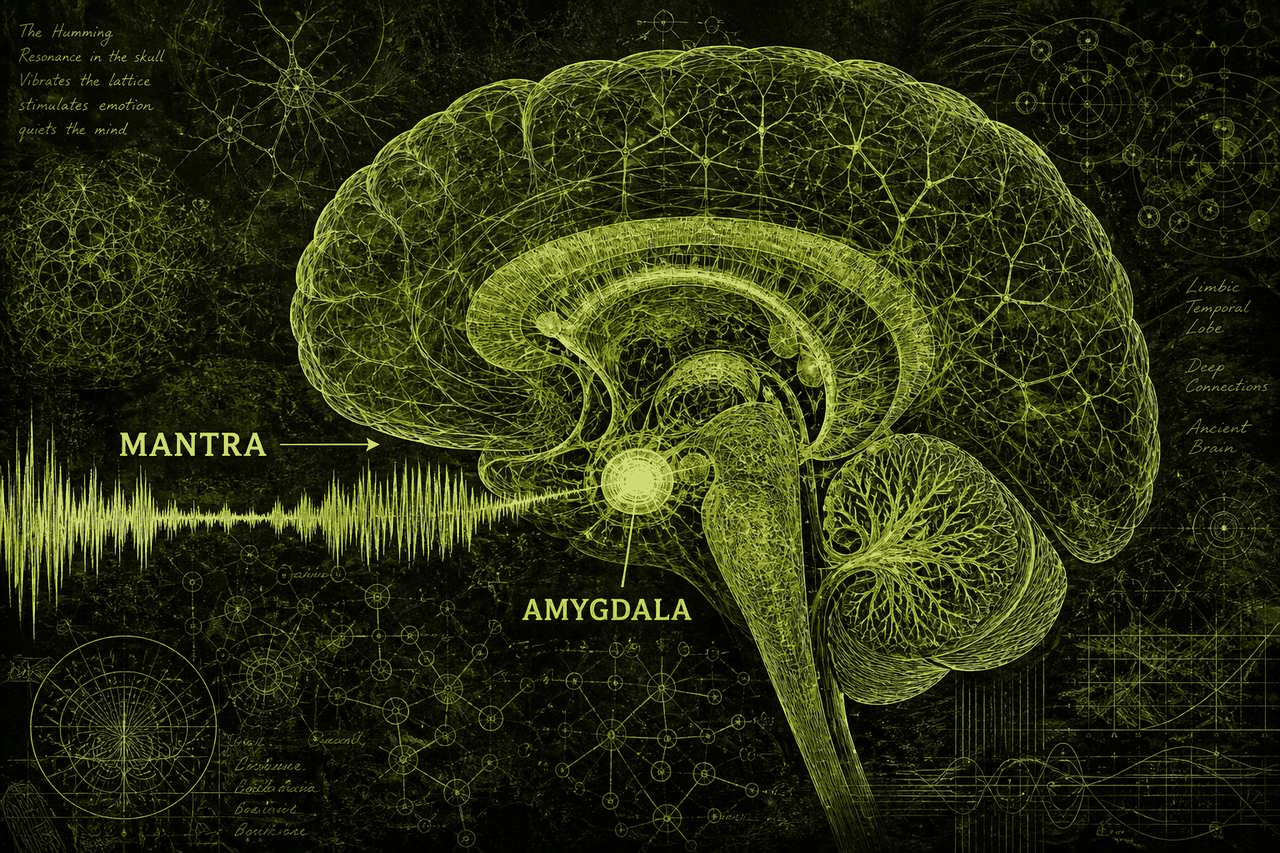
Dark lime schematic: a MANTRA waveform entering a labeled AMYGDALA on an anatomical brain field. Schematic still, not an fMRI scan.
Mantra into amygdala. Schematic still. Not a BOLD map. Not a percent drop.

I write from Paris, Tennessee. People ask me if AUM is magic. They ask if chanting shrinks the amygdala. They paste a scan they did not run. Those are hardware questions. I will answer the hardware.

Reality Engineering is the science of making reality respond to intent. Sound is a write-head for state. The old map named the syllable. The scanner named a cluster. The gatekeeper hid the input and rented the mystery.

What does mantra do to the brain?

A mantra is a patterned sound plus attention. In the 2011 NIMHANS pilot, audible OM chanting produced BOLD deactivation in limbic regions versus rest. The right amygdala was one of those regions. The control syllable ssss did not. That is a hemodynamic correlate in twelve people. It is not a cosmic download.

I have watched the aisle. Chant this. Become that. Skeptics answering with "just breathing." Both skip the block design. Kalyani, Rao, Kalmady, Behere, Rao, Vasudev, and Gangadhar put twelve right-handed healthy volunteers in a 3 Tesla scanner at NIMHANS. Ages 22 to 39. Mean 28 plus or minus 6. Nine men. Four had formal yoga training. The rest were naive. They chanted audible OM: the vowel for 5 seconds, the consonant M for 10 seconds. Fifteen-second blocks. Ten of those. Interleaved with rest and with a 15-second ssss. Ten minutes of EPI. SPM5. Family-wise error at p less than 0.001 on a priori limbic masks.

No significant activation during OM versus rest. Significant deactivation in amygdala, anterior cingulate, hippocampus, insula, orbitofrontal cortex, parahippocampal gyrus, and thalamus. The ssss task produced neither activation nor deactivation in those regions. That is the whole finding. A syllable with vibration around the ears. A syllable without it. Rest. One of those three quieted the limbic set.

Related reading: raising kundalini is recruiting the vagus. That page is the trunk. This page is a sound that may knock on the auricular branch of that trunk. And binaural beats versus isochronic versus 40Hz: other constructions that marketing also sells as "the frequency." Different input. Same hunger.

Does OM chanting deactivate the amygdala?

In Kalyani and colleagues 2011, yes, in that sample: significant right-amygdala deactivation during audible OM versus rest, family-wise error p less than 0.001, T of 5.2. n equals 12. Four had yoga training. The authors call it a pilot. They also say a relaxation confound could not be ruled out. I will not invent a percent drop the paper did not print.

Table 1 of that paper lists the peak. Right amygdala. Talairach 24, minus 10, minus 08. T equals 5.2. FWE p less than 0.001. Left amygdala is not in that table. I am leaving the laterality as they wrote it. Bilateral deactivation showed up in orbitofrontal, anterior cingulate, parahippocampal gyri, thalami, and hippocampi. Right amygdala is named extra because it was not bilateral in their report.

I will not turn T of 5.2 into a percent. BOLD is a relative signal. The paper did not print a percent drop. Marketing will. I will not. A significant deactivation in a twelve-person pilot is a correlate. It is not a dose. It is not your Tuesday. It is not a promise that any Sanskrit file on a phone will reprint that voxel.

Kumar, Nagendra, Manjunath, Naveen, and Telles, writing in the same journal a year earlier, collected the older OM physiology. Mental OM in seven experienced meditators dropped heart rate versus a control period of nontargeted thinking. A later Telles comparison: repeating OM versus repeating One, both slowed heart and breath, OM alone reduced skin resistance. Those are autonomic notes. They are not fMRI. They sit next to Kalyani. They do not replace it.

What is the amygdala?

The amygdala is an almond-shaped cluster in the temporal lobe, just beneath the uncus. StatPearls (AbuHasan, Reddy, Siddiqui) puts it at about 13 nuclei in five groups. It sits on fear conditioning, anxiety, aggression, and emotional memory. Electrical stimulation evokes fear. Lesions block some unconditioned fear. It is hardware. It is not a mood.

That word is the whole page. Amygdala. Not a personality. Not a color. A cluster that tags threat and tags some reward, then talks to hypothalamus, brainstem, and cortex. Two major outputs in the StatPearls page: stria terminalis dorsal, ventral amygdalofugal pathway ventral. Basolateral nucleus in the stress loop. Central nucleus in the physiological response to a stressor. Bed nucleus of the stria terminalis in the extended amygdala for anxiety.

If that cluster is loud, intent dumps as alarm. A vision board on a screaming nerve is a poster. A mantra on a screaming nerve is still a sound. The point of the fMRI finding is smaller: a specific audible construction quieted BOLD in that cluster versus rest, in that sample, while a hiss did not. Related reading: why vision boards fail.

I will not call the amygdala a lizard brain and stop. It is paired. It is connected. It learns. Sah and colleagues, which StatPearls cites, treat the amygdaloid complex as anatomy and physiology, not as a slogan. The still on this page points a line at a glowing spot. That line is a schematic. The cluster is real. The glow is art.

Why would a chant hit the vagus?

Kalyani hypothesized that the vibration around the ears during audible OM reaches the auricular branch of the vagus, the same branch Kraus used for transcutaneous VNS in 2007. Kraus saw limbic BOLD decreases including amygdala in 22 healthy subjects. The OM authors say that mechanism is preliminary. ssss controlled for expiration without the ear vibration.

That hypothesis is why they chose loud chanting instead of mental japa. Earlier electrophysiology used mental OM. They wanted a vibration you could confirm. After the scan, an investigator asked whether subjects felt vibration during OM and not during ssss. The control was the expiratory act without the ear buzz. If both had quieted the limbic set, expiration would have been enough. ssss did not. That is the contrast they designed.

Kraus, Hosl, Kiess, Schanze, Kornhuber, and Forster stimulated the left outer auditory canal in 22 healthy subjects. Earlobe stimulation was sham. tVNS dropped BOLD in amygdala, hippocampus, parahippocampal gyrus, middle and superior temporal gyrus. Insula, precentral gyrus, and thalamus went up. Earlobe sham did not copy that pattern. Heart rate, blood pressure, and peripheral microcirculation did not move in that session. Kalyani lined their deactivations next to Kraus and called the vagal story preliminary. I will keep that word.

Bernardi and colleagues, in BMJ in 2001, had 23 healthy adults recite the rosary and yoga mantras at six cycles a minute. Cardiovascular rhythms synchronized. Baroreflex sensitivity rose. That is a breath-rate finding, not an amygdala map. It still says a voiced formula at a slow cadence is a control input. Related reading: the vagus as the recruited trunk.

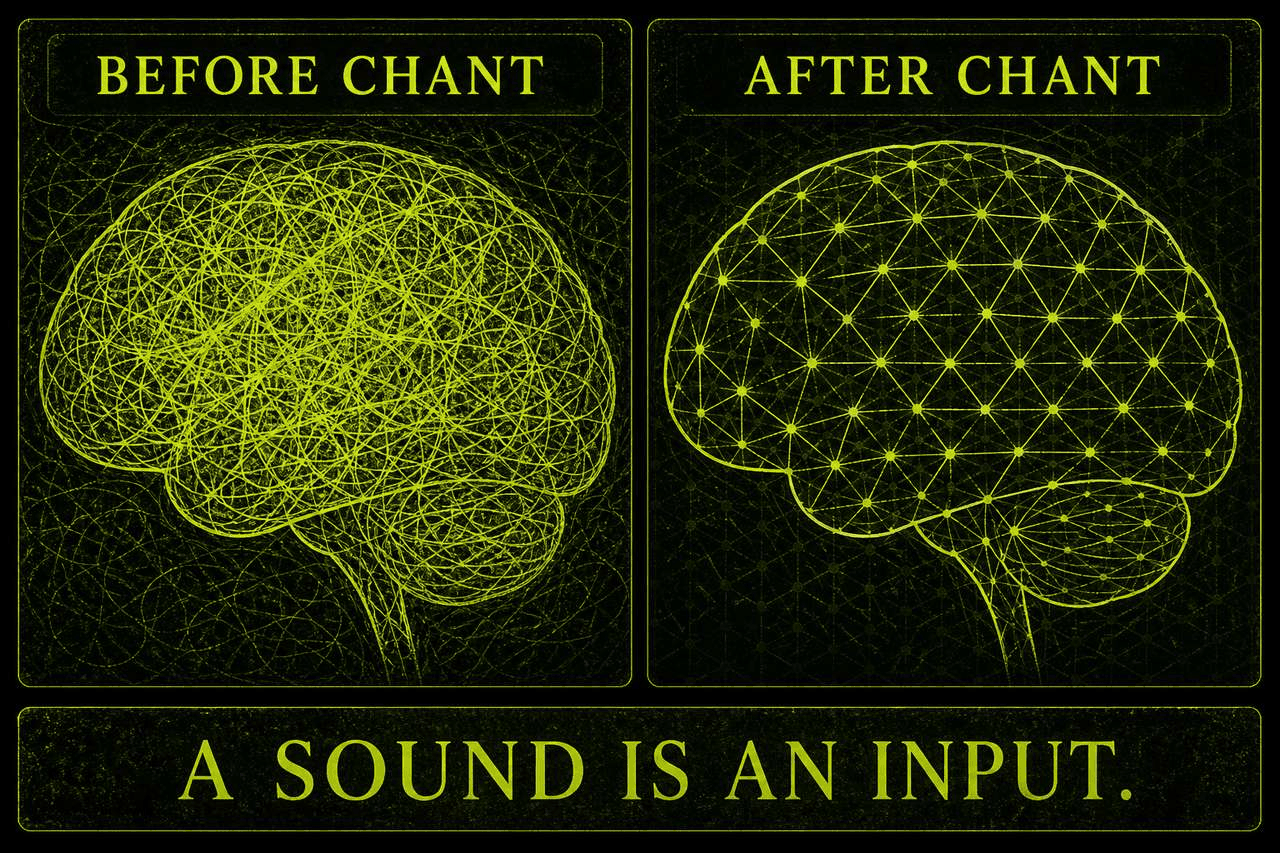
Dark lime split labeled BEFORE CHANT and AFTER CHANT. Left brain filled with tangled lines. Right brain a geometric node grid. Footer: A SOUND IS AN INPUT. Schematic still, not an fMRI scan and not a percent drop.
Before chant versus after chant. Footer on the still: a sound is an input. Schematic. Not a scan. Not a measured percent.

Is the before/after still a brain scan?

No. The stills on this page are schematic. They are not fMRI slices. They are not BOLD maps. BEFORE CHANT and AFTER CHANT is a drawing of noise versus order. The footer says a sound is an input. Do not quote the art as data. The data is in the papers I opened.

I drew the pair because people search the pair. Chaos on the left. Grid on the right. That is a memory palace. It is the same move as millivolt numerals on the meridians still and one-to-one chakra-gland lines on the endocrine still: labeled schematic, not a meter. If you need a scan, open Kalyani Figure 2. That figure is theirs. This one is mine. Mine does not have a color bar. Mine does not have a T score.

The hero is the same honesty. A waveform labeled MANTRA. A spot labeled AMYGDALA. The anatomy is allowed. The implied laser is art. Sound does not travel as a green ribbon through cortex. Sound is pressure. The brain writes a BOLD change. I will not pretend the ribbon is a tractograph.

Why does marketing collapse mantra into mystery?

Mystery rents better than a 15-second block design. A secret syllable sells initiation. A BOLD deactivation in twelve people sells a lab. The gatekeeper hid the input and charged for the secret. The people hunting a sound that changes state were not wrong to hunt.

I have seen the aisle. Activate your pineal with a seed sound. 432 hertz. A download. Skeptics answering with "placebo." Both skip the contrast. Both skip that ssss did not copy OM. Both skip that the authors refused to rule out relaxation. The translation was sitting in International Journal of Yoga in 2011. A vibration. A hypothesized auricular vagus. A quieted cluster. A small n.

The enemy is that hide. I already ran this translation on kundalini as vagus superconductor and on delivery methods the marketing collapses. Intention is current. Sound is one write-head. A screaming amygdala dumps the signal as alarm. Software still needs hardware.

Question Mantra aisle What the papers actually did What I will not claim
What you are looking at A sacred syllable. AUM. A secret. Audible OM: 5 s vowel, 10 s M. 15 s blocks. 10 cycles. 3T fMRI. n=12. That any phone chant reprints that voxel.
Amygdala "It shuts the fear center." Right amygdala deactivation vs rest. T=5.2. FWE p<0.001. Not listed as bilateral. A percent drop. The paper did not print one.
Control None. Faith. ssss for 15 s: expiration without ear vibration. No limbic deactivation there. That expiration is the whole mechanism.
Vagus story The sound "stimulates the vagus." Hypothesis: auricular branch, lined up with Kraus 2007 tVNS (n=22). Authors: preliminary. That OM equals clinical VNS.
The still A scan they did not run. Schematic art. Footer: a sound is an input. That the drawing is a BOLD map.
How you start A guru. A seed. A frequency shop. A count you can fail. Breath as a switch. A 1-10 you write down. That you need to buy a track to test the first layer.

Two columns. One input. The stills on this page are drawings. The numbers are from papers I opened. Do not quote the art as a scan.

What should I run if I want a number?

Start with Protocol 01, the free Neural Recalibration. Four-count inhale, eight-count exhale, seven minutes, a number before and a number after. You can add a tone if you want. You do not need a Sanskrit password for the first test. If the method earns it, the Library of Biological Wizardry is the rest of the stack. Sound is an input. The brake is how you stop screaming into it.

You can keep the syllable. I will not take your AUM. Run 7 minutes of 4 in, 8 out. Write 1 to 10 before. Write 1 to 10 after. Do three days. If you want the voiced version, hum on the exhale. Feel whether the ears buzz. That is closer to Kalyani's construction than a silent loop on a phone. The mystery was optional.

A quieted amygdala and a recruited vagus are cousins. Breath is the cheap recruitment. Voice is a second switch. I translated the trunk on the kundalini page. This page is the write-head. A 1-to-10 you write down is the first output you own.

The Library of Biological Wizardry is 15 protocols, 9 volumes, and live instruments. Reality Engineering: the science of making reality respond to intent. Sound is one hardware layer. It is not the product they actually want, which is a life that answers. You do not need the archive to test the first layer.

Run the brake first.

Protocol 01 is free. Seven minutes. 4 in, 8 out. A 1-10 before. A 1-10 after. No faith. No seed sound required. If the method earns the rest of the stack, the Library is there.

What I will not claim

I will not invent a percent drop. I will not treat a schematic still as a scan. I will not upgrade a twelve-person pilot into a clinical protocol. This is an educational mechanism page. It is not medical advice.

I will not fight the people who wanted the syllable to be real. The hunger was honest. The enemy is the gatekeeper who hid the input and sold the secret. The HOW is boring on purpose. A block. A contrast. A cluster. A count. A number you have to look at.

If you are in medical trouble, talk to a clinician. I am an author in Paris, Tennessee, not your doctor. The papers are linked because I opened them. They are not a Tuesday promise.

Direct answers

Short answers you can lift from this page. Visible text matches the FAQ schema exactly. A mantra is an input. The stills are schematic. None of this is medical advice.

What does mantra do to the brain?

A mantra is a patterned sound plus attention. In the 2011 NIMHANS pilot, audible OM chanting produced BOLD deactivation in limbic regions versus rest. The right amygdala was one of those regions. The control syllable ssss did not. That is a hemodynamic correlate in twelve people. It is not a cosmic download.

Does OM chanting deactivate the amygdala?

In Kalyani and colleagues 2011, yes, in that sample: significant right-amygdala deactivation during audible OM versus rest, family-wise error p less than 0.001, T of 5.2. n equals 12. Four had yoga training. The authors call it a pilot. They also say a relaxation confound could not be ruled out. I will not invent a percent drop the paper did not print.

What is the amygdala?

The amygdala is an almond-shaped cluster in the temporal lobe, just beneath the uncus. StatPearls (AbuHasan, Reddy, Siddiqui) puts it at about 13 nuclei in five groups. It sits on fear conditioning, anxiety, aggression, and emotional memory. Electrical stimulation evokes fear. Lesions block some unconditioned fear. It is hardware. It is not a mood.

Why would a chant hit the vagus?

Kalyani hypothesized that the vibration around the ears during audible OM reaches the auricular branch of the vagus, the same branch Kraus used for transcutaneous VNS in 2007. Kraus saw limbic BOLD decreases including amygdala in 22 healthy subjects. The OM authors say that mechanism is preliminary. ssss controlled for expiration without the ear vibration.

Is the before/after still a brain scan?

No. The stills on this page are schematic. They are not fMRI slices. They are not BOLD maps. BEFORE CHANT and AFTER CHANT is a drawing of noise versus order. The footer says a sound is an input. Do not quote the art as data. The data is in the papers I opened.

Why does marketing collapse mantra into mystery?

Mystery rents better than a 15-second block design. A secret syllable sells initiation. A BOLD deactivation in twelve people sells a lab. The gatekeeper hid the input and charged for the secret. The people hunting a sound that changes state were not wrong to hunt.

What should I run if I want a number?

Start with Protocol 01, the free Neural Recalibration. Four-count inhale, eight-count exhale, seven minutes, a number before and a number after. You can add a tone if you want. You do not need a Sanskrit password for the first test. If the method earns it, the Library of Biological Wizardry is the rest of the stack. Sound is an input. The brake is how you stop screaming into it.

Is this medical advice?

No. This page is an educational mechanism explainer by JM Thomas. It is not a diagnosis, treatment, cure, or prevention of any disease. Named papers are literature, not a promise about your Tuesday.

Sources I actually opened

Kalyani, B.G., Rao, N.P., Kalmady, S.V., Behere, R.V., Rao, H., Vasudev, M.K., & Gangadhar, B.N. “Neurohemodynamic correlates of ‘OM’ chanting: A pilot functional magnetic resonance imaging study.” International Journal of Yoga 4(1):3-6 (Jan–Jun 2011). n=12. Audible OM vs ssss vs rest. Right amygdala deactivation vs rest (T=5.2, FWE p<0.001). No percent drop reported. PMID 21654968. PMC3099099. pmc.ncbi.nlm.nih.gov/articles/PMC3099099

Kraus, T., Hösl, K., Kiess, O., Schanze, A., Kornhuber, J., & Forster, C. “BOLD fMRI deactivation of limbic and temporal brain structures and mood enhancing effect by transcutaneous vagus nerve stimulation.” Journal of Neural Transmission 114:1485-1493 (2007). n=22. Left outer auditory canal tVNS vs earlobe sham. Limbic BOLD decreases including amygdala. PMID 17564758. doi.org/10.1007/s00702-007-0755-z

AbuHasan, Q., Reddy, V., & Siddiqui, W. “Neuroanatomy, Amygdala.” StatPearls [Internet]. Updated 17 Jul 2023. Almond-shaped temporal-lobe cluster, ~13 nuclei, five groups. Fear conditioning, anxiety, emotional memory. Bookshelf NBK537102. PMID 30725787. ncbi.nlm.nih.gov/books/NBK537102

Kumar, S., Nagendra, H., Manjunath, N., Naveen, K., & Telles, S. “Meditation on OM: Relevance from ancient texts and contemporary science.” International Journal of Yoga 3(1):2-5 (2010). Collects Telles autonomic and evoked-potential OM work. PMID 20948894. PMC2952121. pmc.ncbi.nlm.nih.gov/articles/PMC2952121

Telles, S., Nagarathna, R., & Nagendra, H.R. “Autonomic changes during ‘OM’ meditation.” Indian Journal of Physiology and Pharmacology 39:418-420 (1995). n=7 experienced meditators. Heart rate down during mental OM vs nontargeted thinking. PMID 8582759.

Telles, S., Nagarathna, R., & Nagendra, H.R. “Autonomic changes while mentally repeating two syllables-one meaningful and the other neutral.” Indian Journal of Physiology and Pharmacology 42:57-63 (1998). OM vs One. Both slowed heart and breath. OM alone reduced skin resistance. PMID 9513797.

Bernardi, L., Sleight, P., Bandinelli, G., et al. “Effect of rosary prayer and yoga mantras on autonomic cardiovascular rhythms: comparative study.” BMJ 323:1446-1449 (22–29 Dec 2001). n=23. Recitation at six cycles a minute. Cardiovascular synchronicity and baroreflex sensitivity rose. PMID 11751348. doi.org/10.1136/bmj.323.7327.1446