Mechanism · Kundalini · Vagus · Hardware

Raising the Kundalini is recruiting the Vagus nerve to act as a superconductor.

JM Thomas · Paris, Tennessee · 15 August 2026

People search “kundalini vagus nerve” after a rise they cannot name. Yoga called it a coiled force climbing the spine. Anatomy already had a trunk: cranial nerve X, heart, gut, larynx. Raising is recruitment. Hardware. Not a personality upgrade.

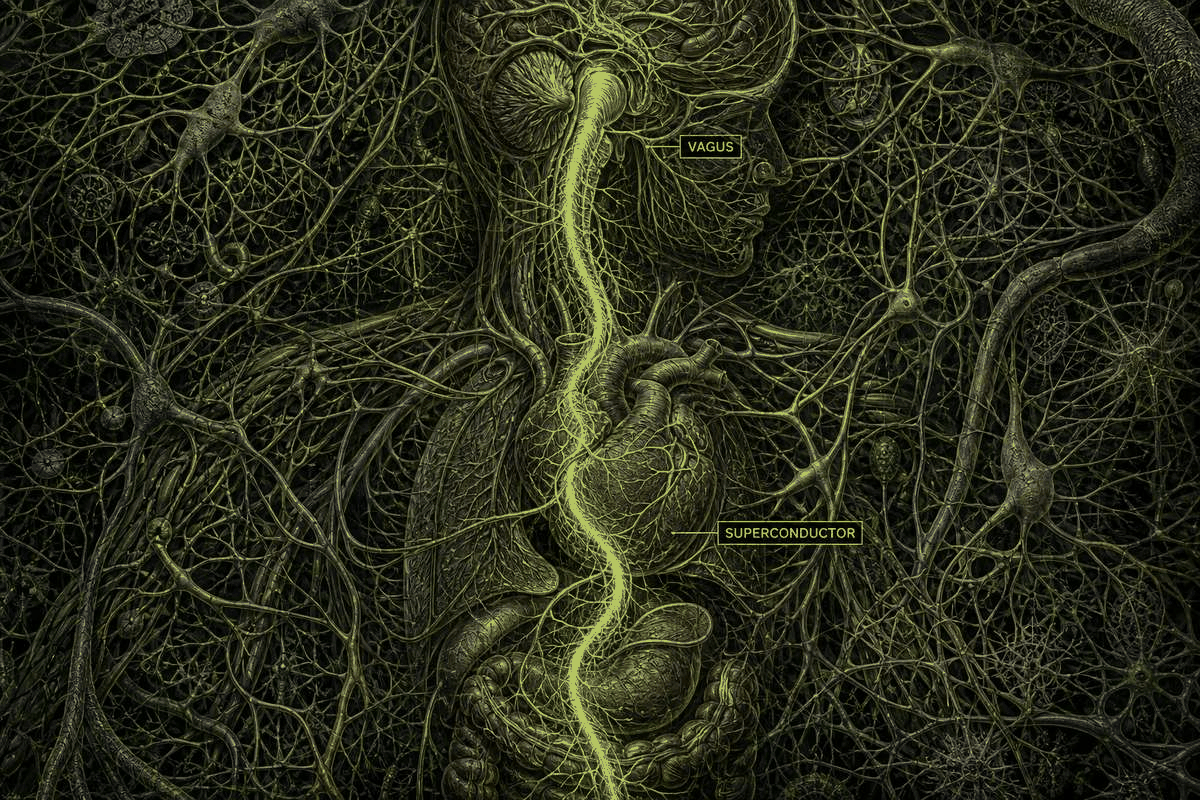
Dark anatomical field of head and torso. A glowing central trunk labeled Vagus and Superconductor running brainstem to heart and gut.
The trunk was never missing. The name for it was hidden.

I write from Paris, Tennessee. I am not here to mock the map. The map was a field note. The enemy is the gatekeeper who sold mystery and hid the nerve.

Reality Engineering is the science of making reality respond to intent. Kundalini and the vagus are hardware. The product you want is a life that answers. A calmer nerve is a layer. It is not the whole machine.

What is kundalini, in the body?

Kundalini is a reported somatic and energetic rise along the spine in yoga and tantra literature. Sanskrit names a coiled force at the base of the spine that climbs a central channel. Science has not isolated a kundalini particle. The honest translation is a bottom-up autonomic event people feel as heat, current, and lift.

In the literature I opened, kuṇḍalinī is the coiled snake. Dormant at muladhara, the root. When it moves, reports say it climbs sushumna, the central channel inside or alongside the spine, station by station, toward the crown. That is a body story. Heat. Tremor. Breath that will not stay small. A lift behind the sternum. A voice that drops. The texts treated those as purification. Practitioners still report them as sensation, not as a slide deck.

I will not translate that into a joke. People felt a line. They drew the line on a map. Chakras are stations on that map. Ida and pingala are the side channels. The map was a field note. It requires a trunk that already exists, plus a practice that recruits it.

What I will not do is claim a lab “proved kundalini.” MIT did not. No fMRI paper I opened named a kundalini voxel. The scientific move is smaller and cleaner. Match the reported rise to hardware you can name. Then run a count you can fail.

What is the vagus nerve?

The vagus is cranial nerve X, the longest cranial nerve. It leaves the medulla, exits the jugular foramen, and wanders through the neck to the larynx, heart, lungs, and gut. It is the main parasympathetic trunk to those organs. Most of its fibers are sensory, carrying the body back up to the brainstem.

StatPearls (Kenny and Bordoni, updated 2022) is the anatomy page I opened. Cranial nerve X originates in the medulla oblongata. It leaves the skull through the jugular foramen. In the neck it rides the carotid sheath. Four named neck branches: pharyngeal, superior laryngeal, recurrent laryngeal, superior cardiac. Then it keeps going. Bronchial. Esophageal. Gastric. Celiac. Heart rate. Voice. Swallow. Gut motility. That is a lot of body for one nerve. The Latin is vagary. Wandering.

Gerritsen and Band, writing in Frontiers in Human Neuroscience in 2018, cite the classic split: roughly 80 percent of vagal fibers are afferent. The nerve is mostly a listening line. It tells the brainstem what the viscera are doing. Then it talks back. Cardiac branches slow the sinoatrial node. Laryngeal branches move the voice box. Gut branches push rest-and-digest chemistry. You do not “believe” this trunk. You can cut it in surgery and watch the voice fail. You can stimulate it and watch heart rate drop.

Stephen Porges introduced Polyvagal Theory in 1995 as a model of two vagal source nuclei and a phylogenetic story about social engagement. I am labeling that as a model, not settled law. The anatomy of CN X does not depend on whether you buy the whole Porges stack. Use the model if it helps you think. Do not treat it as a statute.

So: longest cranial nerve. Parasympathetic. Heart, gut, larynx. A two-way cable. That is the hardware under the old map.

Is raising kundalini recruiting the vagus?

As a translation, yes. Raising the Kundalini is recruiting the Vagus nerve to act as a superconductor. The yoga map described a rise. The anatomy already had a trunk from brainstem to heart and gut. Recruitment means putting that trunk online with breath, voice, and attention. It is a mechanism claim, not a lab proof that kundalini equals CN X.

Look at the overlap without forcing a one-to-one. The reported rise travels a midline. The vagus is not the spinal cord. It is a pair of wanderers from the brainstem through the throat, the chest, the solar plexus, the gut. Practitioners still point at those stations when they talk. Throat. Heart. Belly. The map was never a cartoon of a snake in bone. It was a report of a current that used the cavities the nerve already owns.

Breath is the switch the papers actually measured. Gerritsen and Band call slow, deep, extended-exhale breathing respiratory vagal nerve stimulation, rVNS. A model. Their claim is parsimonious: contemplative practices share a respiratory discipline, and that discipline phasically and tonically stimulates the vagus. Lehrer and Gevirtz, in 2014, describe why breathing near 0.1 Hz, about 5.5 to 6 breaths a minute, drives huge heart-rate oscillations through the baroreflex. Resonance. Each breath becomes an external stimulus to a feedback loop that already exists.

Laborde and colleagues, in a 2022 systematic review, pulled 223 studies of voluntary slow breathing and heart rate variability. Vagally mediated HRV went up during the session, after one session, and after multi-session interventions. Effect sizes were moderate during, small after. Most studies had a high risk of bias. I am keeping that sentence. The direction still points at the nerve.

Voice is a second switch. Kalyani and colleagues ran a 2011 pilot fMRI study of audible OM chanting in 12 healthy volunteers, compared with a “ssss” control and rest. OM produced limbic deactivation, including significant deactivation of the right amygdala. The “ssss” condition did not. The authors hypothesized vibration through the auricular branch of the vagus. Sample is small. Mechanism is hypothesized. I will not invent a percent drop I did not see in the paper.

Yoga is a third. Streeter and colleagues randomized healthy adults to 60 minutes of yoga or metabolically matched walking, three times a week for 12 weeks. Yoga n=19. Walking n=15. The yoga group reported greater mood improvement and greater anxiety decrease. Thalamic GABA, measured by MRS, correlated with those mood shifts. Earlier Streeter work had already associated a yoga session with a 27 percent rise in GABA in experienced practitioners versus a reading control. Later Streeter writing names a Vagal-GABA theory: postures and breathing as parasympathetic stimulation with a GABA consequence. Correlation. Not a kundalini assay.

Put those next to the folklore. A rise along a midline. Breath that lengthens. A tone in the throat. A body that stops screaming. That is recruitment. The gatekeeper hid the trunk and sold the mystery. The trunk was always there.

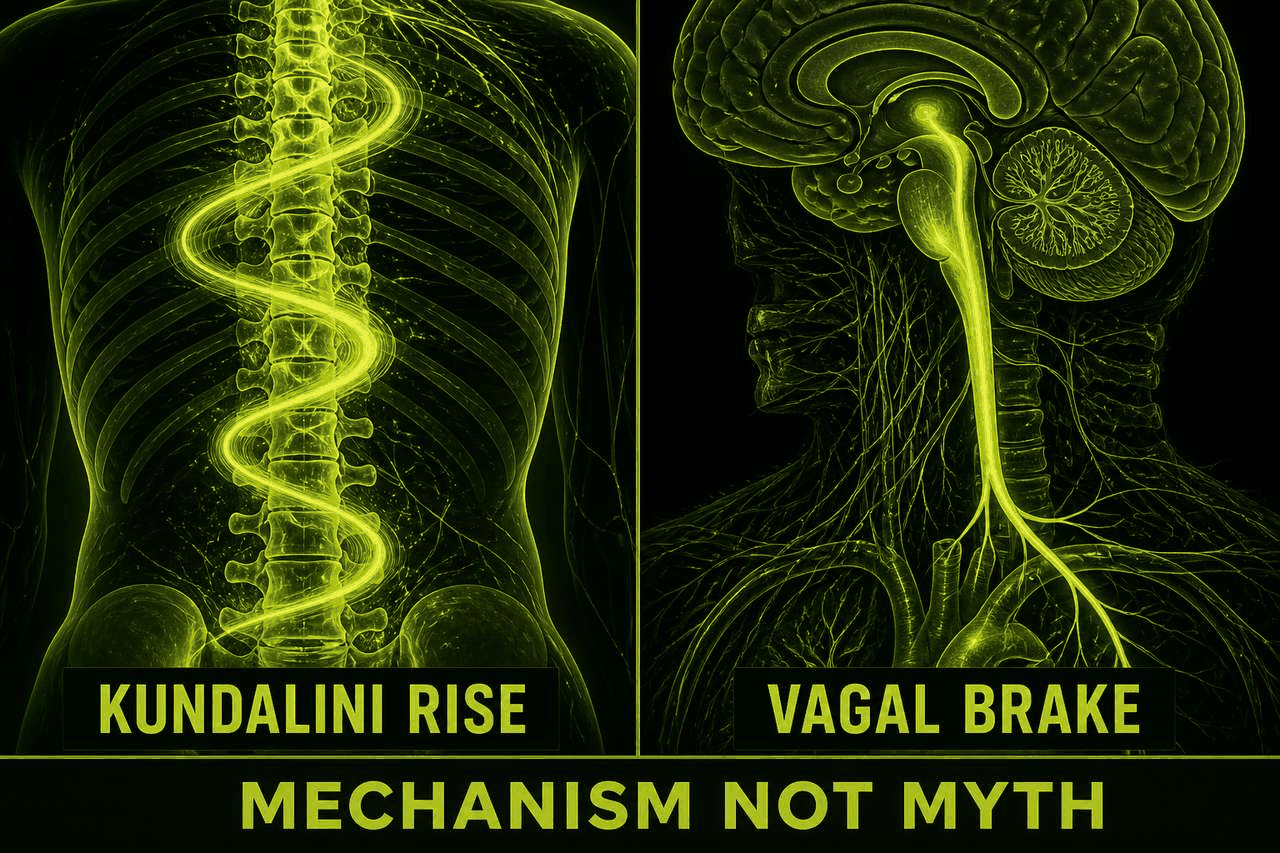
Two-panel anatomical comparison. Left: kundalini rise along the spine. Right: vagal brake from brainstem to chest. Banner: mechanism not myth.
Same hunger. Two names. One trunk you can train.

What does a superconductor mean here?

A physics superconductor carries current with almost no resistance. The vagus is not that metal. Superconductor here means a low-noise trunk: when the brake is online, signal travels farther with less sympathetic dump. When the brake is offline, the same intent hits a screaming line.

I am using a lab word as a metaphor on purpose. Your vagus is not a physics superconductor. What it can do is carry a clean parasympathetic signal while the sympathetic line quiets. HRV is one readout of that cleanliness. Lehrer’s resonance work is another: at the right breath rate the oscillations get huge and simple. That is low resistance in the only sense this page needs.

Intent is current. Attention is current. A prayer, a plan, a sentence you mean. If the cable is full of noise, the current dumps. If the cable is recruited, the same current arrives. That is why the Library treats the vagus as hardware and 40Hz as another layer, not as the operating system. A 40Hz gamma pulse is a sensory drive. The song is one input. The nerve is the trunk those inputs ride.

Recruitment is not possession. You lengthen the exhale. You give the larynx a tone. You sit long enough that the baroreflex can do what Lehrer measured. The folklore called that raising. I am calling it hiring the cable that was already on payroll.

Question Folklore “rise” Vagal recruitment A 7-minute song
What it is Coiled force climbing a central channel Cranial nerve X put online as a low-noise trunk One audio input. Headphones. A flicker.
Where it runs Spine, stations, crown Medulla to larynx, heart, gut Cochlea to cortex, if the file is even a pulse train
How you start it Guru, mantra, luck, years Slow breath, long exhale, a tone, a count you can fail Press play
Brake Often skipped, then blamed on unworthiness The point of the work Usually skipped
Proof Testimony. A map. Anatomy. HRV. Named papers. Your 1-10. A testimonial on a sales page
When it dies Wait for the next awakening Check the brake. Then talk about software. Buy the next track

The song column is a sibling, not an enemy. I wrote how the Genius Song works as input versus operating system. This page is the trunk. 40Hz is a different hardware layer. None of those three is the OS by itself.

Why the rise fails when the brake is offline

You cannot load a rise on hardware that is still dumping cortisol into the line. Force without a brake is noise. A frequency, a mantra, a weekend intensive: same pattern. State moves for a night. Tuesday it dies. The brake was never online.

Everyone “knows breathing calms you down.” Almost nobody does it with a count they can fail, a duration they cannot bargain with, and a score they have to look at. That gap is the whole first product.

Laborde’s after-one-session effect on RMSSD was small. The during-session effect was larger. Translation: the nerve answers while you are recruiting it. It does not always stay loud when you stop. So a peak experience without a repeatable brake is a weather report. You felt the front move through. You did not install climate control.

The gatekeeper prefers weather. Weather is dramatic. A brake is boring. Four in. Eight out. Seven minutes. A number. Boring is how hardware gets trained.

Related reading: why vision boards fail when the hardware is screaming. A collage is an outcome picture. Same trunk. Same missing brake. And meridians as piezoelectric fascia: the old chart sits on connective tissue planes. Same translation job. Different layer.

What to run if you want a number

Start with Protocol 01, the free Neural Recalibration. Four-count inhale, eight-count exhale, seven minutes, a 1-10 before and a 1-10 after. No headphones. If the method earns it, the Library of Biological Wizardry is the rest of the stack. The vagus is hardware. It is not the OS.

Protocol 01 is the brake in public. Long exhale is the limb Gerritsen named and Lehrer’s resonance work sits near. I am not telling you 4/8 is the only ratio the literature will ever support. I am telling you it is a count you can fail in a chair without buying a device.

Write the number. Rate activation, or calm, 1 to 10 before. Rate it after. Do three days. If the number does not move, you learned something cheap. If it moves, you just ran hardware. That is the smallest honest test I know.

The Library of Biological Wizardry is 15 protocols, 9 volumes, and live instruments. Reality Engineering: the science of making reality respond to intent. A calmer nerve is how you get a clean line. The product is a life that answers. You do not need the archive to test the first layer.

Run the brake first.

Protocol 01 is free. Seven minutes. 4 in, 8 out. A 1-10 before. A 1-10 after. No faith. No headphones. If the method earns the rest of the stack, the Library is there.

What I will not claim

I will not tell you MIT proved kundalini. I will not invent an amygdala percent I did not read. I will not call Polyvagal Theory a statute. I will not diagnose a crisis. This is an educational mechanism page. It is not medical advice.

I will not fight the people who felt a rise. The feeling can be real as sensation. The map can be useful as a map. The enemy is the gatekeeper who hid the trunk and charged rent on the mystery. The HOW is boring on purpose. A nerve. A count. A number.

If you are in medical trouble, talk to a clinician. I am an author in Paris, Tennessee, not your doctor. The papers are linked because I opened them. They are not a Tuesday promise.

Direct answers

Short answers you can lift from this page. Visible text matches the FAQ schema exactly. Kundalini is a reported rise. The vagus is the trunk. Raising is recruitment. None of this is medical advice.

What is kundalini scientifically?

Kundalini is a reported somatic and energetic rise along the spine in yoga and tantra literature. Sanskrit names a coiled force at the base of the spine that climbs a central channel. Science has not isolated a kundalini particle. The honest translation is a bottom-up autonomic event people feel as heat, current, and lift. MIT did not prove kundalini.

What is the vagus nerve?

The vagus is cranial nerve X, the longest cranial nerve. It leaves the medulla, exits the jugular foramen, and wanders through the neck to the larynx, heart, lungs, and gut. It is the main parasympathetic trunk to those organs, and most of its fibers are sensory, carrying the body back up to the brainstem.

Is raising kundalini recruiting the vagus nerve?

As a translation, yes. Raising the Kundalini is recruiting the Vagus nerve to act as a superconductor. The yoga map described a rise. The anatomy already had a trunk from brainstem to heart and gut. Recruitment means putting that trunk online with breath, voice, and attention. It is a mechanism claim, not a lab proof that kundalini equals CN X.

What does a superconductor mean here?

A physics superconductor carries current with almost no resistance. The vagus is not that metal. Superconductor here means a low-noise trunk: when the brake is online, signal travels farther with less sympathetic dump. When the brake is offline, the same intent hits a screaming line.

Does slow breathing raise vagal tone?

Voluntary slow breathing increases vagally mediated heart rate variability in the papers I opened. Laborde and colleagues meta-analyzed 223 studies and found vmHRV up during the session, after one session, and after multi-session work. Lehrer and Gevirtz describe resonance near six breaths a minute. That is a number, not a miracle.

Why does the kundalini rise fail when the brake is offline?

You cannot load a rise on hardware that is still dumping cortisol into the line. Force without a brake is noise. Protocol 01 is a free 7-minute vagal brake with a 1-10 score before and after. Run the brake. Then talk about software.

What should I run if I want a number?

Start with Protocol 01, the free Neural Recalibration. Four-count inhale, eight-count exhale, seven minutes, a number before and a number after. No headphones. If the method earns it, the Library of Biological Wizardry is the rest of the stack: 15 protocols, 9 volumes, and live instruments you can measure.

Is this medical advice?

No. This page is an educational mechanism explainer by JM Thomas. It is not a diagnosis, treatment, cure, or prevention of any disease. Anatomy papers and yoga studies are literature, not a promise about your Tuesday.

Sources I actually opened

Kenny, B.J., Bordoni, B. “Neuroanatomy, Cranial Nerve 10 (Vagus Nerve).” StatPearls, updated 7 Nov 2022. ncbi.nlm.nih.gov/books/NBK537171

Gerritsen, R.J.S., Band, G.P.H. “Breath of Life: The Respiratory Vagal Stimulation Model of Contemplative Activity.” Frontiers in Human Neuroscience 12:397 (2018). pmc.ncbi.nlm.nih.gov/articles/PMC6189422

Lehrer, P.M., Gevirtz, R. “Heart rate variability biofeedback: how and why does it work?” Frontiers in Psychology 5:756 (2014). frontiersin.org/…/10.3389/fpsyg.2014.00756

Laborde, S. et al. “Effects of voluntary slow breathing on heart rate and heart rate variability: a systematic review and a meta-analysis.” Neuroscience and Biobehavioral Reviews (2022). 223 studies. vmHRV up during, after one session, and after multi-session work. doi.org/10.1016/j.neubiorev.2022.104711

Kalyani, B.G. et al. “Neurohemodynamic correlates of ‘OM’ chanting: A pilot functional magnetic resonance imaging study.” International Journal of Yoga 4(1):3-6 (2011). n=12. Right amygdala deactivation during OM, not during “ssss.” pmc.ncbi.nlm.nih.gov/articles/PMC3099099

Streeter, C.C. et al. “Effects of yoga versus walking on mood, anxiety, and brain GABA levels: a randomized controlled MRS study.” Journal of Alternative and Complementary Medicine 16(11):1145-1152 (2010). Yoga n=19, walking n=15. doi.org/10.1089/acm.2010.0007

Porges, S.W. “Orienting in a defensive world: Mammalian modifications of our evolutionary heritage. A Polyvagal Theory.” Psychophysiology 32:301-318 (1995). A model of two vagal source nuclei. Not treated here as settled law.