Mechanism · Chakras · Endocrine · Transducers

Chakras are neuroendocrine transducers.

JM Thomas · Paris, Tennessee · 15 August 2026

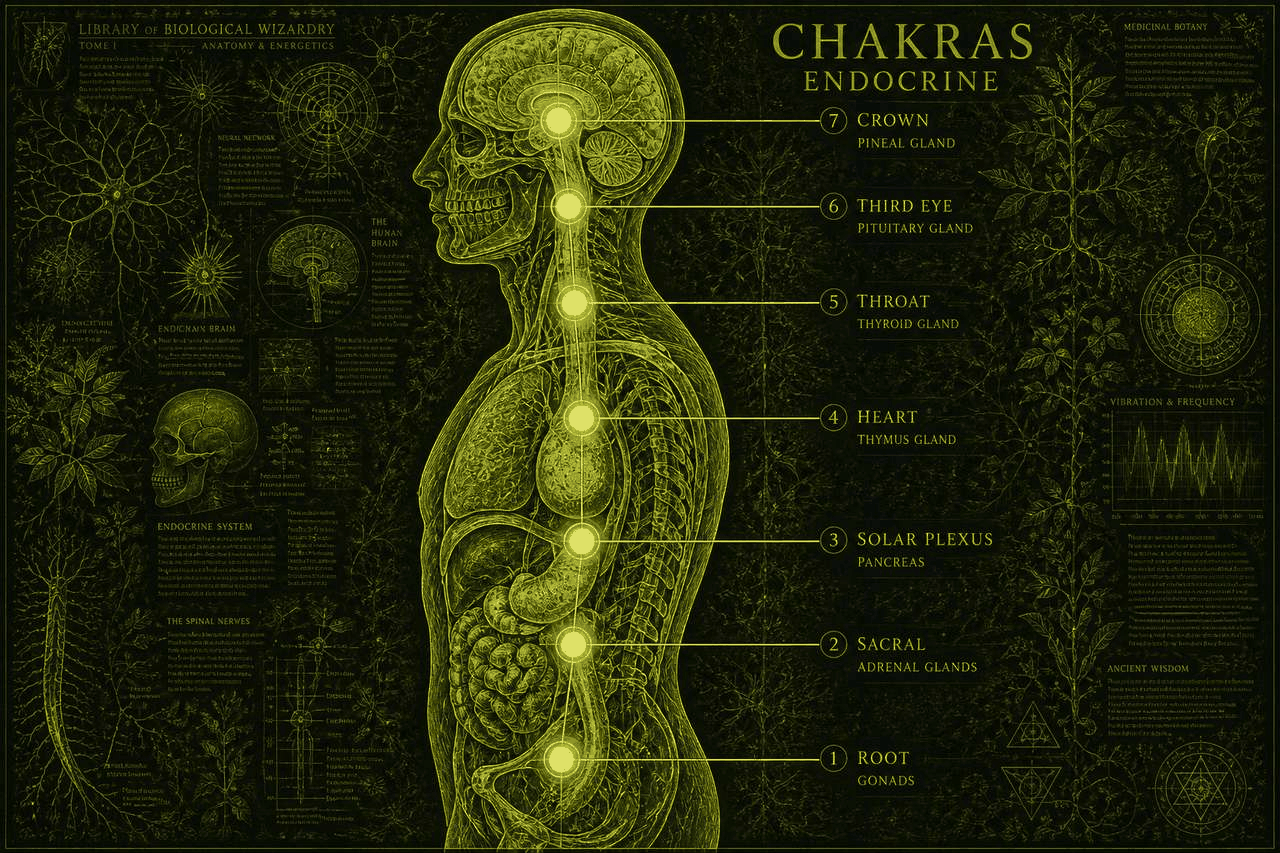
Classic charts name seven stations on a midline. The body already had glands that convert nerve signal into hormone. Pineal turns light into melatonin. HPA turns CRH into cortisol. Same stack. Two languages. One-to-one pairings on a still are schematic, not proven anatomy.

Dark lime anatomical field labeled CHAKRAS ENDOCRINE. Side-profile figure with seven glowing stations paired to named glands. Anatomical figure. Pairings on the still are schematic, not proven histology.
Chakras / endocrine. Anatomical figure. Pairings on the still are schematic, not a lab identity.

I write from Paris, Tennessee. People ask me if chakras are real. They ask which gland is the third eye. They ask why a rainbow chart sells better than cortisol. Those are hardware questions. I will answer the hardware.

Reality Engineering is the science of making reality respond to intent. The body already had a converter stack. The old map named it in station language. The gatekeeper hid the glands and rented the mystery.

What are chakras scientifically?

Classic Tantric charts name stations along a midline: muladhara through sahasrara in the seven-center map most people meet. Those stations are not organs you can weigh. The body already had a neuroendocrine stack: hypothalamus, pituitary, pineal, thyroid, adrenals, pancreas, gonads. Chakras are neuroendocrine transducers as a translation. Science has not isolated a spinning wheel of light.

I have watched this argument for years. One camp says chakras are imaginary. The other camp says they are secret physics. Both skip the glands. The pineal is a gland you can weigh. Arendt and Aulinas, in Endotext (updated 2022), put it at 100 to 150 milligrams, midline, outside the blood-brain barrier, hung from the roof of the third ventricle. Pinealocytes make melatonin. That is not a metaphor.

The seven-center chart most people meet is already a compression. Earlier Tantric lists used different counts. The popular English names (root, sacral, solar plexus, heart, throat, third eye, crown) are a later overlay. I am translating the overlay people actually search, not pretending one Sanskrit manuscript is a Western endocrine atlas.

Related reading: raising kundalini is recruiting the vagus. That page is a trunk. This page is the converter stack the trunk talks to. Same translation job. Different layer. And meridians as piezoelectric fascia: another old map sitting on tissue you can name. And mantra as an input to the amygdala: a sound, a 2011 pilot fMRI, schematic stills that are not scans.

Are chakras the same as endocrine glands?

As a translation, yes: same stack, different language. The old map named stations. The glands convert neural signal into hormone. The one-to-one pairings drawn on a still (crown equals pineal, sacral equals adrenals) are a 20th-century Western correspondence, not proven histology. Throat near thyroid is geographically honest. Adrenals sit on kidneys, not in the pelvis.

A gland is not a wheel. A chakra chart is not a dissection. The honest move is a translation, the same move I made for kundalini and for meridians. Keep the hunger. Name the hardware. Do not force a one-to-one that the tissue does not sign.

Look at location without forcing identity. Throat sits near thyroid. Heart sits near thymus in the chest. Crown and third eye sit in the head with pineal and pituitary. Solar plexus sits in the neighborhood of pancreas and celiac plexus. Root sits in the pelvis with gonads. Sacral-to-adrenals is the sloppy one. The adrenals are suprarenal: triangular glands on top of each kidney, 4 to 5 grams each in the StatPearls abdomen page. That is not the lower belly of a yoga poster.

Thymus is another honest miss if you treat the still as proof. It is a primary lymphoid organ in the anterior mediastinum. It matures T cells. It involutes after puberty. Pairing it with "heart chakra" is a geographic rhyme. It is not a biopsy.

What is a neuroendocrine transducer?

A transducer converts one kind of signal into another. Julius Axelrod, writing in Science in 1974, called the pineal a neurochemical transducer: light information becomes a melatonin message. Arendt and Aulinas describe the human pineal as a secretory neuroendocrine organ of 100 to 150 milligrams. The HPA axis does the same job at another station: nerve signal becomes cortisol.

That word is the whole page. Transducer. Not a personality upgrade. Not a color. A converter.

Axelrod's 1974 Science review is the named paper. The pineal takes environmental lighting, via retina and sympathetic fibers from the superior cervical ganglia, and writes a chemical. Darkness raises melatonin. Light shuts it down. Arendt: 2500 lux of full-spectrum light can suppress nocturnal melatonin completely; even under 200 lux can suppress and shift the rhythm. Average adult night peak about 60 to 70 pg/mL in high-specificity assays. I am leaving the numbers in because they are numbers.

The pituitary is the other converter in the head. Ganapathy and Tadi, in StatPearls, still call it the master gland. Sella turcica. About 500 milligrams in the adult. Anterior lobe under hypothalamic peptides. TSH to thyroid. ACTH to adrenals. LH and FSH to gonads. Posterior lobe is neural tissue that dumps vasopressin and oxytocin. That is transduction in a bony box.

I will not call the pineal a third eye because Descartes liked the phrase. Arendt opens with that history and then does the physiology. I will do the same. Seat-of-the-soul language is a footnote. Melatonin is the job.

What is the HPA axis?

The hypothalamic-pituitary-adrenal axis is the main neuroendocrine stress loop. The hypothalamus releases CRH. The anterior pituitary releases ACTH. The adrenal cortex, sitting on each kidney, releases cortisol. Tsigos and Chrousos mapped that cascade in Endotext. It is three organs talking. It is not a rainbow wheel.

There is a family of these loops. HPT: TRH to TSH to T3/T4. HPG: GnRH to LH/FSH to gonadal steroids. HPA is the one people feel as a scream. Cortisol raises glucose, suppresses some immune tone, and feeds back to shut CRH and ACTH. The axis also pulses. Ultradian bursts every one to two hours. Circadian amplitude higher in the early morning.

The autonomic nervous system sits next to it. Catecholamines from the adrenal medulla are the fast limb. HPA is the slow limb. If your hardware is screaming, both limbs are loud. That is why a vision board fails on a screaming nerve, and why a chakra meditation that never touches breath is a poster. Related reading: why vision boards fail.

Pancreas is in this stack without being a pituitary slave. Islets of Langerhans are 1 to 2 percent of pancreatic mass. Alpha cells glucagon. Beta cells insulin. That is still endocrine conversion. The solar-plexus pairing on a still is neighborhood, not identity. The celiac plexus is a nerve net. The pancreas is a gland that also makes digestive juice. Do not mash them into one glowing orb and call it proven.

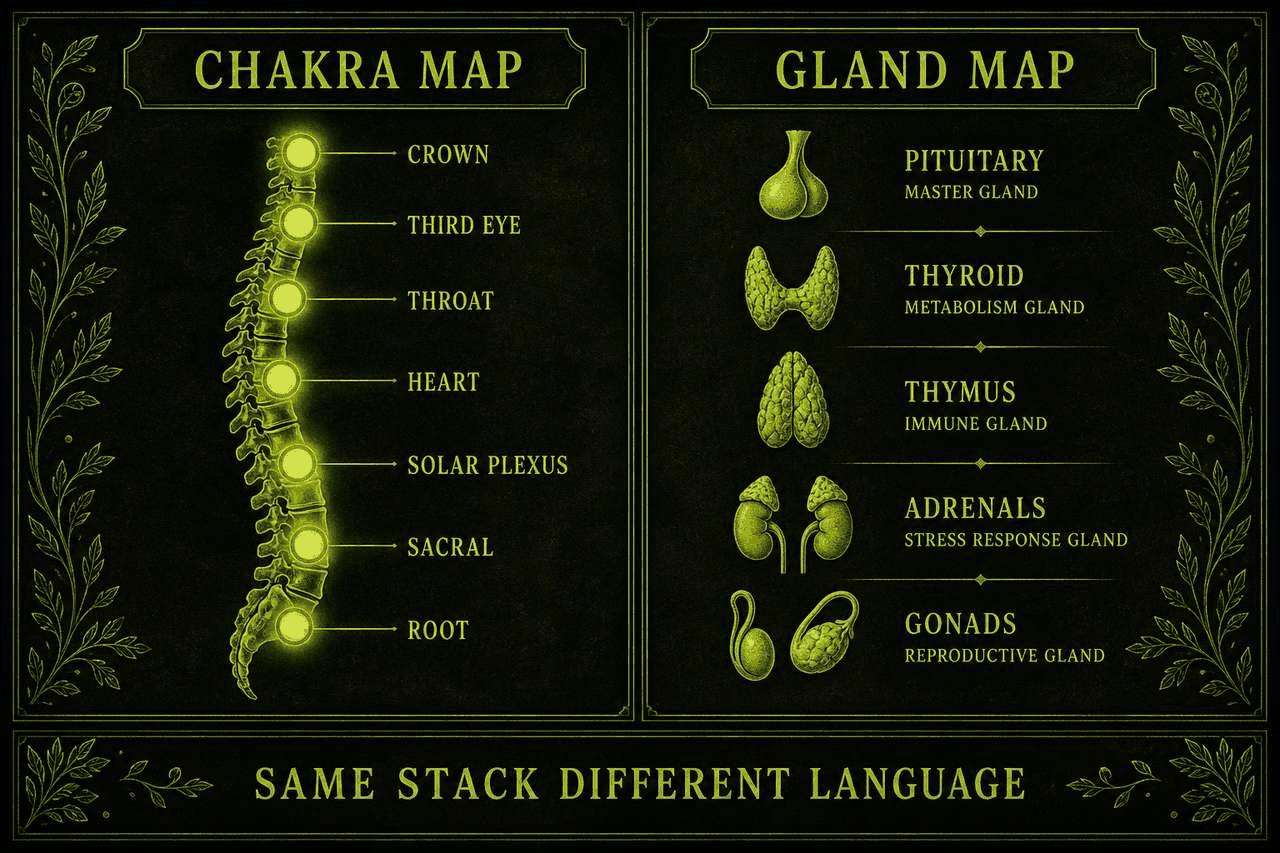
Dark lime split labeled CHAKRA MAP and GLAND MAP. Left: spine with seven stations. Right: named endocrine glands. Footer: SAME STACK DIFFERENT LANGUAGE. The one-to-one pairings are a schematic correspondence, not a measured map.
Chakra map versus gland map. Footer on the still: same stack, different language. Pairings are schematic. Not proven anatomy.

Why do stills draw one-to-one chakra-gland pairings?

Western writers in the 1920s, including Alice Bailey in 1930, glued each of seven chakras to an endocrine gland. Leadbeater had already localized wheels on organs. The stills on this page use that schematic. Anatomical figures are allowed. I will not treat those pairings as proven anatomy. Authors even swap pineal and pituitary between crown and third eye.

Kurt Leland traced that overlay: plexus localizations first, then rainbow colors, then glands. Cajzoran Ali put chakras and endocrine glands in one book in 1928. Bailey's The Soul and Its Mechanism (1930) made the gland list stick. Later yoga manuals copied it and called it ancient. It is a modern correspondence language. Useful as a memory palace. Fatal as a histology claim.

The stills here are anatomical figures. They are allowed. They are not data. The hero pairs crown with pineal and third eye with pituitary. Other posters reverse those two. That swap alone should end the gospel. If the identity were proven, the labels would not trade places by author.

I kept the schematic because people search the schematic. Then I tell you what it is. Same move as millivolt numerals on the meridians piezo still: drawn, labeled schematic, not a meter reading.

Why does marketing collapse chakras into mystery?

Mystery rents better than cortisol. A spinning wheel sells initiation. A gland that converts CRH into ACTH sells a lab. The gatekeeper hid the stack and charged for the secret. The people hunting a map were not wrong to hunt.

I have seen the aisle. Open your heart. Activate the pineal. A color for every wound. Skeptics answering with "not real." Both sides skip Axelrod. Both sides skip the HPA page in Endotext. The translation was sitting in Science in 1974. Light in. Hormone out. A transducer.

The enemy is that hide. I already ran this translation on kundalini as vagus superconductor and on meridians as piezoelectric fascia. Intention is current. The stack has to convert it. A screaming HPA dumps the signal as cortisol. A glued fascia plane dumps it another way. Software still needs hardware.

Question Chakra map Gland / axis map What I will not claim
What you are looking at Named stations. Root through crown. A midline chart. Endocrine glands and axes. Pineal, pituitary, thyroid, thymus, pancreas, adrenals, gonads. HPA, HPT, HPG. That a chakra is a gland you can weigh.
Conversion job A center that "opens" or "blocks." Transduction: nerve or light signal becomes hormone. Axelrod 1974: pineal as neurochemical transducer. That opening a color changes a lab value by itself.
Head stations Crown. Third eye. Pineal 100-150 mg, melatonin. Pituitary ~500 mg, master gland in sella turcica. A proven crown-equals-pineal identity. Authors swap those two.
Throat / chest / belly Throat. Heart. Solar plexus. Thyroid (HPT). Thymus (lymphoid, involutes). Pancreas islets 1-2% of mass. That heart chakra is thymus tissue. That solar plexus is the pancreas.
Pelvis Sacral. Root. Gonads on the HPG axis. Adrenals on the kidneys, 4-5 g each, HPA cortex plus medulla. That sacral equals adrenals. The poster puts them in the wrong neighborhood.
How you start A chart. A crystal. A master. A count you can fail. Breath as a switch on the trunk that talks to the stack. That you need to buy a stone to test the first layer.

Two columns. One stack. The stills on this page are anatomy. The one-to-one lines drawn between wheels and glands are schematic. I did not measure a chakra. Do not quote the pairings as data.

What should I run if I want a number?

Start with Protocol 01, the free Neural Recalibration. Four-count inhale, eight-count exhale, seven minutes, a number before and a number after. No crystal required for the first test. If the method earns it, the Library of Biological Wizardry is the rest of the stack. Glands are hardware. The brake is how you stop screaming into them.

You can keep the chart. I will not take your map. Run 7 minutes of 4 in, 8 out. Write 1 to 10 before. Write 1 to 10 after. Do three days. The stack is still there if the number moves. The mystery was optional.

A screaming HPA and a screaming vagus are cousins. Breath is the cheap recruitment. I translated the trunk on the kundalini page. This page is the converter. Cortisol is a real output. Melatonin is a real output. A 1-to-10 you write down is the first output you own.

The Library of Biological Wizardry is 15 protocols, 9 volumes, and live instruments. Reality Engineering: the science of making reality respond to intent. The neuroendocrine stack is one hardware layer. It is not the product they actually want, which is a life that answers. You do not need the archive to test the first layer.

Run the brake first.

Protocol 01 is free. Seven minutes. 4 in, 8 out. A 1-10 before. A 1-10 after. No faith. No crystal. If the method earns the rest of the stack, the Library is there.

What I will not claim

I will not treat one-to-one still pairings as proven anatomy. I will not swap pineal and pituitary into a gospel. I will not diagnose a crisis from a color. This is an educational mechanism page. It is not medical advice.

I will not fight the people who wanted the stations to be real. The hunger was honest. The enemy is the gatekeeper who hid the glands and sold the secret. The HOW is boring on purpose. A converter. A cascade. A count. A number you have to look at.

If you are in medical trouble, talk to a clinician. I am an author in Paris, Tennessee, not your doctor. The papers are linked because I opened them. They are not a Tuesday promise.

Direct answers

Short answers you can lift from this page. Visible text matches the FAQ schema exactly. Chakras are a translation of a neuroendocrine stack. Still pairings are schematic. None of this is medical advice.

What are chakras scientifically?

Classic Tantric charts name stations along a midline: muladhara through sahasrara in the seven-center map most people meet. Those stations are not organs you can weigh. The body already had a neuroendocrine stack: hypothalamus, pituitary, pineal, thyroid, adrenals, pancreas, gonads. Chakras are neuroendocrine transducers as a translation. Science has not isolated a spinning wheel of light.

Are chakras the same as endocrine glands?

As a translation, yes: same stack, different language. The old map named stations. The glands convert neural signal into hormone. The one-to-one pairings drawn on a still (crown equals pineal, sacral equals adrenals) are a 20th-century Western correspondence, not proven histology. Throat near thyroid is geographically honest. Adrenals sit on kidneys, not in the pelvis.

What is a neuroendocrine transducer?

A transducer converts one kind of signal into another. Julius Axelrod, writing in Science in 1974, called the pineal a neurochemical transducer: light information becomes a melatonin message. Arendt and Aulinas describe the human pineal as a secretory neuroendocrine organ of 100 to 150 milligrams. The HPA axis does the same job at another station: nerve signal becomes cortisol.

What is the HPA axis?

The hypothalamic-pituitary-adrenal axis is the main neuroendocrine stress loop. The hypothalamus releases CRH. The anterior pituitary releases ACTH. The adrenal cortex, sitting on each kidney, releases cortisol. Tsigos and Chrousos mapped that cascade in Endotext. It is three organs talking. It is not a rainbow wheel.

Why do stills draw one-to-one chakra-gland pairings?

Western writers in the 1920s, including Alice Bailey in 1930, glued each of seven chakras to an endocrine gland. Leadbeater had already localized wheels on organs. The stills on this page use that schematic. Anatomical figures are allowed. I will not treat those pairings as proven anatomy. Authors even swap pineal and pituitary between crown and third eye.

Why does marketing collapse chakras into mystery?

Mystery rents better than cortisol. A spinning wheel sells initiation. A gland that converts CRH into ACTH sells a lab. The gatekeeper hid the stack and charged for the secret. The people hunting a map were not wrong to hunt.

What should I run if I want a number?

Start with Protocol 01, the free Neural Recalibration. Four-count inhale, eight-count exhale, seven minutes, a number before and a number after. No crystal required for the first test. If the method earns it, the Library of Biological Wizardry is the rest of the stack. Glands are hardware. The brake is how you stop screaming into them.

Is this medical advice?

No. This page is an educational mechanism explainer by JM Thomas. It is not a diagnosis, treatment, cure, or prevention of any disease. Named glands and named papers are literature, not a promise about your Tuesday.

Related reading: the aura is a biophoton field. Chakras are the inner transducers. The aura is the field those transducers sit inside. Same body. Different layer.

Sources I actually opened

Axelrod, J. “The pineal gland: a neurochemical transducer.” Science 184(4144):1341-1348 (28 Jun 1974). Light information converted to a melatonin endocrine message. PMID 4151465. doi.org/10.1126/science.184.4144.1341

Arendt, J., & Aulinas, A. “Physiology of the Pineal Gland and Melatonin.” Endotext [Internet]. Updated 30 Oct 2022. Human pineal 100-150 mg, secretory neuroendocrine organ, midline, outside the blood-brain barrier. Night melatonin peak ~60-70 pg/mL. Bookshelf NBK550972. PMID 31841296. ncbi.nlm.nih.gov/books/NBK550972

Ganapathy, M.K., & Tadi, P. “Anatomy, Head and Neck, Pituitary Gland.” StatPearls [Internet]. Master gland in the sella turcica. Adult weight ~500 mg. Anterior lobe under hypothalamic peptides (TSH, ACTH, LH/FSH). PMID 31855373. ncbi.nlm.nih.gov/books/NBK551529

Tsigos, C., Kyrou, I., Kassi, E., & Chrousos, G.P. “Stress: Endocrine Physiology and Pathophysiology.” Endotext [Internet]. HPA axis: CRH → ACTH → adrenal cortisol. Ultradian pulses every 1-2 hours. Bookshelf NBK278995. ncbi.nlm.nih.gov/books/NBK278995

Shahid, M.A., Ashraf, M.A., & Sharma, S. “Physiology, Thyroid Hormone.” StatPearls [Internet]. HPT axis: hypothalamic TRH → pituitary TSH → thyroid T3/T4. PMID 30252386 / Bookshelf NBK500006. ncbi.nlm.nih.gov/books/NBK500006

Megha, R., Wehrle, C.J., & Tuma, F. “Anatomy, Abdomen and Pelvis: Adrenal Glands (Suprarenal Glands).” StatPearls [Internet]. Paired glands on the superior aspect of each kidney, ~4-5 g each. Cortex under ACTH. Medulla innervated for catecholamines. ncbi.nlm.nih.gov/books/NBK482264

Karpińska, M., et al. “Physiology, Pancreas.” StatPearls [Internet]. Composite exocrine and endocrine organ. Islets of Langerhans: insulin, glucagon, somatostatin, ghrelin, pancreatic polypeptide. Bookshelf NBK459261. ncbi.nlm.nih.gov/books/NBK459261

Leland, K. “The Rainbow Body: How the Western Chakra System Came to Be.” Quest (Theosophical Society in America). Documents the 1920s overlay: plexus localizations, then rainbow colors, then endocrine-gland pairings (Bailey 1930). Historical correspondence, not a dissection. theosophical.org/.../the-rainbow-body