Mechanism · Meridians · Fascia · Piezo Load

Meridians are piezoelectric fascia.

JM Thomas · Paris, Tennessee · 15 August 2026

Classic charts draw qi channels. Langevin and Yandow mapped a human arm in 2002 and put more than 80% of acupuncture points on connective tissue planes. Dry collagen makes charge under shear. Same path. Two languages. Millivolt art on a still is not a meter reading.

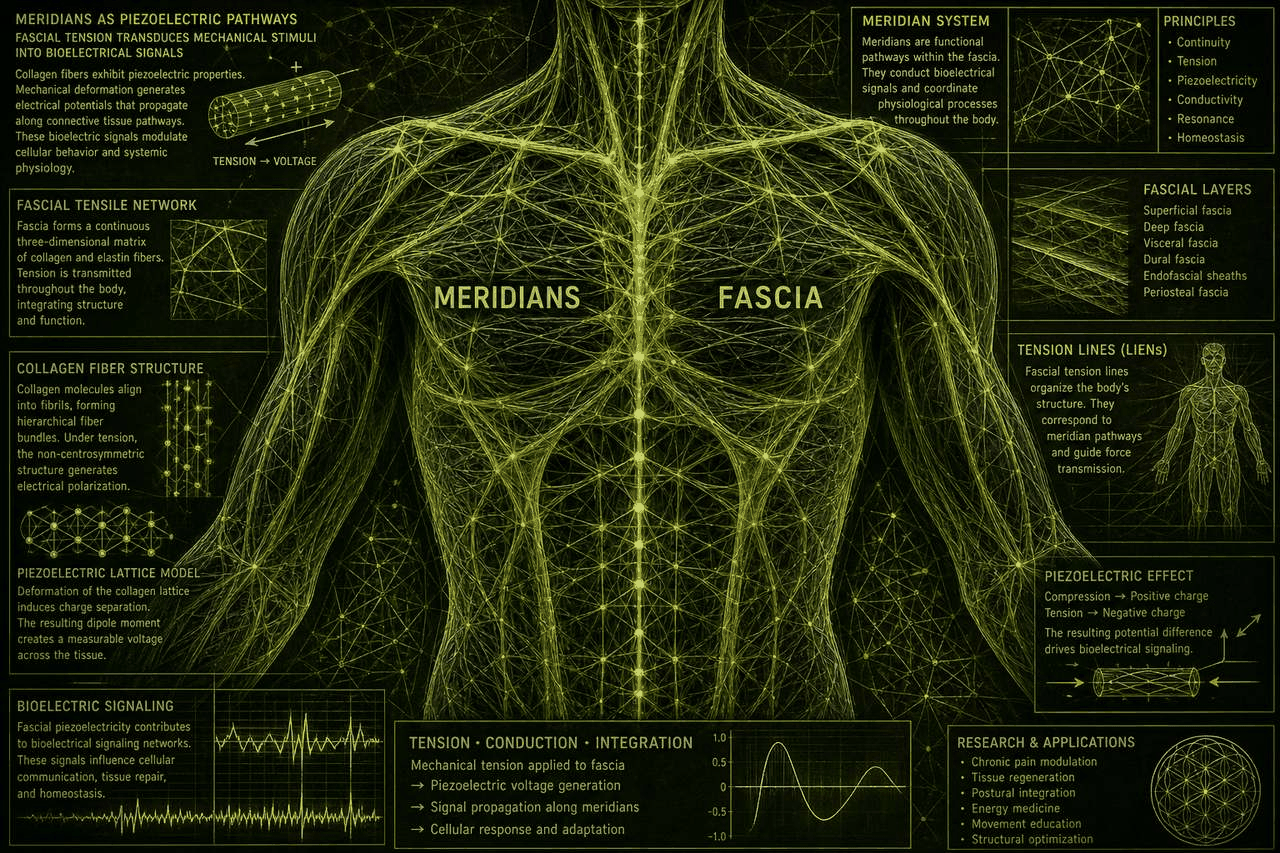
Dark lime anatomical infographic. Central torso labeled MERIDIANS and FASCIA with a glowing collagen network. Panels name piezoelectric pathways, fascial tensile network, collagen fiber structure, and tension converting to voltage.
Meridians / fascia. Anatomical figure. Not a lab trace.

I write from Paris, Tennessee. People ask me if meridians are real. They ask if qi is electricity. They ask why a needle tugs. Those are hardware questions. I will answer the hardware.

Reality Engineering is the science of making reality respond to intent. The body already had a tensile net. The old map named it in organ language. The gatekeeper hid the overlap and rented the mystery.

What are meridians scientifically?

Classic Chinese charts draw channels that carry qi between surface and viscera. Langevin and Yandow treated that network as a map of interstitial connective tissue. In 2002 they mapped the human arm and found an 80% correspondence between acupuncture points and intermuscular or intramuscular connective tissue planes. The map was fascia. Science has not isolated a qi particle.

I have watched this argument for years. One camp says meridians are imaginary. The other camp says they are a secret physics. Both skip the tissue. Helene Langevin did not skip it. She is a neurologist and a licensed acupuncturist. Jason Yandow sat with the Visible Human arm sections and marked the points from Cheng's textbook.

Ultrasound in living people already showed cleavage planes under points. The cadaver work tested the chart against planes you can see. Heart, lung, and large intestine meridians followed fascia between biceps, triceps, and brachialis. Pericardium and triple heater followed intramuscular splits. Small intestine as a line did not. Three of its four points still sat at plane intersections.

Qi, in their table, becomes the sum of metabolism, movement, signaling, information exchange. Meridian qi becomes biochemical and bioelectrical signaling in connective tissue. I like that translation. I will not pretend they bottled qi.

Are meridians the same as fascia?

As a translation, yes. Meridians are piezoelectric fascia: the old chart and the connective tissue planes are the same path in two languages. Langevin's arm study put more than 80% of points and 50% of meridian intersections on those planes. That is anatomy in one limb, not a proof that every named vessel is a unique wire.

Fascia is the body-wide net. Superficial. Deep. Visceral. Dural. It wraps muscle, bone, nerve, vessel. A needle over a cleavage plane hits more of that net than a needle over a muscle belly. Langevin's earlier work on needle grasp fits. Rotation winds connective tissue around the shaft. Pullout force goes up. Muscle contraction was not the story. The tug the old texts called a fish on a line is tissue winding.

In 60 healthy people, pullout force averaged 18% greater at acupuncture points than at paired controls two centimeters away. Grasp still happened at the controls. Subcutaneous tissue is everywhere. More of it sits at the intersections.

Related reading: raising kundalini is recruiting the vagus. That page is a trunk. This page is the net the trunk runs through. Same translation job. Different layer. And chakras as neuroendocrine transducers: the old map named stations. The body already had glands that convert nerve signal into hormone.

What is the 80% acupuncture fascia overlap?

Langevin and Yandow sectioned a human arm from olecranon to humeral head. They marked 24 acupuncture points and 51 other meridian intersections from Cheng's textbook. More than 80% of the points and 50% of the intersections coincided with intermuscular or intramuscular connective tissue planes. Their cylinder model put chance at P less than 0.001. It is one arm. It is not a whole-body census.

I will keep the numbers tight. Library DNA says 80% acupuncture/fascia overlap. The paper is more precise. Arm. Postmortem. Textbook locations without live palpation. Five-millimeter assumed width for a point and for a plane. Hypergeometric test on the middle cylinder. P less than 0.001 for six or seven of eight points landing on planes, and for 14 of 28 intersections.

They expected similar geometry in forearm, leg, thigh, trunk, face. They did not publish that census here. Honest page, honest scope. An 80% on one mapped limb is a mechanism clue. It is not a slogan you print on a mug and stop thinking.

Is fascia piezoelectric?

Dry collagen is. Fukada and Yasuda measured piezoelectricity in dried human and ox femur in 1957, then in ox and horse Achilles tendon in 1964. Shear on oriented collagen fibers produced charge. The 1964 tendon constants were the largest they had seen in crystalline polymers. Those were dried specimens. I will not treat millivolt labels on a still as a living map of your Tuesday.

1957: dried femur. Direct effect. Converse effect. Charge appeared when shear made collagen fibers slip. Maximum piezoelectric constant about 6×10⁻⁹ c.g.s. e.s.u., roughly one-tenth of quartz d11. Boiling the sample and drying it again barely changed the effect. Living cells were not the origin. Crystalline collagen was.

1964: Achilles tendon. Highly oriented collagen. Direct and converse again. They reported −d14 = d25 = 8.0×10⁻⁸ c.g.s. e.s.u., with smaller d15, d31, d33. Hydrogen-bond displacement in the polypeptide chain was their proposed origin. They even built a gramophone pickup from a thin tendon sheet. That sentence is physics. It is not a meridian millivolt.

Wet tissue at walking frequencies is a different argument. Streaming potentials. Hydration. I will not launder a dried-bone constant into a live fascia voltage and call it qi. Tension can become charge in collagen. That is the mechanism door. The door is not a numbered map of your chest.

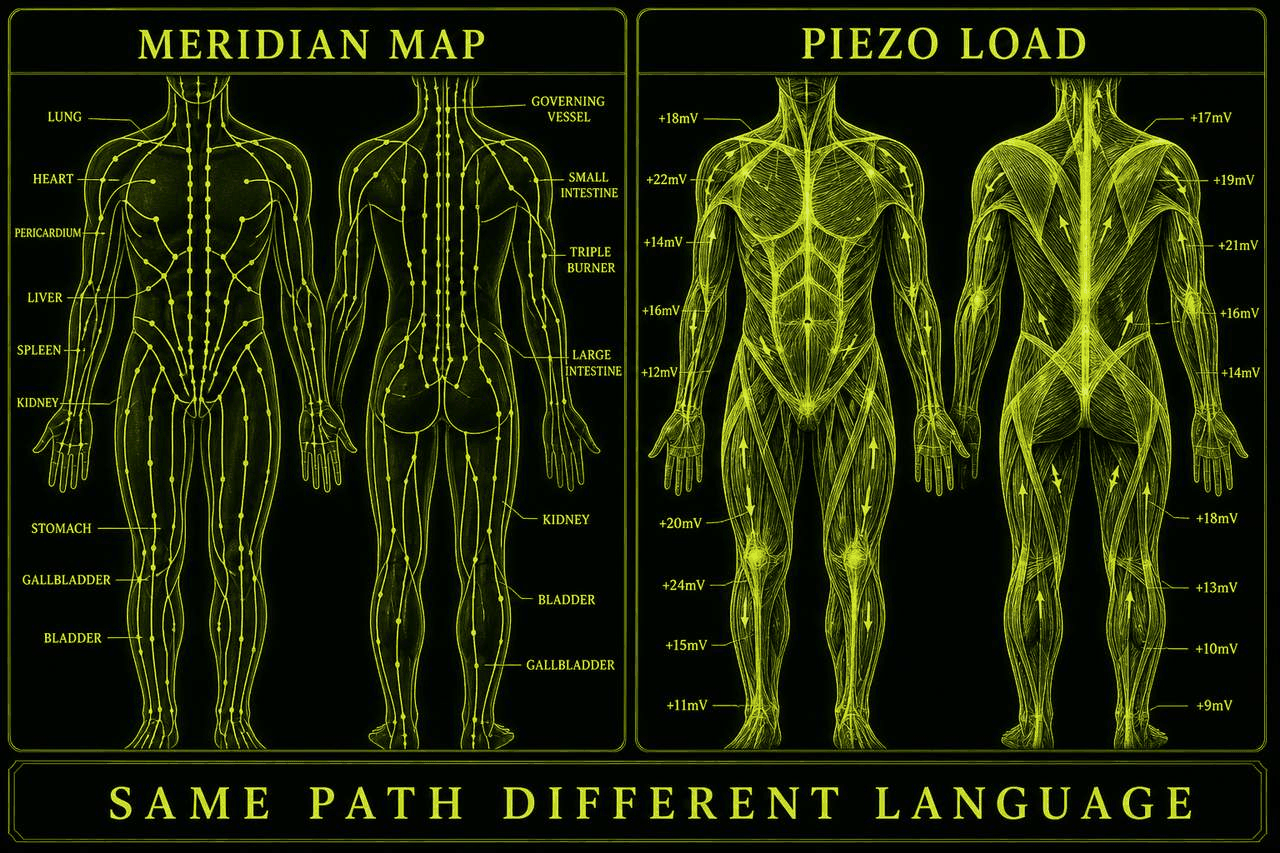
Dark lime split labeled MERIDIAN MAP and PIEZO LOAD. Left: front and back anatomical figures with classic meridian names. Right: fascial web with tension arrows. Footer: SAME PATH DIFFERENT LANGUAGE. Millivolt numerals on the right panel are schematic, not measured data.
Meridian map versus piezo load. Millivolt numerals on the still are schematic. Not a measured map.

Do meridians conduct electricity?

Sometimes the impedance is lower. Ahn, Wu, Badger, Hammerschlag, and Langevin measured 23 people in 2005. Pericardium meridian segments averaged 70.4 ohms against 75.0 ohms on a parallel control. Spleen segments did not differ. Ultrasound suggested the drop tracked needle contact with connective tissue, not a magic wire. Mixed data. Not a conductivity gospel.

They used four gold-plated needles as electrodes. 3.3 kHz AC. 20, 40, and 80 microamps. Control needles 0.8 cm medial. Pericardium: 70.4 ± 5.7 Ω versus 75.0 ± 5.9 Ω, p = 0.0003. Spleen: 67.8 ± 6.8 Ω versus 68.5 ± 7.5 Ω, p = 0.70. I am leaving the miss in. A real mechanism page keeps the miss.

Skin-surface conductance studies have a long, messy history. Pressure, moisture, abrasion. Ahn went deeper on purpose. The honest read is still small and mixed. Lower impedance where the needle sits in a plane. Not a glowing circuit diagram with invented millivolts.

Why does marketing collapse meridians into mystery?

Mystery rents better than fascia. A chart with organ names sells initiation. A connective tissue plane sells a needle that tugs. The gatekeeper hid the overlap and charged for the secret. The people hunting a path were not wrong to hunt.

I have seen the aisle. Qi as a personality upgrade. Meridians as a private physics. Skeptics answering with "not real." Both sides skip Langevin. Both sides skip Fukada. The translation was sitting in The Anatomical Record in 2002. 80% of the points on one mapped arm were holes into more fascia.

The enemy is that hide. I already ran this translation on kundalini as vagus superconductor and on why vision boards fail. Intention is current. The net has to carry it. A screaming nerve dumps the signal. A glued fascia plane dumps it another way. Software still needs hardware.

Question Meridian map Fascia / piezo load What I will not claim
What you are looking at Named channels. Lung, heart, bladder. Qi between surface and viscera. Interstitial connective tissue planes. A tensile net around muscle, bone, viscera. That every named vessel is a unique histological wire.
Overlap Textbook points on Cheng's chart. 80% of arm points, 50% of arm meridian intersections, on planes. P < 0.001 vs chance in their model. A whole-body 80% census. They mapped one arm.
Needle tug De qi. Fish on a line. Connective tissue winding. 18% greater pullout at points vs controls in 60 people. That the tug proves a miracle.
Electric story Qi as current. Dry collagen piezo under shear. PC meridian 70.4 vs 75.0 Ω. Spleen no difference. Millivolt labels on a still. A living fascia voltmeter of your Tuesday.
How you start Point location. Initiation. A master. Palpable yield. A plane. A count you can fail. That you need to buy a needle to test the first layer.

Two columns. One path. The still on this page is anatomy. The millivolt numerals drawn on the piezo panel are schematic. I did not measure them. Do not quote them as data.

What should I run if I want a number?

Start with Protocol 01, the free Neural Recalibration. Four-count inhale, eight-count exhale, seven minutes, a number before and a number after. No needles required for the first test. If the method earns it, the Library of Biological Wizardry is the rest of the stack. Fascia is hardware. The brake is how you stop screaming into it.

You can keep the chart. I will not take your map. Run 7 minutes of 4 in, 8 out. Write 1 to 10 before. Write 1 to 10 after. Do three days. The net is still there if the number moves. The mystery was optional.

A glued plane and a screaming nerve are cousins. Breath is the cheap recruitment. I translated the trunk on the kundalini page. This page is the wrap. Tension is energy trapped in a static loop. That line is from the archive. Unwinding it starts with a count you can fail.

The Library of Biological Wizardry is 15 protocols, 9 volumes, and live instruments. Reality Engineering: the science of making reality respond to intent. Fascia is one hardware layer. It is not the product they actually want, which is a life that answers. You do not need the archive to test the first layer.

Run the brake first.

Protocol 01 is free. Seven minutes. 4 in, 8 out. A 1-10 before. A 1-10 after. No faith. No needles. If the method earns the rest of the stack, the Library is there.

What I will not claim

I will not treat millivolt numerals on a still as data. I will not stretch one arm's 80% into a whole-body census. I will not launder dried-collagen constants into live fascia volts. I will not diagnose a crisis. This is an educational mechanism page. It is not medical advice.

I will not fight the people who wanted the channels to be real. The hunger was honest. The enemy is the gatekeeper who hid the planes and sold the secret. The HOW is boring on purpose. A net. A tug. A count. A number you have to look at.

If you are in medical trouble, talk to a clinician. I am an author in Paris, Tennessee, not your doctor. The papers are linked because I opened them. They are not a Tuesday promise.

Direct answers

Short answers you can lift from this page. Visible text matches the FAQ schema exactly. Meridians sit on fascia. Dry collagen is piezoelectric. Millivolt art is not a meter. None of this is medical advice.

What are meridians scientifically?

Classic Chinese charts draw channels that carry qi between surface and viscera. Langevin and Yandow treated that network as a map of interstitial connective tissue. In 2002 they mapped the human arm and found an 80% correspondence between acupuncture points and intermuscular or intramuscular connective tissue planes. The map was fascia. Science has not isolated a qi particle.

Are meridians the same as fascia?

As a translation, yes. Meridians are piezoelectric fascia: the old chart and the connective tissue planes are the same path in two languages. Langevin's arm study put more than 80% of points and 50% of meridian intersections on those planes. That is anatomy in one limb, not a proof that every named vessel is a unique wire.

What is the 80% acupuncture fascia overlap?

Langevin and Yandow sectioned a human arm from olecranon to humeral head. They marked 24 acupuncture points and 51 other meridian intersections from Cheng's textbook. More than 80% of the points and 50% of the intersections coincided with intermuscular or intramuscular connective tissue planes. Their cylinder model put chance at P less than 0.001. It is one arm. It is not a whole-body census.

Is fascia piezoelectric?

Dry collagen is. Fukada and Yasuda measured piezoelectricity in dried human and ox femur in 1957, then in ox and horse Achilles tendon in 1964. Shear on oriented collagen fibers produced charge. The 1964 tendon constants were the largest they had seen in crystalline polymers. Those were dried specimens. I will not treat millivolt labels on a still as a living map of your Tuesday.

Do meridians conduct electricity?

Sometimes the impedance is lower. Ahn, Wu, Badger, Hammerschlag, and Langevin measured 23 people in 2005. Pericardium meridian segments averaged 70.4 ohms against 75.0 ohms on a parallel control. Spleen segments did not differ. Ultrasound suggested the drop tracked needle contact with connective tissue, not a magic wire. Mixed data. Not a conductivity gospel.

Why does marketing collapse meridians into mystery?

Mystery rents better than fascia. A chart with organ names sells initiation. A connective tissue plane sells a needle that tugs. The gatekeeper hid the overlap and charged for the secret. The people hunting a path were not wrong to hunt.

What should I run if I want a number?

Start with Protocol 01, the free Neural Recalibration. Four-count inhale, eight-count exhale, seven minutes, a number before and a number after. No needles required for the first test. If the method earns it, the Library of Biological Wizardry is the rest of the stack. Fascia is hardware. The brake is how you stop screaming into it.

Is this medical advice?

No. This page is an educational mechanism explainer by JM Thomas. It is not a diagnosis, treatment, cure, or prevention of any disease. Cadaver maps and dried-collagen papers are literature, not a promise about your Tuesday.

Sources I actually opened

Langevin, H.M., & Yandow, J.A. “Relationship of acupuncture points and meridians to connective tissue planes.” The Anatomical Record 269(6):257-265 (15 Dec 2002). 24 arm points, 51 meridian intersections. >80% of points and 50% of intersections on connective tissue planes. PMID 12467083. doi.org/10.1002/ar.10185

Langevin, H.M., Churchill, D.L., Wu, J., Badger, G.J., Yandow, J.A., Fox, J.R., & Krag, M.H. “Evidence of connective tissue involvement in acupuncture.” The FASEB Journal 16(8):872-874 (10 Apr 2002). Needle grasp = connective tissue winding, not muscle contraction. PMID 11967233. doi.org/10.1096/fj.01-0925fje

Langevin, H.M., Churchill, D.L., Fox, J.R., Badger, G.J., Garra, B.S., & Krag, M.H. “Biomechanical response to acupuncture needling in humans.” Journal of Applied Physiology 91:2471-2478 (2001). n=60. Pullout force ~18% greater at acupuncture points vs paired controls. doi.org/10.1152/jappl.2001.91.6.2471

Ahn, A.C., Wu, J., Badger, G.J., Hammerschlag, R., & Langevin, H.M. “Electrical impedance along connective tissue planes associated with acupuncture meridians.” BMC Complementary and Alternative Medicine 5:10 (9 May 2005). n=23. Pericardium 70.4 vs 75.0 Ω (p=0.0003). Spleen no difference (p=0.70). doi.org/10.1186/1472-6882-5-10

Fukada, E., & Yasuda, I. “On the piezoelectric effect of bone.” Journal of the Physical Society of Japan 12(10):1158-1162 (1957). Dried human and ox femur. Max ~6×10⁻⁹ c.g.s. e.s.u. Shear on collagen. doi.org/10.1143/JPSJ.12.1158

Fukada, E., & Yasuda, I. “Piezoelectric effects in collagen.” Japanese Journal of Applied Physics 3:117 (1964). Ox and horse Achilles tendon. −d14 = d25 = 8.0×10⁻⁸ c.g.s. e.s.u. Dried, oriented collagen. doi.org/10.1143/JJAP.3.117