Resonant breathing · six a minute · five-second lag
Breathe slow enough that blood pressure has time to fall.
You wanted six breaths a minute to drop the stress sheet after the fast sip already sat in the app.
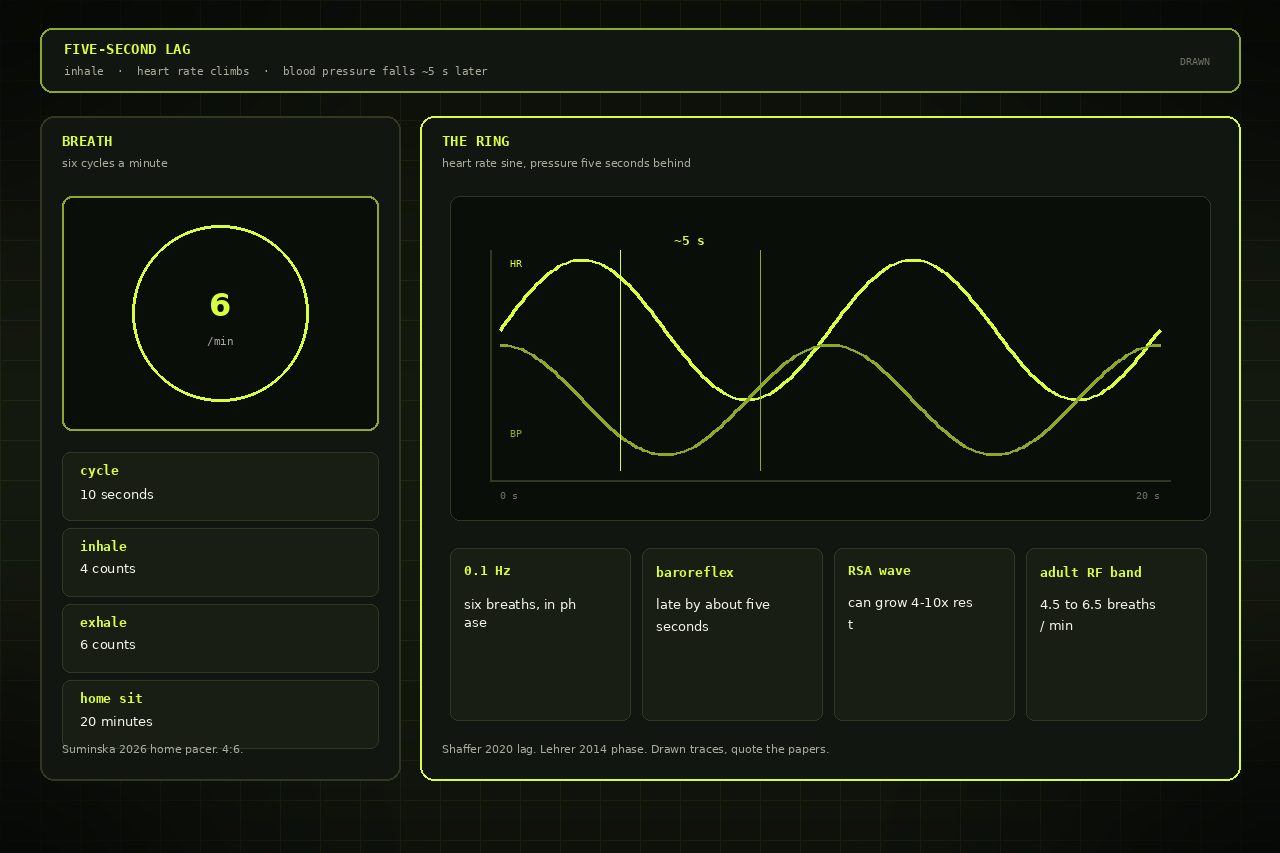
Resonant breathing, also called 0.1 Hz breathing, is about six breaths a minute. Hertz is how many times something happens in one second, so 0.1 Hz is one breath every ten seconds. The baroreflex is the loop that lets blood pressure fall then rise. The five-second lag is how long blood pressure takes to fall after a beat. RF is resonance frequency, each person's own slow rate. DASS is a stress, anxiety, and depression sheet. HRV, RMSSD, and HF are resting heart-rhythm scores. Sci Rep is the journal. The waitlist is people who waited. 4:6 is four seconds in and six seconds out.
What is resonant breathing?
Resonant breathing is about six breaths a minute, the slow rate people already want when they want blood pressure to have time to fall. Keep the six-a-minute name if that slow rate is why you came.
People already breathe near six a minute. You wanted six breaths a minute to drop the stress sheet after the fast sip already sat in the app, so stay with that name.
What is 0.1 Hz breathing?
0.1 Hz breathing is that same slow rate written as a frequency. Hertz is how many times something happens in one second, so 0.1 Hz is one breath every ten seconds, about six breaths a minute.
People already want that slow rate. Keep the six-a-minute name.
What is the baroreflex?
The baroreflex is the loop that lets blood pressure fall then rise. People already want a breath slow enough that blood pressure can fall then rise.
Keep wanting six breaths a minute so blood pressure has time to fall.
What is the five-second lag?
The five-second lag is how long blood pressure takes to fall after a beat. Earlier different work from Shaffer and Meehan in 2020 named that five-second lag and named RF from 4.5 to 6.5. RF, also called resonance frequency, is the slow rate that belongs to that person.
People already want six breaths a minute so blood pressure has those five seconds to fall. Keep the six-a-minute name.
What is resonance frequency?
Resonance frequency is each person's own slow rate, and the short name is RF. People in this study used either their own slow rate or a fixed 0.1 Hz rate, about six breaths a minute.
They compared those two rates. Keep wanting six breaths a minute.
Did six breaths a minute drop the stress sheet?
Suminska, with Rynkiewicz and Szulczewski, published this paper in 2026 in Sci Rep, and Sci Rep is the journal. You can read the paper at doi.org/10.1038/s41598-026-53333-6 and at nature.com/articles/s41598-026-53333-6.
The title of the paper is “Resonance frequency versus fixed 0.1 Hz breathing in HRV biofeedback: a four-week randomized comparison.” It also carries DOI 10.1038/s41598-026-53333-6. HRV biofeedback is people watching their heart-rhythm scores while they breathe. Randomized means they put people into groups by chance.
Eighty-eight people were randomized. Eighty people finished. Fifty-one were women. Those people had a mean age of 30.86. Mean is the average.
People used RF, fixed 0.1 Hz, or the waitlist. An arm is one of the groups they compared. The waitlist is people who waited. People who breathed used 4:6, four seconds in and six seconds out. People did a mean of 21.44 home sessions.
People filled the DASS, a sheet that scores stress, plus anxiety and depression. DASS stress sat at F(2,77)=8.506. F is a size score. Stress dropped.
They compared RF and 0.1 Hz. Keep wanting six breaths a minute.
Resting RMSSD and HF went down in every arm, including the waitlist. Those resting heart-rhythm scores are HRV, plus RMSSD and HF. Resting HRV did not rise. Keep wanting six breaths a minute.
What is the waitlist?
The waitlist is people who waited. People in that arm waited while the other people breathed.
That waitlist arm is a real comparison. Keep wanting six breaths a minute.
What is HRV?
HRV is a resting heart-rhythm score, and RMSSD and HF are too. People in this study showed resting RMSSD and HF down in every arm, including the waitlist.
Stress dropped. Resting HRV did not rise. Keep the six-a-minute name.
What is DASS?
DASS is the sheet they used for stress, plus anxiety and depression. People filled that sheet. DASS stress sat at F(2,77)=8.506. Stress dropped.
People already want that drop. Keep the six-a-minute name.
What is the physiological sigh next to six breaths a minute?
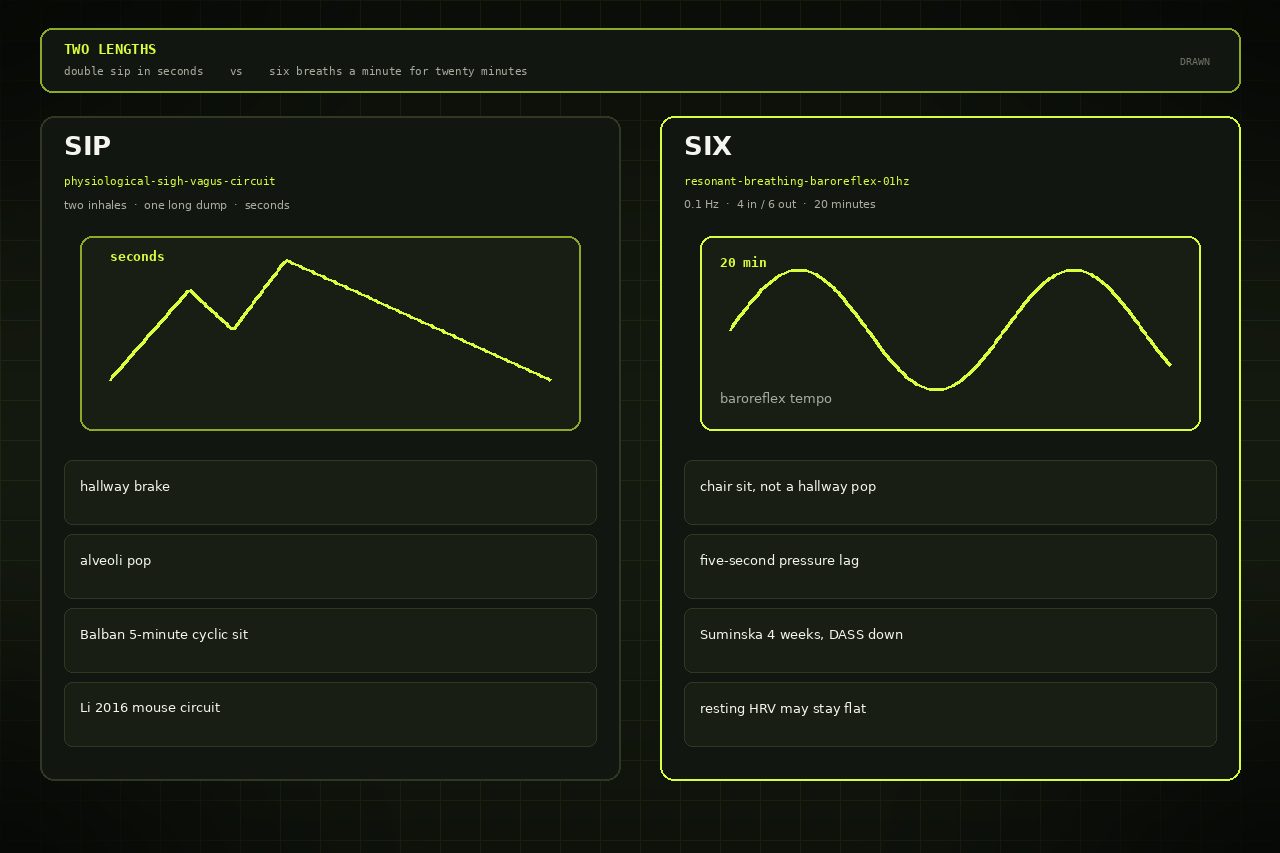
A physiological sigh is a nearby different breath, two inhales and one long exhale, the fast sip people already use in an app. You can see that sip next to six breaths a minute in the compare picture.
Stay with six breaths a minute if you opened this so blood pressure has time to fall.
If you want a page about that sigh, open the physiological sigh page.
If you want a page about If the kettle clicks, sit down and write, open the if-then page.
Can you still want six breaths a minute?
People already breathe near six a minute, and you can still want six breaths a minute. Keep the six-a-minute name.
Stress dropped. Resting HRV did not rise.
If you feel unusual distress or you need care, talk to a clinician, because this page is educational and not a diagnosis.
Can you still want six breaths a minute to drop the stress sheet?
You wanted six breaths a minute to drop the stress sheet after the fast sip already sat in the app. Keep the six-a-minute name.
Stress dropped and resting HRV did not rise. You can still want six breaths a minute.
Sources
Suminska, Rynkiewicz, Szulczewski. “Resonance frequency versus fixed 0.1 Hz breathing in HRV biofeedback: a four-week randomized comparison.” Sci Rep 2026;16:22630. DOI 10.1038/s41598-026-53333-6. n=88 randomized. 80 finished. 51 women. Mean age 30.86. RF / fixed 0.1 Hz / waitlist. 4:6. Home sessions mean 21.44. DASS stress F(2,77)=8.506. Resting RMSSD and HF down in every arm including waitlist. doi.org/10.1038/s41598-026-53333-6 · nature.com/articles/s41598-026-53333-6
Shaffer and Meehan 2020. Earlier different work. 5 s lag. RF 4.5 to 6.5.