Implementation intentions · cue weld · Hallam 3T
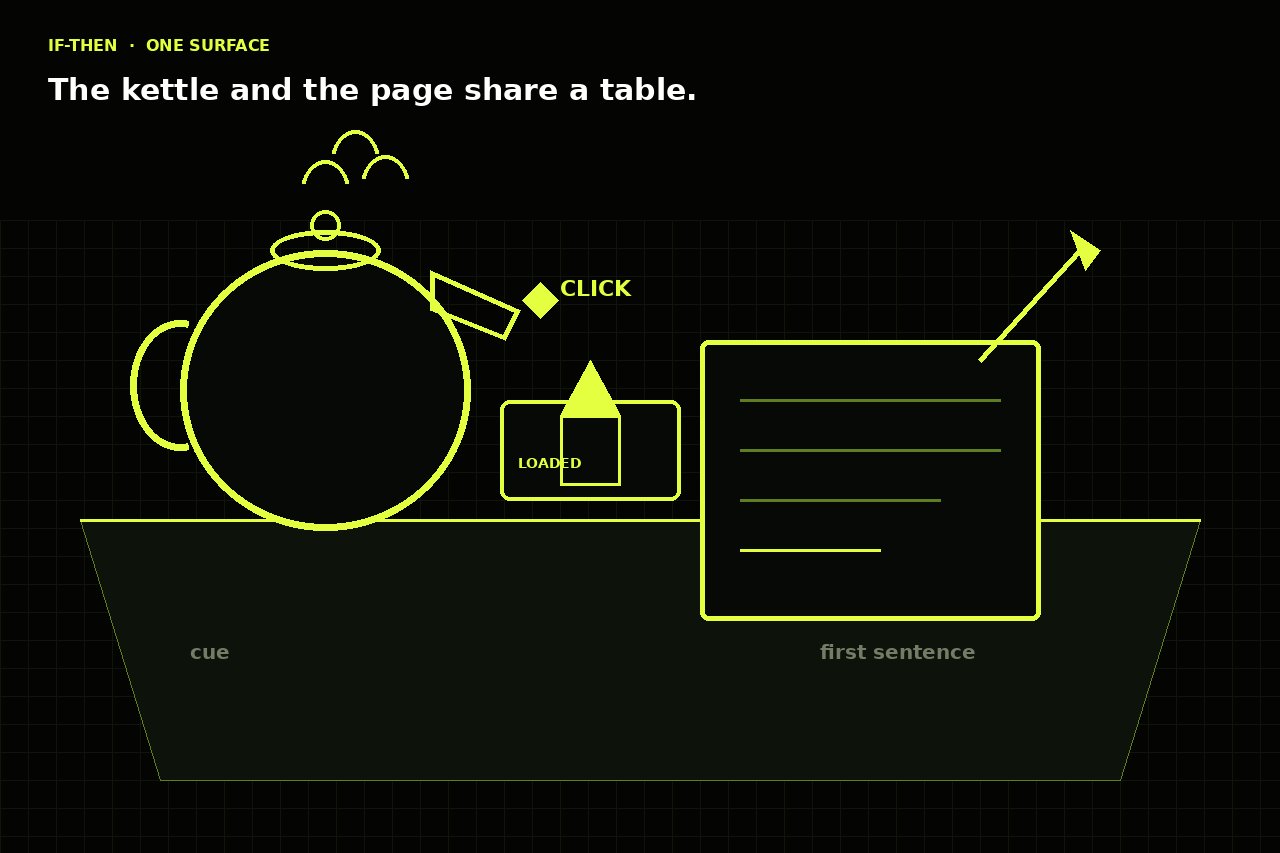
If the kettle clicks, sit down and write.
An if-then plan welds a named cue to an act. Forty people in a 3T showed the weld on the left amygdala.
You already wrote write-every-morning. Then the morning came and you made coffee. The wish sat in the kitchen with no wire to the chair. Steam. Mug. Phone. No click assigned to the sit.
The wish has no door
A goal intention names a destination. It does not name the thing in the room that starts the first step.
Gollwitzer called that second act of willing an implementation intention. Situation Y shows up, start act X. The if-part makes the cue hot. The then-part hands the start to that cue, so you do not have to reopen the case when steam hits the spout.
That is why a loud wish still stalls. The morning has steam and a mug and a phone. None of those objects were told to start the sit. So they start coffee. The chair waits. You call it a motivation problem. It is a missing door.
Which means the hunger can stay. You do not need a new desire. You need a named click that already happens in your house, welded to one first move you can fail in a notebook.
If-then is a weld
The format is contingent. If this, then that. A calendar block lists a time. It does not join the cue to the act.
Webb and Sheeran spent years on the two pieces. The if-part raises the accessibility of the specified opportunity. The then-part forges a link between that opportunity and the prepared response. Encounter the cue and the act starts without a second committee meeting in the skull.
Gollwitzer named the trick strategic automaticity. You decide once, on purpose. Later the kettle does the deciding. That is the opposite of trying harder at 7:12 a.m. while the mug is already in your hand.
Say the line out loud once. Kettle clicks, chair, first sentence. Put the paper away. The weld is supposed to run from the click, not from another reread.
A cue word on a 3T
Hallam put forty right-handed students in a 3 Tesla at Sheffield. Half got a goal intention. Half got an if-then welded to a cue word on the screen.
Mean age 20. Twenty women, twenty men. IAPS pictures of disgust and sadness. Each trial flashed ATTEND, REAPPRAISE, or SUPPRESS for three seconds, then a picture for ten. The goal-intention group heard "adopt a detached and unemotional attitude." The if-then group got the same job tied to a cue: if I see REAPPRAISE, then I tell myself these are just pixels on a screen and the picture can't get to me.
Both groups lowered affect versus attend, F(1,36)=118.1. The if-then group dropped more. Mean change 1.85 versus 1.31, t(34)=1.85, p less than .05. Left amygdala followed that split. Attend versus if-then, t=2.82. Attend versus goal intention did not. Lower self-report lined up with lower left amygdala, r=-.344, and the if-then half carried that correlation, r=-.512.
The effort group lit bilateral DLPFC. The if-then group lit right inferior frontal gyrus and ventro-parietal cortex, the pair that grabs a cue and retrieves the prepared line. Amygdala talked to orbitofrontal cortex on the if-then runs. Amygdala talked to DLPFC on the goal-intention runs. Skin conductance, 26 people, did not split the groups. The feeling rating did.
Hallam reported the map at p less than .001 uncorrected. Treat the voxels as a photograph of a weld, not a new law. The affect numbers are the lock. Forty young adults. Liberal threshold. Same story the behavior papers already had, now with an amygdala that quieted when the cue word owned the job instead of a vague try-harder instruction.
The picture hits at 100 ms
Schweiger Gallo put the same if-then on EEG. The plan changed the picture at about 100 milliseconds. That is perception, not a pep talk after the fact.
Gilbert ran the other photograph in 2009. Sixteen people, ages 19 to 36, mean 22.7, eleven women, five men, NYU, 3T Siemens Allegra. One instruction welded a target to a button. The other said you can score points, and left you to start it yourself. Same task. Different wording. Self-initiated runs were worse and louder in a frontoparietal net. Cued runs preferred medial BA10. Self-initiated runs preferred lateral BA10.
A destination you have to keep pushing uses the lateral surface. A destination handed to a cue uses the medial one. That is the same weld Hallam later showed on disgust pictures. Different scanner. Different job. Same split between trying and triggering.
Contingent beats a calendar
Sheeran, Listrom, and Gollwitzer put 642 tests on the table in 2025. Contingent if-then plans beat schedule plans. Rehearse once. Do not keep the sheet in your pocket.
Sample-weighted d sat at 0.36, 95% CI 0.33 to 0.40. Trim-and-fill barely moved it, d=0.35. Publication bias is real. Egger's b=1.06. RoBMA, the Bayesian model that prices that bias, still found extreme evidence for an effect, BF10=319.3, with a smaller model-averaged d=0.15. Quote both numbers. Do not shop the pretty one.
Affect regulation held at d=0.66 across 26 tests, and that set was homogenous. Behavior change sat smaller, d=0.27, and messy. Cognitive jobs sat at d=0.47. Motivation mattered a lot. When the goal was already strong, d=0.79. Weak wanting plus a pretty plan is still weak wanting. The weld needs a destination you actually want.
Format was the steal. Contingent d=0.43. Schedule d=0.29. Rehearsal raised the effect, d=0.45 versus 0.33. Recording the plan cut it, d=0.31 versus 0.44. Visualising the act added nothing. Time-and-place as a cue worked, d=0.46. Asking people to invent their own cue sagged, d=0.16. One plan held. Seven or eight held. Three to five sagged. Start with one click you already meet.
The 2006 chapter is the older lock. Ninety-four tests. d=0.65. More than eight thousand people. The 2025 review is larger, more honest about bias, and still says the same practical thing. Write if-then. Say it once. Want the thing. Name a cue the house already makes.
A collage still needs a door
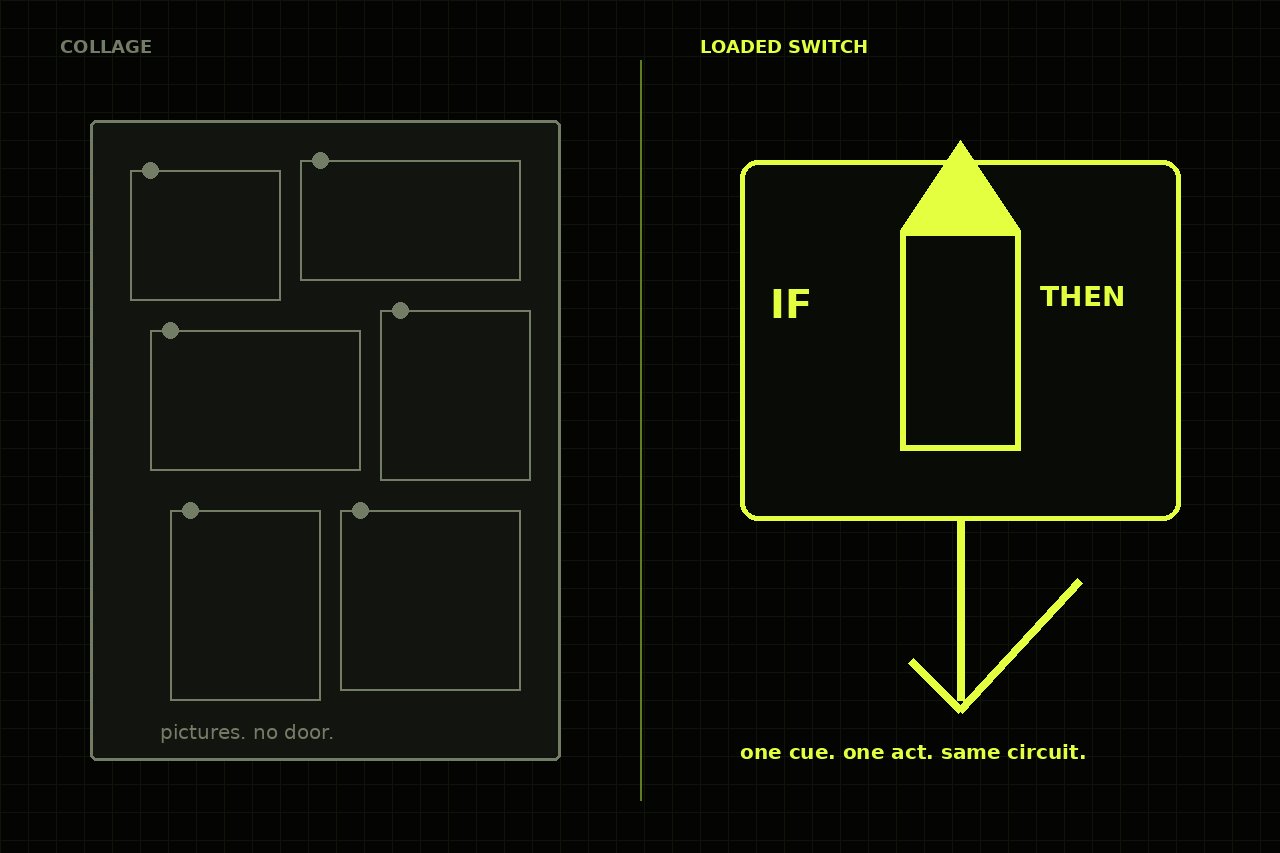
A vision board is an outcome picture. An if-then plan is a cue with a first step welded to it. They do different jobs.
The collage can stay on the wall. It still has no click. The kettle has a click. The chair has a first sentence. Wire those two and the morning has a door. I already wrote the hardware problem on why vision boards fail. This page is the missing weld.
Leave the collage on the wall if you want a reminder of the destination. Write the if for the first step. The picture does not start the sit. The click does.
Load the cue tonight
Pick one act you already want. Pick one cue that already happens in the house. Weld them. Say the line once. Put the paper away.
Kettle done, first sentence. Phone on the charger, open the file. Porch light on, walk ten minutes. One cue. One first move you can fail on paper.
Do it for seven mornings. Write yes or no. The log is the test. A pretty plan with no log is another wish.
If the chest is already loud, sit first. Lengthen the exhale until that 1-to-10 drops a point. Then write the if. That sit is Protocol 01. Free. The weld still needs a quiet enough nerve to hold a cue.
One click. One first sentence.
Don't chase forty student scans. Chase whether your own named cue started the act, written yes or no for a week, even if Wednesday is a miss. The Library is the paid archive if you want more named sits after that log exists.
Leftover objections
Do I need a 3T scanner to know the plan worked?
No. The scanner photographed a weld. Your log is whether the named cue showed up and the act started. A kettle click plus a first sentence is the home instrument.
Is a calendar block the same thing?
A schedule lists when and where. An if-then welds the cue to the act. Sheeran 2025 split those formats across 642 tests. Contingent plans ran larger (d=0.43) than schedule plans (d=0.29).
What if I write ten of them?
The 2025 review found no magic count. One plan and seven or eight plans both held. Three to five plans sagged. Start with one cue you actually meet.
Can I keep the plan on my phone and reread it?
Recording the plan cut the effect (d=0.31 vs 0.44). Rehearsing it once raised the effect. Say it out loud. Put the paper away. The cue has to own the start, not another reread.
Is this a medical page?
No. Forty student scans and a 642-test review are literature. If a cue arrives with panic, call a doctor, not another plan.
Files and numbers
Hallam, G.P., Webb, T.L., Sheeran, P., Miles, E., Wilkinson, I.D., Hunter, M.D., Barker, A.T., Woodruff, P.W.R., Totterdell, P., Lindquist, K.A., and Farrow, T.F.D. "The Neural Correlates of Emotion Regulation by Implementation Intentions." PLoS ONE 2015;10(3):e0119500. DOI 10.1371/journal.pone.0119500. PMID 25798822. PMC4370584. n=40, 20 per arm, mean age 20, range 18-23, 3T. Affect change 1.85 vs 1.31, t(34)=1.85, p<.05. Left amygdala attend>if-then t=2.82. r=-.344 overall, r=-.512 if-then arm. Map at p<.001 uncorrected. SCR n=26, no group split. doi.org/10.1371/journal.pone.0119500 · PMC4370584
Gilbert, S.J., Gollwitzer, P.M., Cohen, A.-L., Oettingen, G., and Burgess, P.W. "Separable brain systems supporting cued versus self-initiated realization of delayed intentions." Journal of Experimental Psychology: Learning, Memory, and Cognition 2009;35(4):905-915. DOI 10.1037/a0015535. PMID 19586260. n=16, ages 19-36, mean 22.7, 11 women, 5 men, 3T Siemens Allegra. Cued: medial BA10. Self-initiated: lateral BA10, poorer performance. doi.org/10.1037/a0015535 · europepmc.org/article/MED/19586260
Sheeran, P., Listrom, O., and Gollwitzer, P.M. "The when and how of planning: Meta-analysis of the scope and components of implementation intentions in 642 tests." European Review of Social Psychology 2025;36(1):162-194. DOI 10.1080/10463283.2024.2334563. 642 tests. d=0.36, 95% CI [0.33, 0.40]. RoBMA (bias-priced Bayesian average) d=0.15, BF10=319.3. Contingent d=0.43 vs schedule d=0.29. Rehearsal d=0.45 vs 0.33. Recording d=0.31 vs 0.44. Affect d=0.66. Motivation d=0.79. doi.org/10.1080/10463283.2024.2334563 · Konstanz record
Gollwitzer, P.M., and Sheeran, P. "Implementation intentions and goal achievement: A meta-analysis of effects and processes." Advances in Experimental Social Psychology 2006;38:69-119. DOI 10.1016/S0065-2601(06)38002-1. 94 tests, d=0.65, more than 8,000 participants. doi.org/10.1016/S0065-2601(06)38002-1
Gollwitzer, P.M. "Implementation intentions: Strong effects of simple plans." American Psychologist 1999;54(7):493-503. DOI 10.1037/0003-066X.54.7.493. Theory paper. No trial n. doi.org/10.1037/0003-066X.54.7.493
Schweiger Gallo, I., Keil, A., McCulloch, K.C., Rockstroh, B., and Gollwitzer, P.M. "Strategic automation of emotion regulation." Journal of Personality and Social Psychology 2009;96(1):11-31. DOI 10.1037/a0013460. PMID 19210061. EEG Study 3, modulation near 100 ms. doi.org/10.1037/a0013460 · europepmc.org/article/MED/19210061
Webb, T.L., and Sheeran, P. "How do implementation intentions promote goal attainment? A test of component processes." Journal of Experimental Social Psychology 2007;43(2):295-302. DOI 10.1016/j.jesp.2006.02.001. Cue accessibility and cue-response links. doi.org/10.1016/j.jesp.2006.02.001