Mechanism · Vision Boards · Hardware · Brake

Vision boards fail when the hardware is screaming.

JM Thomas · Paris, Tennessee · 15 August 2026

A vision board is an outcome picture. You pin the life you want. Then you wait. NYU work on positive fantasies shows that move can drop energy, including systolic blood pressure, before you take a step. A screaming nerve makes it worse. Intention is current. Hardware has to be online.

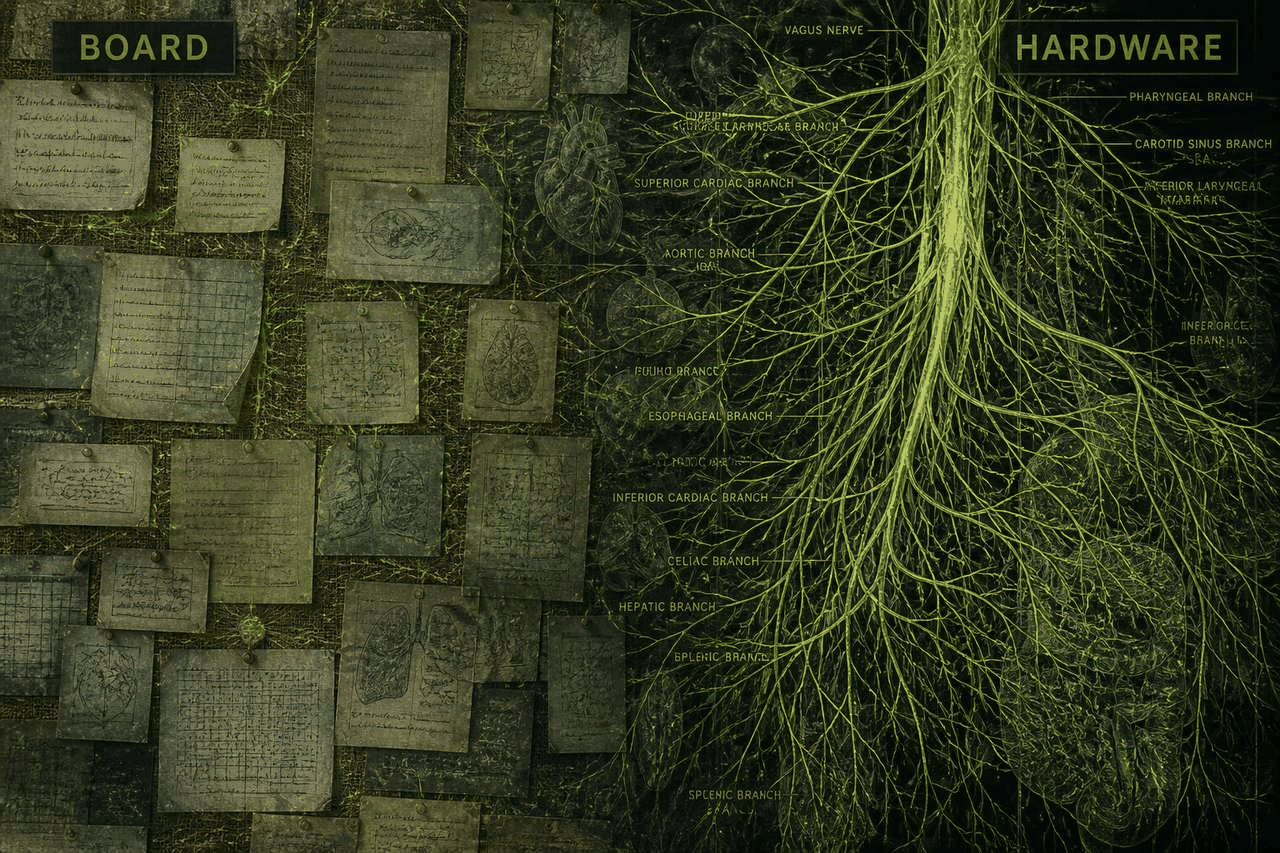
Dark lime split. Left panel labeled BOARD with pinned anatomical notes. Right panel labeled HARDWARE with a glowing vagus nerve map.
The collage is a field note. The trunk is the machine.

I write from Paris, Tennessee. I am not here to mock the wall. People wanted a life that answers. They were handed a collage and told to feel it. The hunger was honest. The mechanism was hidden.

Reality Engineering is the science of making reality respond to intent. A picture can name the intent. A calmer nerve is how the current travels. A board without hardware is a poster in a storm.

What is a vision board supposed to do?

A vision board is a collage of the life you want. House. Body. Partner. Number in a bank. You pin the end state on a wall and look at it. The hunger is real. The product you were sold is a picture of arrival, not a count you can fail.

The board got famous when a film told millions to feel the already-done life. Magazines printed the ritual. Pinterest made it a feed. Cut. Glue. Stare. Repeat. I will not fight the people who did that in good faith. They were trying to aim.

Aim is useful. An image can hold a sentence you mean. The error is treating the image as the load. You still have a body. You still have a line from brainstem to heart and gut. If that line is screaming, the picture is scenery.

I have watched the same pattern on a 7-minute song. Headphones. Hope. A flicker. Tuesday it dies. The collage is that ritual with glue. Same fail. Different prop.

Why don't vision boards work?

Vision boards fail for two stacked reasons. An outcome collage lets you mentally consummate the future, which can drop energy before you act. Then the same picture hits a nervous system that is still screaming. Intention is current. Hardware that is dumping cortisol will not carry it.

Heather Kappes and Gabriele Oettingen ran four experiments in 2011. Induced positive fantasies about an idealized future produced less energy than fantasies that questioned the future, negative fantasies, or neutral ones. They measured energy two ways. People said they felt less energized. Systolic blood pressure dropped. That is a body number, not a vibe.

Study 4 is the mean one. Students went without food and water for hours. Some then ate crackers. For the thirsty ones, a fantasy about a tall glass of water dropped blood pressure. A fantasy about exam success did not. For the ones who had already drunk, the exam fantasy did the dropping. The more pressing the need, the more the pretty picture relaxed them at the wrong time.

Oettingen and Doris Mayer had already split the fork in 2002. Positive expectations are judgments that a desired future is likely. Those predicted high effort and better performance. Positive fantasies are the felt images of already having it. Those predicted the reverse. Graduates hunting jobs. Students with a crush. Undergraduates facing an exam. Patients after hip-replacement surgery. Follow-ups ran weeks to two years. Same split each time.

Oettingen and Thomas Wadden saw it in a weight program in 1991. The more positively people fantasized about success, the fewer pounds they shed. I will not invent a pound count I did not read off the table. The direction is enough.

A vision board is that fantasy, glued. You look at the house. Your body gets a sip of arrival. Effort feels optional. Then you call it blocked. The board did what the papers said it would do. It let you consummate the future in the present.

Does process visualization work better than the collage?

Pham and Taylor had college freshmen mentally simulate either the process of studying or the outcome of a good grade for several days before a midterm. Process simulation enhanced studying and improved grades. That lift ran through more planning and less anxiety. Outcome simulation did not do that job.

Taylor, Pham, Rivkin, and Armor wrote the wider map in 1998. Mental simulation of the process for reaching a goal produced progress. Envisioning successful completion, the self-help default, did not. A board is almost always the completion shot. The A. The keys. The body in the photo. Almost never the ugly middle.

Process is boring on purpose. Open the book. Sit the hours. Make the call. That is a rehearsal you can fail. A collage cannot fail. Play is play. Glue is glue. That is why the wall feels productive and the week does not move.

Oettingen later named a repair: contrast the wish with the obstacle in the present, then write an if-then. Wish. Outcome. Obstacle. Plan. I am not selling her workbook. I am naming the missing half. A board that never names Tuesday will keep paying you in pictures.

Why intention dies on a screaming nerve

You cannot load a sentence you mean on hardware that is still dumping cortisol into the line. A collage, a mantra, a 7-minute song: same pattern. State moves for a night. Tuesday it dies. The brake was never online.

The energy papers measured a drop after a pretty future. That is one fail. The other fail is louder. Sympathetic dump. Tight jaw. Short exhale. A body that is already in traffic. You pin a calm life on the wall and the cable is still screaming. Current hits noise. Noise wins.

I wrote the hardware translation on a sibling page: raising kundalini is recruiting the vagus as a superconductor. Cranial nerve X. Medulla to larynx, heart, gut. Slow breathing is one switch the papers actually measured. Laborde and colleagues pulled 223 studies of voluntary slow breathing. Vagally mediated HRV went up during the session, after one session, and after multi-session work. Lehrer and Gevirtz describe resonance near six breaths a minute. That is a count. It is not a magazine spread.

The song aisle fails the same way. A frequency hits a screaming system. I mapped that on Brain Song vs Genius Song and on how the Genius Song works. File versus system. Collage versus system. Same missing brake.

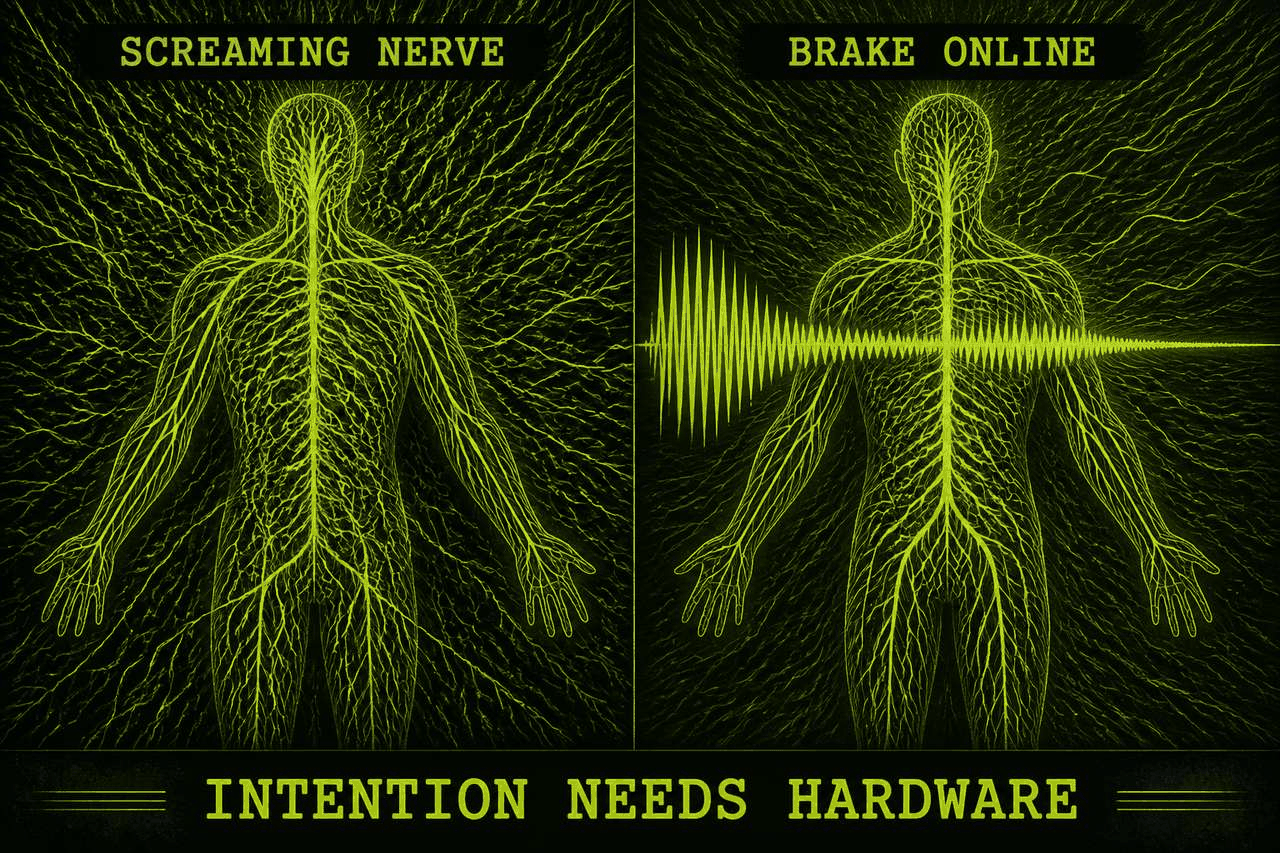
Two anatomical silhouettes. Left labeled SCREAMING NERVE with chaotic branching. Right labeled BRAKE ONLINE with a waveform that flattens. Footer: INTENTION NEEDS HARDWARE.
Same body. Brake offline versus brake online.
Question Vision board Process rehearsal Brake plus a score
What you own A collage of arrival A mental run of the steps Counts, a duration you can fail, a 1-10
What the papers measured Positive fantasies sap energy. Systolic BP can drop. Process simulation lifted studying and grades via planning and less anxiety. Slow breathing lifts vagally mediated HRV in the reviews I opened.
Can you fail it? No. Looking is looking. Yes. Skip the step in the rehearsal. Yes. Shorten the exhale. Bargain the clock.
When it dies Buy a new poster. Blame worthiness. You still need a body that can carry the plan. Check the brake. Then talk about software.

The board column is a sibling of the song column. Both sell an input and skip the trunk. The enemy is the gatekeeper who hid the nerve and rented the mystery. The HOW is boring. Four in. Eight out. Seven minutes. A number.

What to run instead of another collage

Start with Protocol 01, the free Neural Recalibration. Four-count inhale, eight-count exhale, seven minutes, a number before and a number after. No headphones. If the method earns it, the Library of Biological Wizardry is the rest of the stack. That is hardware. It is a poster-free morning.

Keep the seven-minute clock if you already sit that long in front of the wall. Change the machine. Inhale for four. Exhale for eight. Sit until the timer ends. Write 1 to 10 before. Write 1 to 10 after. Do three days. If the number moves, you just ran hardware.

You can still keep a picture. I will not take your wall. Put the obstacle next to the wish. Write one if-then you can fail. Then recruit the trunk. A board that follows a brake is a note. A board that replaces a brake is a lullaby.

The Library of Biological Wizardry is 15 protocols, 9 volumes, and live instruments. Reality Engineering: the science of making reality respond to intent. A calmer nerve is a clean line. The product is a life that answers. You do not need the archive to test the first layer.

Run the brake first.

Protocol 01 is free. Seven minutes. 4 in, 8 out. A 1-10 before. A 1-10 after. No faith. No headphones. If the method earns the rest of the stack, the Library is there.

What I will not claim

I will not tell you a collage is evil. I will not invent a pound count from the 1991 table. I will not treat mental contrasting as a spell. I will not diagnose a crisis. This is an educational mechanism page. It is not medical advice.

I will not fight the people who wanted this to work. The enemy is the gatekeeper who sold the picture and hid the nerve. The HOW is boring on purpose. A count. A duration. A number you have to look at.

If you are in medical trouble, talk to a clinician. I am an author in Paris, Tennessee, not your doctor. The papers are linked because I opened them. They are not a Tuesday promise.

Direct answers

Short answers you can lift from this page. Visible text matches the FAQ schema exactly. A board is an outcome picture. Energy can drop. The nerve still has to come online. None of this is medical advice.

Why don't vision boards work?

Vision boards fail for two stacked reasons. An outcome collage lets you mentally consummate the future, which can drop energy before you act. Then the same picture hits a nervous system that is still screaming. Intention is current. Hardware that is dumping cortisol will not carry it.

What is a vision board supposed to do?

A vision board is a collage of the life you want. House. Body. Partner. Number in a bank. You pin the end state on a wall and look at it. The hunger is real. The product you were sold is a picture of arrival, not a count you can fail.

Do positive fantasies sap energy?

In four experiments, Heather Kappes and Gabriele Oettingen found that induced positive fantasies about an idealized future produced less energy than questioning, negative, or neutral fantasies. Energy was measured by reported energization and by systolic blood pressure. The drop was larger when the fantasy matched a more pressing need.

What is the difference between a fantasy and an expectation?

Oettingen and Mayer, in 2002, split two future thoughts. Positive expectations are judgments that a desired future is likely, and they predicted high effort and better performance. Positive fantasies are the felt images of already having it, and they predicted the reverse. Job search, a crush, an exam, hip-replacement recovery. Same split.

Does process visualization work better than outcome visualization?

Pham and Taylor had college freshmen mentally simulate either the process of studying or the outcome of a good grade for several days before a midterm. Process simulation enhanced studying and improved grades. That lift ran through more planning and less anxiety. Outcome simulation did not do that job.

Why does intention fail on a screaming nervous system?

You cannot load a sentence you mean on hardware that is still dumping cortisol into the line. A collage, a mantra, a 7-minute song: same pattern. State moves for a night. Tuesday it dies. The brake was never online. Protocol 01 is a free 7-minute vagal brake with a 1-10 score before and after.

What should I run instead of another collage?

Start with Protocol 01, the free Neural Recalibration. Four-count inhale, eight-count exhale, seven minutes, a number before and a number after. No headphones. If the method earns it, the Library of Biological Wizardry is the rest of the stack: 15 protocols, 9 volumes, and live instruments you can measure.

Is this medical advice?

No. This page is an educational mechanism explainer by JM Thomas. It is not a diagnosis, treatment, cure, or prevention of any disease. Motivation papers and anatomy papers are literature, not a promise about your Tuesday.

Sources I actually opened

Kappes, H.B., & Oettingen, G. “Positive fantasies about idealized futures sap energy.” Journal of Experimental Social Psychology 47(4):719-729 (2011). Four experiments. Energy by self-report and systolic blood pressure. Larger drop when the need was more pressing. doi.org/10.1016/j.jesp.2011.02.003

Oettingen, G., & Mayer, D. “The motivating function of thinking about the future: Expectations versus fantasies.” Journal of Personality and Social Psychology 83(5):1198-1212 (2002). Job search, crush, exam, hip-replacement. Follow-up weeks to two years. doi.org/10.1037/0022-3514.83.5.1198

Pham, L.B., & Taylor, S.E. “From thought to action: Effects of process-versus outcome-based mental simulations on performance.” Personality and Social Psychology Bulletin 25(2):250-260 (1999). Process simulation enhanced studying and grades via planning and reduced anxiety. doi.org/10.1177/0146167299025002010

Taylor, S.E., Pham, L.B., Rivkin, I.D., & Armor, D.A. “Harnessing the imagination: Mental simulation, self-regulation, and coping.” American Psychologist 53(4):429-439 (1998). Process simulation produced progress. Envisioning successful completion did not. doi.org/10.1037/0003-066X.53.4.429

Oettingen, G., & Wadden, T.A. “Expectation, fantasy, and weight loss: Is the impact of positive thinking always positive?” Cognitive Therapy and Research 15:167-175 (1991). More positive success fantasies, fewer pounds shed. Direction cited, no invented pound count. doi.org/10.1007/BF01173206

Laborde, S. et al. “Effects of voluntary slow breathing on heart rate and heart rate variability: a systematic review and a meta-analysis.” Neuroscience and Biobehavioral Reviews (2022). 223 studies. vmHRV up during, after one session, and after multi-session work. doi.org/10.1016/j.neubiorev.2022.104711

Lehrer, P.M., & Gevirtz, R. “Heart rate variability biofeedback: how and why does it work?” Frontiers in Psychology 5:756 (2014). Resonance near six breaths a minute. frontiersin.org/…/10.3389/fpsyg.2014.00756