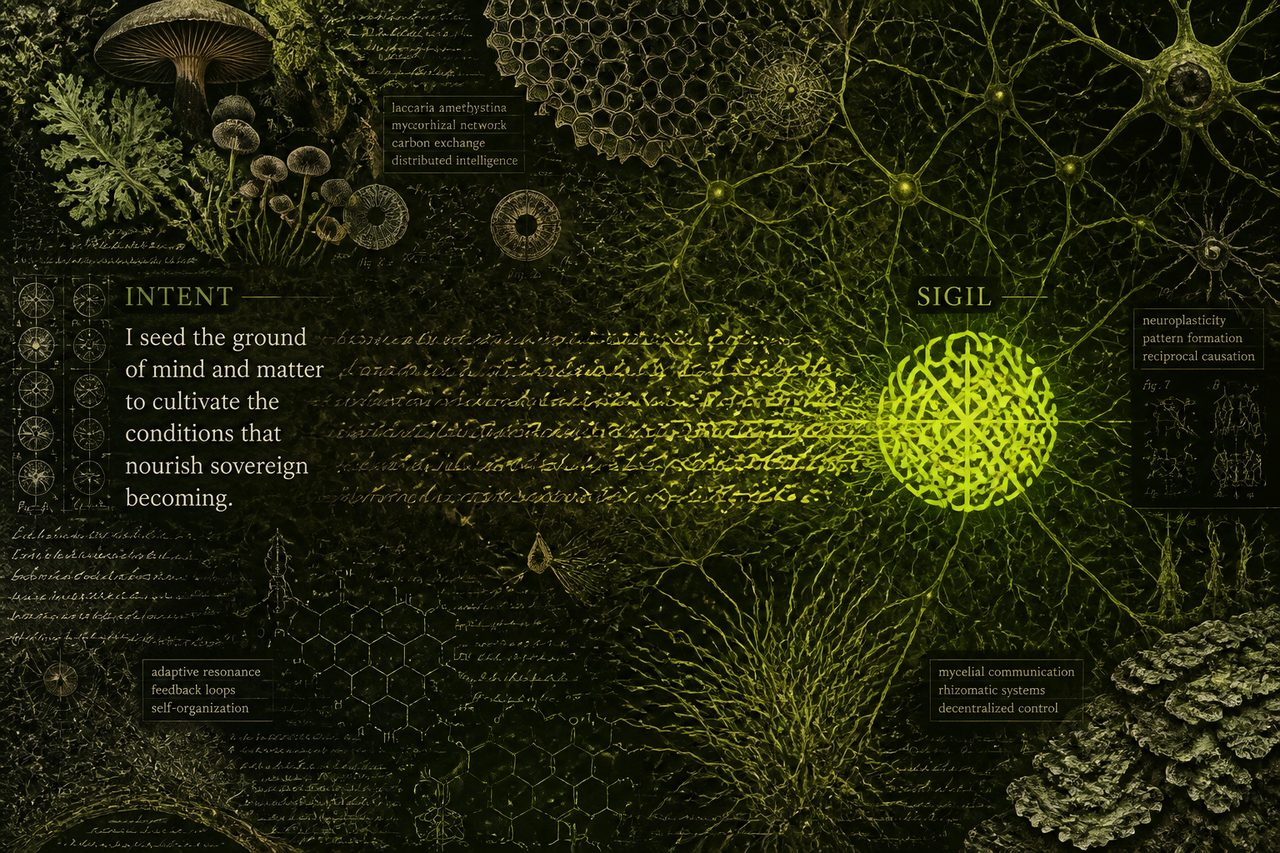
Mechanism · Sigil · Compression · DLPFC
A sigil is data compression. Forgetting is the DLPFC release.
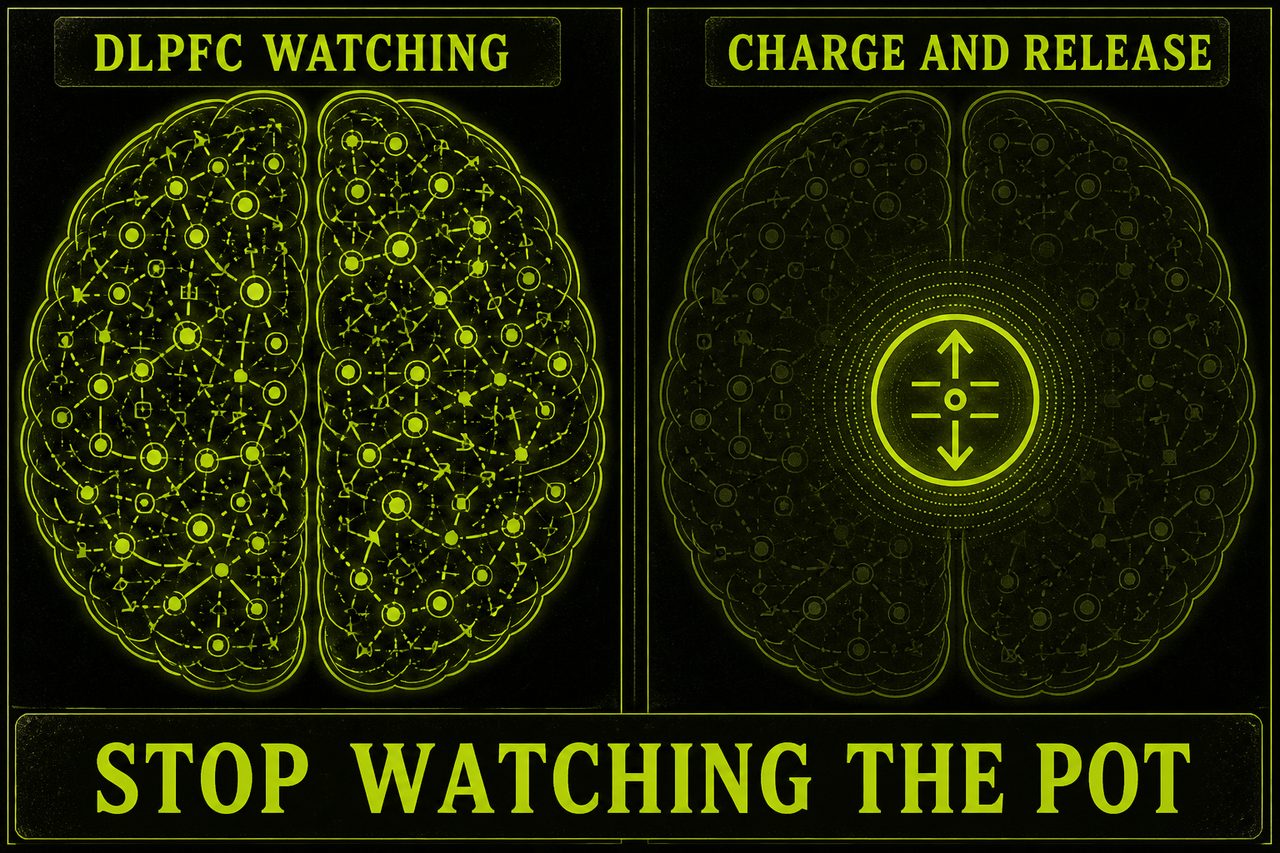
A sigil is a sentence crushed into a glyph the editor cannot easily unpack. Austin Spare charged it, then required a deliberate striving to forget it. The dorsolateral prefrontal cortex is the watcher that keeps a goal in working memory. Lust for result is that watcher staying online. The stills on this page are schematic. I do not have an fMRI of a charged glyph. I will not invent one.
I write from Paris, Tennessee. People ask me if sigils are real. They ask if you have to forget them. They paste a chaos-magic thread and want a scanner to bless it. Those are hardware questions. I will answer the hardware. I will not baptize a glyph with a fake voxel.
Reality Engineering is the science of making reality respond to intent. A sentence is semantic data. A glyph is visual data. Visual data processes faster. The old map named the seal. The lab named the editor. The gatekeeper hid the compression step and rented the mystery.
What is a sigil?
A sigil is a compressed intention. In medieval magic it was a seal for a named spirit. Austin Osman Spare flipped the method: you write a sentence of desire, collapse the letters into a glyph the conscious mind cannot easily read, charge it, then forget it. The old word still means seal. The modern use is data compression.
The Latin is sigillum. Seal. Grimoires listed seals for angels and demons. The Lesser Key of Solomon printed seventy-two of them. Spare, writing in the early twentieth century, refused the catalog. He treated those beings as complexes in the unconscious that you could build, not as landlords you had to petition. The method that survived into chaos magic is his, not Solomon's.
Write the sentence. Strip the vowels. Strip the repeats. Rearrange the leftovers into a monogram. That is not poetry. That is lossy compression. The meaning is still in the shape. The editor cannot read the shape as easily as it could read the sentence. Related reading: why vision boards fail. A vision board keeps the sentence in English, on the wall, under the watcher. A sigil hides the sentence from the watcher on purpose.
Grant Morrison later called corporate logos viral sigils. Nike. McDonald's. Disney's signature. Condensed desire, repeated until the conscious mind stops parsing it. That is a media claim, not a lab. I am leaving it as a claim. The mechanism I am willing to stand on is smaller: compression plus release.
How does Austin Spare's sigil method work?
Write a present-tense statement of intent. Strip vowels and repeated letters. Rearrange what is left into a monogram you can hold in the eye. Charge it in a brief gnostic state (exhaustion, climax, freeze-gaze, breath hold). Then destroy or file the paper and stop rehearsing the sentence. Ray Sherwin called that last move hurling the glyph into the subconscious unencumbered by desire. Spare required a deliberate striving to forget it.
Frater U.D., writing the standard modern walkthrough of Spare, is blunt about the implant. The sigil plus its meaning has to land in the unconscious. Consciousness has to forget it so the unconscious can obey the encoded direction without hindrance. Activation is a trance of some kind. Euphoria. Ecstasy. Physical fatigue. The freeze-gaze in a mirror until the arms shake. A mantra of the original sentence, faster and faster, while the eye stays on the glyph. Then the paper is burned or wiped. The instruction is no longer a thought you are having. It is a file you wrote.
In the Library stack the same sequence has names you can run as a test. Statement of Intent. Compression (semantic data into visual data). Loading phase, gnosis. The Imprint, the Enter keystroke. The Release. Record the date. Set a manifestation window, thirty days is enough. Score binary outcome. Track lust for result. Inverse correlation is the prediction. That is not a scanner. That is a lab notebook. Amateurs believe. Professionals verify.
Related reading: a mantra is an input to the amygdala. A chant is a patterned sound plus attention. A sigil is a patterned shape plus a drop in commentary. Different write-head. Same hunger for a mechanism the gatekeeper would not print.
Why do you have to forget a sigil?
Because the watcher is the leak. Wegner's 1994 ironic-process theory says any attempt to control a mental state installs two processes: an operator that hunts for the intended state, and a monitor that hunts for failure. The monitor has to keep the target accessible in order to check for it. Lust for result is that monitor sitting on the desire. Spare's forget is taking the monitor off the job so the compressed instruction can run without a running commentary.
Wegner, Schneider, Carter, and White ran the white-bear studies. Try not to think of a white bear and the bear returns. Under load, the operator that was keeping the bear out fails, and the monitor that was hunting for the bear hands it back. Psychological Review, 1994. Ironic processes of mental control. I opened that paper. I am not stretching it into a spell. I am naming the shape of lust for result in a vocabulary a lab already used.
You must stop observing the pot so it can boil. That line is in the archive for a reason. A watched desire is a desire still in working memory. Working memory is the editor's desk. If the sentence is still on the desk, the glyph never left the front office. Forgetting, in Spare's sense, is not amnesia. You will remember that you did a working. What you drop is the rehearsal. The checking. The peeking at the calendar. The "has it happened yet."
What is the DLPFC?
The dorsolateral prefrontal cortex is the lateral frontal editor. Hathaway and Newton (StatPearls, updated 29 May 2023) associate it with planning, strategy, and executive decisions. Lesions there tend to cost working memory and delayed-response performance. Miller and Cohen (2001) treat prefrontal patterns as goal representations that bias other regions. Brodmann areas 9 and 46 are the usual map. It is hardware that keeps a goal online. It is not a demon.
I am not going to call it a lizard-brain override and stop. Hathaway and Newton put the prefrontal cortex as the anterior-most frontal region: working memory, planning, decision-making, behavioral regulation. Lateral PFC versus ventromedial. Dorsolateral lesions: loss of working memory, trouble with delayed response, trouble switching rules. Ventromedial lesions: confabulation, poor judgment, emotional lability. Different editors. Different failures.
Miller and Cohen, Annual Review of Neuroscience, 2001: cognitive control stems from active maintenance of patterns of activity in prefrontal cortex that represent goals and the means to achieve them. Those patterns provide bias signals to other structures. They guide the flow. That is the watcher in lab language. Cieslik and colleagues, mapping the region in Cerebral Cortex, still put DLPFC on Brodmann 9 and 46, and then spend the paper showing it is not one blob. I will not pretend it is one switch.
When Spare said forget, he was asking the editor to put the file down. When a chaos magician talks about gnosis, they are describing a brief window where that editor is occupied or flooded. Exhaustion. Orgasm. Breath hold. Freeze-gaze. None of those are a DLPFC lesion. They are a few seconds where the bias signal is not rehearsing the sentence. That is the whole trick. The still on this page labels it CHARGE AND RELEASE. That label is a drawing.
Does charging a sigil turn the DLPFC off?
I do not have an fMRI of a charged glyph. I will not invent one. The claim on this page is a translation, not a scan. Spare's method compresses a sentence into a visual that the editor cannot easily unpack, then drops the rehearsal. That is a DLPFC-shaped description of a practice that already existed. The stills are schematic. Do not quote the art as a BOLD map.
This is the honesty the aisle will not give you. There is a 2011 NIMHANS pilot of audible OM with a right-amygdala deactivation. There is no matching 2011 of a Spare glyph. If someone sells you a "sigil brain scan," ask for the journal, the n, the contrast, and the p. If they cannot name those, they are renting mystery. I will not join them.
What I will say: the practice already knew the leak. Charge and forget is older than Miller and Cohen. The lab later named a region that does the watching. Mapping one onto the other is a translation layer. It is not a new finding. The people who drew seals were not stupid. The gatekeeper who told you it was only superstition, and the gatekeeper who told you it was only a spirit, both skipped the compression step.
What is lust for result?
Lust for result is checking whether the pot has boiled. It is the editor remaining online after the write. Chaos magic named it. Wegner described the same shape as ironic monitoring. Gollwitzer's implementation intentions (1999) show the other side: if you bind a cue to a response in advance, you can pass control to the environment and stop re-deliberating. Encode. Release. Watching is the third thing, and it is the one that spoils the first two.
Peter Gollwitzer, American Psychologist, 1999: implementation intentions are if-then plans. If situation X, then response Y. Forming that link, he wrote, is "passing the control of one's behavior on to the environment." Action initiation becomes swift and efficient and does not require conscious intent in the moment. That is not sigil magic. That is the other half of the same shape. You encode. You stop sitting on the plan with the editor. The cue fires the response.
A vision board is the sentence left on the wall. An if-then plan is the sentence bound to a cue and then dropped. A sigil is the sentence crushed into a shape and then dropped. Three compressions. One of them keeps the English visible, which is why the board so often becomes a shrine to checking. Related reading: intention on a screaming nerve.
| Move | What you write | What you do with the watcher |
|---|---|---|
| Vision board | Pictures and a sentence in English | Keep looking. The editor stays hired. |
| If-then plan | If X, then Y | Bind it, then let the cue carry it. Gollwitzer 1999. |
| Sigil | Sentence crushed into a glyph | Charge, then forget. Spare. Sherwin. |
Run the brake first.
A screaming nerve writes noise into any glyph. Protocol 01 is free. Four-count inhale. Eight-count exhale. Seven minutes. A number before and a number after. That is the hardware check. The Library of Biological Wizardry is the rest of the stack if the method earns the next hour. No password. No spirit petition. A write, then a measurement.
What should I run if I want a number?
Start with Protocol 01, the free Neural Recalibration. Four-count inhale, eight-count exhale, seven minutes, a number before and a number after. A screaming nerve writes noise into any glyph. If you want the Spare stack as a test, write one sentence, compress it, charge it, record the date, set a 30-day window, score binary outcome, and track how often you peeked. Inverse correlation with peeking is the prediction. If the method earns it, the Library of Biological Wizardry is the rest of the stack.
One sentence. Present tense. Specific enough to score, open enough that the world has more than one path. Compress it until you cannot read the English at a glance. Charge it once, in a state where the editor is busy. Put the paper away. Do not make a shrine. Do not tell the group chat every morning. Write the date. Write the window. Write yes or no at the end. Write how many times you peeked. That notebook is the experiment. The Aetheric Engine in the Library is the same write with a machine in the loop: you type the intent, the system turns meaning into a resonant frequency. The result is not art. It is the physical shadow of your sentence. You still have to stop watching the pot.
FAQ
Short answers you can lift from this page. Visible text matches the FAQ schema exactly. A sigil is compression plus release. The stills are schematic. None of this is medical advice.
What is a sigil?
A sigil is a compressed intention. In medieval magic it was a seal for a named spirit. Austin Osman Spare flipped the method: you write a sentence of desire, collapse the letters into a glyph the conscious mind cannot easily read, charge it, then forget it. The old word still means seal. The modern use is data compression.
How does Austin Spare's sigil method work?
Write a present-tense statement of intent. Strip vowels and repeated letters. Rearrange what is left into a monogram you can hold in the eye. Charge it in a brief gnostic state (exhaustion, climax, freeze-gaze, breath hold). Then destroy or file the paper and stop rehearsing the sentence. Ray Sherwin called that last move hurling the glyph into the subconscious unencumbered by desire. Spare required a deliberate striving to forget it.
Why do you have to forget a sigil?
Because the watcher is the leak. Wegner's 1994 ironic-process theory says any attempt to control a mental state installs two processes: an operator that hunts for the intended state, and a monitor that hunts for failure. The monitor has to keep the target accessible in order to check for it. Lust for result is that monitor sitting on the desire. Spare's forget is taking the monitor off the job so the compressed instruction can run without a running commentary.
What is the DLPFC?
The dorsolateral prefrontal cortex is the lateral frontal editor. Hathaway and Newton (StatPearls, updated 29 May 2023) associate it with planning, strategy, and executive decisions. Lesions there tend to cost working memory and delayed-response performance. Miller and Cohen (2001) treat prefrontal patterns as goal representations that bias other regions. Brodmann areas 9 and 46 are the usual map. It is hardware that keeps a goal online. It is not a demon.
Does charging a sigil turn the DLPFC off?
I do not have an fMRI of a charged glyph. I will not invent one. The claim on this page is a translation, not a scan. Spare's method compresses a sentence into a visual that the editor cannot easily unpack, then drops the rehearsal. That is a DLPFC-shaped description of a practice that already existed. The stills are schematic. Do not quote the art as a BOLD map.
What is lust for result?
Lust for result is checking whether the pot has boiled. It is the editor remaining online after the write. Chaos magic named it. Wegner described the same shape as ironic monitoring. Gollwitzer's implementation intentions (1999) show the other side: if you bind a cue to a response in advance, you can pass control to the environment and stop re-deliberating. Encode. Release. Watching is the third thing, and it is the one that spoils the first two.
What should I run if I want a number?
Start with Protocol 01, the free Neural Recalibration. Four-count inhale, eight-count exhale, seven minutes, a number before and a number after. A screaming nerve writes noise into any glyph. If you want the Spare stack as a test, write one sentence, compress it, charge it, record the date, set a 30-day window, score binary outcome, and track how often you peeked. Inverse correlation with peeking is the prediction. If the method earns it, the Library of Biological Wizardry is the rest of the stack.
Is this medical advice?
No. This page is an educational mechanism explainer by JM Thomas. It is not a diagnosis, treatment, cure, or prevention of any disease. Named papers are literature, not a promise about your Tuesday.
Sources I actually opened
Spare, A.O. The Book of Pleasure (Self-Love): The Psychology of Ecstasy (1913; 2005 facsimile, I-H-O Books). Source of the modern sigil method. Wikipedia's Sigil entry quotes Spare requiring "a deliberate striving to forget it." I am treating that as the standard attribution, not as a voxel.
Sherwin, R. The Book of Results (1992, Revelations 23 Press). "The magician acknowledges a desire, he lists the appropriate symbols and arranges them into an easily visualised glyph. Using any of the gnostic techniques he reifies the sigil and then, by force of will, hurls it into his subconscious from where the sigil can begin to work unencumbered by desire." Quoted via Wikipedia, Sigil.
Frater U.D. "Austin Osman Spare and His Theory of Sigils." Chaos Matrix library. Plant into the unconscious, then forget so the unconscious can obey without hindrance. Activation in trance (fatigue, ecstasy, freeze-gaze). Destroy after internalization. chaosmatrix.org/library/chaos/spare/aosig.html
Miller, E.K., & Cohen, J.D. "An integrative theory of prefrontal cortex function." Annual Review of Neuroscience 24:167-202 (2001). Cognitive control as active maintenance of goal patterns in PFC that bias other structures. PMID 11283309. doi.org/10.1146/annurev.neuro.24.1.167
Hathaway, W.R., & Newton, B.W. "Neuroanatomy, Prefrontal Cortex." StatPearls [Internet]. Updated 29 May 2023. Dorsolateral PFC: planning, strategy, executive decisions. Lesions: working-memory loss, delayed-response failure, trouble switching rules. Bookshelf NBK499919. PMID 29763094. ncbi.nlm.nih.gov/books/NBK499919
Cieslik, E.C., Zilles, K., Caspers, S., et al. "Is There 'One' DLPFC in Cognitive Action Control? Evidence for Heterogeneity From Co-Activation-Based Parcellation." Cerebral Cortex 23(11):2677-2689 (2013). DLPFC as Brodmann 9 and 46, then subdivided. PMID 22923087. doi.org/10.1093/cercor/bhs256
Wegner, D.M. "Ironic processes of mental control." Psychological Review 101(1):34-52 (1994). Operator plus ironic monitor. The monitor keeps the unwanted (or the target) accessible in order to check for it. Under load, the monitor wins. PMID 8121959. doi.org/10.1037/0033-295x.101.1.34
Gollwitzer, P.M. "Implementation intentions: Strong effects of simple plans." American Psychologist 54(7):493-503 (1999). If-then plans pass control to the environment (quoting Gollwitzer 1993, p. 173). Action initiation becomes swift, efficient, and does not require conscious intent in the moment. PMID not printed on the Konstanz PDF I opened. doi.org/10.1037/0003-066x.54.7.493
Morrison, G. "Pop Magic!" In Metzger, R. (ed.), Book of Lies: The Disinformation Guide to Magick and the Occult (2003). Corporate logos as viral sigils. Cited as a media claim, not as data.