SATS · Neville · Sleep onset · 2000 / 2013 Science
SATS: Neville's state akin to sleep
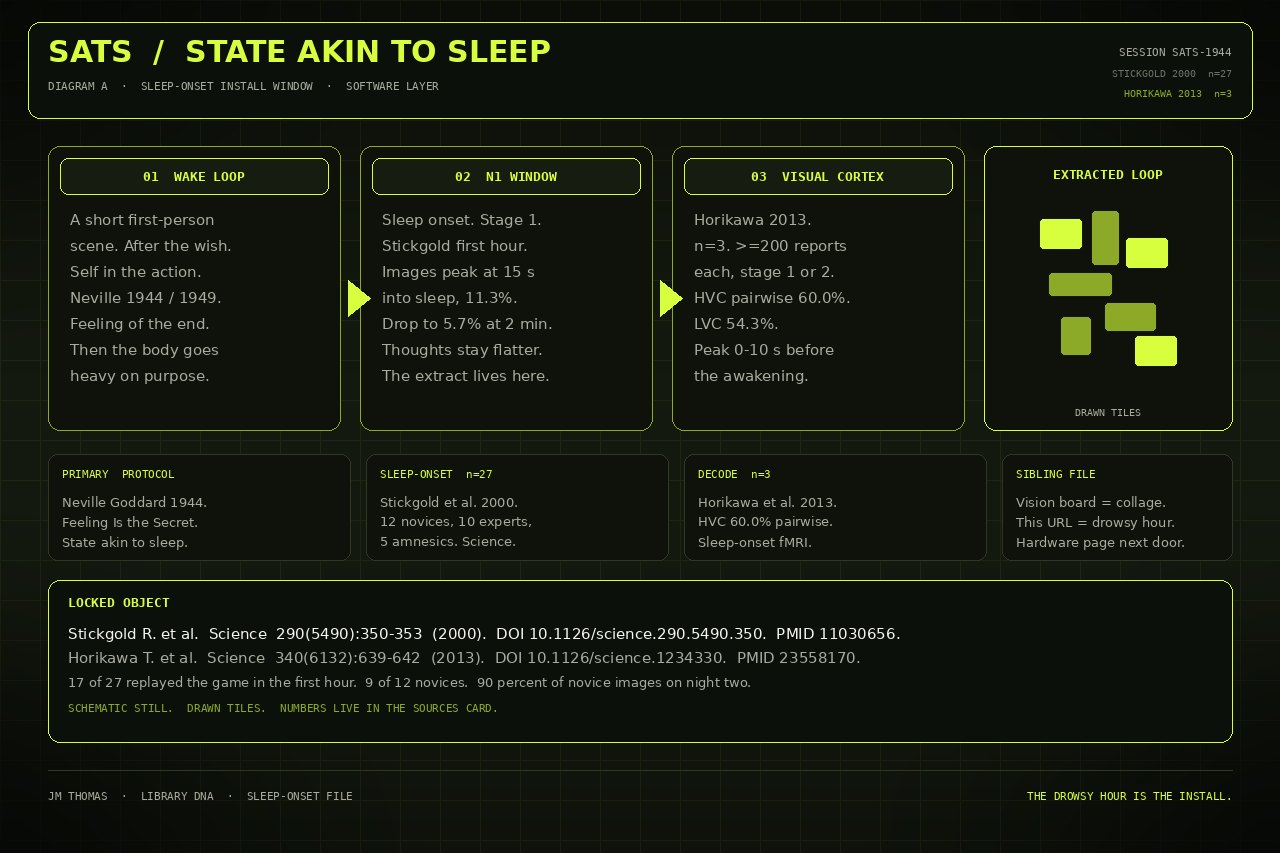
Neville Goddard parked a short scene of the wish fulfilled in the drowsy hour before sleep. I opened Stickgold 2000 in full, Science 290(5490):350-353, n=27, and 17 of 27 replayed Tetris in that first hour. Horikawa 2013 then decoded the pictures at sleep onset from fMRI, n=3, higher visual cortex pairwise accuracy 60.0%.
I sat with the Stickgold PDF from a Boston lab archive, PMID 11030656, and with the Europe PMC abstract of Horikawa, PMID 23558170. The ATR lab page locked the awakening count. A public PDF of the 2013 paper locked the pairwise percents. Those are the files this URL uses.
People already run SATS. r/NevilleGoddard still posts the weekly beginner thread. An iHeart episode on 3 August 2026 walked a ten-second scene before sleep. TrueCosmic published a SATS sleep-debt note on 17 July 2026. The hunger is live. The mechanism was already in Science, twice.
Reality Engineering is the science of making reality respond to intent. The drowsy hour is one install window. Volume 7 already treated visualization as volitional downward causation. This page names the hour the brain already uses to extract a loop from the day and write it into visual cortex. Protocol 01 can wait until the count has earned the next hour.
Neville parked the scene at sleep onset
SATS is state akin to sleep. Neville Goddard, Feeling Is the Secret, 1944. A drowsy threshold. Body still. A short first-person scene that implies the wish is already true, looped until sleep takes you.
I opened archive copies of the 1944 sleep chapter and the 1949 Out of This World sequence. The 1944 line is the name of the window: it is in sleep and in prayer, a state akin to sleep, that a person enters the subconscious to make impressions. He asked one question as the body went heavy. How would I feel were my wish realized? That feeling was supposed to monopolize attention as you relax into sleep.
The 1949 book gave the three moves in order. Define the objective. Construct an event you would encounter following fulfillment, with the action of self predominant. Immobilize the body and induce a condition akin to sleep, then feel yourself into the action here and now. Participate. Do the handshake from the inside. Skip the balcony seat.
He wanted a moderate drowsiness, still able to steer thought. Full unconsciousness drops the scene. Full wakefulness keeps the critic on the door. The hour in between is the file. That is SATS. Students shortened the phrase because "state akin to sleep" is a mouthful, and the acronym stuck.
A long movie of getting the thing is the wrong object. He wanted the after. Congratulation already happened. Keys already in the palm. The friend already said the sentence. Five to ten seconds, looped, first person, until the body goes. Then you leave it alone. Digging it up at breakfast to check whether the world moved is a different practice, and it belongs to the critic he was trying to step around.
The gatekeeper sold the daytime collage and left this hour unlabeled. The hunger for a life that answers was always honest. The missing noun was the drowsy extract.
Twenty-seven people, seven hours of Tetris
Stickgold R., Malia A., Maguire D., Roddenberry D., O'Connor M. Replaying the game: hypnagogic images in normals and amnesics. Science 2000;290(5490):350-353. DOI 10.1126/science.290.5490.350. PMID 11030656. n=27. 12 novices, 10 experts, 5 amnesics. 17 of 27 reported stereotyped Tetris images in the first hour of sleep.
Robert Stickgold wrote from the Laboratory of Neurophysiology, Department of Psychiatry, Harvard Medical School, 74 Fenwood Road, Boston. Margaret O'Connor wrote from the Memory Disorders Research Center at Boston University Medical School, Beth Israel Deaconess. I opened the PDF. The n below is the n that page locked.
They asked 27 people to play seven hours of Tetris over three days. Two hours at first exposure, then one hour each morning and evening. Macintosh Tetris, Sphere 1988, Spectrum HoloByte. Sessions between 7 and 11 a.m. and between 7 and 11 p.m. The Nightcap sleep monitor woke them in the first hour of attempted sleep, after 15, 45, 75, 120, and 180 seconds of eyelid quiescence, plus a handful of wake probes. Maximum ten report requests a night.
Twelve novices, ages 18 to 25, less than ten hours of lifetime video games, no prior Tetris. Ten experts, same age band, averaging over 200 hours of lifetime Tetris. Five amnesic patients, ages 21 to 62, mean 42.8, SD 14.9, all with extensive bilateral medial temporal lobe damage including hippocampus. Three lesions from anoxia, one from herpes simplex encephalitis, one from a cerebrovascular accident. Wechsler Memory Scale III General Memory Index 48.6, SD 3.2. Dense amnesia. They still produced the pictures.
Out of 27, 17 people, 63 percent, reported stereotypical hypnagogic images of Tetris during the first nights of play. Falling pieces. Rotating. Fitting into empty spaces. Among 38 imagery reports, nobody described the picture around the play window, the scoreboard, or the keyboard. Two reports saw the computer itself. The extract was the tiles. The rest of the room dropped out.
Nine of 12 novices produced 19 Tetris-image reports over two nights. Five of 10 experts produced 11 reports over three nights, 4.7 percent of 235 reports. Three of five amnesics produced eight reports over three nights, 7.4 percent of their hypnagogic reports, next to 7.2 percent in the combined normals. The amnesics could not remember the game from session to session. One patient, PLS, showered, put on pajamas, came back, and asked the experimenter who he was and what he was doing in her bedroom. She still produced Tetris imagery that night.
DF, another amnesic, said he saw images turned on their side, like blocks, and wished he could remember where they were from. The pictures arrived without the episode. That is the sentence SATS needs. Sleep onset can write a loop the hippocampus never filed.
Night two carried the pictures
Ninety percent of the novice image reports, 17 of 19, arrived on the second night. Two thirds of the thought-only reports, 8 of 12, arrived on the first night. Chi-square on those counts: x2 = 10.6, df = 1, P = 0.001. Stickgold flagged that more work would be needed to confirm the lag. I left it as a lag on a small table, because that is how he left it.
A simple replay of today's pixels would have peaked on night one. The extract waited. Daytime Tetris images in the waking novices and experts followed the same delay. Seven of 12 novices and 4 of 10 experts reported 44 waking images, and only four of those, 9 percent, landed on the first day of play. Binomial P less than 0.0001 on that split. The brain took a day to decide the tiles were worth the loop.
Across sleep onset itself, the pictures had a thin peak. After an initial 2.5-fold rise from presleep to 15 seconds into sleep, 4.5 percent versus 11.3 percent, the frequency of Tetris images dropped in half, to 5.7 percent, after two minutes. Thoughts about Tetris without images did the opposite start: 7.8 percent presleep, 3.9 percent at 15 seconds, then flat. Images belonged to the first minute. Thoughts belonged to the waiting.
Two experts folded in older versions they had not played in one year and five years. Color. Music from a Nintendo copy. The lab game was silent and black-and-white. Recent play lit a remote file. The loop is associative. It pulls the family of the thing, then abstracts it.
Imagery also tracked who still had work to do. The three novices who produced zero Tetris images had scored twice as well in the first two-hour session, 2984 versus 1516, unpaired t, df = 10, t = 3.69, P = 0.004. Experts showed a negative correlation with initial performance that approached significance, r = -0.54, df = 8, P = 0.11. The people who already owned the skill sent fewer tiles into the hour. The people who were still learning sent more.
That is a designed SATS scene in lab clothing. A short, stereotyped, first-person visual loop, stripped of the room, written at sleep onset, stronger after a day of contact, stronger when the skill still has a gap. Neville asked you to pick the loop on purpose. Stickgold showed the slot already accepts one.
Three brains, two hundred awakenings
Horikawa T., Tamaki M., Miyawaki Y., Kamitani Y. Neural decoding of visual imagery during sleep. Science 2013;340(6132):639-642. DOI 10.1126/science.1234330. PMID 23558170. n=3. Sleep stage 1 or 2. At least 200 visual-report awakenings each. Higher visual cortex pairwise decoding 60.0%, 95% CI 59.0 to 61.0%.
Tomoyasu Horikawa, Masako Tamaki, Yoichi Miyawaki, Yukiyasu Kamitani. ATR Computational Neuroscience Laboratories, Kyoto 619-0288, Japan. Published online 4 April 2013. I opened the Europe PMC abstract. The ATR lab page locked the awakening protocol. A public PDF of the paper locked the pairwise accuracies I print below. ScienceDirect stayed behind a wall on this pass, so those two open files plus the abstract are the lock.
Three subjects slept in the scanner. EEG marked stage 1 or 2. They were awakened and asked for a free verbal report of the visual experience just before the wake. The lab repeated that until each person had given at least 200 awakenings with a visual report. Words for objects and scenes were pulled with WordNet, grouped as synsets, about 20 object categories. Decoders were linear support vector machines trained on fMRI collected while the same person viewed web images of those categories, awake.
Then the trained decoder was pointed at the sleep volumes immediately before each awakening. The pictures people later named were already sitting in visual cortex. Mean pairwise decoding accuracy in higher visual cortex, the ventral region covering lateral occipital complex, fusiform face area, and parahippocampal place area, was 60.0%, 95% CI 59.0 to 61.0%, three participants pooled. Label-shuffled decoders lost. Wilcoxon rank-sum and permutation tests, P less than 0.001.
Lower visual cortex, V1 to V3 combined, scored 54.3%, CI 53.4 to 55.2, for all pairs. Above chance, and worse than the higher belt. Accuracy rose along the pathway from V1 toward object areas. The time window peaked around 0 to 10 seconds before awakening, no correction for hemodynamic delay. The private movie had a public address. Visual cortex, sleep onset, the seconds before you would have said the word.
n=3 is a small human sample. Two hundred awakenings each is a large within-person sample. I kept both facts in the same paragraph. Horikawa measured that sleep-onset imagery uses the same visual cortical patterns as seeing. He did not enroll a manifestation trial. The bridge is still usable. If you loop a scene in that hour, you are writing into a cortex that already treats the loop as seeing.
We don't believe. We measure.
Loop the after, then drop it
Take Neville's three moves and park them on the two Science files. First, one objective. One. The extract in Stickgold was one game. Scattered wishes split the hour.
Second, a short scene that can only exist after the thing is true. Handshake after the job. Keys already in the palm. The friend saying the sentence in the past tense. Self in the action. The tiles in Stickgold were falling in front of the eyes, fitting, rotating. Nobody sat in a chair typing. The useful loop is the after-image, stripped of the room.
Third, the body goes heavy. Moderate drowsiness. Still steering. Horikawa's people were in stage 1 or 2, and the decode peaked in the last ten seconds before the wake. That is the same thin peak Stickgold saw at 15 seconds into sleep. You are hunting that minute, then you let sleep take the rest. Forcing wakefulness to "do it right" keeps the critic. Falling all the way through on the first loop still plants a picture. Stickgold's amnesics planted tiles they could not narrate.
Night two is allowed to matter. A single heroic bedtime of begging is a first-night thought report. The image rate in novices waited. Run the scene on consecutive nights. Track a binary: did I enter the drowsy hour, yes or no. Track a 1 to 10 on whether the scene felt like a fact. Leave the outer world alone in the morning. Checking is the critic coming back online.
Lust for result, in the Library's manifestation ledger, is supposed to run inverse to the outcome. That is a testable note. Record the date. Set a window, 30 days is the example in Volume 1. Binary success or failure. The drowsy hour is the plant. The ledger is the proof. SATS without a ledger is weather.
The collage file lives next door
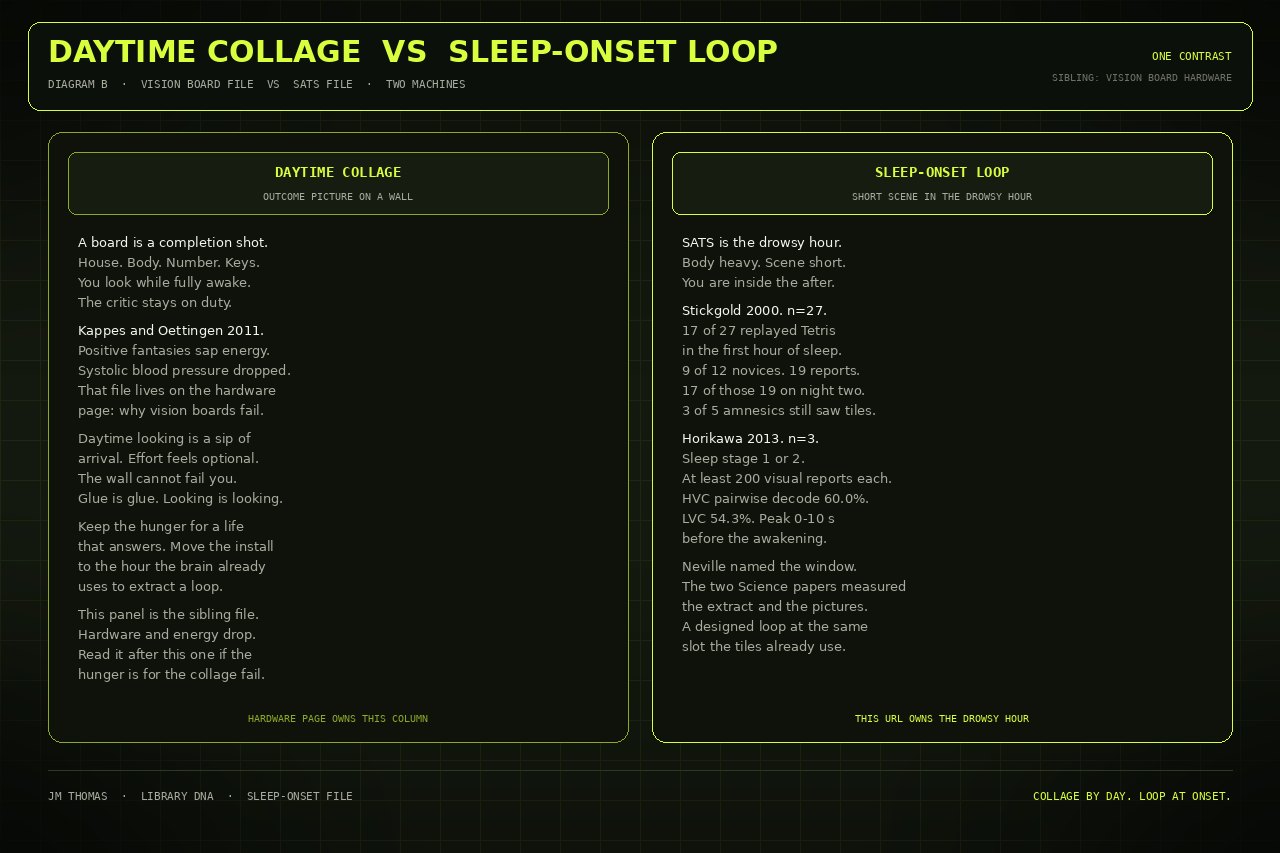
One contrast, then a wall. A vision board is an outcome picture that can drop energy while you look at it awake. Kappes and Oettingen, 2011, Journal of Experimental Social Psychology. Positive fantasies. Systolic blood pressure. That page owns the daytime collage and the screaming-nerve hardware.
This URL owns the sleep-onset loop. Same hunger for a life that answers. Different machine. A board is a completion shot you stare at with the critic on duty. SATS is a five-second after-scene you occupy as the critic steps off. You can keep a picture on the wall. The install still happens in the hour Stickgold measured.
Yoga nidra, on its own page, is a guided rest where experienced meditators showed default-mode decoupling. Fialoke 2024. That is a different window with a different scan. MILD after a wake-back-to-bed is REM lucidity on the LaBerge page. SATS sits earlier, at N1, in the first hour, with a scene you picked. Three files. Three clocks.
A count you can fail in a chair
You will not get a Horikawa trace from a kitchen pillow. You can get a 1 to 10 on whether the scene felt settled, and a binary on whether you entered the drowsy hour at all. That is a chair number. It is the kind a night can actually produce.
Protocol 01 is free and daily. Four-count inhale, eight-count exhale, seven minutes. Write the number before you start, write it after you stop. The nerve still has to carry the current. SATS is the night file. The count is the morning stack. Run both if you want a week you can fail in public with yourself.
The Library of Biological Wizardry holds the rest of the sequence, the ledger, and the live instruments, and it can wait until the count has earned the next hour. No initiate password. A scene, a night, a number.
Run the count, then the hour
Four in, eight out, seven minutes, a number before and a number after. That is the daily stack. Tonight, one short after-scene in the drowsy hour. This page named the window. The Library is the rest of the map, and you can walk there when you want the next file.
This is an educational mechanism page by JM Thomas. A clinician owns diagnosis, treatment, cure, and prevention of any disease. Stickgold 2000 is a sleep-onset imagery study. Horikawa 2013 is an fMRI decode in three people. Neville 1944 is a lecture book. Talk to a clinician if unusual distress, insomnia, or dissociation is on the table.
FAQ
Short answers you can lift. Drawn stills. Educational page.
What is SATS?
State akin to sleep. Neville Goddard's 1944 name for the drowsy threshold where a short, first-person scene of the wish fulfilled is looped until sleep takes the body. Feeling Is the Secret, chapter on sleep.
What did Stickgold 2000 measure at sleep onset?
Hypnagogic Tetris imagery after 7 hours of play over 3 days. Science 290(5490):350-353. n=27: 12 novices, 10 experts, 5 amnesics. 17 of 27 reported stereotyped falling-tile images in the first hour.
When did the novice images show up?
Mostly night two. Nine of 12 novices gave 19 Tetris-image reports across two nights. Seventeen of those 19, 90 percent, landed on the second night. First-night images were the exception.
What did Horikawa 2013 decode?
Visual content at sleep onset from fMRI, n=3, at least 200 visual-report awakenings each, stage 1 or 2. Higher visual cortex pairwise accuracy 60.0%, 95% CI 59.0 to 61.0%. Lower visual cortex 54.3%. Science 340(6132):639-642.
How do you run SATS?
Pick one short scene that could only happen after the wish is already true. Immobilize the body. Enter the drowsy hour. Loop the scene from the inside until sleep. Neville 1949: action of self, following fulfillment.
How does SATS sit next to a vision board?
The collage is a daytime completion shot on the hardware page. SATS is the sleep-onset loop on this URL. Kappes and Oettingen measured energy drop from positive fantasies. Stickgold measured the extract in the first hour of sleep.
Where do I get a daily number?
Protocol 01. Four-count inhale, eight-count exhale, seven minutes. Write a 1 to 10 before and after. SATS is the night file. The count is the daily stack.
Is this medical advice?
Educational mechanism page by JM Thomas. A clinician owns diagnosis and treatment. Stickgold 2000 is a sleep-onset imagery study. Horikawa 2013 is an fMRI decode in three people. Neville 1944 is a lecture book.
Files I opened
Stickgold, R., Malia, A., Maguire, D., Roddenberry, D., and O'Connor, M. "Replaying the game: hypnagogic images in normals and amnesics." Science 2000;290(5490):350-353. DOI 10.1126/science.290.5490.350. PMID 11030656. I opened the PDF. n=27 (12 novices, 10 experts, 5 amnesics). 17 of 27 reported stereotyped Tetris images. 9 of 12 novices, 19 reports, 17 of 19 on night two. 3 of 5 amnesics, 8 reports. Image rate 11.3% at 15 s into sleep, 5.7% at 2 min. doi.org/10.1126/science.290.5490.350
Horikawa, T., Tamaki, M., Miyawaki, Y., and Kamitani, Y. "Neural decoding of visual imagery during sleep." Science 2013;340(6132):639-642. DOI 10.1126/science.1234330. PMID 23558170. I opened the Europe PMC abstract. ATR lab page: n=3, at least 200 visual-report awakenings each, stage 1 or 2. Public PDF: HVC pairwise 60.0%, 95% CI 59.0 to 61.0%. LVC 54.3%, CI 53.4 to 55.2. Peak 0 to 10 s before awakening. europepmc.org/article/MED/23558170
Same Horikawa article via DOI. Publisher fetch was blocked on this pass. Accuracy numbers taken from a public PDF of the paper. Awakening n taken from the ATR lab page. doi.org/10.1126/science.1234330
Goddard, N. Feeling Is the Secret (1944), sleep chapter. Archive PDF. "State akin to sleep." Feeling of the wish fulfilled before dropping off. No trial n. Lecture book.
Goddard, N. Out of This World (1949). Archive PDF. Three steps: define the objective, construct an event following fulfillment with action of self, immobilize the body and induce a condition akin to sleep. No trial n. Lecture book.