MILD · lucid dream
They used MILD after a night wake. They noticed they were dreaming.
You swing your feet to the floor in the dark after a few hours of sleep.
The mattress holds the heat under your calves. The lamp stays off. Your hand finds the edge of the mattress. The dream you came for is the one you hope to notice before it ends. They used MILD after a night wake, and they noticed they were dreaming.
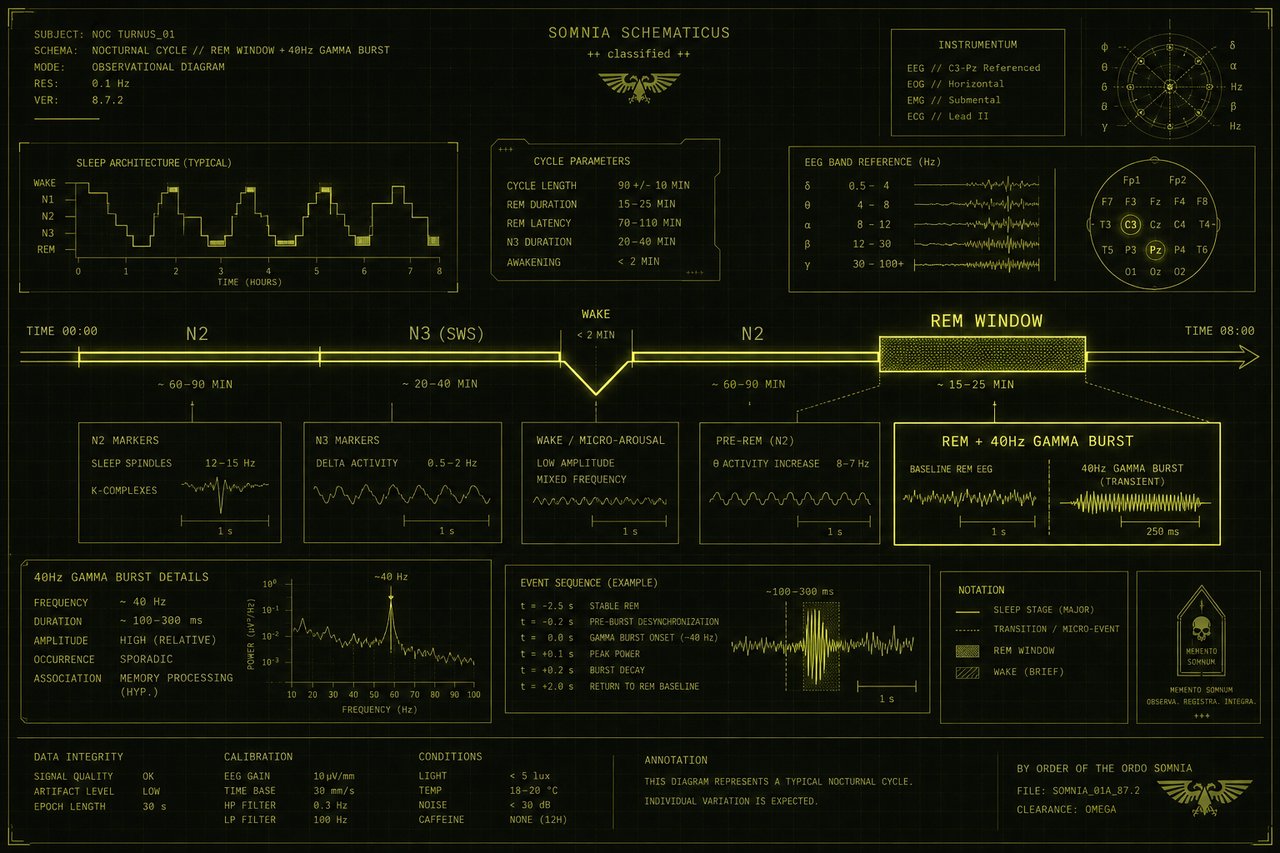
You sat up because you wanted to catch the dream
A lucid dream is a dream you know is a dream while the dream is still going. You can still see the street or the room inside it.
Most vivid dreams happen in REM sleep. REM is a stage of sleep named for rapid eye movement, which means your eyes move under the lids while the rest of you stays still.
You came for that stage so you can look around inside it and remember the street later.
MILD is the night habit for noticing the dream
Stephen LaBerge named that night habit MILD, and the letters stand for mnemonic induction of lucid dreams, which is a memory trick you use on purpose after you wake so the later job is waiting when dream sleep returns.
You wake, remember you want to notice the next dream, say a line, and go back to sleep.
The book line is, "Next time I'm dreaming, I'll remember I'm dreaming."
That line is prospective memory, which means remembering to do a job later. You use the same kind of memory when you remember to pick up milk after work. With MILD, the later job is noticing the dream after you fall back asleep.
LaBerge wrote the method with Howard Rheingold in Exploring the World of Lucid Dreaming. Wikipedia keeps a short page on MILD.
Wake-back-to-bed puts the next dream closer
Wake-back-to-bed is a timing habit you can add to MILD. You sleep first. You wake for about thirty minutes. You say the line. Then you go back to sleep.
After you have slept, you reach the next stretch of REM sooner because the long first block of the night is already behind you, and REM is the dream stage, so you meet the next dream sooner when you lie down again.
Yoga nidra is a rest practice people do while they stay awake on purpose. Wake-back-to-bed is a pause in the night so you can say the line and return to sleep. You can do MILD without the thirty-minute wake.
A lab put current on a sleeping scalp
Ursula Voss and her group ran a different method in 2014. They worked with twenty-seven people who were new to lucid dreams. They used tACS during REM. tACS is a weak alternating current on the scalp. Alternating means the current flips back and forth. The scalp is the skin on the head.
They put that current on the front and side of the head, a place researchers call fronto-temporal, while the person was already in REM. Hertz is how many times something shakes in one second. Forty hertz, written 40 Hz, means forty shakes a second. They also tried twenty-five hertz.
At 40 Hz and at 25 Hz, people reported self-reflective awareness in the dream, which means they could notice themselves inside the scene before it ended. The other frequencies they tried did not do that. The Voss 2014 paper is in Nature Neuroscience.
Voss used electricity on the skin. LaBerge's MILD uses a line you say after you wake.
Stephen LaBerge came back in 2018 with Kristen LaMarca and Benjamin Baird. One hundred twenty-nine people signed up. One hundred twenty-one were in the final count. They used MILD plus wake-back-to-bed plus a drug called galantamine. Galantamine is a drug that affects acetylcholine, a brain chemical your memory uses. They tested zero, four, and eight milligrams. People had more lucid dreams as the dose went up. Talk to a clinician before you ever touch a drug like that. You do not need that drug for MILD after a wake.
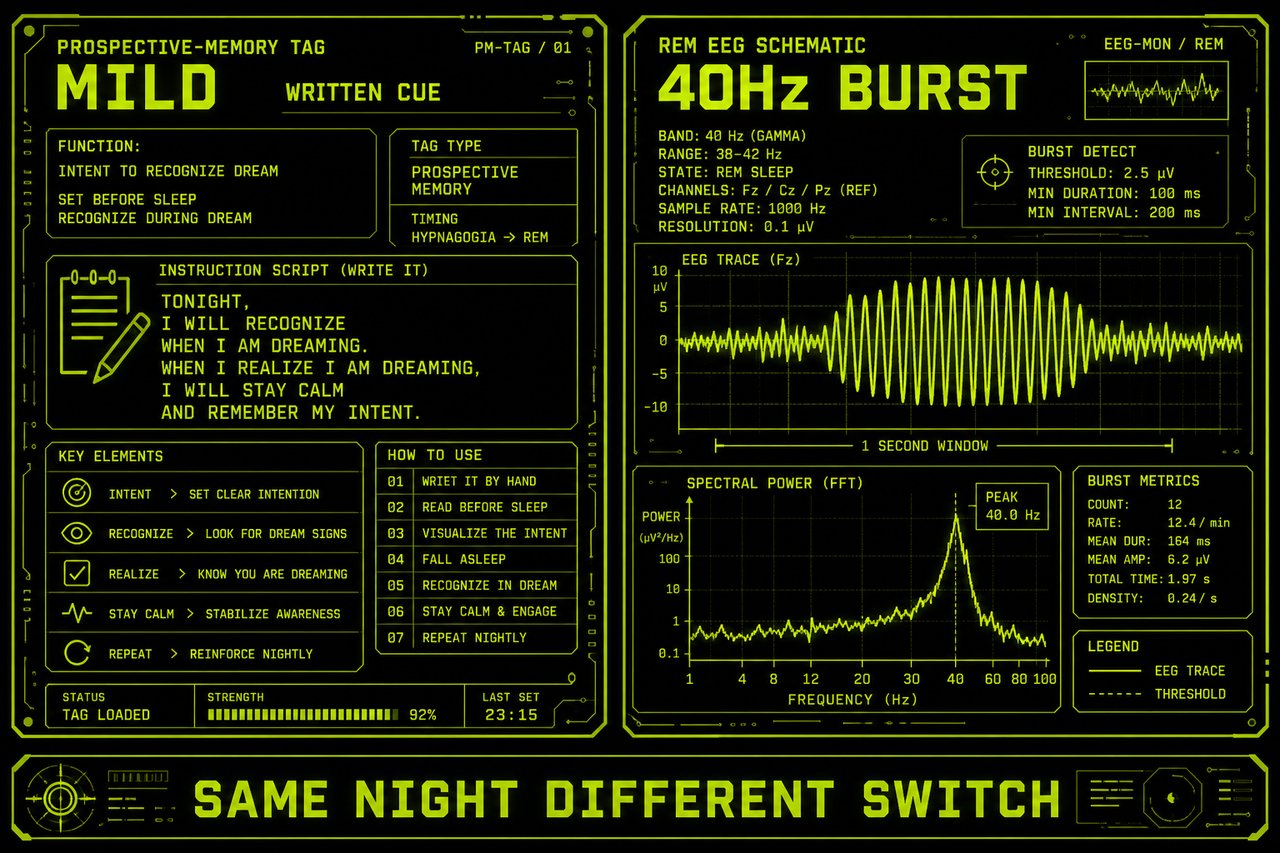
Keep the 40 Hz listen for waking hours
Headphones send sound into your ears. The Voss lab put a weak current on the scalp while people were already in REM.
A shop headband that plays 40 Hz is still playing sound. That number still means forty shakes a second. On a speaker those are forty pulses of air. On tACS those are forty flips of a weak current on the skin.
If you use a 40 Hz track, keep the track for listening while you are awake. A headband that plays tones is still sending sound into your ears. Voss's method used a current on a sleeping scalp.
After a wake, sit up and say the line
You can try MILD in bed. Sleep first if you can. After you wake, sit up long enough to remember why you woke. Say the line out loud or in your head: "Next time I'm dreaming, I'll remember I'm dreaming." Then lie down and go back to sleep.
If you want the timing habit, stay awake about thirty minutes after that first sleep, then say the line and go back. You can do that in your own room.
The 2018 test used galantamine. Skip the drug for this night habit. Keep the 40 Hz listen for hours you are awake.
Questions after a night wake
Do I need the lab current for MILD?
MILD is a line you say after you wake. The lab current was a different method on a sleeping scalp.
Do I need galantamine for this night habit?
Talk to a clinician before you ever touch a drug like that. MILD works as a night habit without it.
Does the 40 Hz track stay?
Keep it for waking hours. Headphones play sound. The lab used current.
Sit up after a wake and say the line
You swung your feet to the floor because you wanted to notice the dream while it was still going.
MILD is the habit you can do in that bed. After a wake, sit up, say the notice-the-dream line, and go back to sleep. Researchers put a weak current on a sleeping scalp. A headband that plays sound is still sending sound into your ears.
Keep MILD for the night. Use headphones when you want sound. Keep the 40 Hz listen for waking hours.
Sources
LaBerge, S., & Rheingold, H. Exploring the World of Lucid Dreaming. Book people read at home. MILD: mnemonic induction of lucid dreams. Next time I'm dreaming, I'll remember I'm dreaming. Prospective memory is remembering to do a job later. wikipedia.org/wiki/Mnemonic_induction_of_lucid_dreams
Wake-back-to-bed. Sleep, then wake for about thirty minutes, say the line, and go back. Next REM, the dream stage, comes closer. Timing after sleep. Yoga nidra is a different rest practice. wikipedia.org/wiki/Lucid_dream
Voss, U., et al. "Induction of self awareness in dreams through frontal low current stimulation of gamma activity." Nature Neuroscience 17:810-812 (2014). 27 people who were new to lucid dreams. Fronto-temporal tACS during REM. tACS is a weak alternating current on the scalp. 40 Hz and 25 Hz induced self-reflective awareness in the dream. Other frequencies did not. Headphones play sound. MILD is a line you say. PMID 24816141. doi.org/10.1038/nn.3719
LaBerge, S., LaMarca, K., & Baird, B. "Pre-sleep treatment with galantamine stimulates lucid dreaming: A double-blind, placebo-controlled, crossover study." PLOS ONE 2018;13(6):e0201246. 129 enrolled, 121 analyzed. MILD plus wake-back-to-bed plus galantamine at 0, 4, or 8 mg. Lucid-dream frequency rose as the dose rose. Galantamine is a drug that affects acetylcholine, a brain chemical used in memory. doi.org/10.1371/journal.pone.0201246