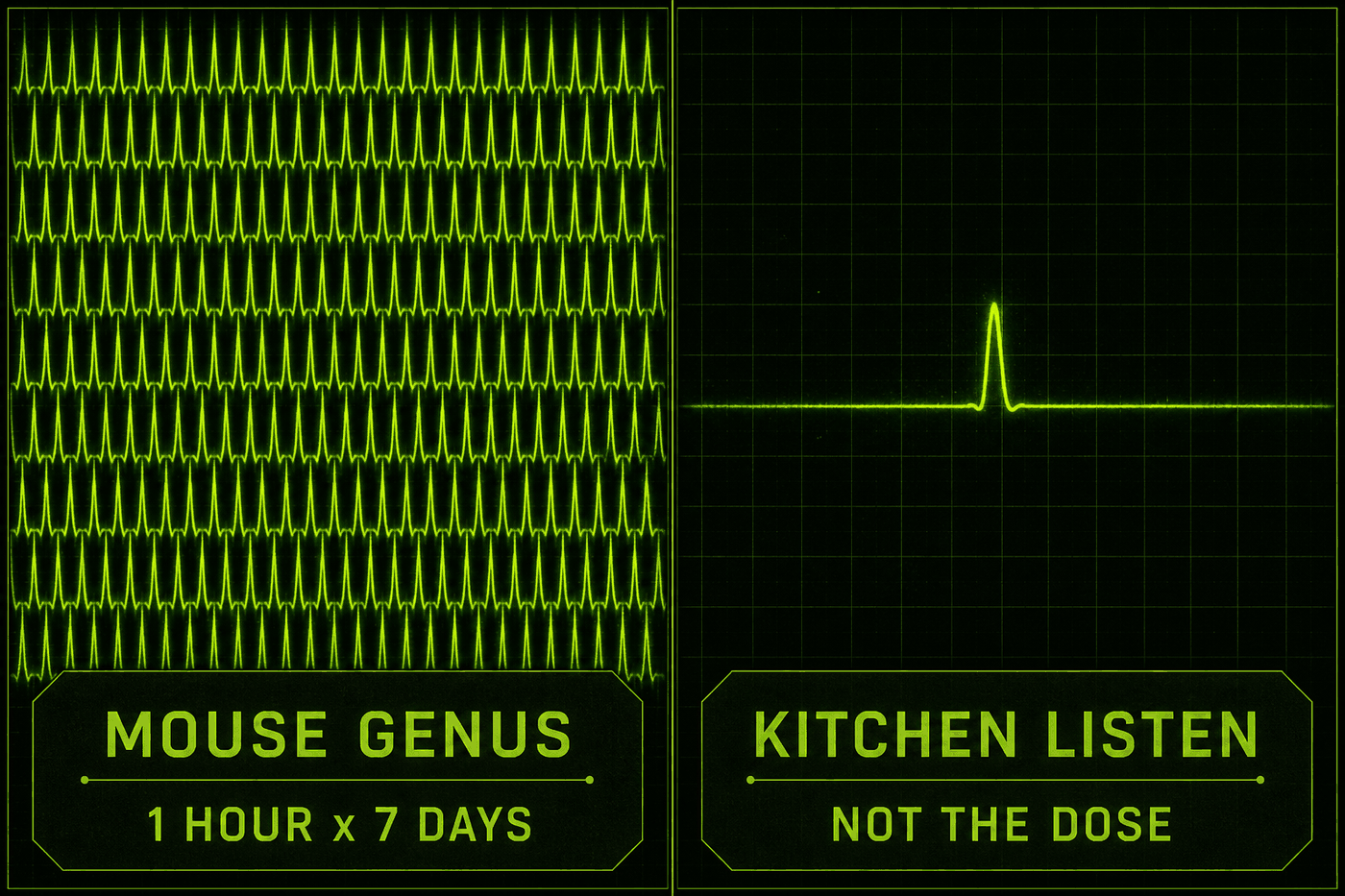
Lab category · GENUS · Dose · Not a kitchen listen
40Hz is a pulse train. GENUS is a dose. A kitchen listen is not the protocol.
People type what does 40Hz gamma wave do after a YouTube track or a flicker video. Here is the lab category. 40Hz is a pulse you can count. GENUS is the MIT name for driving that pulse with light, sound, or both, at a dose of hours and days. A kitchen listen is not that protocol.
What does a 40Hz gamma wave actually do?
A 40Hz gamma wave is a 40-cycle-per-second rhythm. MIT papers showed that driving tissue at 40Hz, not the other frequencies they tested, changed amyloid-beta, microglia, and local gamma power in Alzheimer-model mice. That is a named pulse train at a named dose. It is not a personality upgrade.
Gamma is a fast brain rhythm. Labs usually put it somewhere between 30 and 100 cycles per second. 40Hz is the test frequency the Tsai group picked and kept. The mechanism they are arguing is simple enough to write on a card. Drive the tissue at 40. Watch whether neurons, glia, vessels, and fluid systems answer.
I write from Paris, Tennessee. I have watched the same Hertz get sold as genius, luck, and a new personality. Reality Engineering is the science of making reality respond to intent. 40Hz is one hardware layer. It is not the whole product.
In the 2016 Nature paper, Hannah Iaccarino, Annabelle Singer, Li-Huei Tsai and colleagues first used optogenetics. They drove fast-spiking parvalbumin-positive interneurons at 40Hz in the hippocampus of 5XFAD mice. MIT News reported a 40 to 50 percent drop in hippocampal beta amyloid after an hour. Stimulation at other frequencies, from 20 to 80Hz, did not produce that decline. Then they built a strip of LEDs. One hour of 40Hz flicker cut visual-cortex amyloid in early-stage mice. The proteins returned within 24 hours after a single session. That last line is the dose talking. One sit-down moved tissue. Tissue moved back.
That is what a 40Hz gamma wave does in the papers I opened. A drive signal. The answer is in the tissue, the hours, and the frequency they actually used.
What is GENUS?
GENUS is Gamma Entrainment Using Sensory Stimulation, the MIT Tsai lab name for non-invasive 40Hz light, sound, or combined pulses. The 2016 Nature paper started with optogenetics, then a 40Hz LED flicker. The 2019 Cell paper added 40Hz tone trains and combined audio plus visual.
Keep the word honest. GENUS is not a brand of kitchen audio. It is a lab method. Picower writes it as Gamma ENtrainment Using Sensory stimuli. Same idea. You deliver a sensory pulse train at 40Hz. You ask whether cortex locks to that rate. Then you look at pathology, microglia, vessels, fluid clearance, and behavior in the models you actually ran.
The 2019 Cell paper by Anthony Martorell and the same group is the audio chapter. 40Hz tone trains drove gamma activity in auditory cortex and hippocampal CA1. Combined light plus sound reached more of the neocortex than either sense alone. Combined GENUS, not either sense alone, produced a microglial-clustering response and dropped amyloid in medial prefrontal cortex. Whole-brain analysis showed a wider plaque drop across neocortex after the pair.
Park and Tsai summed a decade of that trail in a February 2025 PLOS Biology review, including later tactile 40Hz work and glymphatic clearance papers. I am not going to turn that review into a cure. I am going to keep the name attached to the method.
If you landed here from a 7-minute song page, that is a different product shape. How the Genius Song works is the song-product question. This page is the lab category those searches were pointing at.
What dose did the mouse papers use?
Typical GENUS mouse dose is one hour a day for days. Iaccarino et al. found one hour of 40Hz flicker cut visual-cortex amyloid in early-stage mice, and those proteins returned within about 24 hours. Seven days of one hour a day reduced plaques. Martorell et al. used seven days of auditory GENUS, then looked at tissue.
Write the numbers down. One hour. Not seven minutes. Seven days in the depositing-mouse flicker arm and in the 2019 auditory arm. Then they looked at tissue. MIT News, 7 December 2016: an hour of 40Hz light cut visual-cortex amyloid by half in early-stage mice, and the proteins returned to original levels within 24 hours. The Nature paper’s Extended Data Figure 8 plots that return.
The seven-day arm is the other half of the dose. After treating depositing mice one hour a day for seven days, both plaques and free-floating amyloid were markedly reduced in visual cortex. Martorell’s auditory protocol was the same daily hour, for a week, in 5XFAD mice. Spatial and recognition memory moved. Amyloid moved in auditory cortex and hippocampus. Combined audio plus visual, for that same daily hour, reached prefrontal cortex in a way either sense alone did not.
Frequency mattered in the 2016 design. 40Hz did the amyloid work they reported. 20Hz, 80Hz, and random flicker did not. If someone sells you “gamma” as a vibe, ask which Hertz, which waveform, which hours, and which paper. The papers I opened named 40.
Is a kitchen 40Hz video the same as GENUS?
GENUS is a named stimulus, a named duration, and a named paper trail. A kitchen speaker or a YouTube 40Hz track is usually unmatched intensity, unmatched waveform, unmatched hours, and unmatched measurement. Same Hertz on a label is not the same protocol. Mouse tissue is not a laptop.
Mouse tissue sat in a dark chamber with a programmed LED strip, or heard a 40Hz tone train at a lab intensity, for an hour. Your laptop is a different speaker, a different spectrum, a different distance, a different visual angle, and a different nervous system. Hertz is the easy part of the label. Dose is the part the caption skips.
I am not going to mock anyone for wanting this to work. The enemy is the gatekeeper who sold the flicker and hid the hours. Keep the hours attached to the Hertz.
| Question | GENUS lab dose | Kitchen 40Hz video | 7-minute affiliate song |
|---|---|---|---|
| What it is | Named MIT method. Light, sound, or both at 40Hz. | A file on a speaker. Hertz in the title. | A 7-minute listen sold as the switch. |
| Typical duration | 1 hour a day for 7 days in the mouse papers. Human device trials use 60 minutes daily for months. | Whatever you last. Often minutes. Rarely an hour a day for a week with a log. | Seven minutes. Built to sell. |
| Stimulus | Programmed 40Hz flicker and/or 40Hz tone trains. Combined in the 2019 Cell paper. | Unknown waveform. Unknown intensity. Unknown visual angle. | Public copy says binaural / theta. I will not invent its Hertz without a spectrogram. |
| What they measured | Amyloid, microglia, memory tasks, later vessels and glymphatic flow in mice. EEG and imaging in human pilots. | A feeling. Maybe a comment. | A testimonial on a sales page. |
| Honest claim | A research protocol with a paper trail. Mouse first. Human still being tested. | Same number on a label. Not the protocol. | One input. Not the operating system. |
What do we actually know in humans?
Not as a proven Tuesday treatment. Mouse GENUS is Alzheimer-model tissue at a lab dose. Human work includes MIT pilot GENUS, Cognito Therapeutics OVERTURE feasibility study of 76 people, and a fully enrolled HOPE pivotal trial with no public topline as of this writing. Spectris is investigational and not FDA approved. This page is not medical advice.
Park and Tsai wrote the line the field already knew. It is a great time to have Alzheimer disease if you are a mouse. Translation is the job. I opened the human writeups. Here is what they actually say.
MIT’s own human pilots: Chan et al. published in PLOS One in 2022. Picower’s GENUS page and the 2025 review both describe Phase 1 and 2A audio-visual GENUS as safe, well tolerated, and able to raise 40Hz power and coherence. Treated participants showed reduced brain atrophy, improved sleep patterns, and better face-name association after three months compared with untreated controls. That is a pilot, not a product claim for your kitchen.
Cognito Therapeutics is the MIT spinout. Their OVERTURE feasibility study (NCT03556280) treated 76 people with mild-to-moderate Alzheimer disease, randomized 2:1 to daily one-hour stimulation or sham, for six months. Cognito’s own clinical page reports, versus control, a 76 percent reduction in MMSE decline, a 77 percent reduction in ADCS-ADL decline, and a 69 percent slowing of MRI brain-volume loss, with 85 percent adherence. That is a company-reported feasibility result, not a settled Phase III win. Independent writeups note OVERTURE was not powered as a confirmatory efficacy trial.
HOPE (NCT05637801) is the pivotal. Spectris AD, active versus sham, 60 minutes daily for about 12 months, about 670 people, fully enrolled as of the April 2026 registry update I opened. Topline was described as anticipated later in 2026. As of 15 August 2026 I have not opened a public HOPE efficacy readout. Spectris is investigational and not FDA approved. I will not invent that outcome.
Other human notes, smaller and mixed. MIT News on the 2025 review cites a 2022 Harvard-affiliated tACS case series that reported tau reduction in three of four volunteers. That sample is tiny. The same review cites a 2023 Scotland study that used audio-visual stimulation near 37.5Hz in more than 100 people and reported better memory recall. That is not an Alzheimer pivotal. Ismail et al., 2018, reported no significant effect of 40Hz light on amyloid load in a small clinical group. Soula et al., 2023, failed to replicate the mouse amyloid drop. Park and Tsai acknowledge that paper and argue methods. I am refusing to hide the split.
So: 40Hz gamma is real as a research category. Human GENUS is early. Some pilots look promising. A large sham-controlled year of daily hours is still the test. A YouTube listen is none of those sentences.
Why is a 7-minute listen not the protocol?
Seven minutes is long enough to sit still. It is short enough to sell. The mouse papers used one hour a day for seven days, then looked at tissue. A 7-minute affiliate song is a different product shape. I wrote that page separately as How the Genius Song works. This page is the lab category.
You can feel sharper after any ritual that takes you off the phone. The track gets the credit. The sit-down did half the work. That is state. State is allowed. State is not GENUS dose.
If the question is the song as a product, go read How the Genius Song works. I will not rewrite it here. Input versus operating system lives on that page. Dose versus kitchen listen lives on this one.
If the question is how the sound is built, go read binaural beats vs isochronic vs 40Hz. A difference tone is not a pulse train. Same Hertz on a sales page is not the same delivery. This page stays on dose.
And if you want to know which half of the evening was the sit-down, write a number. Rate activation 1 to 10 before. Rate it after. Do the same with a silent 7-minute sit. Compare. That is the smallest honest test I know, and it does not require a lab LED strip.
What should I run if I want a number?
Start with Protocol 01, the free Neural Recalibration. Four-count inhale, eight-count exhale, seven minutes, a 1-10 before and a 1-10 after. No headphones. If the method earns it, the Library of Biological Wizardry is the rest of the stack. 40Hz is one hardware layer. It is not the OS.
You cannot load intention on hardware that is still dumping cortisol into the line. Almost nobody runs a count they can fail, a duration they cannot bargain with, and a score they have to look at. That gap is the first move.
The Library of Biological Wizardry treats 40Hz as one layer in Reality Engineering: the science of making reality respond to intent. Audio is an input. The vagus is hardware. Measurement is how you know the input landed. Live instruments in the browser give you a number that is not a mood.
You do not need to buy the archive to test the first layer. Run the free protocol. If the number moves, you just ran hardware. APEIRON is the neuro-entrainment companion on the site. A pacing engine, not a miracle file. Same rule. Input is not the OS.
Run the brake first.
Protocol 01 is free. Seven minutes. 4 in, 8 out. A 1-10 before. A 1-10 after. No faith. No headphones. If the method earns the rest of the stack, the Library is there.
What I will not claim
I will not tell you a kitchen 40Hz video clears plaques in a healthy adult. I will not tell you MIT proved a 7-minute song is GENUS. I will not invent a HOPE Phase III readout. Alzheimer-model mouse papers are literature. Human trials are a different population and a different dose. This is not medical advice.
I will not fight the people who want this to work. The enemy is the gatekeeper who sold the flicker and hid the HOW. The HOW is boring on purpose. Named stimulus. Named hours. Named paper. A number you write down.
If you have Alzheimer disease, or you are caring for someone who does, talk to a clinician. Cognito’s device is investigational. Flicker can be a seizure risk for some people. I am an author in Paris, Tennessee, not your doctor. The papers are linked because I opened them. They are not a Tuesday promise.
Direct answers
Short answers you can lift from this page. Visible text matches the FAQ schema exactly. 40Hz is a pulse. GENUS is a dose. Kitchen audio is not the protocol. Human evidence is still early. None of this is medical advice.
What does a 40Hz gamma wave actually do?
A 40Hz gamma wave is a 40-cycle-per-second rhythm. MIT papers showed that driving tissue at 40Hz, not the other frequencies they tested, changed amyloid-beta, microglia, and local gamma power in Alzheimer-model mice. That is a named pulse train at a named dose. It is not a personality upgrade.
What is GENUS?
GENUS is Gamma Entrainment Using Sensory Stimulation, the MIT Tsai lab name for non-invasive 40Hz light, sound, or combined pulses. The 2016 Nature paper started with optogenetics, then a 40Hz LED flicker. The 2019 Cell paper added 40Hz tone trains and combined audio plus visual.
What dose did the mouse papers use?
Typical GENUS mouse dose is one hour a day for days. Iaccarino et al. found one hour of 40Hz flicker cut visual-cortex amyloid in early-stage mice, and those proteins returned within about 24 hours. Seven days of one hour a day reduced plaques. Martorell et al. used seven days of auditory GENUS, then looked at tissue.
Is 40Hz gamma real?
Yes as a research category. 40Hz is a lab frequency inside the gamma band. Iaccarino, Singer, Tsai and colleagues reported in Nature in 2016 that 40Hz, not other frequencies they tested, reduced amyloid-beta in Alzheimer-model mice. Other labs have published related work. At least one 2023 mouse paper failed to replicate the amyloid drop. Human evidence is early and mixed. The literature is not a kitchen YouTube video.
Does 40Hz light flicker treat Alzheimer disease in humans?
Not as a proven Tuesday treatment. Mouse GENUS is Alzheimer-model tissue at a lab dose. Human work includes MIT pilot GENUS, Cognito Therapeutics OVERTURE feasibility study of 76 people, and a fully enrolled HOPE pivotal trial with no public topline as of this writing. Spectris is investigational and not FDA approved. This page is not medical advice.
Why is a kitchen 40Hz video not GENUS?
GENUS is a named stimulus, a named duration, and a named paper trail. A kitchen speaker or a YouTube 40Hz track is usually unmatched intensity, unmatched waveform, unmatched hours, and unmatched measurement. Same Hertz on a label is not the same protocol. Mouse tissue is not a laptop.
Why is a 7-minute listen not the protocol?
Seven minutes is long enough to sit still. It is short enough to sell. The mouse papers used one hour a day for seven days, then looked at tissue. A 7-minute affiliate song is a different product shape. I wrote that page separately as How the Genius Song works. This page is the lab category.
Is this medical advice?
No. This page is an educational mechanism explainer by JM Thomas. It is not a diagnosis, treatment, cure, or prevention of any disease. Alzheimer-model mouse papers and human trials are literature, not a promise about your Tuesday.
Sources I actually opened
I fetched these pages for this article. I did not invent trial n, Phase III outcomes, or mouse results from memory. If a number is here, it came from one of these sources or from the paper abstract and MIT writeup attached to it.
Iaccarino, H.F., Singer, A.C., Martorell, A.J. et al. “Gamma frequency entrainment attenuates amyloid load and modifies microglia.” Nature 540, 230–235 (2016). nature.com/articles/nature20587
Martorell, A.J. et al. “Multi-sensory Gamma Stimulation Ameliorates Alzheimer’s-Associated Pathology and Improves Cognition.” Cell (2019). doi.org/10.1016/j.cell.2019.02.014
Trafton, A. “Unique visual stimulation may be new treatment for Alzheimer’s.” MIT News, 7 December 2016. One hour of 40Hz flicker. Proteins returned within 24 hours after a single session. news.mit.edu/2016/visual-stimulation-treatment-alzheimer-1207
Orenstein, D. “Evidence that 40Hz gamma stimulation promotes brain health is expanding.” MIT News, 14 March 2025. Companion to Park & Tsai, PLOS Biology. news.mit.edu/2025/evidence-40hz-gamma-stimulation-promotes-brain-health-expanding-0314
Park, J.M. and Tsai, L.-H. “Innovations in noninvasive sensory stimulation treatments to combat Alzheimer’s disease.” PLOS Biology 23(2): e3003046 (28 February 2025). journals.plos.org/plosbiology/article?id=10.1371/journal.pbio.3003046
Picower Institute. “GENUS.” Method page for Gamma ENtrainment Using Sensory stimuli, including 2022 human pilot summary. picower.mit.edu/innovations-inventions/genus
Cognito Therapeutics. “Clinical Studies.” OVERTURE n=76 company-reported outcomes; HOPE fully enrolled. cognitotx.com/clinical-studies
HOPE Study registry. NCT05637801. Active, not recruiting. About 670 subjects. 60 minutes daily for about 12 months. Last registry update I opened: 29 April 2026. centerwatch.com/clinical-trials/listings/NCT05637801
Chan, D. et al. “Gamma frequency sensory stimulation in mild probable Alzheimer’s dementia patients: Results of feasibility and pilot studies.” PLOS One (2022). Cited via Picower GENUS page and Park & Tsai 2025. doi.org/10.1371/journal.pone.0278412
Hajós, M. et al. “Safety, tolerability, and efficacy estimate of evoked gamma oscillation in mild to moderate Alzheimer’s disease.” Frontiers in Neurology (2024). OVERTURE writeup. doi.org/10.3389/fneur.2024.1343588
Soula, M. et al. “Forty-hertz light stimulation does not entrain native gamma oscillations in Alzheimer’s disease model mice.” Nature Neuroscience 26, 570–578 (2023). Failed replication I am not hiding. doi.org/10.1038/s41593-023-01270-2