Mechanism · Binaural · Isochronic · 40Hz Pulse

Marketing collapses four deliveries into one Hertz.

JM Thomas · Paris, Tennessee · 15 August 2026

A binaural beat is a difference tone built inside the head. An isochronic tone is a pulse in the air. A 40Hz GENUS train is a timed burst the lab named. 40Hz light is a flicker at the eye. Affiliate copy prints one number and sells all four as the same switch.

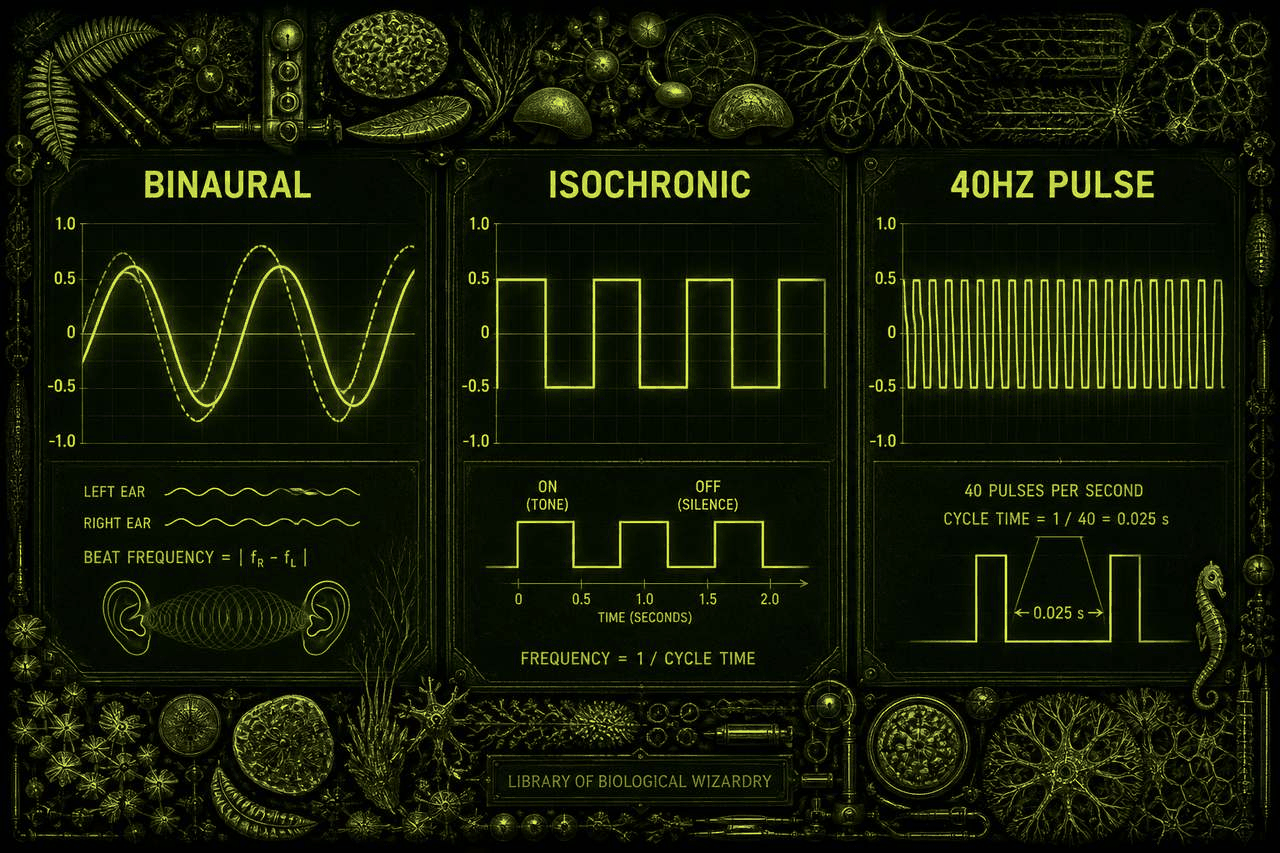
Dark lime three-panel chart. Left labeled BINAURAL with two ear tones and beat frequency equals the absolute difference. Center labeled ISOCHRONIC with on-tone off-silence square wave. Right labeled 40HZ PULSE with 40 pulses per second and cycle time 0.025 seconds.
Three constructions. One marketing Hertz.

I write from Paris, Tennessee. People ask me if binaural beats are 40Hz. They ask if isochronic is better. They ask if the Genius Song is the lab protocol. Those are construction questions. I will answer the construction. Dose lives on a sibling page. The song as a SKU lives on another.

Reality Engineering is the science of making reality respond to intent. Sound can be an input. The nerve still has to carry it. A Hertz on a thumbnail is not a machine. Related reading: mantra as an input to the amygdala. A voiced syllable is another construction. A 2011 pilot fMRI, not a percent drop.

What is the difference between binaural beats and isochronic tones?

A binaural beat is a difference tone your brain builds when each ear gets a slightly different frequency through headphones. An isochronic tone is one carrier chopped on and off at a regular rate. The pulse is in the air. Speakers work. Marketing sells both as 40Hz and skips the construction.

I have watched this collapse on sales pages for years. Headphones optional. Speakers fine. 40Hz gamma. NASA. Genius. The file is never named as a pair of carriers, a square chop, or a tone train. Buyers argue brands. The tissue never got the same event.

The honest split is simple. Binaural needs isolation. Left ear one tone. Right ear another. The beat is not in the room. Isochronic does not need that trick. One speaker. On. Off. On. Off. You can hear the rate with one ear. Labs often call the speaker family monaural beats or amplitude-modulated tones. Isochronic is the aisle name for the hard on/off version.

Neither construction is GENUS. Neither is a 40Hz LED. I will keep those in their own rows.

What is a binaural beat?

Gerald Oster's 1973 Scientific American article: two tones of slightly different frequency, one to each ear through stereophonic earphones. You perceive a third modulation at the difference. Carrier works best near 440 Hz and vanishes above about 1,000 Hz. Headphones are required. A speaker in a kitchen mixes the tones before they reach you.

Oster split two old facts. Strike 440 Hz and 434 Hz in the same air and you get a physical beat at 6 Hz. One ear is enough. That is monaural. Feed the two tones through padded stereophonic earphones, one to each ear, and the beat changes character. Now both ears have to work. The percept sits inside the head. That is binaural.

He put numbers on the window. Best carrier near 440 Hz. Above that the beats get faint. Above about 1,000 Hz they vanish. Rapid beats, up to about 26 per second, can be heard near that 440 Hz carrier. Past about 30 Hz of difference you start hearing two tones, not one beat. Ingendoh, Posny, and Heine restated the same window in 2023: carriers under 1 kHz, difference around 1 to 30 Hz, headphones so each ear stays isolated.

Chaieb, Wilpert, Reber, and Fell mapped the anatomy in 2015. Monaural beats demodulate in the cochlea. Binaural beats are built later, in the superior olivary complex, the first station that sees both ears. Draganova's MEG work, which they cite, found the cortical steady-state response to monaural beats about five times larger than the binaural one. Schwarz and Taylor could evoke a 40 Hz binaural ASSR with a 400 Hz carrier and could not detect it above 3,000 Hz. The construction is small. It is real. It is not a speaker in a kitchen.

A 400 Hz left and a 440 Hz right will give you a 40 Hz difference percept. That sentence is physics. It is not Martorell's protocol. Do not glue them.

What is an isochronic tone?

An isochronic tone is a single tone pulsed on and off at even intervals. The on/off is the beat. Labs more often name this family monaural beats or amplitude-modulated tones. Chaieb and colleagues treat monaural beats as a physical AM signal you can hear with one ear or both. No phantom third tone. Speakers are enough.

Isochronic is a commercial word. I will not pretend it is Oster's term. The lab cousin is a physical beat: two nearby sines mixed into one channel, or one carrier whose amplitude is chopped. Mix 400 Hz and 440 Hz into one speaker and the air already contains a 40 Hz envelope. You do not need the olivary trick. One ear is enough. Chaieb's table is blunt. Monaural: physical, peripheral, heard across a wider beat range and at higher carriers. Binaural: subjective, central, low carriers only.

The hard chop is what people mean when they say isochronic. Tone. Silence. Tone. Silence. Equal spacing. Frequency equals 1 over cycle time. A 10 Hz isochronic tone turns on ten times a second. A 40 Hz chop would be 40 onsets a second, cycle time 0.025 s. That is a pulse train. It is closer to a click rate than to Oster's phantom third tone.

Galambos, Makeig, and Talmachoff recorded a 40 Hz auditory potential in 1981 when they delivered clicks at 40 per second. Chaieb cites that paper as the 40 Hz ERP, the ancestor of the auditory steady-state response. I am not claiming your YouTube isochronic file is Galambos. I am naming the family. A timed burst in the air is a different event from a difference tone in the head.

Is 40Hz gamma a binaural beat?

No. 40Hz is a lab frequency inside the gamma band. Martorell et al. in Cell in 2019 drove auditory GENUS with trains of tones flickering at 40 Hz, not classic binaural pairs. Iaccarino et al. in Nature in 2016 used 40Hz light flicker. A binaural pair at 400 and 440 Hz can produce a 40 Hz difference percept. That is not the GENUS stimulus. Dose lives on a sibling page.

I opened the Cell paper's writeups for this. Martorell designed auditory tone stimulation that drove gamma in auditory cortex and hippocampal CA1. Seven days of that auditory GENUS. Tones flickering at 40 Hz. Trains. Not a 400/440 headphone pair sold as gamma. Combined audio plus visual GENUS went further, into medial prefrontal cortex. That is a protocol with hours and tissue. It is not a 7-minute file.

Iaccarino, Singer, Tsai and colleagues used light. 40Hz flicker at the eye. Visual cortex. Alzheimer-model mice. That delivery does not go through headphones at all. I wrote the dose, the mouse-versus-human split, and what a kitchen listen is not, on what a 40Hz gamma wave actually does. This page will not rewrite it. This page is how the sound is built.

Searchers mash the words. 40Hz binaural beats. Isochronic 40Hz. Are binaural beats 40Hz. The honest answer is: 40Hz is a rate. Binaural is a construction. You can aim a binaural difference at 40 Hz. You can chop an isochronic carrier at 40 Hz. You can fire a GENUS tone train at 40 Hz. You can flicker a light at 40 Hz. Four machines. One number. The tissue keeps the receipt.

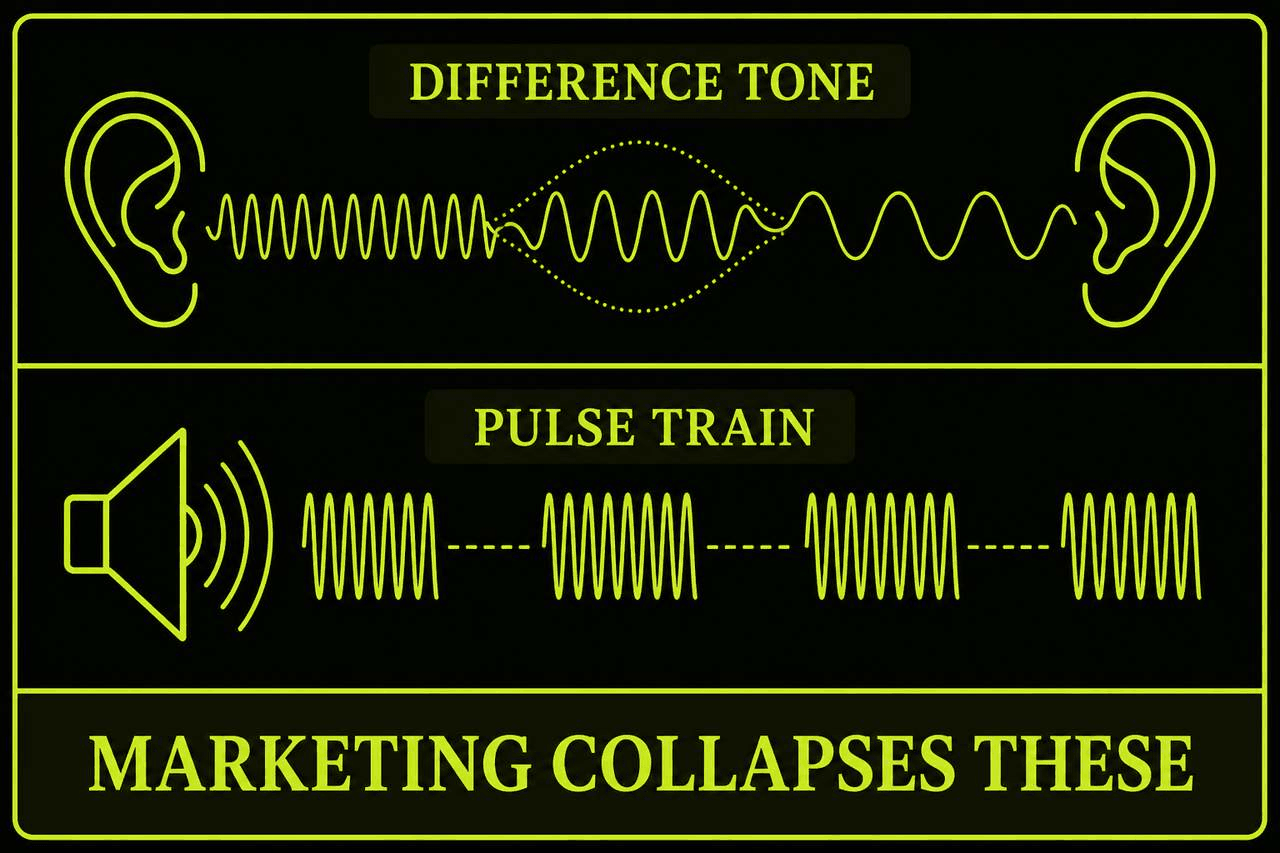
Dark lime split. Top panel labeled DIFFERENCE TONE with two ears and overlapping sine waves. Middle panel labeled PULSE TRAIN with a speaker and packets of tone separated by silence. Footer: MARKETING COLLAPSES THESE.
Difference tone versus pulse train. Marketing prints one Hertz.

Why does marketing collapse these deliveries?

Affiliate copy needs one Hertz and one promise. Headphones, speakers, light, and a 40Hz tone train are four different machines. Same number on a label is not the same input. I have not spectrogrammed a paid Genius Song or Brain Song file, so I will not invent those Hertz.

I have seen the aisle. Genius Song. Brain Song. Genius Switch. Public copy talks binaural, theta, NASA, 7 minutes. Searchers map that story onto MIT 40Hz. I already said this on how the Genius Song works and on Brain Song vs Genius Song. A file is one input. A system has counts, a duration you can fail, and a 1-10 you write down. This page adds the missing layer: even the file is not one kind of file.

The EEG story is mixed, and I will not hide that. Ingendoh, Posny, and Heine reviewed 14 EEG studies in 2023. Five lined up with the brainwave-entrainment hypothesis. Eight contradicted it. One mixed. Methods were a mess: frequencies, durations, eyes open or closed, pink noise or not. They refused to call it settled. Garcia-Argibay, Santed, and Reales ran a 2019 meta-analysis of 22 behavioral studies, 35 effect sizes, overall Hedges g of 0.45 for cognition, anxiety, and pain. Direction and size moved with frequency, time under exposure, and whether you played the beats before the task or during it. That is a behavioral pooled effect. It is not "proven IQ." Chaieb's 2015 review already warned that cognition and mood findings contradict each other, and that the binaural percept is weak.

So the gatekeeper move is easy. Print 40Hz. Hide the headphones. Hide the hours. Hide the measurement. Sell the flicker as the OS. The enemy is that hide. The people hunting a mechanism were not wrong to hunt.

Question Binaural Isochronic / AM 40Hz pulse train 40Hz light
What the tissue gets A difference percept built in the brainstem. Two carriers, one per ear. A physical envelope in the air. One channel. On/off or mixed sines. Trains of tones at 40 per second. Martorell auditory GENUS. Flicker at the eye. Iaccarino visual GENUS.
Headphones? Required. Isolation is the mechanism. Optional. Speakers work. Lab speakers or transducers. Not a phantom third tone. None. This is light.
Speakers? They mix the pair and kill the binaural trick. Yes. That is the point. Yes. The train is in the room. Irrelevant.
Typical window Carriers under ~1 kHz. Difference ~1-30 Hz. Best near 440 Hz carrier. Wider. One ear is enough. Higher carriers still work for physical beats. Mouse papers: 1 hour a day for days. See the dose page. Same GENUS clock. 40 times a second at the retina.
What I will not claim Settled EEG entrainment. Proven IQ. A paid SKU's Hertz. That "isochronic" is a lab synonym for GENUS. That a 7-minute YouTube is Martorell. That a phone flash is Iaccarino.

Four columns. One Hertz in the ad. The dose page keeps the hours. This table keeps the wiring.

What should I run if I want a number?

Start with Protocol 01, the free Neural Recalibration. Four-count inhale, eight-count exhale, seven minutes, a number before and a number after. No headphones. If the method earns it, the Library of Biological Wizardry is the rest of the stack. Delivery is one input. The brake is hardware.

You can keep the track. I will not take your headphones. Run the same 7 minutes with a 1-10 before and after. Then run 7 minutes of 4 in, 8 out, no file. Compare the two numbers. That is the smallest honest test I know. It does not require a spectrogram of a paid SKU.

A screaming nerve will dump either delivery. I translated that hardware on kundalini as vagus superconductor and on why vision boards fail. Intention is current. The trunk has to be online. A difference tone hitting cortisol is still noise.

The Library of Biological Wizardry is 15 protocols, 9 volumes, and live instruments. Reality Engineering: the science of making reality respond to intent. 40Hz is one hardware layer. It is not the product they actually want, which is a life that answers. You do not need the archive to test the first layer.

Run the brake first.

Protocol 01 is free. Seven minutes. 4 in, 8 out. A 1-10 before. A 1-10 after. No faith. No headphones. If the method earns the rest of the stack, the Library is there.

What I will not claim

I will not invent the Hertz of a paid Genius Song or Brain Song file. I have not spectrogrammed one. I will not treat Garcia-Argibay's g of 0.45 as an IQ jump. I will not call isochronic a synonym for GENUS. I will not diagnose a crisis. This is an educational mechanism page. It is not medical advice.

I will not fight the people who wanted a 7-minute listen to work. The hunger was honest. The enemy is the gatekeeper who printed one Hertz and hid the construction. The HOW is boring on purpose. Two carriers or one chop. Headphones or speakers. Light or sound. Hours or a clip. A number you have to look at.

If you are in medical trouble, talk to a clinician. I am an author in Paris, Tennessee, not your doctor. The papers are linked because I opened them. They are not a Tuesday promise.

Direct answers

Short answers you can lift from this page. Visible text matches the FAQ schema exactly. A binaural beat is a difference tone. An isochronic tone is a pulse. 40Hz is a rate, not a construction. None of this is medical advice.

What is the difference between binaural beats and isochronic tones?

A binaural beat is a difference tone your brain builds when each ear gets a slightly different frequency through headphones. An isochronic tone is one carrier chopped on and off at a regular rate. The pulse is in the air. Speakers work. Marketing sells both as 40Hz and skips the construction.

What is a binaural beat?

Gerald Oster's 1973 Scientific American article: two tones of slightly different frequency, one to each ear through stereophonic earphones. You perceive a third modulation at the difference. Carrier works best near 440 Hz and vanishes above about 1,000 Hz. Headphones are required. A speaker in a kitchen mixes the tones before they reach you.

What is an isochronic tone?

An isochronic tone is a single tone pulsed on and off at even intervals. The on/off is the beat. Labs more often name this family monaural beats or amplitude-modulated tones. Chaieb and colleagues treat monaural beats as a physical AM signal you can hear with one ear or both. No phantom third tone. Speakers are enough.

Is 40Hz gamma a binaural beat?

No. 40Hz is a lab frequency inside the gamma band. Martorell et al. in Cell in 2019 drove auditory GENUS with trains of tones flickering at 40 Hz, not classic binaural pairs. Iaccarino et al. in Nature in 2016 used 40Hz light flicker. A binaural pair at 400 and 440 Hz can produce a 40 Hz difference percept. That is not the GENUS stimulus. Dose lives on a sibling page.

Do binaural beats actually entrain the brain?

The EEG literature is mixed. Ingendoh, Posny, and Heine reviewed 14 EEG studies in 2023. Five lined up with brainwave entrainment. Eight contradicted it. One mixed. Methods were too heterogeneous to settle the question. Garcia-Argibay's 2019 meta-analysis of 22 behavioral studies found an overall g of 0.45 for cognition, anxiety, and pain, with direction depending on frequency, duration, and timing. Neither paper is an IQ promise.

Why does marketing collapse these deliveries?

Affiliate copy needs one Hertz and one promise. Headphones, speakers, light, and a 40Hz tone train are four different machines. Same number on a label is not the same input. I have not spectrogrammed a paid Genius Song or Brain Song file, so I will not invent those Hertz.

What should I run if I want a number?

Start with Protocol 01, the free Neural Recalibration. Four-count inhale, eight-count exhale, seven minutes, a number before and a number after. No headphones. If the method earns it, the Library of Biological Wizardry is the rest of the stack. Delivery is one input. The brake is hardware.

Is this medical advice?

No. This page is an educational mechanism explainer by JM Thomas. It is not a diagnosis, treatment, cure, or prevention of any disease. Entrainment papers and Alzheimer-model mouse papers are literature, not a promise about your Tuesday.

Sources I actually opened

Oster, G. “Auditory beats in the brain.” Scientific American 229(4):94-102 (October 1973). Binaural vs monaural. Headphones required. Carrier best near 440 Hz, gone above ~1,000 Hz. Difference window. PMID 4727697. doi.org/10.1038/scientificamerican1073-94

Chaieb, L., Wilpert, E.C., Reber, T.P., & Fell, J. “Auditory beat stimulation and its effects on cognition and mood states.” Frontiers in Psychiatry 6:70 (2015). Monaural = physical AM. Binaural = superior olive. Draganova MEG: monaural ASSR ~5× binaural. Contradictory cognition/mood findings. doi.org/10.3389/fpsyt.2015.00070

Ingendoh, R.M., Posny, E.S., & Heine, A. “Binaural beats to entrain the brain? A systematic review…” PLoS ONE 18(5):e0286023 (19 May 2023). 14 EEG studies. Five support, eight contradict, one mixed. Heterogeneous methods. doi.org/10.1371/journal.pone.0286023

Garcia-Argibay, M., Santed, M.A., & Reales, J.M. “Efficacy of binaural auditory beats in cognition, anxiety, and pain perception: a meta-analysis.” Psychological Research 83:357-372 (2019). 22 studies, 35 effect sizes, overall g = 0.45. Direction depends on frequency, duration, timing. doi.org/10.1007/s00426-018-1066-8

Martorell, A.J. et al. “Multi-sensory Gamma Stimulation Ameliorates Alzheimer’s-Associated Pathology and Improves Cognition.” Cell (2019). Auditory GENUS: trains of tones flickering at 40 Hz. Not classic binaural pairs. Seven days. doi.org/10.1016/j.cell.2019.02.014

Iaccarino, H.F., Singer, A.C., Martorell, A.J. et al. “Gamma frequency entrainment attenuates amyloid load and modifies microglia.” Nature 540, 230–235 (2016). 40Hz light flicker. Separate delivery. Dose on the sibling page. nature.com/articles/nature20587

Galambos, R., Makeig, S., & Talmachoff, P.J. “A 40-Hz auditory potential recorded from the human scalp.” PNAS 78(4):2643-2647 (1981). Clicks at 40/s. Cited via Chaieb as the 40 Hz ERP / ASSR ancestor. doi.org/10.1073/pnas.78.4.2643