yoga nidra · yogic sleep · sankalpa
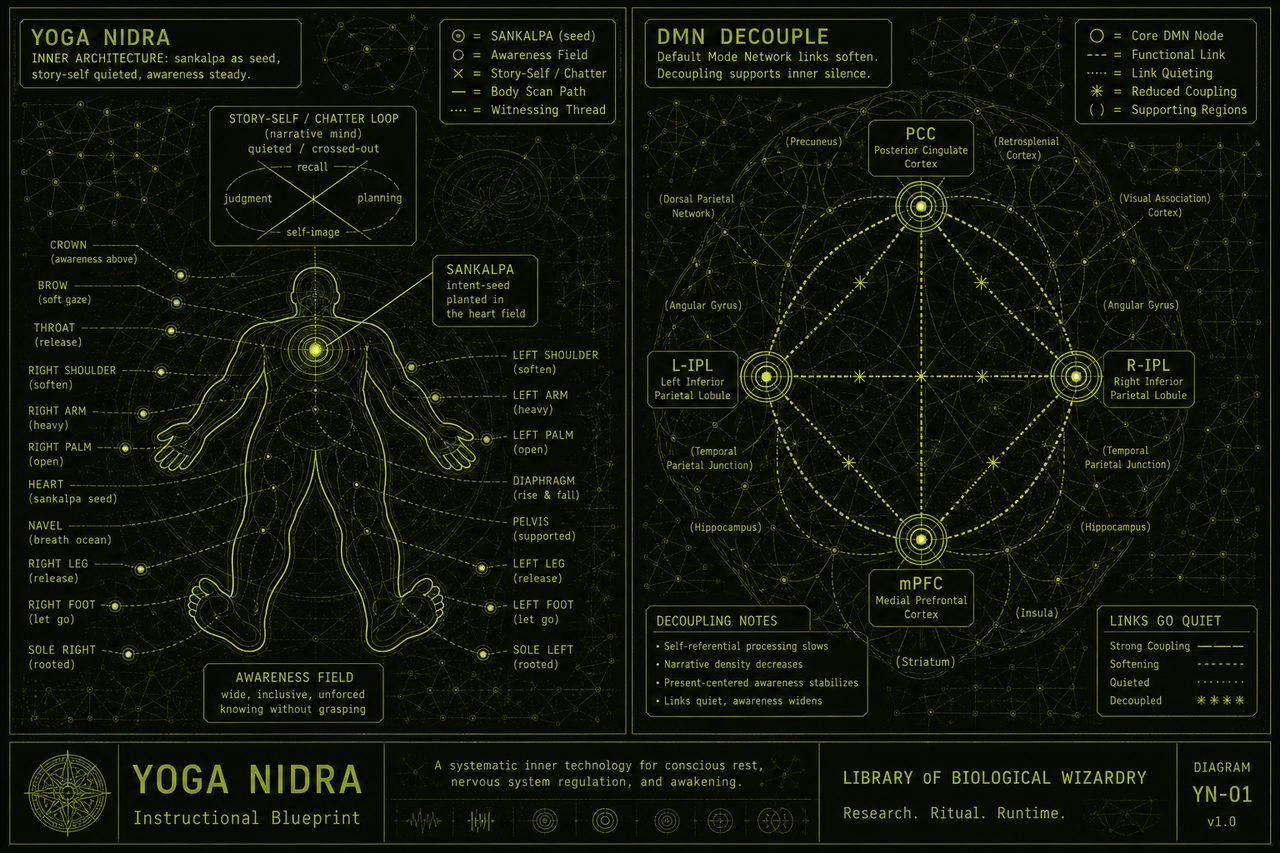
Yoga nidra is yogic sleep. You stay aware, and you plant a resolve while the chatter goes quiet.
You wanted a rest where you could still plant a wish.
Yoga nidra is yogic sleep. That name means you rest and you stay aware. You can plant a short wish while you rest. Swami Satyananda Saraswati wrote that map in a book called Yoga Nidra in 1993. Keep the yoga nidra name, and keep the wish you plant while you rest. In 2024, Fialoke's group watched the chatter network loosen in people who already had hours of practice.
What is yoga nidra?
Yoga nidra is yogic sleep. You lie down and stay aware, and you rest without falling fully asleep. You often listen while a teacher walks you through the body, live or on a recording. You hear the words and you feel the body, and the voice that talks to itself gets quieter as you rest.
Swami Satyananda Saraswati named yogic sleep and the sankalpa in Yoga Nidra, a book from Yoga Publications Trust in 1993. That book is an old map of the practice. Satyananda wrote how to rest and how to plant a wish. He did not run a scanner study.
What is a sankalpa?
A sankalpa is a resolve. It is a short wish or intention you plant while you rest and stay aware. You say it when the voice that talks to itself has gone quiet. The part of you that narrates is not arguing with the wish in that moment. Satyananda put that resolve in the old map.
People still come to yoga nidra for that resolve. They want a rest where they can plant a wish without arguing with themselves. Fialoke's group later scanned people during yoga nidra. They did not test whether a planted wish came true.
What did the 2024 yoga nidra scan show?
Fialoke, Tripathi, Thakral, Dhawan, Majahan, and Garg scanned people during yoga nidra in 2024. They published the work in the journal Scientific Reports. They used a twenty-minute English audio guide from Sri Sri Ravi Shankar and the Art of Living. They used fMRI, a scan that watches blood flow in the brain.
They brought in 30 meditators and 31 novices. A meditator here is a person who already practiced yoga. A novice is a person who did not. They dropped people whose brains did not show they were hearing the words. That left 28 meditators and 24 people in the control group.
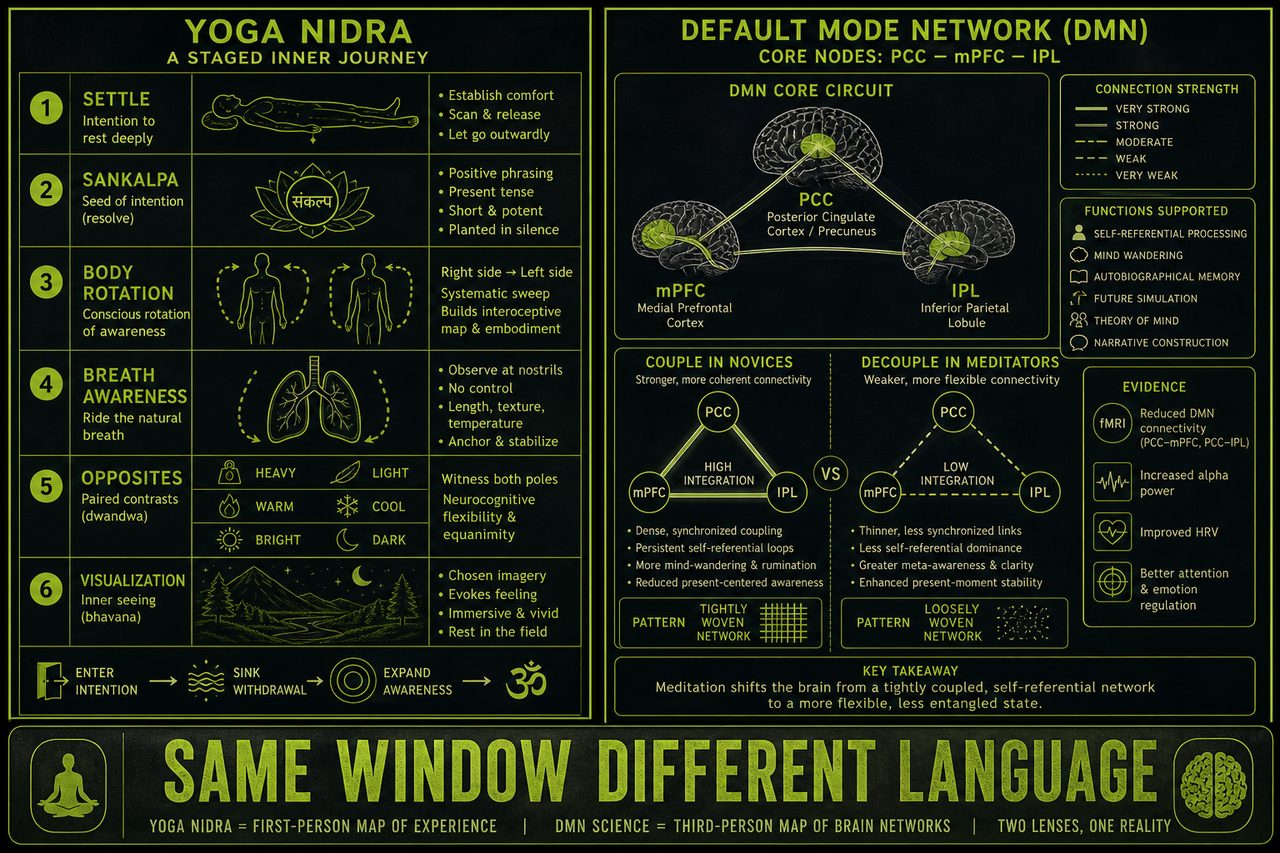
They split the twenty minutes into four periods. The first three lasted four minutes each, and the last lasted a little under four minutes. When they looked at the audio itself, hearing, language, and movement areas lit up. The default mode network, or DMN, is the brain's resting chatter network. When you rest, you use that network to talk to yourself. People did not show those chatter areas shutting off at the same time the audio areas lit up. The group did not run a sankalpa trial.
Do meditators and beginners look the same?
People with practice hours and beginners did not look the same. The people who already had hours showed a quieter chatter network, and the beginners did not.
The group watched functional connectivity, which means how much two brain areas move together. They looked at four hubs of the chatter network and how each one moved with a rest map called Default A. Default A is a standard map of that chatter network that labs use. One hub is the PCC, a hub at the back of that chatter network.
Meditators showed less of that moving together at all four stages of yoga nidra than the beginners did. Meditators already showed that quieter talking in the first four minutes, and they showed the quietest talking in the last stage. When the group compared yoga nidra with rest, meditators showed less talking in the chatter network through the whole twenty minutes. Beginners showed a slight rise or no change. Before the session and after it, the two groups looked the same at rest.
Did more yoga hours change the scan?
The meditators were householders, people with regular lives. They had about 2,517 hours of yoga on average, plus or minus 1,839 hours. That yoga mixed postures, breath work, and meditation. They were not 10,000-hour monks.
People with more hours had a quieter link from the PCC, that back hub, to Default A during yoga nidra. People already had that quieter link in the first four minutes, and they had it again in the last stage. After the group took out one person with more than 8,000 hours, they still saw the same pattern. People with more hours showed a quieter chatter network during the rest.
Did Huberman invent yoga nidra?
Andrew Huberman popularized NSDR as a name. NSDR means non-sleep deep rest, a newer name for this kind of rest. Fialoke's paper names NSDR as a recent protocol that uses yoga nidra. Huberman did not invent yoga nidra. Satyananda named yogic sleep and the sankalpa decades earlier. You can keep both names if you want, because people are still using the same kind of rest.
If rest, a body scan, or guided audio distresses you, talk to a clinician.
What do you do with this now?
You wanted a rest where you could still plant a wish. Keep the yoga nidra name and the sankalpa, the short wish you plant while you rest and stay aware.
Fialoke watched the chatter network loosen in people who already had hours of practice. They did not test whether the planted wish came true. Huberman helped spread a new name for the same kind of rest.
If you want that rest tonight, lie down, stay aware, and plant the wish when the voice that talks to itself goes quiet.
Sources
Saraswati, S.S. Yoga Nidra (Yoga Publications Trust, 1993). Old map. Yogic sleep. Sankalpa, a resolve planted while you rest and stay aware. Not a trial.
Fialoke, S., Tripathi, V., Thakral, S., Dhawan, A., Majahan, V., Garg, R. “Functional connectivity changes in meditators and novices during yoga nidra practice.” Sci. Rep. 14:12957 (5 June 2024). PMID 38839877. 20-minute English audio-guided yoga nidra, Sri Sri Ravi Shankar / Art of Living. Recruited meditators n=30, novices n=31. After excluding people with no auditory-comprehension activation: 28 meditators, 24 controls. Four periods T1-T3 240 s, T4 215 s. GLM on audio showed auditory, language, and motor activations. DMN regions did not exhibit concurrent deactivation. They did not run a sankalpa trial. Two-way ANOVA on DMN seeds (PCC, mPFC, right-IPL, left-IPL) to Default A: significant group effects, F range 17.419-30.005, all p < 0.001. No significant main effect of stage. Meditators: markedly reduced FC at all four YN stages versus controls. Present in T1 (four minutes), all seeds to Default A p < 0.05. Strongest at T4, p < 0.01. YN versus rest: meditators show DMN-FC reduction throughout T1-T4. Controls show a slight increase or no change. No group difference in resting-state FC before or after YN (p > 0.05). Group by stage interaction F range 2.711-4.054, all p < 0.05. Householders, average 2517 ± 1839 hours of yoga (asana, pranayama, meditation). PCC seed to Default A versus cumulative practice hours: YN-T1 r(50) = -0.352, p = 0.004; T2 r = -0.276, p = 0.082; T3 r = -0.307, p = 0.043; T4 r = -0.350, p = 0.003. Spearman, FDR. Similar after removing an outlier above 8000 hours. Names NSDR as a recent protocol that uses yoga nidra. doi.org/10.1038/s41598-024-63765-7
Kjaer, T.W. et al. “Increased dopamine tone during meditation-induced change of consciousness.” Cogn. Brain Res. 13:255-259 (2002). n=8 yoga teachers. 65 percent increase in dopamine release. Tiny sample. Not the mechanism of this page. doi.org/10.1016/S0926-6410(01)00106-9
Lou, H.C. et al. “A 15O-H2O PET study of meditation and the resting state of normal consciousness.” Hum. Brain Mapp. 7:98-105 (1999). n=9 PET. Not this scan. doi.org/10.1002/(SICI)1097-0193(1999)7:2<98::AID-HBM3>3.0.CO;2-M