Jhana · absorption · 7T
Jhana quieted the front while the field got louder.
You wanted the jhana to quiet the front after the lids already sat shut in the tube.
Jhana is a deep absorption people climb through named rungs. 7T, also called 7 Tesla, is a strong MRI. fMRI is a scan that watches blood while people stay still. ReHo is a score of how nearby spots move together. The front, also called prefrontal, is the front thinking area. The field, also called posterior sensory, is the back seeing and feeling areas. ACAM-J is access concentration through the jhanas. The tube is the scanner people lie in. bioRxiv is the preprint server. A preprint is a paper not yet through journal review. PLS r tells you how tightly two patterns moved together. J7 and J8 are the last two named rungs.
What is jhana?
Jhana is a deep absorption people climb through named rungs, the kind of absorption people already use when they want the front to sit quieter and the field to sit louder. Keep the jhana name if that quiet front and that louder field are why you came.
People already climb those named rungs. You wanted the jhana to quiet the front after the lids already sat shut in the tube, so stay with that name.
What is 7T fMRI?
7T, also called 7 Tesla, is a strong MRI. fMRI is a scan that watches blood while people stay still. People in this study kept their eyes closed in that scanner. They stayed still while Yang's group recorded blood.
People already want that strong scan to show the front sitting quieter and the field sitting louder. Keep the jhana name.
What is ReHo?
ReHo is a score of how nearby spots move together. The front is the front thinking area they scored. The field is the back seeing and feeling areas they scored.
If you came here because you want that front quieter and that field louder, stay with jhana.
Did jhana quiet the front while the field got louder?
Yang, with Potash, Mackin, Beslic, Bianciardi, Sparby, and Sacchet, posted this paper on 13 November 2025 on bioRxiv, and bioRxiv is the preprint server. A preprint is a paper not yet through journal review. You can read the paper at doi.org/10.1101/2025.11.12.688050 and at ncbi.nlm.nih.gov/pmc/articles/PMC12642441.
The title of the paper is “The neuroscience of highly stable, positive, and refined states of consciousness during jhana-type advanced concentration absorption meditation (ACAM-J).” It also carries DOI 10.1101/2025.11.12.688050, PMID 41292740, and PMCID PMC12642441.
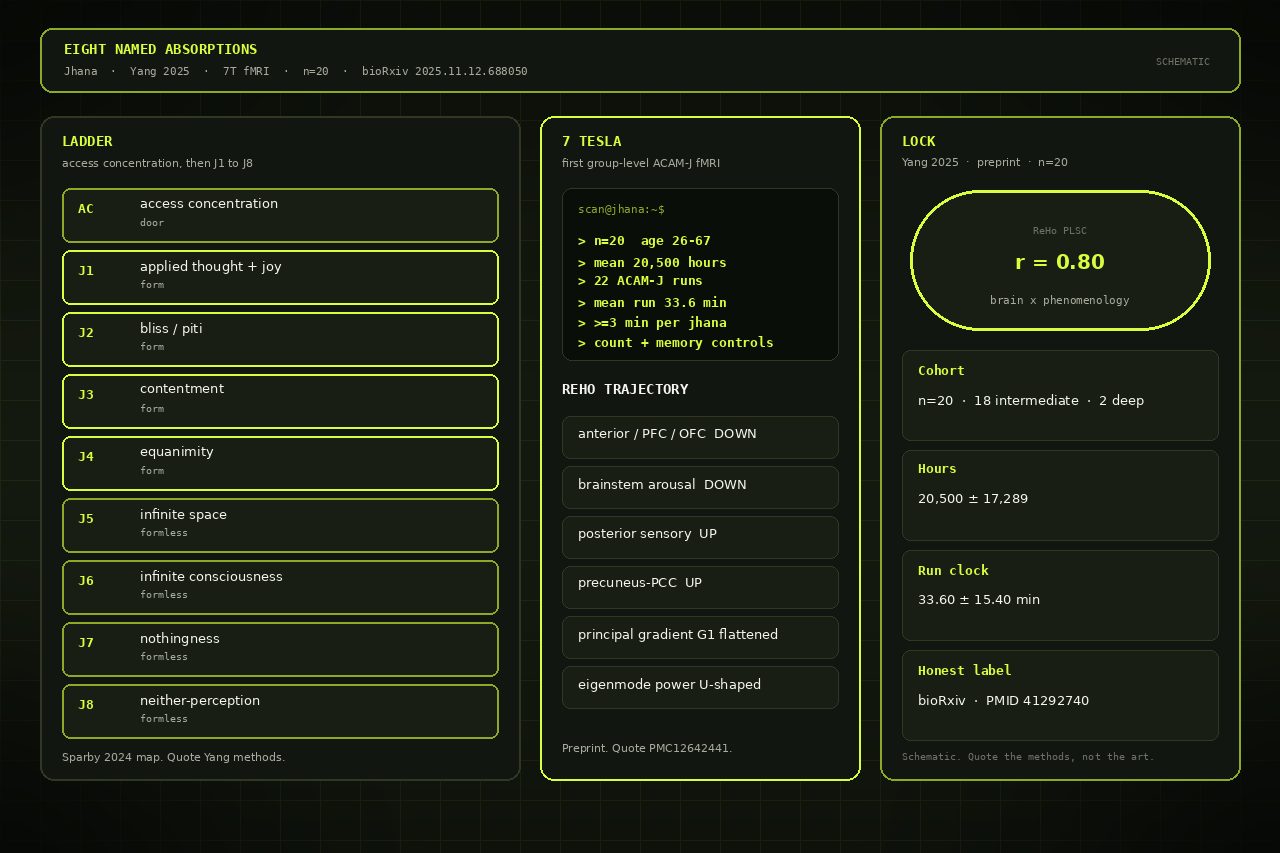
Yang's paper was the first group-level 7T fMRI of ACAM-J. ACAM-J is access concentration through the jhanas. Twenty people walked in. Those people were ages 26 to 67, with a mean age of 43.95. They had a mean of 17.40 years of practice and an estimated 20,500 hours. Eighteen people were intermediate. Two people were deep.
People kept their eyes closed. They ran access concentration through J8, the last named rung. A mean complete run lasted 33.60 minutes.
Prefrontal ReHo fell. That is the front thinking area sitting quieter. Posterior sensory ReHo rose in the visual areas, the precuneus-PCC, the parietal areas, and the somatomotor areas. Those are the back seeing and feeling areas, the field. Visual areas are the seeing spots. Precuneus-PCC is a back middle spot. Parietal areas are the spots on the side and back that handle space and feeling. Somatomotor areas are the spots that handle the body and movement.
People showed more of a front drop in the early states. Anterior means the front. On J7 and J8, the last two named rungs, the field sat louder. Posterior means the back. PLS r sat at 0.80. PLS r tells you how tightly two patterns moved together.
Earlier different work, including Chowdhury in 2025 and Hagerty in 2013, looked at one person. Yang's group scanned twenty people.
Keep wanting the jhana to quiet the front while the field gets louder.
What is ACAM-J?
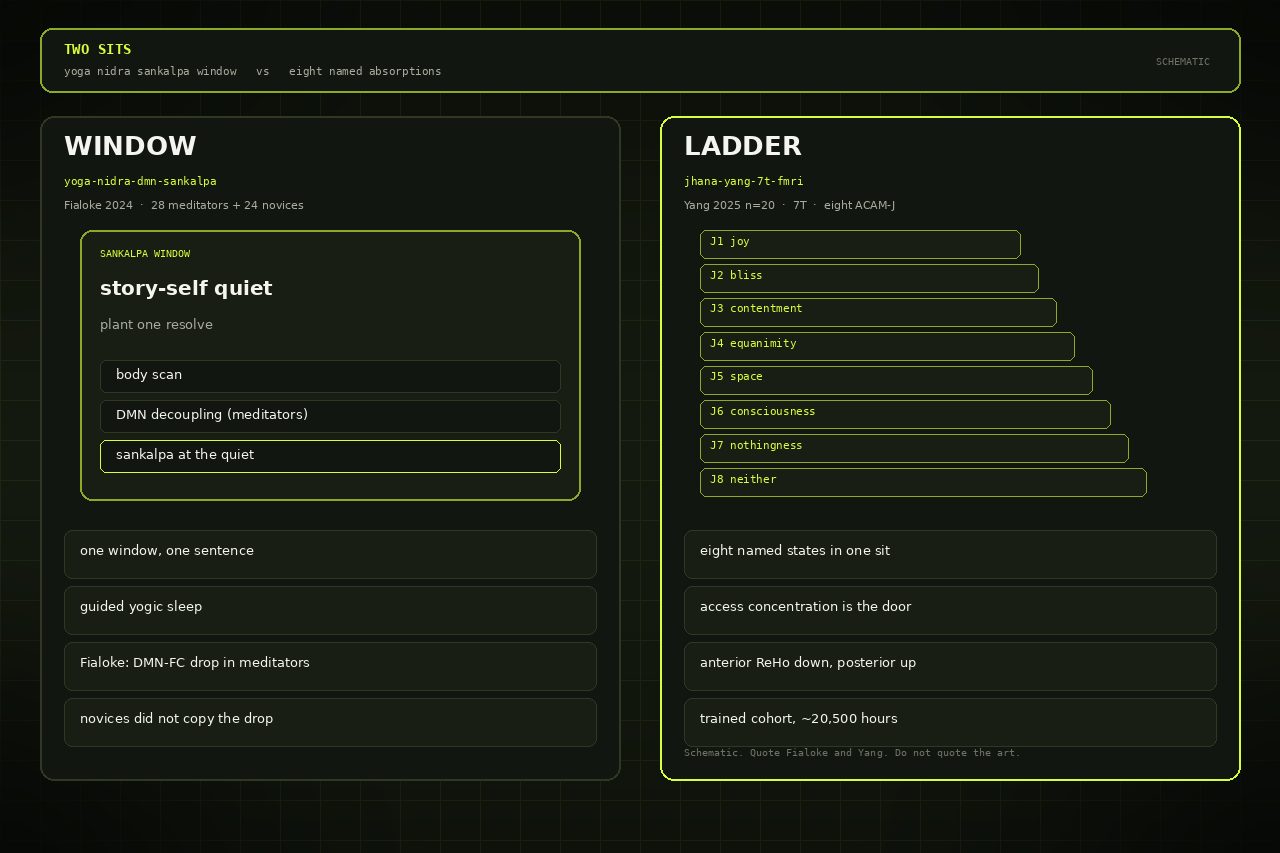
ACAM-J is access concentration through the jhanas. People started at access concentration and climbed through J8, the last named rung.
People already start at access concentration and climb through J8 when they want the front quieter and the field louder. Keep the jhana name.
What are the eight rungs?
The eight rungs are the named absorptions people climb. People in this study ran from access concentration through J8.
Stay with those named rungs if the quiet front and the louder field are why you opened this.
What is yoga nidra next to jhana?
Yoga nidra is a nearby different practice people already use. You can see that practice next to the eight named rungs in the compare picture.
Stay with jhana if the quiet front and the louder field are why you opened this.
Can you still want the jhana to quiet the front?
People already climbed those named rungs with their lids shut in the scanner, and you can still want jhana to quiet the front while the field gets louder. Keep the jhana name.
The front sat quieter. The field sat louder. You can still want the jhana.
If you feel unusual distress or you need care, talk to a clinician, because this page is educational and not a diagnosis.
If you want a page about a twelve-minute chant-and-tap loop and a frontal scan, open the Kirtan Kriya page.
If you want a page about yoga nidra, open the yoga nidra page.
Can you still want the jhana?
You wanted the jhana to quiet the front after the lids already sat shut in the tube. Keep the jhana name.
The front sat quieter. The field sat louder. You can still want the jhana.
Sources
Yang W.F.Z., Potash R., Mackin G., Beslic I., Bianciardi M., Sparby T., Sacchet M.D. “The neuroscience of highly stable, positive, and refined states of consciousness during jhana-type advanced concentration absorption meditation (ACAM-J).” bioRxiv 2025.11.12.688050, posted 13 November 2025. DOI 10.1101/2025.11.12.688050. PMID 41292740. PMCID PMC12642441. PREPRINT. First group-level 7T fMRI of ACAM-J. n=20. Ages 26-67, mean 43.95. Mean 17.40 years, estimated 20,500 hours. 18 intermediate, 2 deep. Eyes closed. Access concentration through J8. Mean complete run 33.60 minutes. Prefrontal ReHo fell. Posterior sensory ReHo rose (visual / precuneus-PCC / parietal / somatomotor). Early states more anterior drop. J7/J8 more posterior rise. PLS r=0.80. doi.org/10.1101/2025.11.12.688050 · ncbi.nlm.nih.gov/pmc/articles/PMC12642441
Chowdhury 2025. Hagerty 2013. Earlier different work.