Scripting · best possible self · dated letter

A twenty-minute letter from a life that already happened.

JM Thomas · 17 August 2026

You write from a Tuesday that already went well, after the work, with the table and the street already named on the page. The page is dated. The timer owns the morning.

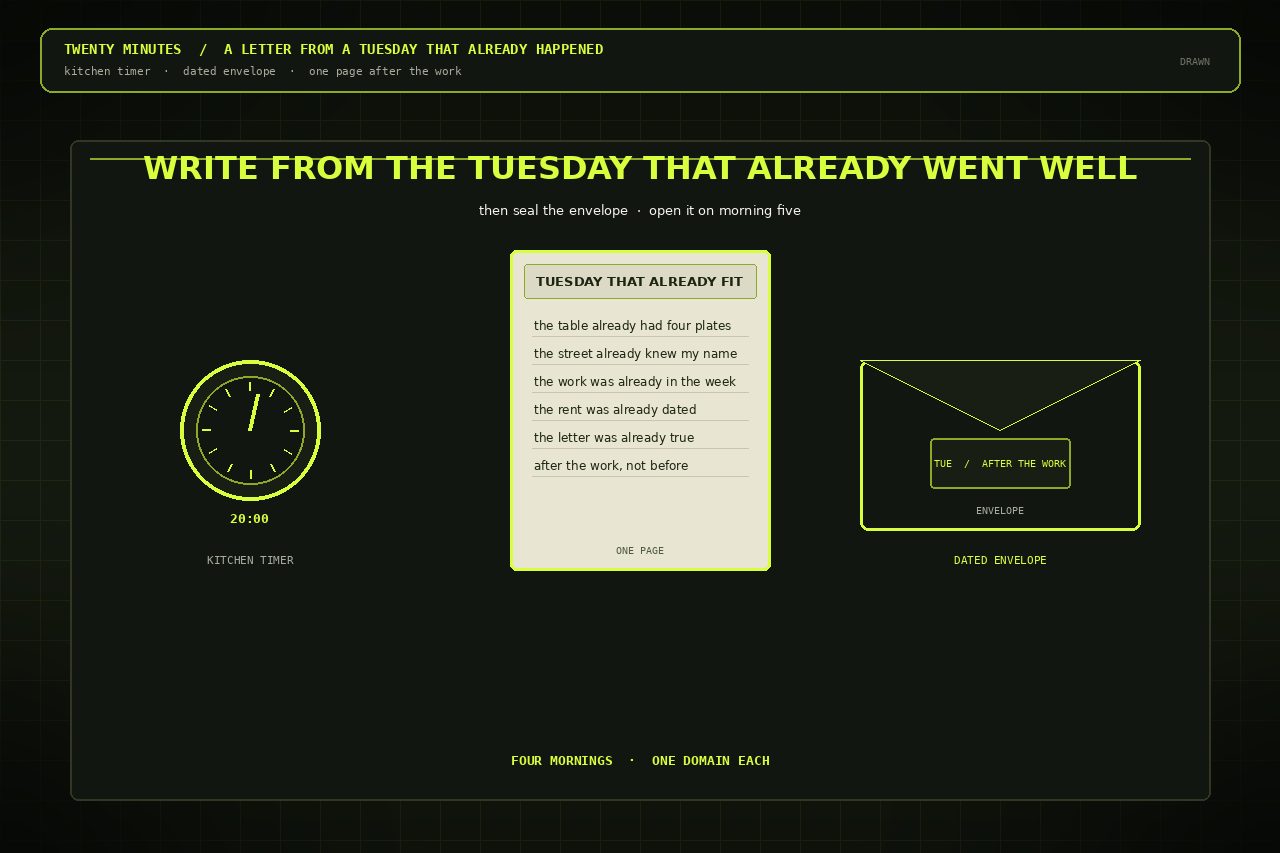
Dark lime drawing of a kitchen timer, a dated envelope, and one handwritten page from a Tuesday that already happened.
Kitchen timer. Dated envelope. One page from a Tuesday that already went well.

I already bought the 369 notebook. Eighteen lines of I am rich. The letter of an actual Tuesday never got written. Scripting, the best-possible-self sit, is that letter: a life that already fits, after you worked to get there, dated on a page you can hold.

Four mornings. Twenty minutes each. Well-being rose at week three. Clinic visits dropped by month five.

Write from a Tuesday that already went well

Picture the life after the work. Then write it as if that Tuesday already arrived.

King's prompt asked for the best possible future self, after everything had gone as well as it could, because the person had worked. The work stays in the sentence. The page is the Tuesday.

Personal room. Relational room. Professional room. One room per morning is enough. The letter names a table, a street, a job that already fits. Vague abundance stays in the notebook you already filled.

Buyers call this scripting. The lab called it best possible self. Same page. Same timer. The sit is the dated letter.

A kitchen timer owns the morning

Twenty minutes. Four consecutive days. A control arm wrote a bland plan for next week.

King. Personality and Social Psychology Bulletin, 2001. 27(7):798-807. DOI 10.1177/0146167201277003. PMID 11461613. Eighty-one undergraduates. Southern Methodist.

Four arms. Trauma. Best possible future self. Both. A non-emotional control. Mood before and after each sit. Health-center visits with consent. Well-being at three weeks. Illness counts across five months against the prior three.

The 369 notebook I already owned asked for eighteen short lines. This sit asked for one long page and a clock. That object is why tonight's letter gets an envelope, not another I-am stack.

The well-being score moved after the third week

Writing the future letter raised subjective well-being at three weeks. Life satisfaction and optimism both sat in that score.

The trauma arm hurt more while they wrote. The future-letter arm stayed quieter on the upset scale and still moved the later score. King printed that pairing on purpose. A hard memory and a hoped-for Tuesday are different pages, and both can move a body count, and only one of them left the room less upset.

The aisle sells the letter as a mood hack and skips the clinic desk. The file kept both clocks.

The clinic desk went quieter by month five

Trauma, the future letter, and the mixed arm all dropped health-center visits across the next five months against the prior three. The bland-plan arm did not.

That is the part of the file a scripting reel rarely quotes. The letter was less upsetting than the trauma page. The clinic count still moved. The control page, the one that planned next week in empty language, left the visit line where it started.

No invented visit totals. King printed the interaction and the direction. The raw visit means stay in the PDF.

Maastricht ran a five-minute picture

Fifty-four people. Twenty-eight on the letter. Twenty-six on daily activities. Five minutes a day for two weeks.

Meevissen, Peters, Alberts. Journal of Behavior Therapy and Experimental Psychiatry, 2011. 42(3):371-378. DOI 10.1016/j.jbtep.2011.02.012. PMID 21450262. Ages 18 to 43. Mean 23.5.

They built the letter in three rooms first, then pictured it. Optimism rose after the first session and held across the two weeks. The rise stayed after they pulled positive mood out of the model, which means the picture was doing work the mood score could not explain away.

King wrote for twenty minutes. Maastricht pictured for five. Same Tuesday. Different clock. Both files moved a future-expectancy line.

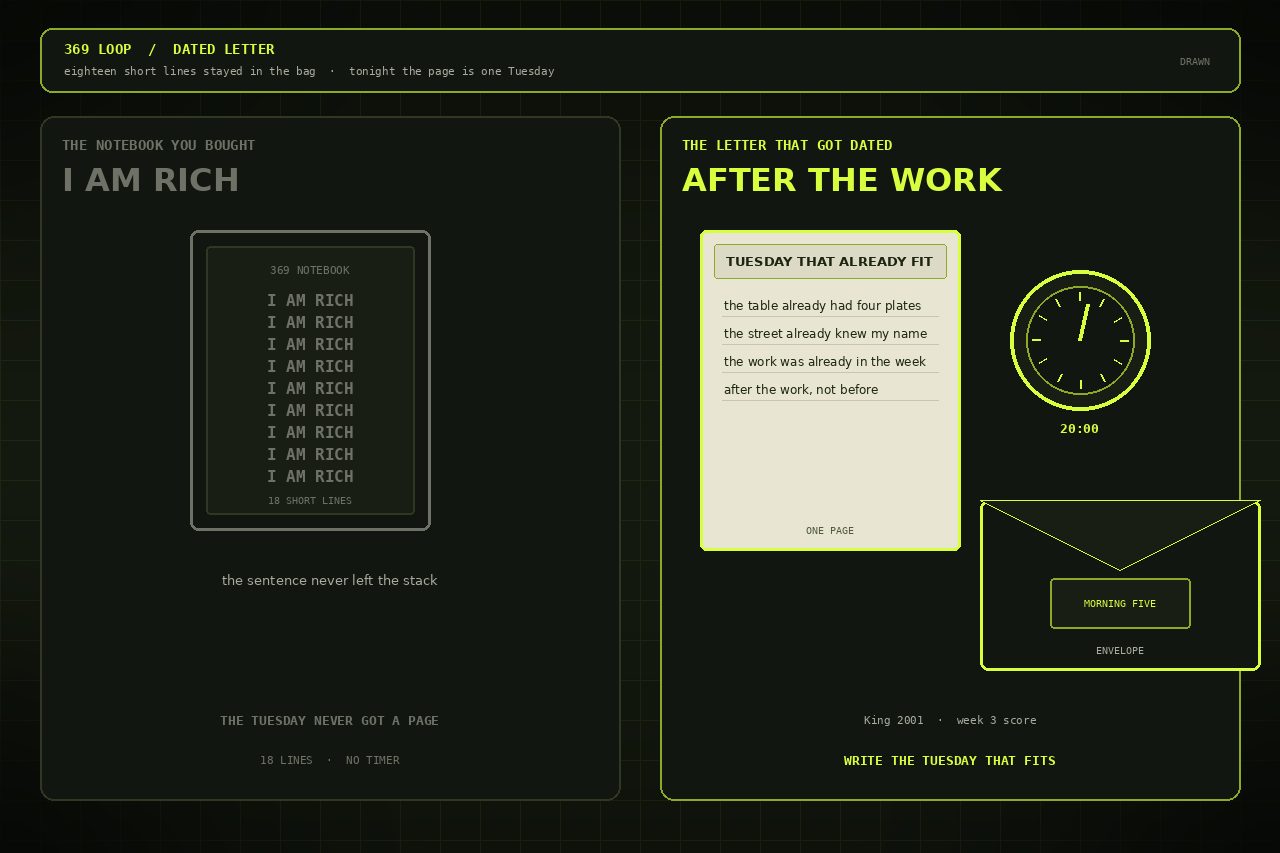
Dark lime split. Left a 369 notebook repeating I AM RICH. Right a dated envelope and a twenty-minute letter.
Left: eighteen I AM RICH lines. Right: a dated letter from a Tuesday that already went well.

A later stack put 2,909 people on the same letter

Twenty-nine trials. Twenty-six articles. Well-being d+ = 0.325. Optimism d+ = 0.334. Positive affect d+ = 0.511.

Carrillo, Rubio-Aparicio, Molinari, Enrique, Sanchez-Meca, Banos. PLOS ONE, 2019. 14(9):e0222386. DOI 10.1371/journal.pone.0222386. 1,270 on the letter. 1,178 controls. 461 on a gratitude sit.

Negative affect d+ = 0.192. Depression d+ = 0.115. The letter added a positive count more than it erased a dark one. Against gratitude sits, positive affect d+ = 0.326 and negative affect d+ = 0.485. The overall well-being gap against gratitude sat near zero.

Shorter total minutes trended larger. Older faces inside a young sample trended larger. Those two slopes were marginal. The stack still printed them.

The affirmation page already ran Wood's doorbell. Four minutes of I'm a lovable person left the low-esteem group worse. Tonight's object is a dated letter, not a doorbell line.

Date the envelope tonight

Set a twenty-minute kitchen timer. Pick one room you already keep. Write from a Tuesday that already went well, after the work. Seal the page in an envelope dated tomorrow. Open it on morning five.

Morning two is the next room. Morning three is the third. Morning four is the room that still has air in it. Leave the four pages in the same folder so you cannot pretend the week did not happen.

If the letter makes the chest loud, sit until that clamp lets go, then start the timer. The Library keeps the other sits if you want them later.

Leave the 369 notebook in the bag. Date the four envelopes first.

After the 369 notebook

Do I need four full mornings if I only have tonight?

King photographed four mornings. Tonight you set a twenty-minute timer, pick one domain, and write from a Tuesday that already went well. Keep the other three mornings on the calendar.

Can I keep the 369 notebook and add this?

You can. Eighteen short lines stay in that notebook. Tonight's page is one long letter from a life that already fits. Fill the four mornings anyway.

Is this the drowsy-hour scene from SATS?

SATS plants a scene as you fall asleep. Tonight's letter is awake. A kitchen timer. A dated envelope. Eyes open until the twenty minutes end. Use the SATS page for the drowsy hour.

What if I cannot picture a family or a job?

Maastricht split the letter into three rooms: personal, relational, professional. Pick the room you already keep. Write that Tuesday first.

Is this a medical page?

Mood scores and clinic-visit counts. Literature. If panic or chest pain arrives, call a doctor, not another letter.

King, then Maastricht, then the stack

King L.A. "The Health Benefits of Writing About Life Goals." Personality and Social Psychology Bulletin 2001;27(7):798-807. DOI 10.1177/0146167201277003. PMID 11461613. n=81 undergraduates. Twenty minutes a day for four consecutive days. Arms: trauma, best possible future self, both, non-emotional control. Future-letter arm: higher subjective well-being at three weeks (life satisfaction and optimism). Less upsetting than trauma writing. Trauma, future-letter, and mixed arms: fewer health-center visits across five months vs the prior three. Control arm did not show that drop. doi.org/10.1177/0146167201277003 · pubmed.ncbi.nlm.nih.gov/11461613

Meevissen Y.M.C., Peters M.L., and Alberts H.J.E.M. "Become more optimistic by imagining a best possible self: Effects of a two week intervention." Journal of Behavior Therapy and Experimental Psychiatry 2011;42(3):371-378. DOI 10.1016/j.jbtep.2011.02.012. PMID 21450262. n=54 (28 letter, 26 daily-activities). Ages 18-43, mean 23.5. Five minutes a day for two weeks. Three rooms first: personal, relational, professional. Optimism rose after one session and across two weeks. The rise stayed after positive mood was controlled. doi.org/10.1016/j.jbtep.2011.02.012 · pubmed.ncbi.nlm.nih.gov/21450262

Carrillo A., Rubio-Aparicio M., Molinari G., Enrique A., Sanchez-Meca J., and Banos R.M. "Effects of the Best Possible Self intervention: A systematic review and meta-analysis." PLOS ONE 2019;14(9):e0222386. DOI 10.1371/journal.pone.0222386. 29 studies in 26 articles. 2,909 people (1,270 letter, 1,178 control, 461 gratitude). Well-being d+ = 0.325. Optimism d+ = 0.334. Positive affect d+ = 0.511. Negative affect d+ = 0.192. Depression d+ = 0.115. Vs gratitude: positive affect d+ = 0.326, negative affect d+ = 0.485, well-being near zero. doi.org/10.1371/journal.pone.0222386 · journals.plos.org/plosone/article?id=10.1371/journal.pone.0222386