Self-affirmation · future values · doorbell
I'm a lovable person. The low-esteem group felt worse.
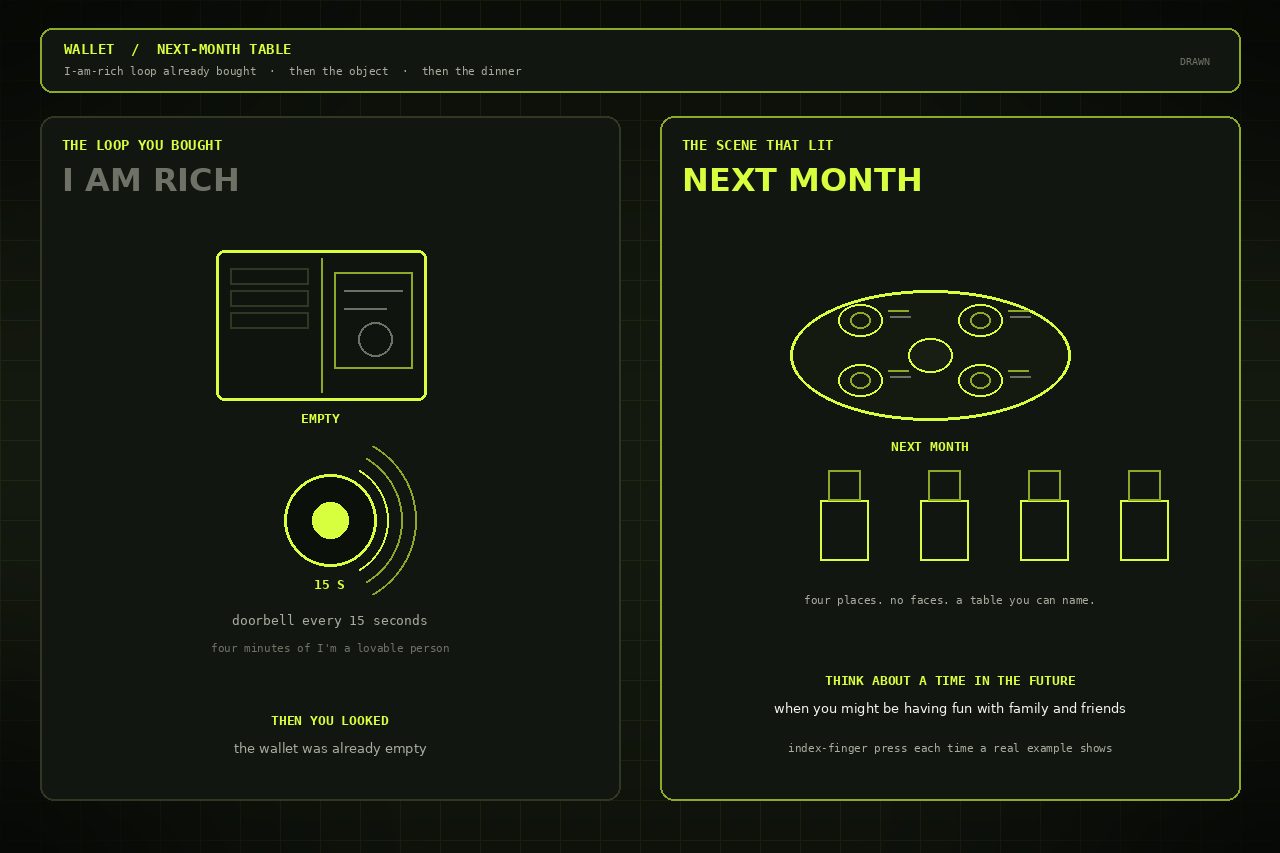
Doorbell every fifteen seconds. Four minutes of the same line. Then the empty wallet on the kitchen table, the one I already checked after the I-am-rich loop.
The tape said I am rich. The wallet stayed empty. That picture is why do affirmations work stays a live search after a bad loop, because the sentence and the object were already in a fight before the doorbell even rang.
Two lab results sit on the same word. A doorbell sit can leave a low-esteem group worse. A twelve-second future-value block on a 3T can light the map that later predicted less sitting.
Four minutes of doorbell, then they felt worse
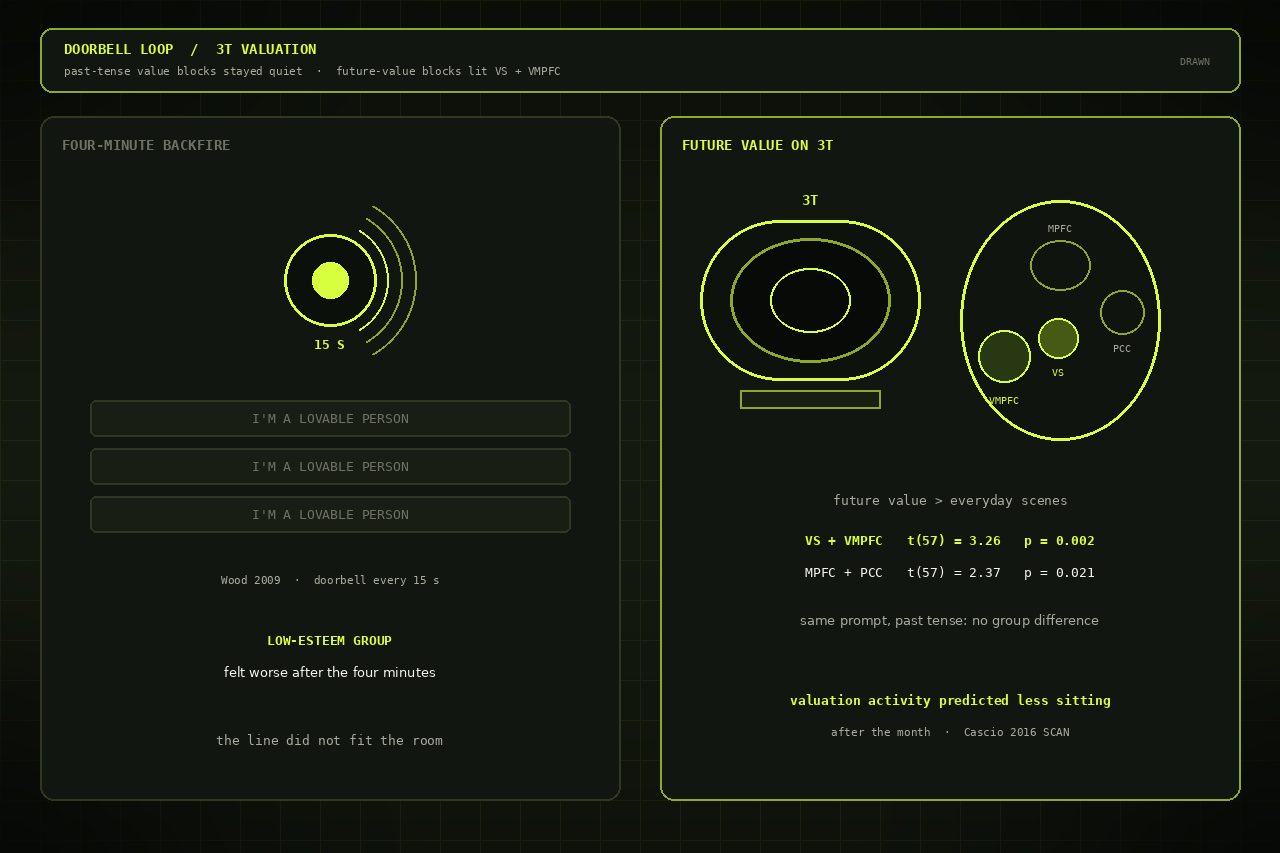
Wood sat people with a doorbell. Every fifteen seconds, I'm a lovable person. Four minutes. The low-esteem group felt worse.
Wood, Perunovic, and Lee. Psychological Science, 2009. 20(7):860-866. DOI 10.1111/j.1467-9280.2009.02370.x. PMID 19493324.
They first surveyed 249 people who already used positive self-statements and believed the lines worked. Then Experiment 1 sat 68 people. A doorbell. I'm a lovable person, every fifteen seconds, for four minutes.
The low self-esteem group felt worse than the low self-esteem people who skipped the line. The high self-esteem group felt a little better. The people who wanted the loop most paid for it in mood.
Picture the doorbell. Picture a line that does not fit the room. That is the first sit, and it is the one most apps still sell.
The wallet already answered the loop
I already bought the I-am-rich tape on a Tuesday, played it at the kitchen table, then opened the wallet and watched the line lose to an object that had been empty before the loop even started. The object won.
A sentence you wish were true and an object that already answered it will fight. The fight is the sit. Four minutes of I'm a lovable person puts that fight on a timer.
The gatekeeper who sold the I-am-rich loop hid the future-value switch. The scanner later lit on a value you already rank, aimed at next month, with a finger press each time a real example showed. The sold loop hid that switch behind a prettier sentence.
Empty wallet on the left. Next month's family table on the right. Pick the right panel tonight.
Next month's family dinner on 3T
Think about a time in the future when you might be having fun with family and friends. Press your index finger each time a real example shows. Twelve seconds.
Cascio, O'Donnell, Tinney, Lieberman, Taylor, Strecher, and Falk. Social Cognitive and Affective Neuroscience, 2016. 11(4):621-629. DOI 10.1093/scan/nsv136. PMID 26541373. PMC 4814782.
Sedentary adults. Sixty-seven in the sample. Affirmed 33. Unaffirmed 28. The ROI tests used t(57). Ages 18 to 64. A 3T GE Signa.
They ranked eight values: creativity, relations with family and friends, sense of humor, independence, business or earning money, politics, religious values, and spontaneity. Friends and family sat at the top for 33 of them. Affirmed people reflected on their highest value. Control reflected on their lowest.
Each block lasted twelve seconds. Ten scenarios in each cell. Forty blocks. Value scenes and everyday scenes, past and future. Everyday meant charging a phone. Value, for the family people, meant the dinner.
Future-oriented core-value blocks against everyday scenes: ventral striatum plus ventromedial prefrontal cortex, t(57)=3.26, p=0.002. Medial prefrontal cortex plus posterior cingulate, t(57)=2.37, p=0.021.
They ran the same prompt in the past tense. Think about a time in the past when you had fun with family and friends. That block showed no group difference on the valuation map, which is the whole switch the I-am loop hides: future value you already keep lights the map, and yesterday's version of the same dinner leaves it quiet.
We don't believe. We measure.
The month after, they sat less
Valuation activity during those future-value blocks predicted less sitting in the month that followed.
Cascio's group reported that link in the SCAN file. More activity in VS plus VMPFC, and in MPFC plus PCC, during future value against everyday scenes lined up with a drop in sedentary time after the month.
Falk, O'Donnell, Cascio, and the same team. Proceedings of the National Academy of Sciences, 2015. 112(7):1977-1982. DOI 10.1073/pnas.1500247112. Companion paper. Cite it. Do not lead with it.
Same sedentary adults. Health messages after the sit. The affirmed arm showed more VMPFC on those messages. Accelerometer sedentary time dropped steeper. Condition by time, p=0.008.
Wrist accelerometer. A month. The dinner scene did more than lift a mood, because the people whose valuation map had lit during those future-value blocks were the ones whose sitting number moved after the health messages.
SATS plants a drowsy scene. Ho'oponopono ran a cuff class.
Sleep-onset SATS plants a scene as you drop off. Kretzer's hooponopono class ran a cuff. This sit is a future value you already keep, pressed with a finger.
I already mapped the drowsy-hour plant on SATS, Neville's state akin to sleep. Use that page when you want a scene at the edge of sleep. Use this page when you are awake and you can name next month's table.
Ho'oponopono on this site is Kretzer's 2007 identity class with a cuff. Four phrases. Millimeters. Different clock. Different instrument.
If an old sentence still owns a Tuesday, the reconsolidation window is the mismatch afternoon. Pull the old line. Live one act it cannot explain. That sit rewrites a file. This sit ranks a value you already keep and aims it forward.
Write one value you already keep
Tonight. One value you already live. Family table next month. Humor. Independence. Rank it the way they ranked eight.
Write one future scene that could actually happen. Twelve seconds. Finger press each time a real example shows. Do that for ten scenes, or until the examples run dry.
Leave I-am-rich off the paper. Leave I'm a lovable person off the paper unless that line is already true in the room.
Name the table. Who sits there next month. That is the sit. The Library keeps the other sits if you want them later.
After the doorbell
Do I need a 3T scanner to run tonight's sit?
No. Cascio photographed the sit. Tonight you write one future value you already keep and press a finger each time a real example shows.
Can I keep saying I am rich if I already paid for the app?
You can. Wood's low-esteem group felt worse after four minutes of I'm a lovable person. My wallet already answered the rich line.
Is this the drowsy-hour scene from SATS?
SATS plants a scene as you fall asleep. Tonight's sit is awake. A future value you already rank. A finger press when a real example shows.
What if I have no family dinner to picture?
They ranked eight values. Humor, independence, religion, creativity, money, politics, spontaneity, family. Pick one you already keep.
Is this a medical page?
Mood ratings and sedentary time. Literature. If a sit arrives with panic, call a doctor, not another I-am tape.
What they ran
Cascio C.N., O'Donnell M.B., Tinney F.J., Lieberman M.D., Taylor S.E., Strecher V.J., and Falk E.B. "Self-affirmation activates brain systems associated with self-related processing and reward and is reinforced by future orientation." Social Cognitive and Affective Neuroscience 2016;11(4):621-629. DOI 10.1093/scan/nsv136. PMID 26541373. PMC 4814782. n=67 sedentary adults (affirmed 33, unaffirmed 28; ROI t(57)). Future-oriented core-value blocks vs everyday scenes: VS+VMPFC t(57)=3.26, p=0.002; MPFC+PCC t(57)=2.37, p=0.021. Past-oriented value blocks: no group difference. Valuation activity predicted less sitting after the month. 12 s blocks on a 3T GE Signa. Index-finger press for each real example. doi.org/10.1093/scan/nsv136 · pmc.ncbi.nlm.nih.gov/articles/PMC4814782
Wood J.V., Perunovic W.Q.E., and Lee J.W. "Positive self-statements: power for some, peril for others." Psychological Science 2009;20(7):860-866. DOI 10.1111/j.1467-9280.2009.02370.x. PMID 19493324. Survey n=249. Experiment 1 n=68. Repeat "I'm a lovable person" every 15 s to a doorbell for four minutes. Low self-esteem felt worse. doi.org/10.1111/j.1467-9280.2009.02370.x · pubmed.ncbi.nlm.nih.gov/19493324
Falk E.B., O'Donnell M.B., Cascio C.N., et al. "Self-affirmation alters the brain's response to health messages and subsequent behavior change." Proceedings of the National Academy of Sciences 2015;112(7):1977-1982. DOI 10.1073/pnas.1500247112. Affirmed arm: more VMPFC on health messages. Steeper drop in accelerometer sedentary time (condition × time p=0.008). Companion. Cite, do not lead. doi.org/10.1073/pnas.1500247112 · pubmed.ncbi.nlm.nih.gov/25646442