Loving-kindness · metta · next chair

Send the warm sentence to the next chair.

JM Thomas · 17 August 2026

A sentence you already mean for one person can be sent to the next face in the room. That is the sit, and it is the one the self-love apps still skip.

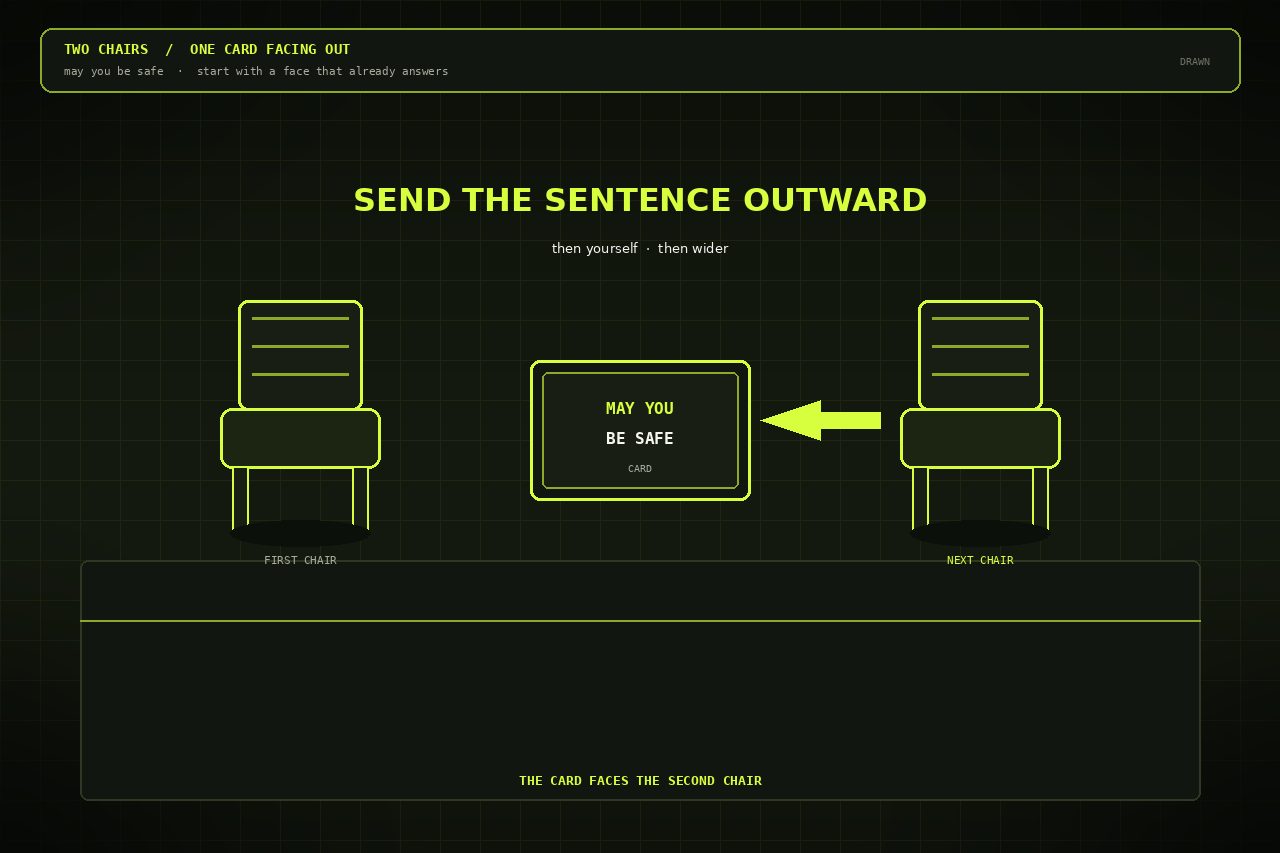
Dark lime drawing of two chairs and a card that says MAY YOU BE SAFE facing the second chair.
Two chairs. A card that says MAY YOU BE SAFE facing the second chair.

The self-love app pointed every line at my own face. The next chair stayed empty. Loving kindness, metta, is the sit that turns the card around and leaves it facing someone who can actually receive it.

A workplace class sent that sentence outward for seven weeks. Daily positive emotions rose after week three. The resources stacked.

Start with a person you already like

Find one person you already feel warm toward. Send May you be safe. Then send it to yourself. Then send it wider.

The first week in that class stayed on the self and ran fifteen minutes. The last week reached all living beings and ran twenty-two minutes. The order matters because you start with a face that already answers, then you widen only after that warmth is real.

Picture a card. MAY YOU BE SAFE. Turn it toward the next chair, not toward the mirror.

The old books called this metta. The class called it loving-kindness. Same sentence. Same widen. The hunger that typed the search already owns the phrase. The sit is where it points.

Detroit, a lunch-hour class

Compuware. Detroit. A 60-minute class in a work week. They practiced at home at least five days.

Fredrickson, Cohn, Coffey, Pek, Finkel. Journal of Personality and Social Psychology, 2008. 95(5):1045-1062. DOI 10.1037/a0013262. PMID 18954193. PMC 3156028.

Two hundred two employees signed on. One hundred thirty-nine finished the reports. Sixty-seven sat the class. Seventy-two waited. Mean age 41. Most were women. The class met six times across seven weeks, and a CD went home so the sit could run on days the lunch room was empty.

Week one: self. Week two: loved ones. Later weeks: acquaintances, strangers, all living beings. They logged emotions every day for nine weeks. One week before the class. Seven weeks of the sit. One week after.

I already owned a self-love app that looped I am enough at my own face. That object is why this sit is a card facing out, not a mirror loop.

The week count moved after week three

Time alone did nothing. The class slot alone did nothing. Time inside the class moved daily positive emotions.

Condition times week: b = 0.041, p = .0004. For the class arm, week predicted the positive count, b = 0.03, p = .0001. The waitlist arm stayed flat.

Nine emotions sat in the daily mean: amusement, awe, contentment, joy, gratitude, hope, interest, love, pride. The rise was a stack, not one mood wearing nine names.

Negative emotions did not drop. Anger stayed. Shame stayed. Fear and sadness stayed on the same line they started on. The sit added a count. It left the other count on the page.

Nine of eighteen resources moved through that rise. Mindfulness. Pathways thinking. Savoring the future. Environmental mastery. Self-acceptance. Purpose in life. Social support received. Positive relations. Fewer illness symptoms. Life satisfaction moved after the resources moved. The direct path from the emotion slope to life satisfaction missed, which is the part of the file most highlight reels skip.

We don't believe. We measure.

An hour later bought more

One hour of practice in week two bought 0.06 units on the 0-to-4 scale. The same hour in week seven bought 0.17.

The dose tripled. After the class ended, practice time fell. The hour still bought about 0.18 in week eight.

They averaged about 80 minutes a week during the class, then about 60 after it ended. The first hard weeks were the ones people quit. The file says the rise waited until week three.

A later campus sit photographed the nerve

Sixty-five people at Chapel Hill. Six weekly hours. High-frequency heart-rate variability at rest, two minutes.

Kok, Coffey, Cohn, Catalino, Vacharkulksemsuk, Algoe, Brantley, Fredrickson. Psychological Science, 2013. 24(7):1123-1132. DOI 10.1177/0956797612470827. PMID 23649562.

People who entered with a quieter, more flexible nerve gained more positive emotion on the class arm, interaction b = 0.043, p = .009. That slope predicted a rise in felt closeness, b = 1.04, p less than .001. The closeness slope predicted a rise in vagal tone, b = 4.90, p = .03, so the nerve moved after the social count moved, and the social count moved after the warm week moved.

That is the order the Chapel Hill file actually printed.

Hutcherson, Seppala, Gross. Emotion, 2008. 8(5):720-724. DOI 10.1037/a0013237. PMID 18837623. A few minutes in a lab. A stranger on the screen. The same kind of sentence. Explicit and implicit warmth toward a new face both rose. The abstract I opened did not print an n. The minutes are the claim I can lock.

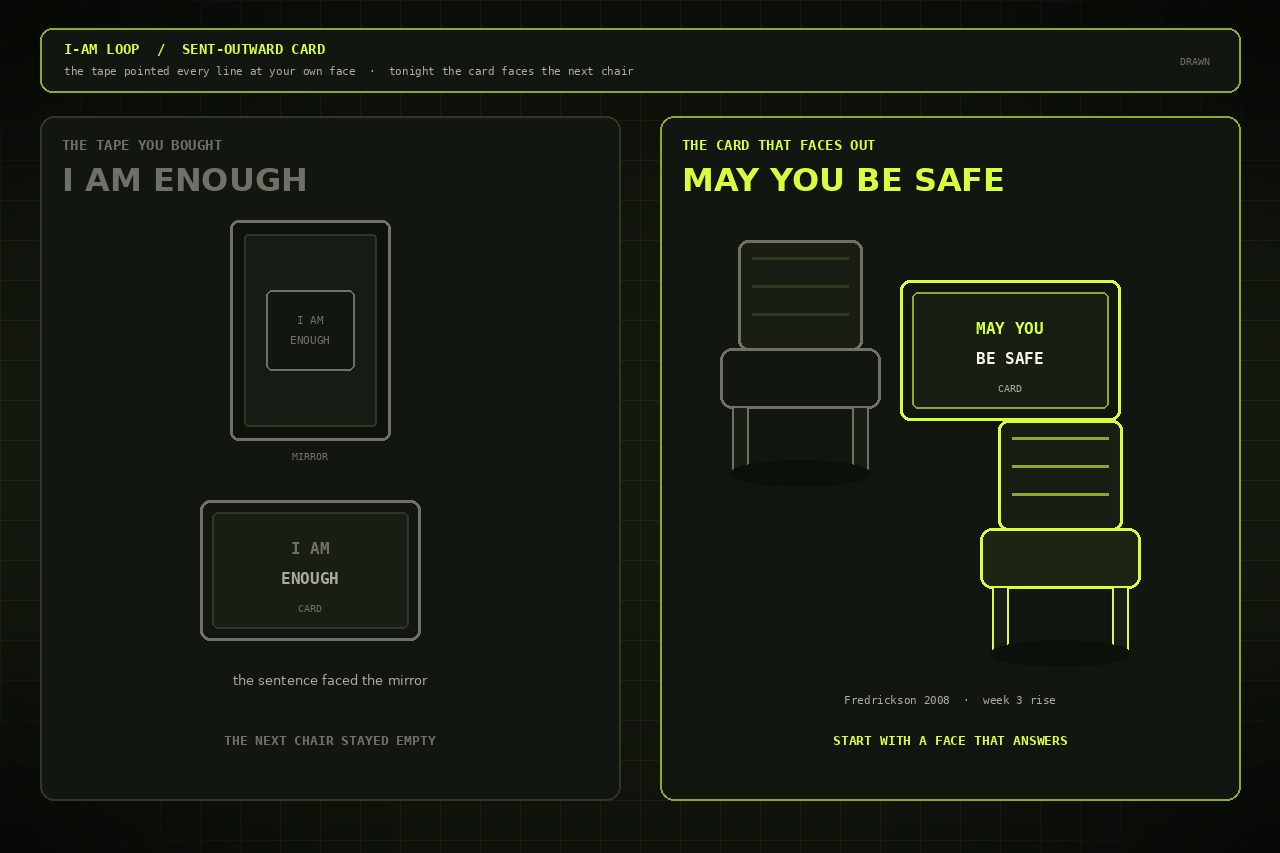
Dark lime split. Left a card that says I AM ENOUGH facing a mirror. Right a card that says MAY YOU BE SAFE facing the next chair.
Left: I AM ENOUGH facing a mirror. Right: MAY YOU BE SAFE facing the next chair.

The I-am tape stays in the drawer

The doorbell sit of I'm a lovable person pointed the sentence at you. Tonight's card points it at the next chair.

The affirmation page already ran Wood's doorbell. Low-esteem felt worse. This sit starts with a person you already like, then widens. Keep those files on their own URLs.

Ho'oponopono ran a four-phrase identity class and a cuff. Different object. Different clock. Tonight's object is one warm sentence facing out.

Face the next chair tonight

Write MAY YOU BE SAFE on a card and face it at the next chair for seven minutes. A 1-to-10 before the first send. The same 1-to-10 on day 21, written on the same scrap so you cannot pretend the week did not happen.

Start with one person you already like. Then yourself. Then one acquaintance. Then the next stranger you will actually see.

If the send makes the chest loud, sit until that 1-to-10 drops, then turn the card again. The Library keeps the other sits if you want them later.

Leave the card facing the next chair. Leave the I-am tape in the drawer until the week count is written.

If you already bought the self-love app

Do I need a workplace class to run tonight's sit?

Fredrickson photographed a lunch-hour class. Tonight you write MAY YOU BE SAFE on a card, face it at the next chair for seven minutes, and log a 1-to-10 before the first send and on day 21.

Can I keep the I-am tape and add this?

You can. The tape pointed every line at your own face. Tonight's card faces the next chair. Fill the week count anyway.

Is this the four-phrase identity class?

Ho'oponopono overwrites an identity file with four lines. Tonight's sit sends one warm sentence outward, starting with a person you already like. Use the Ho'oponopono page for the cuff class.

What if I live alone and have no next chair?

Pick one person you already like who you will see or write this week. Face the card at their name. The next stranger you actually meet is the widen.

Is this a medical page?

Daily emotion scores, resources, and a rest nerve reading. Literature. If panic or chest pain arrives, call a doctor, not another warm sentence.

The files

Fredrickson B.L., Cohn M.A., Coffey K.A., Pek J., and Finkel S.M. "Open Hearts Build Lives: Positive Emotions, Induced Through Loving-Kindness Meditation, Build Consequential Personal Resources." Journal of Personality and Social Psychology 2008;95(5):1045-1062. DOI 10.1037/a0013262. PMID 18954193. PMC 3156028. Completers n=139 (67 class, 72 waitlist). Started 202. Six 60-minute sessions across 7 weeks. Condition × week on daily positive emotions b=0.041, p=.0004. Class arm week slope b=0.03, p=.0001. Waitlist flat. Dose: 1 hour week 2 = 0.06 units, week 7 = 0.17. Nine of 18 resources moved through the emotion slope. Negative emotions did not drop. doi.org/10.1037/a0013262 · pmc.ncbi.nlm.nih.gov/articles/PMC3156028

Kok B.E., Coffey K.A., Cohn M.A., Catalino L.I., Vacharkulksemsuk T., Algoe S.B., Brantley M., and Fredrickson B.L. "How Positive Emotions Build Physical Health: Perceived Positive Social Connections Account for the Upward Spiral Between Positive Emotions and Vagal Tone." Psychological Science 2013;24(7):1123-1132. DOI 10.1177/0956797612470827. PMID 23649562. n=65 (71 consented, 6 excluded). UNC Chapel Hill faculty and staff. Six weekly hours. Rest HF-HRV, 2 minutes. Condition × baseline vagal tone on positive-emotion slope b=0.043, p=.009. Emotion slope to social-connection slope b=1.04, p<.001. Social-connection slope to vagal-tone change b=4.90, p=.03. doi.org/10.1177/0956797612470827 · peplab.web.unc.edu PDF

Hutcherson C.A., Seppala E.M., and Gross J.J. "Loving-kindness meditation increases social connectedness." Emotion 2008;8(5):720-724. DOI 10.1037/a0013237. PMID 18837623. A few minutes in lab. Explicit and implicit warmth toward a novel face rose versus a matched imagery control. n not printed on the abstract this page used. doi.org/10.1037/a0013237 · pubmed.ncbi.nlm.nih.gov/18837623