Ho'oponopono · Kretzer 2007 · identity overwrite · n=23
Ho'oponopono: Kretzer 2007, twenty-three people, eleven millimeters
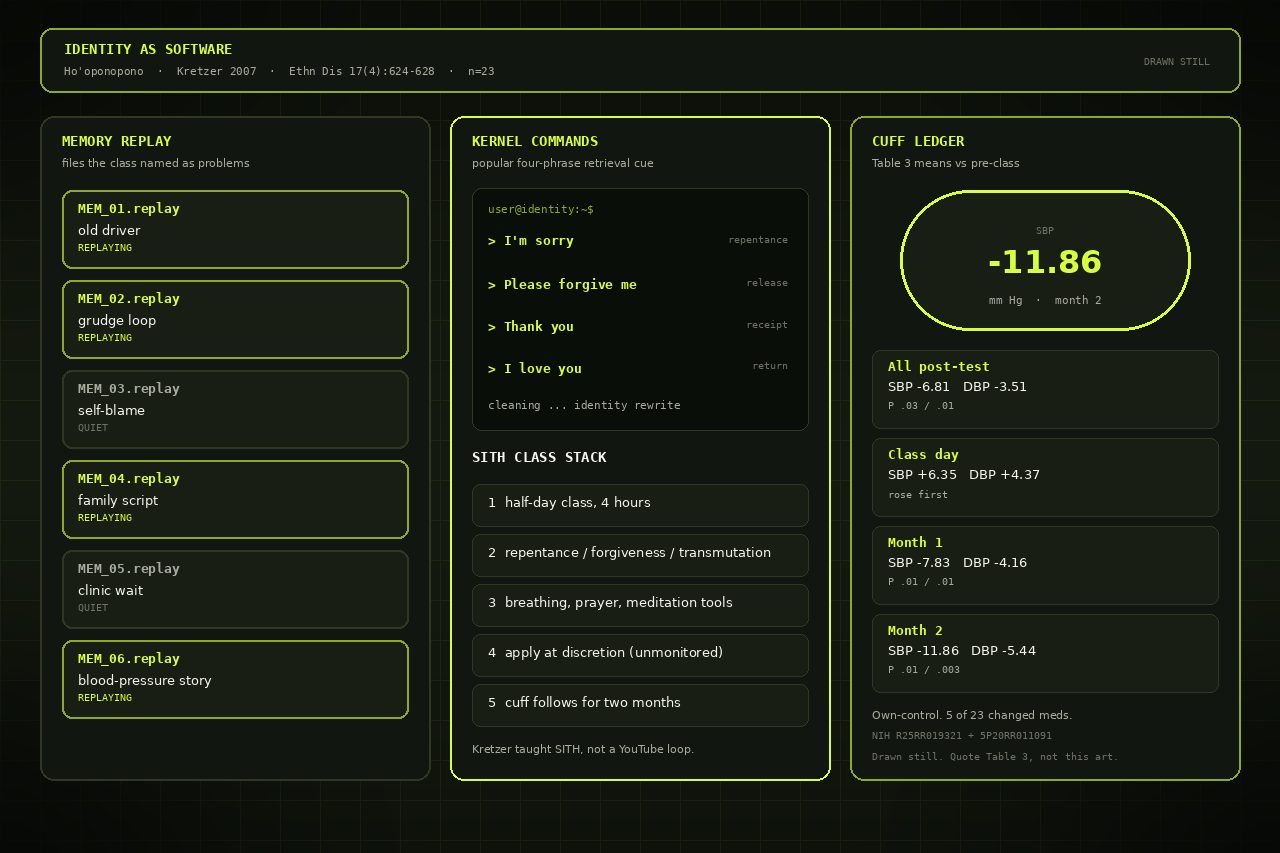
Ho'oponopono, in the version Kikikipa Kretzer taught, is a self-identity rewrite. I opened Ethnicity and Disease 17(4):624-628. Kretzer, Davis, Easa, Johnson, Harrigan. 2007. PMID 18072370. Twenty-three adults in Hawaii. A four-hour class. Own-control cuffs. At month two, systolic sat 11.86 mm Hg below the pre-class mean. Diastolic sat 5.44 below.
I sat with the full five-page article, the Europe PMC PMID lock, and the Hope College PDF of Witvliet with Ludwig plus Vander Laan, Psychological Science 2001, 12(2):117-123, DOI 10.1111/1467-9280.00320, PMID 11340919, n=71. Lawler 2003 sat as a Springer abstract: Journal of Behavioral Medicine 26(5):373-393, DOI 10.1023/A:1025771716686, n=108. Those are the files this URL uses.
The hunger is live this window. Integrative Touch in Tucson ran a Ho'oponopono-inspired sound circle on 25 July 2026. Indu Mitesh Khatri published a 100-percent-responsibility note on 29 July. zonr.org posted the four phrases on 4 August, with comments the same day. A Meetup listed Emotional Wellness with Ho'oponopono and EFT that night. Inner Haven in Grayslake, Illinois, hosted a free community meditation on 10 August. SITH's official desk already has Nello Ceccon on an IZI lecture for 30 August. Buyers are paying for a cleaning. This URL names the cuff.
Reality behaves like software. Volume 7 already said you delete old drivers and install a kernel. Morrnah Nalamaku Simeona took a Hawaiian family-correction meeting and built a solo process she called Self I-Dentity through Ho'oponopono. Memories replay as problems. Cleaning is the delete key. Protocol 01 can wait until the file has earned the next hour.
Morrnah built a solo kernel from a family meeting
Traditional ho'oponopono is a family meeting that makes a relationship right. Morrnah, a kahuna lapa'au, shaped a solo form. The Foundation of I, Inc. Freedom of the Cosmos printed the Basic I Manual, 8th edition, Hong Kong, 1990. Kretzer cited that manual as reference 1. The word, in her paper, means to make right, to rectify, and to correct.
She treated identity the way a radio man treats a circuit. Conscious, subconscious, superconscious. Mind, body, spirit. The more those three share a working relationship, the more the person releases the stress that can ride blood pressure. That is Kretzer's opening hypothesis, written as a class on self-identity offered as an adjunct to standard medical therapy.
The internet reduced the whole stack to four phrases. I'm sorry. Please forgive me. Thank you. I love you. Those four are a retrieval cue. They are useful. They are also thinner than the class Kretzer measured. Her instructor used lectures, discussions, problem-solving, sharing of processes or tools, plus question-and-answer. Participants learned breathing plus prayers plus meditation. They were told they might put those tools in daily life. Post-class practice was left to discretion. Nobody monitored it.
That last sentence is the gift. A weekend that demands a homework log is a different machine. A four-hour install that then lives in the person's own hands is identity work. You load a kernel. You walk out. The cuff keeps talking for two months.
The Library hunger matches that kernel. Grade II already says delete the old drivers, install the new ones. Ho'oponopono, in this file, is that delete key wearing Hawaiian nouns. The family meeting still exists in the culture. This URL owns the 2007 adjunct, the solo class, the millimeters.
Twenty-three cuffs, a four-hour class, nine visits
Kikikipa Kretzer, PhD, University of Hawaii at Manoa. James Davis, David Easa, Rosanne Harrigan, John A. Burns School of Medicine. Julie Johnson, New Mexico State. Longitudinal, own-control. n=23 adults, all over 30, prehypertension or hypertension. University of Hawaii IRB. NIH grants R25RR019321 and 5P20RR011091.
Age 59.5 years, SD 11.2. Sixteen women, seven men. Fifteen Hawaiian or part Hawaiian. Five Asian. Two Caucasian. One other. Long-term Hawaii residents, six years minimum, mean 47.6 years in the islands. Seventy-four percent already on antihypertensives. Eight of 23 also carried a diabetes diagnosis. Eleven said they exercised. Six said they did 30 minutes of aerobic work most days.
Exclusion was short. Pregnant. Incarcerated. Planning to leave Hawaii. Likely to have a big medication change. Terminal illness or hospice. Recruitment ran through fliers, public meetings, word of mouth, provider referrals, and booths at senior centers, health fairs, churches, malls, dental offices, pharmacies. Spirituality was left open. Nobody got turned away for a belief.
Up to nine blood-pressure visits, about a week apart. Pre-class readings started at enrollment, at most 45 days before the class. Follow-up ran two months after. Same investigator supervised. Rest five minutes. Chair, back straight, feet flat, arm at heart level. Cuff bladder around 80 percent of the upper arm. Three readings a visit, same arm when they could. Two automatic digital professional monitors that met or beat SP10-1992 AAMI. Welch Allyn Spot Vital Signs 420 in the reference list.
The class itself lasted four hours. Foundation of I staff taught it. Kretzer thanked them in the acknowledgments for expertise plus assistance plus educational support. Participants kept usual medical therapy plus diet plus exercise unless a clinician changed those. Five people did change meds: two reduced a dose, two switched class, one started a drug. That bias can run either way. Kretzer left it on the table. So does this page.
Spirituality sat on two sheets. Elkins, Hedstrom, Hughes, Leaf, Saunders, Journal of Humanistic Psychology 1988, 28:5-18, the Spiritual Orientation Inventory, 85 items, seven-point Likert, nine domains, chosen because it tracks spirituality without forcing religiosity. Plus Kretzer's own Supplemental Spirituality Questionnaire, 14 scales and one qualitative item, "Tell me how you feel about your own spirituality today." Twenty-one of 23 finished both pre and post.
The millimeters dropped after the class, then kept dropping
Generalized estimating equations on repeated cuffs. Primary comparison: all pre-class readings versus all post-class readings across two months. Then three splits: class day, month one, month two. Table 3 is the lock.
All post-test: systolic minus 6.81 mm Hg, 95 percent CI minus 12.86 to minus 0.76, P=0.03. Diastolic minus 3.51, CI minus 6.02 to minus 0.99, P=0.01.
Class day: systolic plus 6.35, CI 0.80 to 11.90, P=0.03. Diastolic plus 4.37, CI 2.05 to 6.69, P=0.001. Read that twice. The four-hour room raised the cuff. A buyer who wants "I sat down, I cleaned, the number fell before I stood up" does not get that sentence. A buyer who wants "a class can move identity, and the body may take weeks" does.
Month one: systolic minus 7.83, CI minus 13.86 to minus 1.80, P=0.01. Diastolic minus 4.16, CI minus 7.42 to minus 0.90, P=0.01.
Month two: systolic minus 11.86, CI minus 20.77 to minus 2.96, P=0.01. Diastolic minus 5.44, CI minus 9.03 to minus 1.85, P=0.003. That is the eleven-millimeter line in the title. It is the second-month mean, against the person's own pre-class mean, in twenty-three people, with wide intervals, with five medication changes in the mix.
Kretzer compared the size of the drop to published exercise trials. Cooper 2000. Nakamura 1992. Ohkubo 2001. Tsai 2002. Those citations live in her discussion. This page does not steal their n. The mechanism she named is stress relief through mind plus body plus spirit, with cortisol and catecholamines as the speculated path. She called for an RCT. She named regression to the mean as a threat. She named spirituality selection as a threat. She still printed a clinically important two-month drop.
SOI means moved from 5.42 to 5.70, P=0.02, 95 percent CI 0.06 to 0.51. SSQ means moved from 5.67 to 5.98, P=0.01, CI 0.09 to 0.53. The spirituality measure increased by less than 0.3 units. Small on the Likert. Detectable. Blood pressure was the headline. Spirituality was the second benefit. Whether those two rides are the same horse, the pilot cannot say.
We don't believe. We measure.
Witvliet already put a grudge on a finger cuff
Charlotte vanOyen Witvliet, Thomas Ludwig, Kelly Vander Laan. Hope College. Psychological Science, March 2001, 12(2):117-123. DOI 10.1111/1467-9280.00320. PMID 11340919. I opened the Hope College Digital Commons PDF. Seventy-two intro-psych students started. One woman left. Seventy-one reported, 36 men, 35 women. Blood-pressure analyses dropped two more for equipment, so MAP sat on 69.
Within-subjects. Each person named one real offender, then imagined four scripts in counterbalanced blocks: rehearse the hurt, harbor a grudge, empathize, grant forgiveness. Hurt plus grudge averaged into an unforgiving condition. Empathy plus forgiveness averaged into a forgiving condition. Each trial: 8-second relax baseline, 16-second imagery, 8-second recovery. Ohmeda 2300 on the middle finger of the left hand, beat to beat. Corrugator EMG. Skin conductance. Heart rate. Mean arterial pressure.
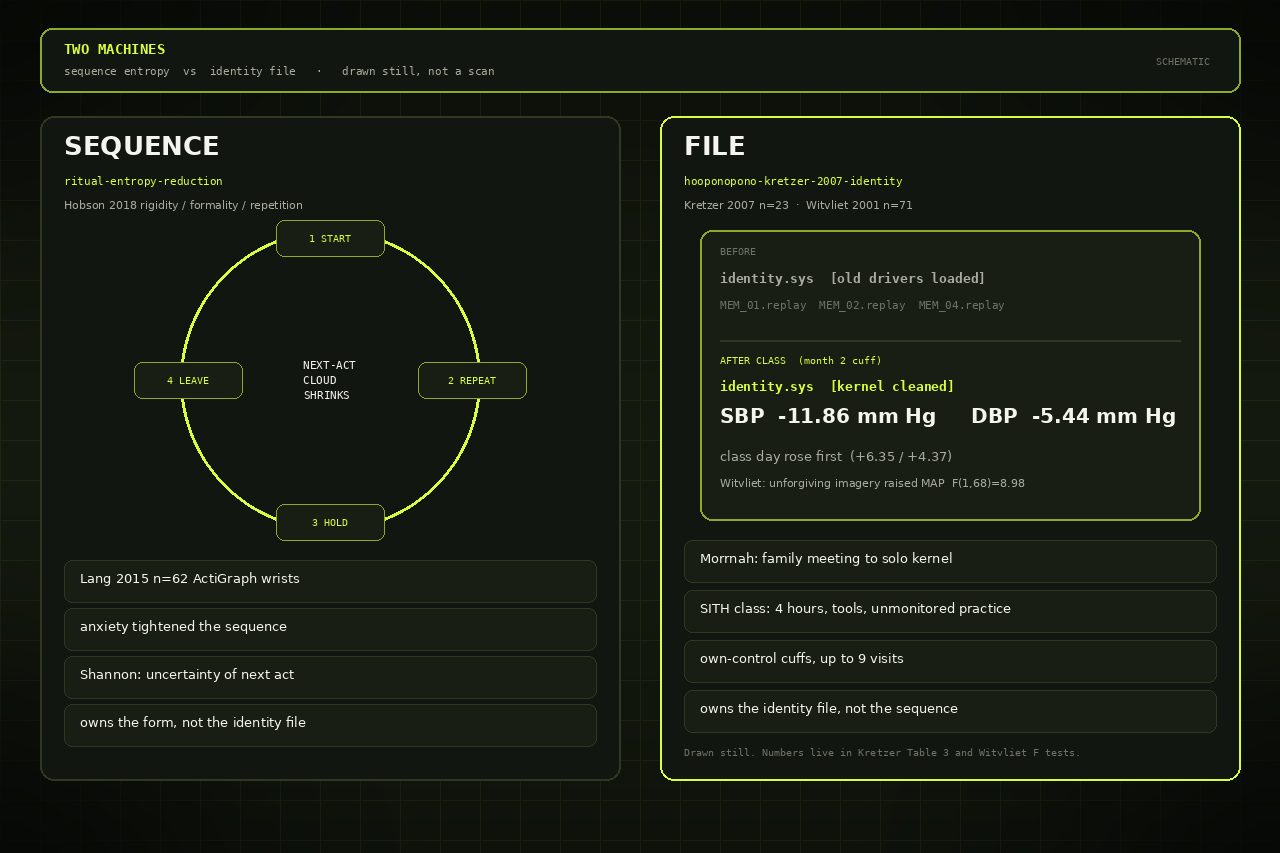
Unforgiving imagery ran higher MAP than forgiving imagery, F(1, 68)=8.98, P less than .01. Recovery MAP did not differ, F(1, 68)=0.185, P=.668. Footnote 2: diastolic stayed higher through the unforgiving blocks. Systolic ran higher in unforgiving epochs two and three. Heart rate, skin conductance, and corrugator stayed elevated into recovery. The authors called the 16-second lab a conservative picture of what a real grudge does in a kitchen, because Lang already said imagery effects mirror life and run smaller.
Self-report on a 0-to-20 stick: unforgiving valence 5.63 versus forgiving 13.21. Arousal 15.34 versus 7.21. Anger 15.75 versus 5.11. Control 8.37 versus 13.03. Empathy 3.87 versus 13.91. Forgiveness 4.08 versus 14.64. Those are Table 1 means. They are ratings, and they move in the same direction as the cuff.
Lawler, Younger, Piferi, Billington, Jobe, Edmondson, Jones. A change of heart. Journal of Behavioral Medicine 2003, 26(5):373-393. DOI 10.1023/A:1025771716686. I opened the Springer abstract. One hundred eight college students, 44 men, 64 women. Two betrayal interviews, parent and friend or partner. Trait forgiveness associated with lower blood pressure. State forgiveness associated with lower blood pressure, heart rate, and rate-pressure product. State forgiveness also tracked diastolic and mean-arterial reactivity in the parent interview. I left the full tables in the paywall. The abstract is enough to name the family: a grudge has a cardiovascular cost. A forgive-script has a smaller one. Kretzer put a Hawaiian identity class on that same cost and watched the cost fall for two months.
The Hawaii State Hospital story stays unlabeled
Joe Vitale made Ihaleakala Hew Len famous for cleaning a ward of criminally insane patients without interviewing them. The story sells. It has no trial n in the files this URL uses. No Ethnicity and Disease table. No GEE. No IRB stamp I can open tonight. I left it unlabeled. A legend can wait. Twenty-three cuffs cannot.
SITH still teaches that you clean the memories in you that replay as the problem out there. That claim is metaphysical. Kretzer did not measure a ward. She measured systolic and diastolic in community adults who already had high numbers, who sat a four-hour class, who kept their pills, and who came back for cuffs. The identity rewrite, in her discussion, is a stress cut. Cortisol. Catecholamines. Vasoconstriction. Those are ordinary nouns. They are enough.
If a later RCT ever puts Hew Len's ward story on a protocol sheet, that paper can have its own URL. This one stays with Table 3.
Memories replay. Cleaning is a delete command.
Volume 7 said reality is software. A memory that keeps replaying is a driver that boots on startup. Ho'oponopono, in Morrnah's solo form, treats that driver as something you can repent plus forgive plus transmute. Kretzer's participants learned processes to care for themselves through those three verbs. Then they went home. The cuff, two months later, sat lower.
A sigil compresses a sentence and dumps the watcher. That URL already exists. A mantra is an audible loop that moved an amygdala in a 2011 NIMHANS pilot. That URL already exists. This URL owns the identity file. You name the replay. You clean it. You stop arguing with the person who stars in the replay, because the file is in you.
That is a hard teaching. It is also the one buyers keep paying for. Total responsibility, in the SITH brochure, means every problem that enters awareness is a memory asking to be cleaned. You can take that as metaphysics. You can take it as a practical rule: the only lever you always have is the state you are running. Kretzer's millimeters are the second reading. Witvliet's MAP F test is the first. Together they say a grudge is expensive hardware, and a clean identity is cheaper to run.
Joe Dispenza's open-label placebo page already owns expectation as a drug. This page owns forgiveness as a kernel command. Two files. Same hunger for a life that answers.
Four phrases as a retrieval cue
Thumb plus two fingers, on the Silva page, is a conditioned trigger loaded at alpha. The four phrases are the hallway version of SITH. You pinch the identity with a sentence. I'm sorry names the replay. Please forgive me asks the field, or the Divine, or your own superconscious, to drop it. Thank you receipts the drop. I love you returns the system to a quieter set point. SITH teachers call that the Zero State. Kretzer did not print Zero State in the 2007 results. She printed millimeters.
You can run the four phrases in a chair tonight. You cannot pretend that chair is Kretzer's class. Her class had an instructor, a four-hour arc, and a community of twenty-three people who already lived with high pressure. Practice after the class went unmonitored, which means some of them may have used the tools daily and some may have used them once. The GEE still found a two-month drop. That is either a strong class or a noisy small n. Both can be true. The interval on month-two systolic runs from minus 20.77 to minus 2.96. Wide. Still below zero.
A daily stack still wants a number you can fail in public with yourself. The phrases can be the identity pass. The breath can be the hardware pass. Mixing them in one sitting is fine. Calling the mix a published protocol is how people invent a lab n. This page does not invent one.
The sequence page lives next door
One contrast, then a wall. A ritual is entropy-reduction tech, a low-entropy sequence Hobson named and Lang put on a wrist. That URL owns the form. This URL owns the file. You can run a tight morning sequence and still boot an old identity. You can clean an identity and still leak entropy all afternoon. Two machines. Same hunger.
A mantra page already measured an audible loop. OM chanting showed limbic deactivation on a NIMHANS pilot fMRI. Four phrases can ride that loop. They still do identity work first. Silva owns the awake alpha countdown. SATS owns the drowsy hour. This URL stays with the kernel.
The stills on these files are schematic. Quote Table 3. Quote Witvliet's F tests. Leave the art as art.
A chair number still owns the week
You cannot take a Welch Allyn 420 home. You can take a 1 to 10 on whether a replay actually quieted, and a binary on whether you ran a clean. Chair numbers. A week can produce them.
Protocol 01 is free and daily. Four-count inhale, eight-count exhale, seven minutes. Write the number before you start, write it after you stop. The nerve still has to carry the current. Ho'oponopono is the identity rewrite. The count is the morning stack. Run both if you want a week you can fail in public with yourself.
The Library of Biological Wizardry holds the rest of the sequence, the ledger, and the live instruments, and it can wait until the count has earned the next hour. No initiate password. A kernel, a cuff story, a number.
Run the count, then the clean
Four in, eight out, seven minutes, a number before and a number after. That is the daily stack. Later, one short identity pass on a replay that still boots. This page named the kernel. The Library is the rest of the map, and you can walk there when you want the next file.
This is an educational mechanism page by JM Thomas. A clinician owns diagnosis and treatment of any disease. Kretzer 2007 is a hypertension adjunct study in twenty-three adults. Witvliet 2001 is a 16-second imagery study in seventy-one students. Lawler 2003 is a betrayal-interview cuff study in one hundred eight students. Talk to a clinician if unusual distress, dissociation, or a psychiatric history is on the table.
FAQ
Short answers you can lift. Drawn stills. Educational page.
What did Kretzer 2007 actually measure?
Own-control blood pressure in 23 adults after a four-hour Self Identity through Ho'oponopono class. Ethnicity and Disease 17(4):624-628. PMID 18072370. Month two: systolic minus 11.86 mm Hg, diastolic minus 5.44. Class day the cuff rose.
Did blood pressure fall on the class day?
It rose. Table 3, intervention day: systolic plus 6.35 mm Hg, diastolic plus 4.37. The drop showed up in month one and deepened in month two. Honest from the first table.
Was this a randomized trial?
No RCT. Pre-test versus post-test, participants as their own controls. Five of 23 changed antihypertensive meds. Kretzer asked for a randomized trial to lock the finding. This URL keeps that ask.
How does Witvliet 2001 sit next to Kretzer?
Witvliet put a grudge and a forgive-script on the same 71 people, 16-second imagery blocks. Mean arterial pressure ran higher in the unforgiving blocks, F(1,68)=8.98. Kretzer put a four-hour identity class on a two-month cuff. Same hunger. Two clocks.
Did Ihaleakala Hew Len empty a hospital ward?
That story has no trial n in the files this URL uses. Kretzer 2007 is the lock. Twenty-three people. A four-hour class. Table 3.
Are the four phrases the whole method?
They are the internet retrieval cue. Kretzer's class used lectures, discussion, breathing plus prayer plus meditation tools from Self Identity through Ho'oponopono. Practice after class was left to discretion and went unmonitored.
Where do I get a daily number?
Protocol 01. Four-count inhale, eight-count exhale, seven minutes. Write a 1 to 10 before and after. Ho'oponopono is the identity rewrite. The count is the daily stack.
Is this medical advice?
Educational mechanism page by JM Thomas. A clinician owns diagnosis and treatment. Kretzer 2007 is a hypertension adjunct study. Witvliet 2001 is a 16-second imagery study. Lawler 2003 is a betrayal-interview cuff study.
The records this URL uses
Kretzer, K., Davis, J., Easa, D., Johnson, J., and Harrigan, R. "Self identity through Ho'oponopono as adjunctive therapy for hypertension management." Ethnicity and Disease 2007;17(4):624-628. PMID 18072370. I opened the full five-page article (idoc.pub scan of ethn-17-04-624) and the Europe PMC abstract. n=23, own-control, four-hour SITH class, up to nine cuff visits. Table 3: all-post SBP -6.81 / DBP -3.51. Class day SBP +6.35 / DBP +4.37. Month 1 SBP -7.83 / DBP -4.16. Month 2 SBP -11.86 / DBP -5.44. SOI 5.42 to 5.70, P=.02. SSQ 5.67 to 5.98, P=.01. 21 of 23 finished both questionnaires. 5 of 23 changed meds. NIH R25RR019321 and 5P20RR011091. europepmc.org/article/MED/18072370 · jstor.org/stable/48667126
Witvliet, C.V.O., Ludwig, T.E., and Vander Laan, K.L. "Granting forgiveness or harboring grudges." Psychological Science 2001;12(2):117-123. DOI 10.1111/1467-9280.00320. PMID 11340919. I opened the Hope College PDF. n=71 (36 male, 35 female). MAP F(1,68)=8.98, P<.01, unforgiving > forgiving. Recovery MAP F(1,68)=0.185, P=.668. Table 1 ratings on a 0-20 stick. doi.org/10.1111/1467-9280.00320 · europepmc.org/article/MED/11340919 · Hope College PDF
Lawler, K.A., Younger, J.W., Piferi, R.L., Billington, E., Jobe, R., Edmondson, K., and Jones, W.H. "A change of heart: cardiovascular correlates of forgiveness in response to interpersonal conflict." Journal of Behavioral Medicine 2003;26(5):373-393. DOI 10.1023/A:1025771716686. I opened the Springer abstract. n=108 (44 male, 64 female). Trait forgiveness associated with lower blood pressure. State forgiveness associated with lower blood pressure, heart rate, and rate-pressure product. Full tables behind the publisher. doi.org/10.1023/A:1025771716686
Elkins, D.N., Hedstrom, L.J., Hughes, L.L., Leaf, J.A., and Saunders, C. "Toward a humanistic-phenomenological spirituality." Journal of Humanistic Psychology 1988, 28:5-18. Kretzer's reference 6 for the Spiritual Orientation Inventory, 85 items, seven-point, nine domains. Instrument citation. doi.org/10.1177/0022167888281002
SITH IZI online lecture listing, 30 August 2026, instructor Nello Ceccon. Official desk fetched 16 August 2026. Demand, not data. hooponopono-asia.org IZI lecture
Inner Haven, Grayslake, Illinois, free Ho'oponopono-inspired community meditation, 10 August 2026. Demand, not data. happeningnext.com Grayslake listing