joe dispenza · ucsd · open-label placebo
People search Joe Dispenza for a how. UCSD measured a seven-day retreat.
You wanted a how you could run, not just a name.
Joe Dispenza is a teacher people search when they want a how for manifestation and healing. Manifestation is the hope that your thoughts and acts can change what happens next. Healing is the hope that the body can get better. You wanted a how you could run, not just a name. In 2025, Jinich-Diamant and colleagues watched twenty people through a seven-day retreat that Dispenza led, then published in Communications Biology, a journal that prints papers on how living systems work. The study was observational, which means they watched people through a week and they did not run a control group. A control group is a second group that skips the week so you can compare.
Who is Joe Dispenza?
People search Joe Dispenza when they want a how for manifestation and healing. They look up his name because they want steps they can run. UC San Diego Today wrote that he led this retreat and that he is a co-author on the paper. The writers also say he is employed by Encephalon, Inc., the company that offered the week.
What did the UCSD paper watch?
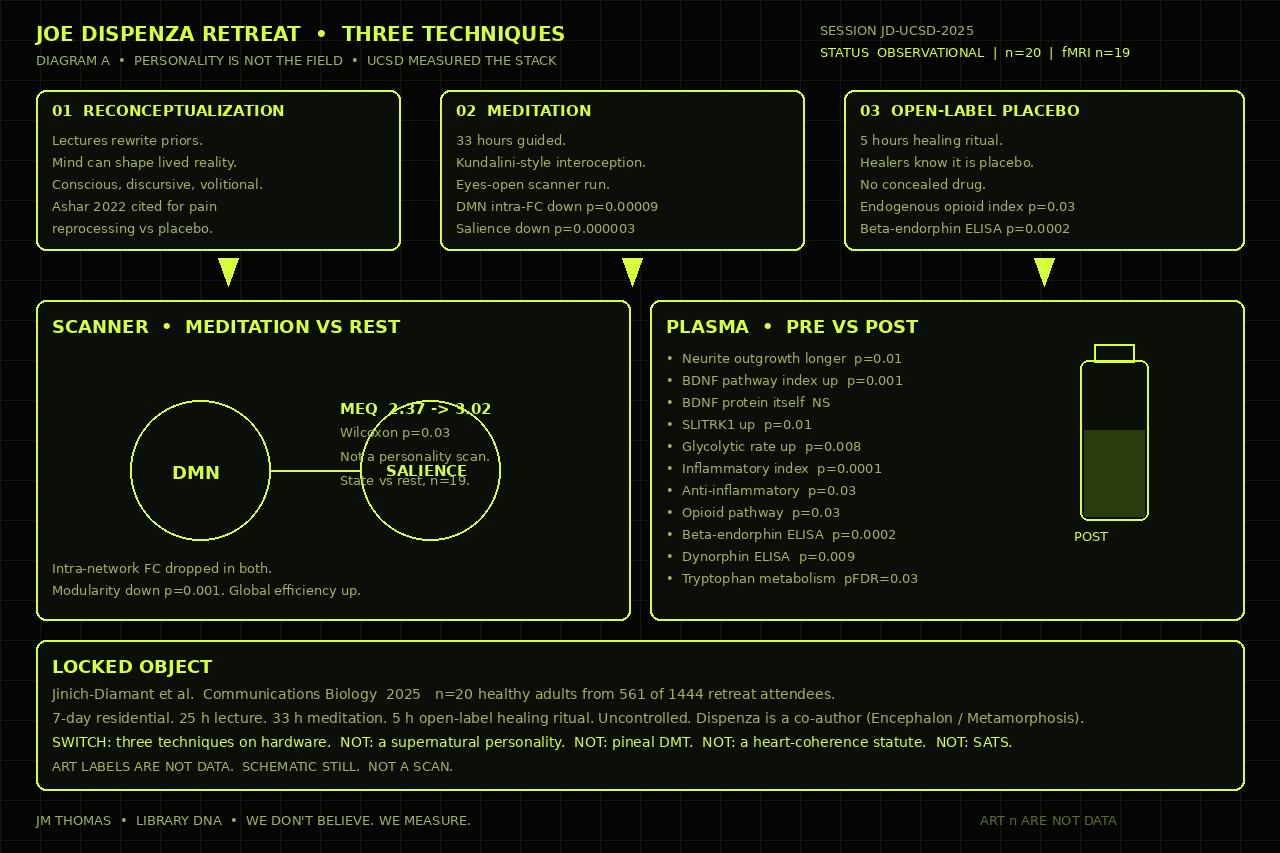
Jinich-Diamant and colleagues picked twenty healthy adults from a bigger retreat, fourteen of them women, age 46.35 plus or minus 10.06 years, chosen at random from 561 people who answered a form out of 1444 people at the retreat. They watched those twenty people for seven days.
People heard 25 hours of lectures. They also spent 33 hours in guided meditation. People spent 5 hours in healing rituals, and nobody hid a drug. The team scanned 19 brains after one T1 file came out corrupt. A T1 file is a structural brain picture, and a corrupt file is a picture the lab could not use.
Jinich-Diamant named three techniques. Reconceptualization is changing how you think about the body. The meditations were guided, and the teachers taught Kundalini-style interoception, which means noticing feelings inside the body and moving that noticing up the middle of the body the way those teachers often do. Open-label placebo healing rituals are the third technique.
People know book names like You Are the Placebo and Becoming Supernatural, and they know a practice called Blessing of the Energy Centers. The authors did not lock any of those three names as the one thing they tested on its own. Dispenza led the week and he is a co-author.
What is an open-label placebo?
An open-label placebo is a ritual or a dummy treatment you take even though you know what it is, and you still take it. The healing circles at this retreat were presented the way open-label placebos are presented in trials.
Carvalho and colleagues wrote a 2016 paper on open-label placebo for chronic low back pain, which means pain that had lasted a long time, and Jinich-Diamant points to that back-pain paper as the open-label placebo literature. Carvalho studied low back pain. Jinich-Diamant watched this retreat.
What changed in the brain after the week?
They used fMRI, a scan that watches blood flow in the brain, and they compared meditation with rest in 19 people. After the week, those 19 people showed less talking inside the default-mode network, which is the brain's resting chatter network. They also showed less talking inside the salience network, the set of brain areas that flag what matters right now. The whole brain looked less split into separate modules, which means the networks were less cut off from each other.
People filled out the MEQ-30 while they meditated in the scanner. That form asks how big the inner experience felt. People scored higher after the week than they did before it. You can read the Communications Biology paper.
What changed in the blood after the week?
They drew plasma, the liquid part of blood, before the week and after it in all twenty people. They put that plasma on nerve cells in a dish. A neurite is a growing arm on a nerve cell in a dish, and after the week the group saw longer neurites.
The group saw a 26-protein BDNF pathway index go up. An index here is a score they built from many proteins, and BDNF is a growth signal in the brain. BDNF protein itself did not move enough to count as a real change. They measured a rise in a protein called SLITRK1. They also saw a higher basal glycolytic rate, which means the cells in the dish burned sugar faster. They measured higher indexes for inflammation, anti-inflammation, and the body's own opioid pathway. ELISA is a lab test that looks for a specific protein, and that test found more beta-endorphin and more dynorphin, two of the body's own pain-easing chemicals. They also saw a shift in tryptophan metabolism. Tryptophan is a building block the body uses to make mood signals.
Can they tell which hour did it?
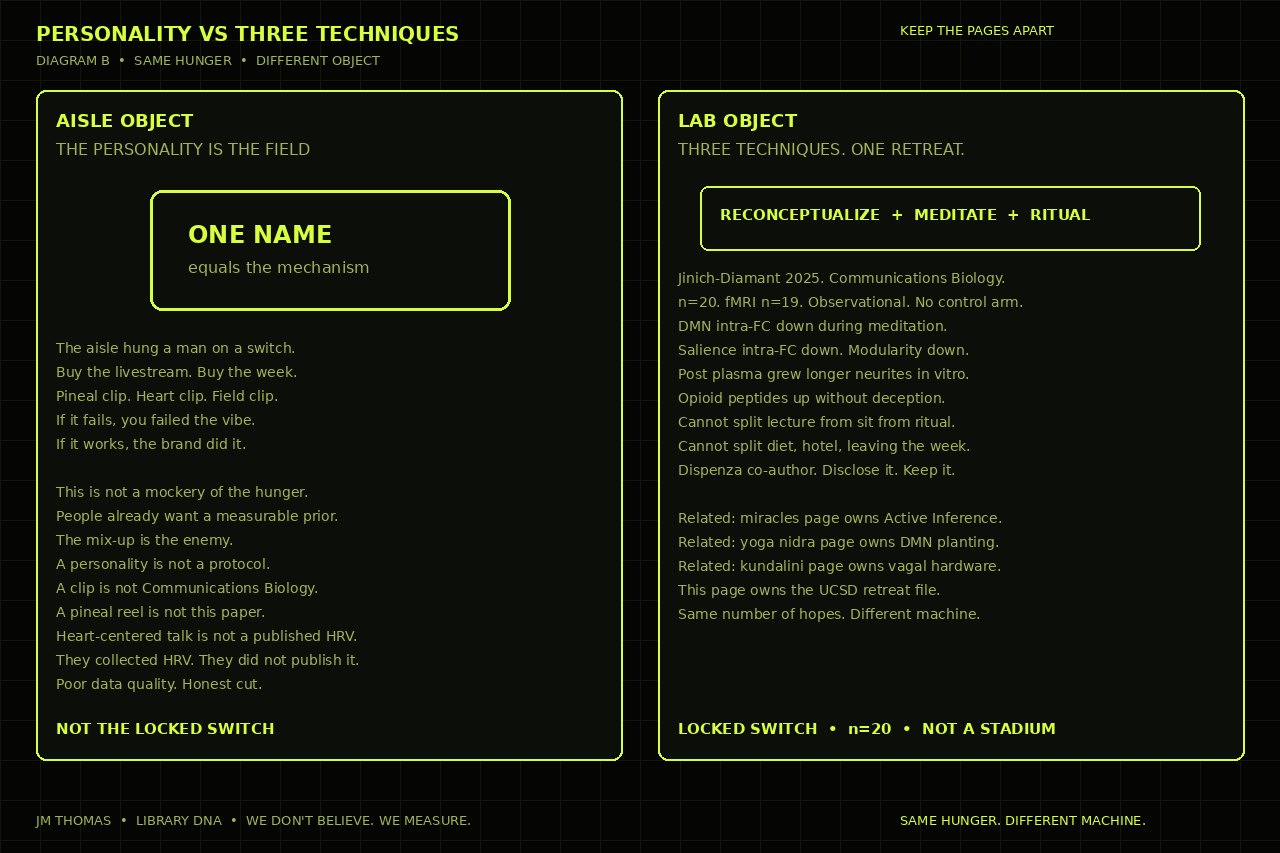
They cannot split the lectures from the meditation from the healing rituals from the hotel week. They did not run a second group that skipped the week, and they did not run a group that only heard lectures, or only meditated, or only joined the circles. Keep wanting a how. The plain fact is they cannot split which hour did it.
How does yoga nidra relate to this week?
Another page on this site covers Fialoke's 2024 yoga nidra paper. Yoga nidra is yogic sleep, a rest where you stay aware, and Fialoke watched the chatter network during a short rest. Jinich-Diamant watched a seven-day retreat with lectures, meditation, and open healing rituals. Both groups saw a quieter chatter network. Open the yoga nidra page if you want that rest.
If this week or these numbers bring unusual distress, talk to a clinician, because this page is educational. The paper watched 20 people and had no control group.
What do you do with this now?
You wanted a how you could run, not just a name. Keep wanting a how.
The week used lectures, meditation, and open healing rituals. You can still want a how you can run.
Sources
Jinich-Diamant, A., et al. "Neural and molecular changes during a mind-body reconceptualization, meditation, and open label placebo healing retreat: an observational study." Communications Biology 2025. Observational, uncontrolled, n=20 healthy adults, 14 female, age 46.35 plus or minus 10.06, randomly selected from 561 of 1444 retreat attendees, fMRI n=19 after one corrupt T1, 7 days, 25 hours of lectures, 33 hours of guided meditation, and 5 hours of healing rituals presented without a concealed drug. Dispenza led the week and is a co-author. Three named techniques: reconceptualization, meditation, open-label placebo healing rituals, with meditations guided and taught Kundalini-style interoception, healing circles presented the way open-label placebos are presented in trials, and no methods line that locks Blessing of the Energy Centers, You Are the Placebo, or Becoming Supernatural as the independent variable. Meditation versus rest, n=19: default-mode intra-network connectivity down after the week, t equals -5.04, p equals 0.00009, Cohen d equals -1.78; salience intra-network connectivity down, t equals -6.71, p equals 0.000003, d equals -1.76; whole-brain modularity down, F 1,18 equals 15, p equals 0.001. MEQ-30 during the scanner sit: pre 2.37 plus or minus 1.26, post 3.02 plus or minus 1.44, Wilcoxon p equals 0.03. Post-retreat plasma, n=20, versus pre: PC12 neurites grew longer in vitro, p equals 0.01; a 26-protein BDNF pathway index went up, t equals 3.21, p equals 0.001; BDNF protein itself was not significant; SLITRK1 went up, p equals 0.01; basal glycolytic rate up, p equals 0.008; inflammatory index p equals 0.0001; anti-inflammatory index p equals 0.03; endogenous opioid pathway index p equals 0.03; ELISA beta-endorphin p equals 0.0002 and dynorphin p equals 0.009; tryptophan metabolism pFDR equals 0.03. Honest cut: they cannot split lecture from sit from ritual from hotel week. DOI 10.1038/s42003-025-09088-3. doi.org/10.1038/s42003-025-09088-3
Same article via DOI. doi.org/10.1038/s42003-025-09088-3
University of California San Diego. "Meditation Retreat Rapidly Reprograms Body and Mind." UC San Diego Today. Retreat led by Joe Dispenza, D.C. Disclosure: Dispenza employed by Encephalon, Inc. today.ucsd.edu/story/meditation-retreat-rapidly-reprograms-body-and-mind
Carvalho, C. et al. "Open-label placebo treatment in chronic low back pain: a randomized controlled trial." Pain 2016. Cited as the literature for open-label placebo. Not this retreat. n not locked on this page. DOI 10.1097/j.pain.0000000000000700. doi.org/10.1097/j.pain.0000000000000700
Fialoke, S. et al. "Functional connectivity changes in meditators and novices during yoga nidra practice." Scientific Reports 2024;14:12957. Related reading only. One short mapping. DOI 10.1038/s41598-024-63765-7. doi.org/10.1038/s41598-024-63765-7