Mechanism · Ritual · Entropy · Structure

A ritual is entropy-reduction tech.

JM Thomas · Paris, Tennessee · 15 August 2026

A ritual is a low-entropy sequence. The old map kept the form when the gatekeeper said the form was empty. The lab map is entropy reduction of the action and the policy, not a cooled universe. Shannon entropy is uncertainty of a distribution. A candle is not a Maxwell demon. If anything, ritual is structure. We don't believe. We measure. The stills on this page are schematic.

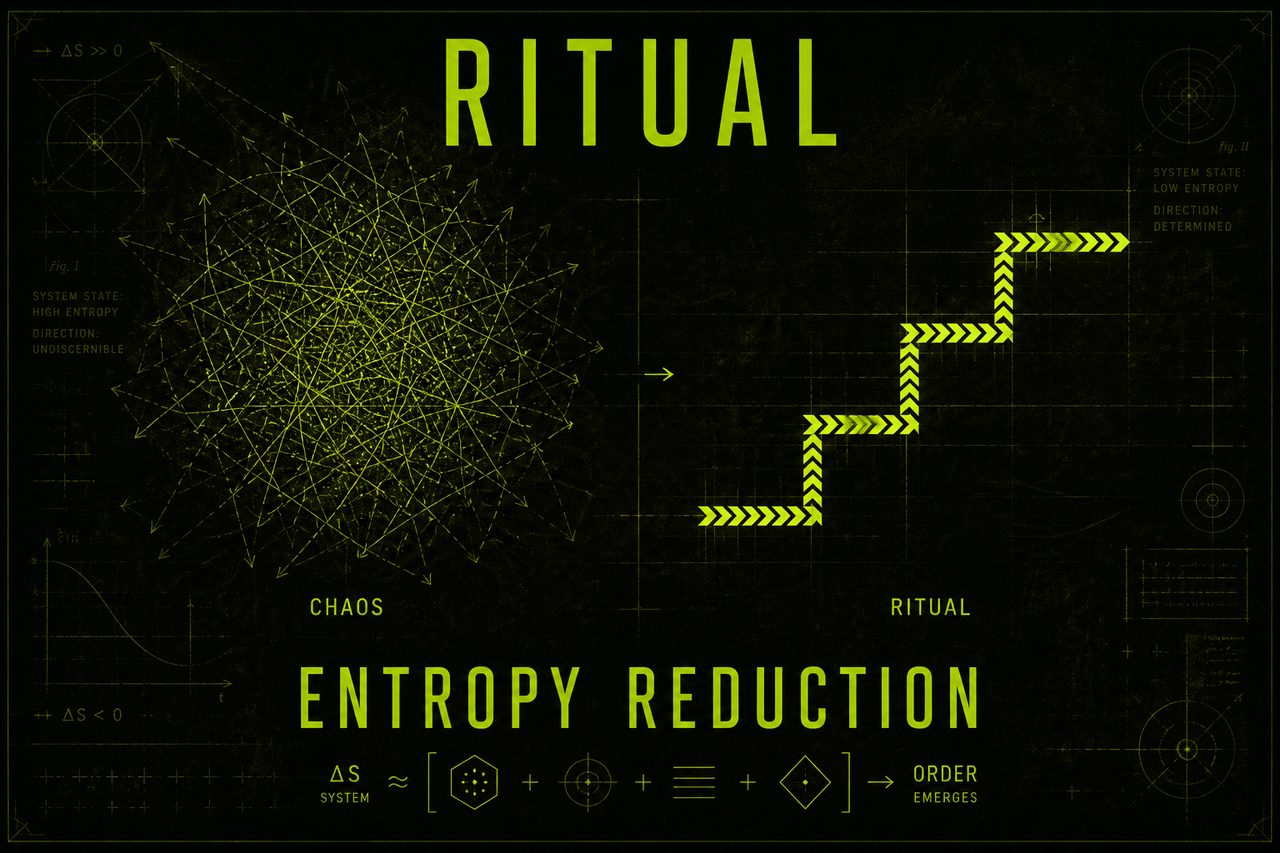
Dark lime schematic: CHAOS high-entropy arrows collapsing into a RITUAL stepped path labeled ENTROPY REDUCTION. Schematic still, not a scan.
Chaos arrows into a ritual path labeled entropy reduction. Schematic still. Do not quote ΔS, art formulas, or slider numbers as data.

I write from Paris, Tennessee. People ask me if ritual is superstition. They paste a reel that says a ritual rewrites physics. They want the HOW without throwing the form away. Those are hardware questions. I will answer the hardware. I will not baptize a candle as a Maxwell demon. I will not tell you the people who kept a sequence were stupid.

The gatekeeper said the form was empty. Bow, sit, repeat: theater for people who needed a story. The aisle said the opposite lie. Buy the object. Skip the sequence. Call it physics. Both hid the mechanism. The people who kept a morning cycle, a temple round, a pre-shot routine were running entropy-reduction tech with the wrong nouns. Reality Engineering is the science of making reality respond to intent. Yesterday's empty form is today's engineering when you name the loop.

What is a ritual, in this stack?

A ritual is a low-entropy sequence. Hobson, Schroeder, Risen, Xygalatas, and Inzlicht (2018) define rituals as predefined sequences characterized by rigidity, formality, and repetition, embedded in a larger system of symbolism and meaning, containing elements that lack direct instrumental purpose. Three functions: emotion, performance goal states, social connection. The old map kept the form. The lab map is entropy reduction of the action and the policy, not a cooled universe. If anything, ritual is structure.

Hobson, Schroeder, Risen, Xygalatas, and Inzlicht. Personality and Social Psychology Review, 2018. The psychology of rituals: an integrative review and a process-based framework. I opened the PDF. Rituals, they write, are predefined sequences characterized by rigidity, formality, and repetition. They are embedded in a larger system of symbolism and meaning. They contain elements that lack direct instrumental purpose. That last clause is the part the gatekeeper used as a weapon. If a step does not move the object, it is empty. Hobson does not say empty. Hobson says the extra steps are part of the machine.

Three functions in their frame. Emotion regulation. Performance goal states. Social connection. I am using their definition. I am not recycling the studies they cite. The candle aisle sells the symbolism without the rigidity. The gatekeeper sells the rigidity as a costume. Both skip the sequence as a constraint on what you can do next.

Related reading: a mantra is a loop you can measure. Related reading: a sigil is data compression. Encode. Release. Stop watching the pot. Those pages are tools. This page is the sequence those tools sit inside. A compressed intended state still needs a low-entropy policy, or the next act explodes into noise.

What kind of entropy does a ritual reduce?

Shannon entropy is the uncertainty of a distribution. Clausius entropy is thermodynamics. A ritual does not lower the thermodynamic entropy of the room. Hirsh, Mar, and Peterson (2012) treat psychological entropy as uncertainty and disorder, a framework for uncertainty-related anxiety, not a kitchen thermometer of the soul. Four tenets: keep uncertainty manageable; uncertainty comes from competing perceptual and behavioral affordances; clear goals and beliefs constrain the spread of those affordances; uncertainty is experienced as anxiety, associated with the anterior cingulate and heightened noradrenaline. The claim on this page is about the spread of possible next acts, not the heat of a candle.

Claude Shannon, 1948. A Mathematical Theory of Communication. Information entropy is the uncertainty of a distribution. A fair coin is one bit. A loaded coin is less. A ritual that always starts the same way, always hits the same marks, always ends on the same breath, is a distribution with a small support. That is the honest information sentence. It does not require you to mock anyone who kept a form. It requires you to stop pretending the form did no work.

Clausius entropy is heat over temperature. The universe does not get colder because you lit a wick. Living systems keep local order by exporting disorder. A ritual does not violate that. Do not baptize a candle as a Maxwell demon. The stills on this page will draw arrows and funnels. Those arrows are schematic. They are not a dataset. They are not a ΔS you can quote as if a lab measured the room.

Jacob Hirsh, Raymond Mar, and Jordan Peterson. Psychological Review, 2012. Psychological entropy: a framework for understanding uncertainty-related anxiety. They take entropy from thermodynamics and from information theory and use it as uncertainty and disorder. Honest: this is a framework, not a kitchen thermometer of the soul. Four tenets. Keep uncertainty at a manageable level. Uncertainty arises from competing perceptual and behavioral affordances. Clear goals and beliefs constrain the spread of those affordances. Uncertainty is experienced as anxiety, associated with the anterior cingulate cortex and heightened noradrenaline.

Anxiety makes the hands repeat

Yes, in the 2015 lab map. Lang, Krátký, Shaver, Jerotijević, and Xygalatas induced public-speaking anxiety in 62 undergraduates (31 high-anxiety, 31 low-anxiety), then had them clean a decorative object while wearing a wrist ActiGraph. Induced anxiety increased repetitiveness and rigidity, not redundancy. Heart rate predicted repetitiveness and rigidity. Self-perceived anxiety marginally predicted redundancy. The authors say the findings accord with an entropy model of uncertainty: anxiety motivates organisms to return to familiar low-entropy states.

Lang, Krátký, Shaver, Jerotijević, and Xygalatas. Current Biology, 2015. Effects of Anxiety on Spontaneous Ritualized Behavior. Sixty-two undergraduates. High-anxiety n=31. Low-anxiety n=31. Public-speaking anxiety, then clean a decorative object. Wrist ActiGraph. Induced anxiety increased repetitiveness and rigidity, not redundancy. Heart rate predicted repetitiveness and rigidity. Self-perceived anxiety marginally predicted redundancy.

The authors' sentence is the one I will keep. The findings accord with an entropy model of uncertainty. Anxiety motivates organisms to return to familiar low-entropy states. You get noisy. The hands look for a small set of moves. The form is not a personality quiz. It is a collapse of the action space. I am not diagnosing anyone who cleans twice. I am naming a paper that put a motion sensor on the wrist and watched the sequence tighten when the heart rate rose.

Does the sequence actually drop anxiety?

Sometimes, modestly, and the weather is honest. Lang, Krátký, and Xygalatas (2020) compared a habitual temple ritual in Mauritius to sitting and relaxing after a public-speaking induction (n=75). The ritual condition showed lower perceived anxiety and lower physiological anxiety assessed as heart-rate variability. Degree of ritualization was suggestive albeit variable. In 2022, n=268 Czech students (92 ritualized, 85 control, 91 neutral). Ritualized action decreased anxiety, but only slightly larger than control or neutral. Confidence intervals often included zero for between-condition differences. The effect was better estimated in the high cognitive-anxiety half. If anything, ritual is structure. We don't believe. We measure.

Two maps. Field, then lab. Honest weather on both.

Lang, Krátký, and Xygalatas. Philosophical Transactions of the Royal Society B, 2020. The role of ritual behaviour in anxiety reduction. An investigation of Marathi religious practices in Mauritius. n=75. Public speaking induction, then a habitual temple ritual versus sit and relax. Ritual condition: lower perceived anxiety and lower physiological anxiety assessed as heart-rate variability. Degree of ritualization: suggestive albeit variable. Further investigation needed. I will not invent an HRV percent. The paper did not hand me a slider to quote as data. The stills will not supply one either.

Lang, Krátký, and Xygalatas. Scientific Reports, 2022. Effects of predictable behavioral patterns on anxiety dynamics. Open paper. n=268 Czech students. 92 ritualized. 85 control. 91 neutral. Hypothesis: repetitive rigid sequences help the cognitive-behavioral system return to low-entropy states. Their line, quote-level: "If anything, ritual is structure." And: "the generative model samples predictions from a well-known probability distribution of habitual behaviors." They cite Friston 2010 and Hirsh 2012. Result: ritualized action decreased anxiety, but only slightly larger than control and neutral. Confidence intervals often included zero for between-condition differences. Better estimated in the high cognitive-anxiety half.

That is not a miracle. That is not a joke. That is a small, honest effect that shows up more where the entropy is already high. The aisle will skip the confidence intervals. The gatekeeper will skip the field result. I will keep both. We don't believe. We measure. If you needed a sequence to be a law of physics, this page will disappoint you. If you needed it to be nothing, this page will disappoint you too.

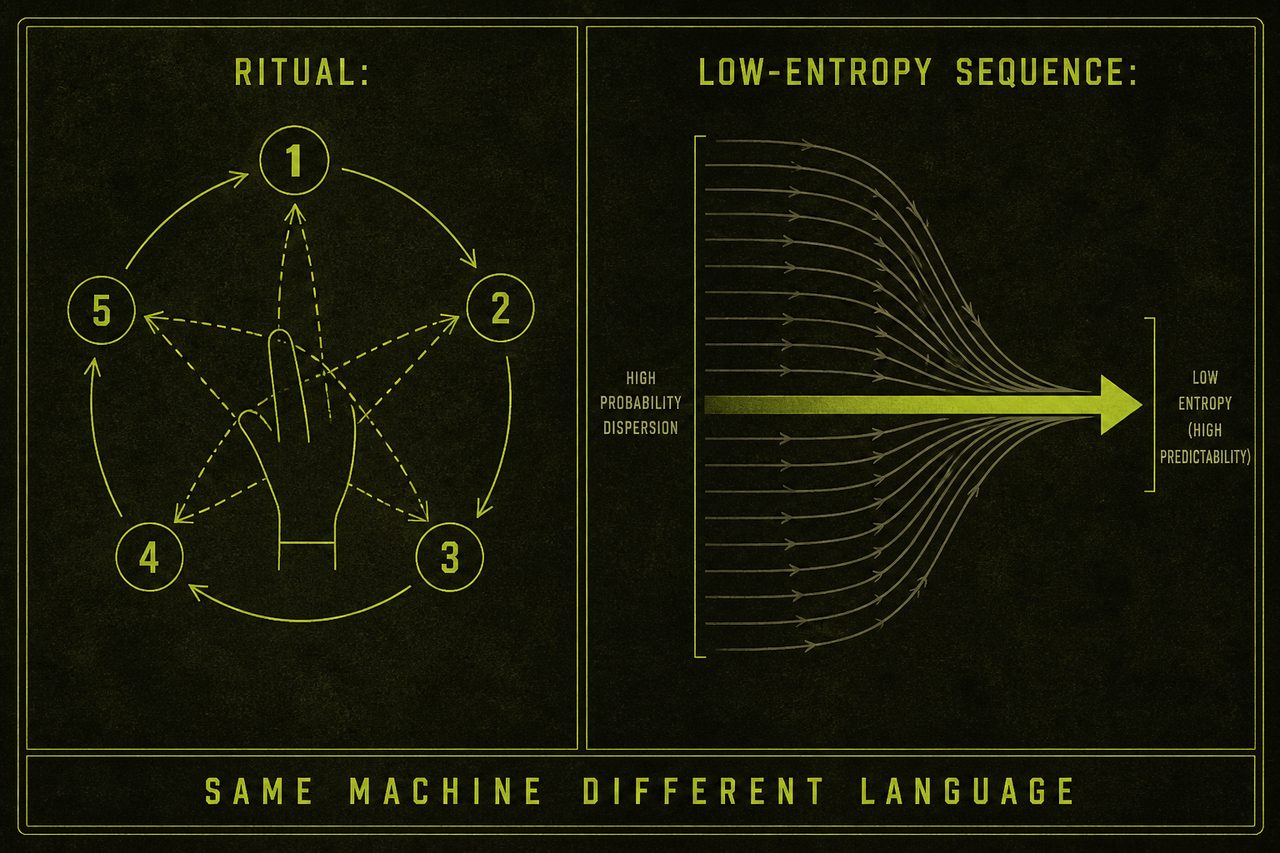
Two-panel schematic: RITUAL numbered cycle versus LOW-ENTROPY SEQUENCE funnel. Footer SAME MACHINE DIFFERENT LANGUAGE. Schematic still, not a scan.
Ritual numbered cycle versus a low-entropy sequence funnel. Schematic still. Footer is the claim. Do not quote ΔS, art formulas, or slider numbers as data.

Active Inference is the same loop with different nouns

Karl Friston. Nature Reviews Neuroscience, 2010. The free-energy principle: a unified brain theory. A living system must keep its sensory entropy low. Surprise cannot be read out on a kitchen meter, so the system minimizes a bound on surprise. Two moves. Update the prediction. Or act until the world samples what you predicted. That is the whole mapping I need from that paper on this page.

Related reading: a miracle is an update the old model called impossible. That page is the surprise loop. This page is the policy that shrinks the next-act cloud so surprise has less room to live. I will not clone that article here. One short mapping. A ritual is a habitual policy. Lang 2022 already said the generative model samples from a well-known distribution of habitual behaviors. Friston named the bound. Hobson named the sequence. Same machine, different language. The still footer is the claim. It is not a scan of a mass.

Precaution, goal demotion, the lagoon and the sea

Pascal Boyer and Pierre Liénard. Behavioral and Brain Sciences, 2006. Why ritualized behavior? Precaution systems and action parsing in developmental, pathological, and cultural rituals. Ritualized behavior as a precaution system plus action parsing. Goal demotion: the usual end-state of the act recedes, and the steps themselves swamp working memory. Named as the old cognitive map, not as a scan of a mass. The swamp is not an insult. It is a mechanism. If the steps eat the buffer, fewer rival acts can fire. The next-act cloud shrinks because the buffer is full of the form.

Bronislaw Malinowski. Magic, Science and Religion. Trobriand lagoon fishing versus open-sea fishing. In the lagoon, the work is technical. On the open sea, where uncertainty is high, the ritual load rises. Named as the ethnographic old map, not as a 2015 motion-capture trial. The sea is a high-entropy environment. The sequence is a way to keep the next act from exploding. The gatekeeper heard that story and said the form was empty. The aisle heard it and sold a charm for the commute. Both skipped the uncertainty. Both skipped the fact that the lagoon already had a technique, and the sea needed a constraint.

The dark twin of a sequence that will not yield

A sequence that will not yield is a trap. Lang 2015 and the entropy papers name OCD and ASD as over-ritualization in the literature. That is not a diagnosis of anyone reading this. It is the name the papers use when the rigidity does not return you to a usable state. It keeps you there. Measurement is the difference. A ritual you can start, finish, and leave is a constraint. A ritual that owns the hour, the room, and the next thought is a loop with the gain stuck high.

Boyer already warned that action parsing can swamp working memory. If the swamp never drains, you are not reducing entropy. You are living inside a small, expensive set. I am naming that so nobody uses this page as a license to ignore a clinician. If compulsive loops or rigid sequences distress you, talk to a clinician. This page is mechanism. It is not a protocol for a diagnosis. The people who needed a form were not the enemy. The enemy is the gatekeeper who called every form empty, and the aisle that will not let a form end.

NameWhat it actually isWhat it is not
RitualA predefined rigid, formal, repetitive sequence with symbolic embedding and non-instrumental steps (Hobson 2018)A candle that rewrites physics
Entropy (info)Uncertainty of a distribution (Shannon 1948). A ritual shrinks the next-act cloudA number you can read off a still
Entropy (thermo)Heat and temperature. A ritual does not cool the roomA Maxwell demon in a gift shop
Rigidity-repetitionThe features anxiety increased in Lang 2015. Heart rate predicted bothA personality type
Over-ritualizationA sequence that will not yield (OCD and ASD named as the papers' topic, not a diagnosis)A vibe you should ignore

Run the brake first.

A screaming nerve writes high entropy onto every next move. Protocol 01 is free. Four-count inhale. Eight-count exhale. Seven minutes. A number before and a number after. That is the hardware check. The Library of Biological Wizardry is the rest of the stack if the method earns the next hour. No initiate password. A sequence, then a measurement. We don't believe. We measure.

What should I run if I want a number?

Start with Protocol 01, the free Neural Recalibration. Four-count inhale, eight-count exhale, seven minutes, a number before and a number after. A screaming nerve writes high entropy onto every next move. You cannot run a clean sequence on that hardware. If the method earns it, the Library of Biological Wizardry is the rest of the stack. We don't believe. We measure.

You will not get a Mauritius temple trial in your kitchen. You can get a 1 to 10 on your own state, and a binary on whether you ran a sequence you can start and leave. That is the first instrument. Brake if the nerve is screaming. Then keep a form short enough to finish. Related reading: Active Inference is the surprise loop. Related reading: a sigil compresses the intended state. Related reading: a mantra is a measured loop. Related reading: a vajra is phononic-crystal fencing. A ritual is the low-entropy policy those tools sit inside. If anything, ritual is structure.

FAQ

Short answers you can lift from this page. Visible text matches the FAQ schema exactly. The stills are schematic. None of this is medical advice.

What is a ritual, in this stack?

A ritual is a low-entropy sequence. Hobson, Schroeder, Risen, Xygalatas, and Inzlicht (2018) define rituals as predefined sequences characterized by rigidity, formality, and repetition, embedded in a larger system of symbolism and meaning, containing elements that lack direct instrumental purpose. Three functions: emotion, performance goal states, social connection. The old map kept the form. The lab map is entropy reduction of the action and the policy, not a cooled universe. If anything, ritual is structure.

What kind of entropy does a ritual reduce?

Shannon entropy is the uncertainty of a distribution. Clausius entropy is thermodynamics. A ritual does not lower the thermodynamic entropy of the room. Hirsh, Mar, and Peterson (2012) treat psychological entropy as uncertainty and disorder, a framework for uncertainty-related anxiety, not a kitchen thermometer of the soul. Four tenets: keep uncertainty manageable; uncertainty comes from competing perceptual and behavioral affordances; clear goals and beliefs constrain the spread of those affordances; uncertainty is experienced as anxiety, associated with the anterior cingulate and heightened noradrenaline. The claim on this page is about the spread of possible next acts, not the heat of a candle.

Does anxiety make the hands repeat?

Yes, in the 2015 lab map. Lang, Krátký, Shaver, Jerotijević, and Xygalatas induced public-speaking anxiety in 62 undergraduates (31 high-anxiety, 31 low-anxiety), then had them clean a decorative object while wearing a wrist ActiGraph. Induced anxiety increased repetitiveness and rigidity, not redundancy. Heart rate predicted repetitiveness and rigidity. Self-perceived anxiety marginally predicted redundancy. The authors say the findings accord with an entropy model of uncertainty: anxiety motivates organisms to return to familiar low-entropy states.

Does a ritual actually drop anxiety?

Sometimes, modestly, and the weather is honest. Lang, Krátký, and Xygalatas (2020) compared a habitual temple ritual in Mauritius to sitting and relaxing after a public-speaking induction (n=75). The ritual condition showed lower perceived anxiety and lower physiological anxiety assessed as heart-rate variability. Degree of ritualization was suggestive albeit variable. In 2022, n=268 Czech students (92 ritualized, 85 control, 91 neutral). Ritualized action decreased anxiety, but only slightly larger than control or neutral. Confidence intervals often included zero for between-condition differences. The effect was better estimated in the high cognitive-anxiety half. If anything, ritual is structure. We don't believe. We measure.

Does a ritual cool the room?

No. A ritual is entropy-reduction tech for the action sequence and the policy. It is not a Maxwell demon that sorts the air. Shannon (1948) named information entropy as the uncertainty of a distribution. Mixing that with Clausius heat is how the aisle sells a candle as physics. The stills on this page are schematic. Do not quote the art as data.

What should I run if I want a number?

Start with Protocol 01, the free Neural Recalibration. Four-count inhale, eight-count exhale, seven minutes, a number before and a number after. A screaming nerve writes high entropy onto every next move. You cannot run a clean sequence on that hardware. If the method earns it, the Library of Biological Wizardry is the rest of the stack. We don't believe. We measure.

Is this medical advice?

No. This page is an educational mechanism explainer by JM Thomas. It is not a diagnosis, treatment, cure, or prevention of any disease. Named papers discuss over-ritualization in OCD and ASD as a literature topic, not a diagnosis of anyone reading this. A sequence that will not yield is a trap. If compulsive loops or rigid sequences distress you, talk to a clinician.

Sources I actually opened

Hobson, N.M., Schroeder, J., Risen, J.L., Xygalatas, D., Inzlicht, M. "The psychology of rituals: An integrative review and process-based framework." Personality and Social Psychology Review 22(3):260-284 (2018). Definition: predefined sequences characterized by rigidity, formality, and repetition; embedded in a larger system of symbolism and meaning; contain elements that lack direct instrumental purpose. Three functions: emotion, performance goal states, social connection. doi.org/10.1177/1088868317734944 · PDF

Lang, M., Krátký, J., Shaver, J.H., Jerotijević, D., Xygalatas, D. "Effects of Anxiety on Spontaneous Ritualized Behavior." Current Biology 25(14):1892-1897 (2015). n=62 undergraduates, HA n=31 / LA n=31. Public-speaking anxiety then clean a decorative object. Wrist ActiGraph. Induced anxiety increased repetitiveness and rigidity, not redundancy. Heart rate predicted repetitiveness and rigidity. Authors: findings accord with an entropy model of uncertainty. OCD and ASD named as over-ritualization in the literature, not a diagnosis of the reader. doi.org/10.1016/j.cub.2015.05.049 · PMID 26096971

Hirsh, J.B., Mar, R.A., Peterson, J.B. "Psychological entropy: A framework for understanding uncertainty-related anxiety." Psychological Review 119(2):304-320 (2012). Entropy from thermodynamics and information theory as uncertainty and disorder. Four tenets as used on this page. Honest: a framework, not a kitchen thermometer of the soul. doi.org/10.1037/a0026767 · author PDF

Lang, M., Krátký, J., Xygalatas, D. "The role of ritual behaviour in anxiety reduction: an investigation of Marathi religious practices in Mauritius." Phil Trans R Soc B 375:20190431 (2020). n=75. Habitual temple ritual vs sit and relax after public speaking. Lower perceived anxiety and lower physiological anxiety assessed as heart-rate variability. Degree of ritualization suggestive albeit variable. I did not invent an HRV percent. doi.org/10.1098/rstb.2019.0431

Lang, M., Krátký, J., Xygalatas, D. "Effects of predictable behavioral patterns on anxiety dynamics." Scientific Reports 12:19240 (2022). n=268 Czech students (92 ritualized / 85 control / 91 neutral). Quote-level: "If anything, ritual is structure." Ritualized action decreased anxiety, but only slightly larger than control or neutral. CIs often included zero for between-condition differences. Better estimated in the high cognitive-anxiety half. They cite Friston 2010 and Hirsh 2012. doi.org/10.1038/s41598-022-23885-4 · open

Boyer, P., Liénard, P. "Why ritualized behavior? Precaution Systems and action parsing in developmental, pathological and cultural rituals." Behavioral and Brain Sciences 29:595-650 (2006). Ritualized behavior as precaution plus action parsing. Goal demotion. Working-memory swamp. Named as the old cognitive map, not as a scan of a mass. doi.org/10.1017/S0140525X06009332

Friston, K. "The free-energy principle: a unified brain theory?" Nature Reviews Neuroscience 11:127-138 (2010). Living systems keep sensory entropy low. Two moves: update the prediction or act. Used here only as the entropy and surprise bridge. The longer translation lives on the miracles page. doi.org/10.1038/nrn2787 · author PDF

Shannon, C.E. "A Mathematical Theory of Communication." Bell System Technical Journal 27:379-423, 623-656 (1948). Information entropy is the uncertainty of a distribution. A ritual does not lower the thermodynamic entropy of the room.

Malinowski, B. Magic, Science and Religion. Trobriand lagoon fishing versus open-sea fishing. Named as the ethnographic old map, not as a 2015 motion-capture trial.