Mechanism · Miracle · Active Inference · Magician's Hack

A miracle is an update the old model called impossible.

JM Thomas · Paris, Tennessee · 15 August 2026

Crowley named magick as causing change in conformity with Will. Friston named two moves against surprise: update the prediction, or act until the world samples it. The second move is Active Inference. The magician's hack is a high-precision prior plus the action that prior requires. That mapping is a translation, not a scan of water into wine. The stills on this page are schematic. I will not baptize a vision board with a free-energy equation.

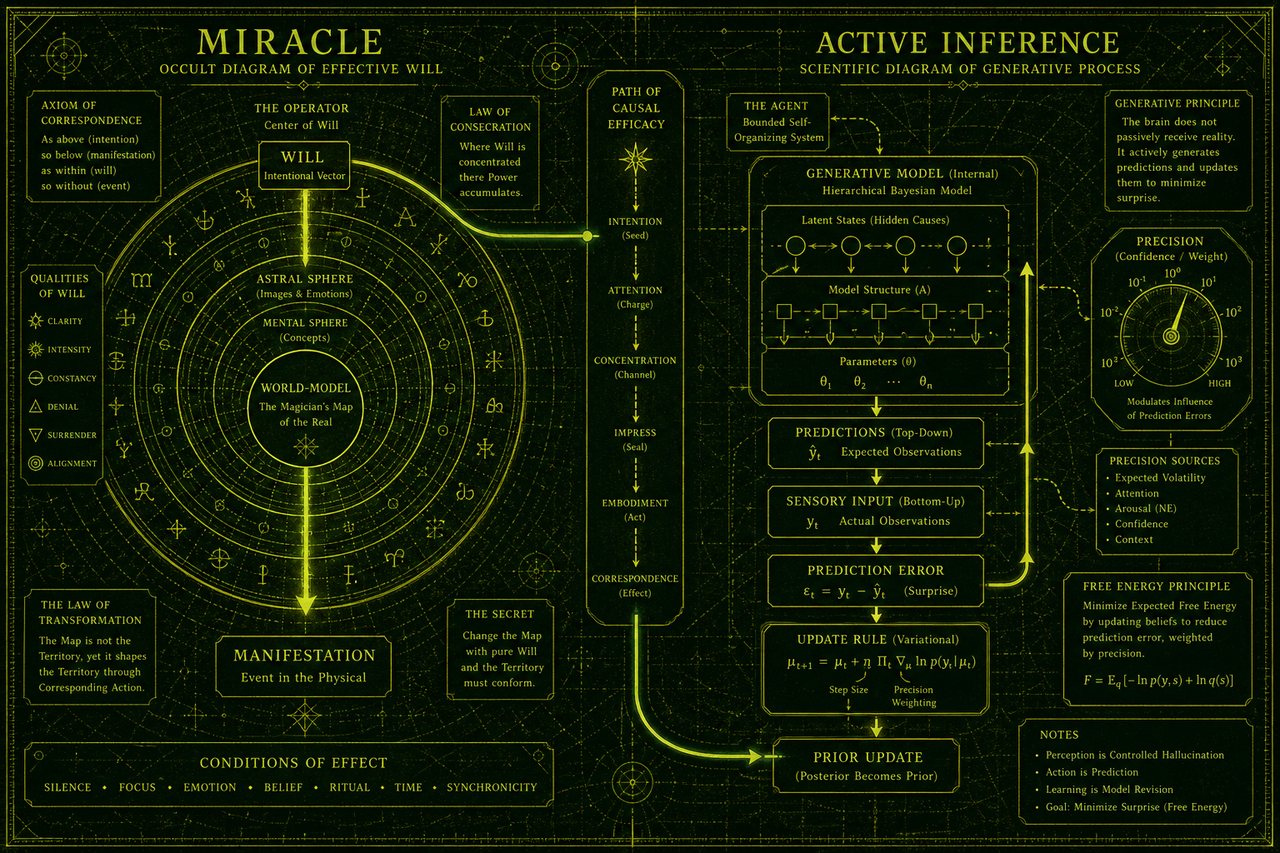
Dark lime schematic: MIRACLE will-vector into a world-model beside ACTIVE INFERENCE prediction and error loops. Schematic still, not a scan.
Will into a world-model, beside prediction and error. Schematic still. Do not quote the art formulas as data.

I write from Paris, Tennessee. People ask me if miracles are real. They paste a reel that says neuroscience proved the law of attraction. They want the HOW without throwing the wonder away. Those are hardware questions. I will answer the hardware. I will not launder The Secret into Nature Reviews Neuroscience.

Reality Engineering is the science of making reality respond to intent. Yesterday's miracle is today's engineering. The gatekeeper told you wonder was childish, then rented a vision board as a substitute for action. The people who sat down to will a change were not stupid. They lacked a name for the two moves against surprise.

What is a miracle, in this stack?

A miracle is an outcome the old generative model called impossible. The old map named wonders. Crowley named magick as causing change in conformity with Will, and said every intentional act is a magickal act. The lab map is Active Inference: you minimize surprise by updating the model or by acting until the world samples what you predicted. Translation is not a scan of water into wine.

The old word is wonder. Something the current story of the world cannot host. Crowley, in Magick in Theory and Practice, defined magick as the science and art of causing change to occur in conformity with Will. Theorem one: every intentional act is a magickal act. His illustration is not a lightning bolt. It is a pen, ink, and paper. He writes sentences. The book reaches a reader. Change, in conformity with Will. That is the honest occult sentence. It does not require you to mock the people who wanted water to become wine. It requires you to stop pretending a prior without an act is a ritual.

Related reading: a sigil is data compression. Encode the intended state. Release it. Stop watching the pot. That page is the compression step. This page is what the compressed prior is doing in the inference loop. The sequence that holds a prior in place is a ritual as entropy-reduction tech.

What is Active Inference?

Karl Friston's free-energy principle says a living system must keep its sensory entropy low. Surprise cannot be read out directly, so the system minimizes a bound on surprise called variational free energy. It can do that two ways: change its predictions (perception) or change the sensory data by acting (action). Selectively sampling the inputs you expect is Active Inference. Feeling your way in the dark is the classroom example: anticipate the next touch, then confirm it.

Karl Friston, Nature Reviews Neuroscience, February 2010. "The free-energy principle: a unified brain theory?" A self-organizing system at equilibrium with its environment must minimize free energy. Biological agents keep their sensory states inside a small set that defines the phenotype. A fish out of water is in a surprising state, emotionally and mathematically. Surprise is the negative log-probability of an outcome. Water flowing uphill is surprising. You cannot read surprise off a meter, so you minimize a bound on it: variational free energy, a function of sensations you have and a recognition density you encode.

Two handles. Change internal states so the recognition density better matches the causes of sensation. That is perception. Change sensory input by acting on the world so the data match what you already predict. That is action. Friston's line: the agent will selectively sample the sensory inputs that it expects. This is known as active inference. The classroom picture is feeling your way in darkness. You anticipate the next touch. Then you try to confirm it. You do not sit in the chair and wait for the wall to come to your hand.

Rao and Ballard, Nature Neuroscience, 1999, had already given cortex a predictive-coding read: extra-classical receptive fields as top-down predictions explaining away bottom-up error. Friston put that architecture under a single bound, then let action join perception on the same quantity. Friston, FitzGerald, Rigoli, Schwartenbeck and Pezzulo, Neural Computation, 2017: Active Inference as a process theory. Perception, policy selection, learning, as a gradient on variational free energy. I opened the 2010 review and the 2017 process paper. I did not open a trial that turned a vision board into a tax refund.

What is the magician's hack?

Hold a precise intended state as a prior, then act so the world is sampled in a way that prior can survive. Precision is the gain on prediction error: high precision means that channel dominates. A screaming watch on the gap is high precision on the error, which is lust for result. Related reading: a sigil compresses the intended state and then you stop watching the pot. The hack is not a PRL of walking on water.

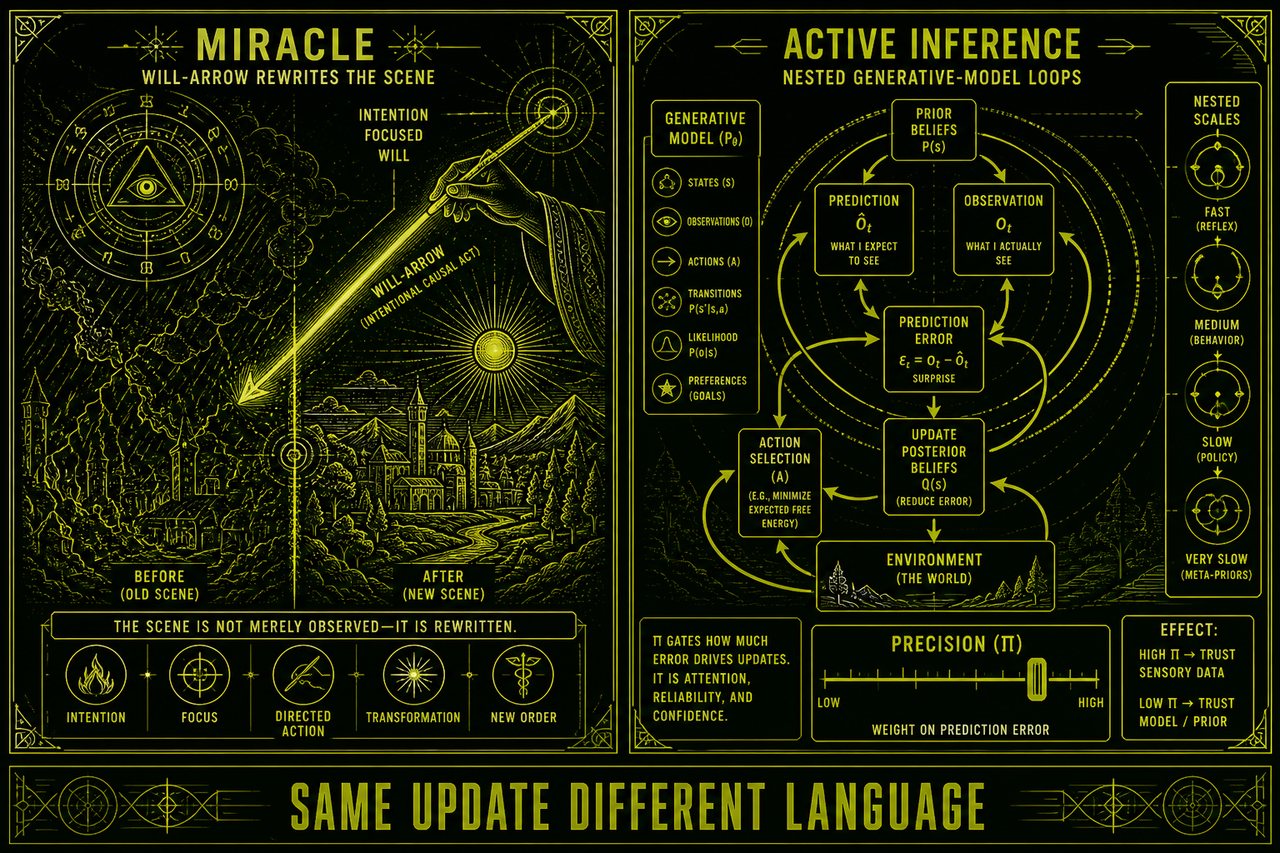
Precision is the gain on prediction error. High precision: that channel dominates the update. Low precision: it is treated as noise. Attention, in this stack, is expected precision. Friston's reaching simulation is the clean picture: a two-jointed arm, a lit target, a prior that the finger will be drawn to the target when the cue appears. Action then fulfills the prior. The insert trajectory hits the green circle. Rewards and goals, he writes, can be considered as prior expectations that an action is obliged to fulfil.

That sentence is the magician's hack in lab clothes. You do not push the world with a slogan. You install a prior precise enough that action is obliged. Then you take the action. The old map called that Will. The aisle sells the prior without the obligation. Related reading: why vision boards fail. Intention on a screaming nerve is a poster. A high-precision watch on the gap is lust for result. The hack fails when the only precise thing in the hierarchy is the error.

Two-panel schematic: MIRACLE will-arrow rewriting a scene versus ACTIVE INFERENCE nested generative-model loops. Footer: SAME UPDATE DIFFERENT LANGUAGE. Schematic still, not a scan.
Miracle versus Active Inference. Schematic still. Footer is the claim. Slider numbers on the art are not a dataset.

Is the law of attraction Active Inference?

The aisle says neuroscience proved the law of attraction. It did not. Active Inference says you will sample what you expect, and you can act to make sensations match a prior. That is a mechanism of perception and control. It is not a voucher that a vision board rewrites the tax code. Mixing those stacks is how the aisle gets away with it.

Reels this year still say neuroscience proved the law of attraction. Predictive processing is live in the journals. A 2026 review still calls PP and Active Inference among the most influential frameworks in cognitive science, and then says the full power waits on tighter mechanistic tests. That is the honest weather. The aisle collapses "you sample what you expect" into "the universe posts you a check." Those are not the same sentence. One is a control loop. The other is a skip of the loop.

The gatekeeper offers two lies. One: nothing you intend can matter, so sit down. Two: intending is the whole ritual, so skip the act. Crowley already refused the second lie with a pen. Friston already refused it with an arm that has to move. I will keep the wonder. I will not keep the skip.

Helmholtz was already in the room

Friston casts the brain as a Helmholtz machine: a generative model of the world it inhabits. Helmholtz treated perception as unconscious inference. Gregory treated perceptions as hypotheses. Rao and Ballard treated extra-classical visual fields as predictions explaining away error. None of those men were selling a manifestation course. They were naming the same loop the magician was already running with different nouns. You do not need to throw Helmholtz out to keep Crowley. You need to stop letting the aisle pretend they are the same PDF.

Friston's mountain-car figure is the other honest picture. The car cannot climb the target hill from a standstill. It has to roll the other way first to gather momentum. A prior on motion that destabilizes the wrong fixed points forces exploration until the attracting state is found. That is not "trust the universe." That is a policy that keeps you moving until the prior can be fulfilled. A vision board that forbids the roll-back is a prior that cannot host the path.

The dark twin of a stuck prior

Fletcher and Frith, Nature Reviews Neuroscience, 2009: perceiving is believing. A Bayesian read of positive symptoms as false inference. A prior that will not yield, or an error channel that will not shut up, can host a world that is not there. I am naming that paper so nobody uses this page as a license to ignore a clinician. A high-precision intended state is a tool. A high-precision prior that will not update is a trap. The difference is measurement and the capacity to act. It is not a vibe.

NameWhat it actually isWhat it is not
Miracle / magickChange in conformity with Will (Crowley); an outcome the old model could not hostA skip of action
Free energy / surpriseA bound on how unexpected your sensations are under your model (Friston 2010)A mood
Active InferenceSample the inputs you expect; act to make the world match the priorA law-of-attraction voucher
PrecisionGain on prediction error; attention as expected precisionVolume of wishing
Magician's hackA precise intended prior that action is obliged to fulfilA PRL of walking on water

Run the brake first.

A screaming nerve writes high precision onto every error. Protocol 01 is free. Four-count inhale. Eight-count exhale. Seven minutes. A number before and a number after. That is the hardware check. The Library of Biological Wizardry is the rest of the stack if the method earns the next hour. No initiate password. A prior, then an act, then a measurement.

What should I run if I want a number?

Start with Protocol 01, the free Neural Recalibration. Four-count inhale, eight-count exhale, seven minutes, a number before and a number after. A screaming nerve writes high precision onto every error. You cannot run a clean prior on that hardware. If the method earns it, the Library of Biological Wizardry is the rest of the stack. Yesterday's miracle is today's engineering.

You will not get Friston's simulated arm in your kitchen. You can get a 1 to 10 on your own state, and a binary on whether you took the action the prior named. That is the first instrument. Encode if you need compression. Release if you are watching the pot. Brake if the nerve is screaming. Then act. Related reading: a ritual is entropy-reduction tech. Related reading: astral projection is running the grid map without the body. A viewpoint that leaves the chair is still a model. A miracle is the model becoming able to host a state it used to call impossible, then sampling it.

FAQ

Short answers you can lift from this page. Visible text matches the FAQ schema exactly. The stills are schematic. None of this is medical advice.

What is a miracle, in this stack?

A miracle is an outcome the old generative model called impossible. The old map named wonders. Crowley named magick as causing change in conformity with Will, and said every intentional act is a magickal act. The lab map is Active Inference: you minimize surprise by updating the model or by acting until the world samples what you predicted. Translation is not a scan of water into wine.

What is Active Inference?

Karl Friston's free-energy principle says a living system must keep its sensory entropy low. Surprise cannot be read out directly, so the system minimizes a bound on surprise called variational free energy. It can do that two ways: change its predictions (perception) or change the sensory data by acting (action). Selectively sampling the inputs you expect is Active Inference. Feeling your way in the dark is the classroom example: anticipate the next touch, then confirm it.

What is the magician's hack?

Hold a precise intended state as a prior, then act so the world is sampled in a way that prior can survive. Precision is the gain on prediction error: high precision means that channel dominates. A screaming watch on the gap is high precision on the error, which is lust for result. Related reading: a sigil compresses the intended state and then you stop watching the pot. The hack is not a PRL of walking on water.

Is the law of attraction Active Inference?

The aisle says neuroscience proved the law of attraction. It did not. Active Inference says you will sample what you expect, and you can act to make sensations match a prior. That is a mechanism of perception and control. It is not a voucher that a vision board rewrites the tax code. Mixing those stacks is how the aisle gets away with it.

Can I measure a miracle?

You can measure a state before and after a seven-minute brake. You can measure whether you took the action the prior required. Friston simulated a reaching arm that fulfilled a prior that the finger would be drawn to a target. That is a motor prior, not a lottery ticket. If you want a number today, start with Protocol 01. Do not baptize a coincidence with a free-energy equation.

What should I run if I want a number?

Start with Protocol 01, the free Neural Recalibration. Four-count inhale, eight-count exhale, seven minutes, a number before and a number after. A screaming nerve writes high precision onto every error. You cannot run a clean prior on that hardware. If the method earns it, the Library of Biological Wizardry is the rest of the stack. Yesterday's miracle is today's engineering.

Is this medical advice?

No. This page is an educational mechanism explainer by JM Thomas. It is not a diagnosis, treatment, cure, or prevention of any disease. Named papers are literature, not a promise about your Tuesday. A stuck high-precision prior is also how some psychiatric models talk about false inference. If unusual beliefs or perceptions distress you, talk to a clinician.

Sources I actually opened

Friston, K. "The free-energy principle: a unified brain theory?" Nature Reviews Neuroscience 11:127-138 (Feb 2010). Agents minimize a bound on surprise by changing predictions or by changing sensory input through action. Selectively sampling expected inputs is Active Inference. Darkness example: anticipate the next touch, then confirm it. doi.org/10.1038/nrn2787 · author PDF

Friston, K., Daunizeau, J., Kiebel, S. "Active inference or reinforcement learning?" PLoS ONE 4:e6421 (2009). Action as fulfilling prior expectations. doi.org/10.1371/journal.pone.0006421

Friston, K.J., FitzGerald, T., Rigoli, F., Schwartenbeck, P., Pezzulo, G. "Active Inference: A Process Theory." Neural Computation 29:1-49 (2017). Perception, policy, learning as a gradient on variational free energy. doi.org/10.1162/NECO_a_00912

Rao, R.P.N., Ballard, D.H. "Predictive coding in the visual cortex: a functional interpretation of some extra-classical receptive field effects." Nature Neuroscience 2:79-87 (1999). Top-down predictions explaining away bottom-up error. doi.org/10.1038/4580

Fletcher, P.C., Frith, C.D. "Perceiving is believing: a Bayesian approach to explaining the positive symptoms of schizophrenia." Nature Reviews Neuroscience 10:48-58 (2009). False inference as a stuck or noisy Bayesian loop. Named as the dark twin of a prior that will not update, not as a diagnosis of anyone reading this. doi.org/10.1038/nrn2536

Crowley, A. Magick in Theory and Practice (Book 4, Part III). Definition: Magick is the Science and Art of causing Change to occur in conformity with Will. Theorem: every intentional act is a magickal act. Illustration: pen, ink, paper. Named as the old map, not as a Friston experiment.

Ikrar, T., Muchsin, W., Sophian, A. "Predictive Processing and Active Inference: A Comprehensive Review..." Journal of NeuroPhilosophy 5(1) (2026). Named only as weather: the framework is influential and still waiting on tighter mechanistic tests. Not a miracle trial. zenodo.org/records/20049615