Frisson · caudate wait · NAcc hit
Goosebumps on a warm neck. Wait in the caudate.
When a drop is fifteen seconds out, the caudate fires. When the chill lands, the nucleus accumbens takes the hit. You can feel both rooms on your skin.
You know that shiver on a warm neck, right before the drop. Hair lifts. Skin goes electric. The wait lives in the caudate. The hit lives in the accumbens. Fifteen seconds of hallway between them.
Hair lifts on a warm neck
Goosebumps are a timestamp. Heart rate climbs with the shiver. Breath follows. Muscle follows. Blood and Zatorre already photographed that on PET in 2001.
Ten McGill musicians. Five women, five men. Ages 20 to 30. Each person had at least eight years of training, and each brought one classical excerpt that reliably raised hair. The same piece sat as another person's "neutral" control, so the group average compared identical notes with different rooms.
Chills showed up in 77% of own-music scans and never on the control track, the noise bed, or the silence condition. Heart rate rose, t=3.02. EMG rose, t=2.41. Respiration rose, t=3.82. Average chill intensity sat at 4.5 out of 10 while emotional intensity sat higher at 7.4 and pleasantness at 4.4 out of 5. The skin event is late. Pleasure has to climb first.
As chill intensity climbed, blood flow rose in left ventral striatum, dorsomedial midbrain, insula, right orbitofrontal cortex, and thalamus. Anterior cingulate lit. SMA lit. Cerebellum lit. Blood flow fell in right amygdala, left hippocampus/amygdala, plus ventral medial prefrontal cortex. Left ventral striatum rCBF tracked chill intensity at r=0.49, which is the photograph of the skin, and it still fails to split the wait from the hit.
Blood, A.J., and Zatorre, R.J. PNAS 98(20):11818-11823 (25 September 2001). DOI 10.1073/pnas.191355898. PMID 11573015. PMC58814. 90-second excerpts. 60-second PET. Three repeats of the selected piece. Then the control piece. Then noise. Then silence. Classical. No lyric. The shiver already had an address in reward tissue. The hallway came later.
Wait in the caudate. Hit in the accumbens.
Close your eyes. A warm neck. A drop you can almost taste. One room is the waiting room. The other room is the hit. Fifteen seconds of hallway between them.
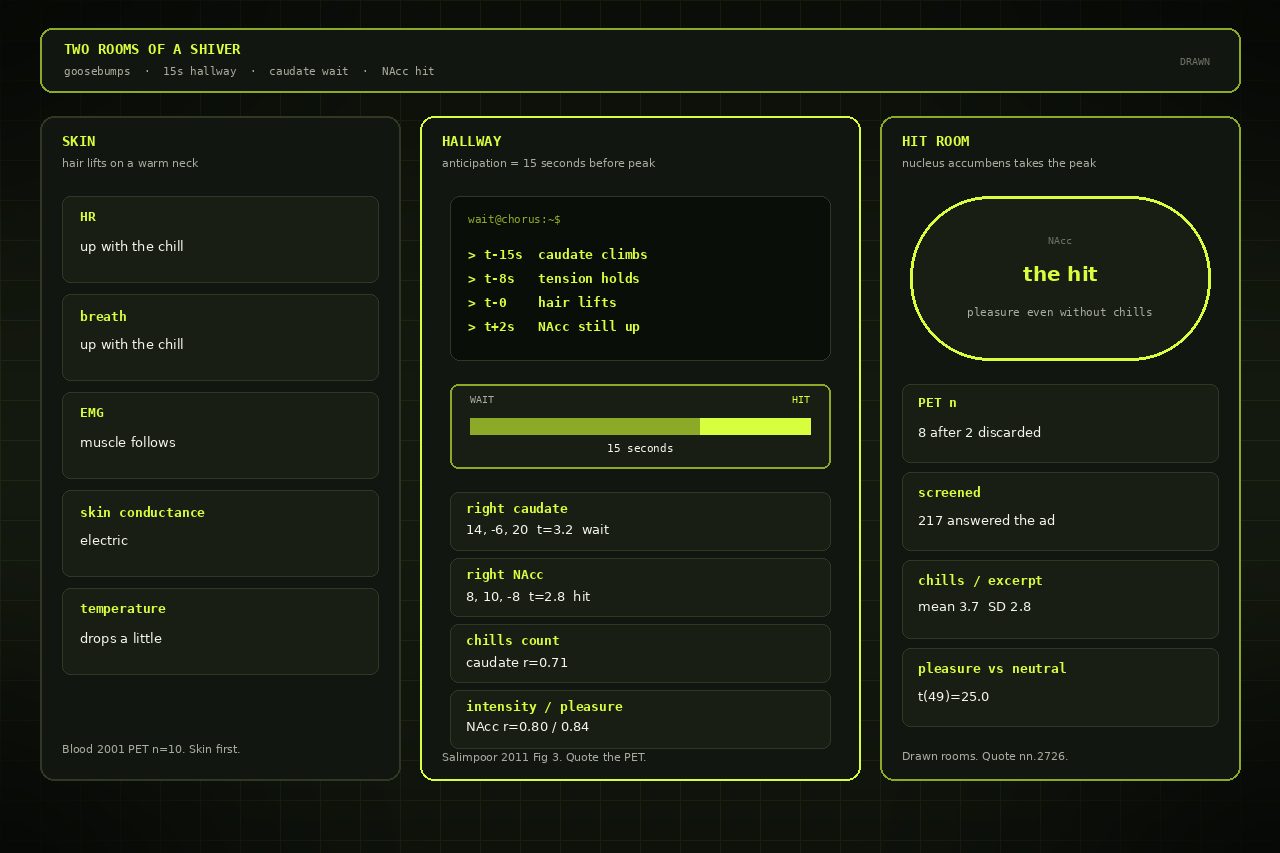
Salimpoor's Figure 3 is the picture. Anticipation epochs were the 15 seconds before a chill. Peak epochs were the chill itself. BOLD in the dopamine-releasing voxels split by time. Right caudate during the wait, coordinates 14, −6, 20, t=3.2. Right nucleus accumbens during the hit, 8, 10, −8, t=2.8.
Caudate climbs in the hallway, then drops when the chorus arrives. Accumbens keeps climbing and peaks on the shiver. Wanting in one room. Liking in the other. Composers already knew the trick. Delay the resolution. Stretch the last bar. The caudate is why that stretch works.
You can fail the wait. Skip the 15 seconds of tension and you skipped the caudate, which is the room that fires while you still only know the drop is coming. Hair never lifts and you still might have liked the song, because pleasure can sign the NAcc without ever asking the skin to move. Accumbens BOLD still tracked pleasure after they threw the chill epochs out. Right NAcc explained 67% of the pleasure-rating variance with chills excluded, t(19)=6.18. The shiver is the loud receipt. Pleasure can still sign in quieter.
That is the mechanism behind searches for frisson, musical chills, or why a song gives goosebumps. An abstract sequence of tones borrowed the same striatal split that food and drugs use, which is a strange trick for something you cannot eat. Wait first. Hit second. Skin last.
Raclopride in the striatum
[11C]raclopride PET. Dopamine knocks the tracer off D2 receptors. Binding potential falls. That fall is the dopamine.
217 people answered an ad for listeners who get chills. Five screens. Ten made the scanner, five women, five men, ages 19 to 24, mean 20.8. Two PET sessions got discarded for discomfort. Eight PET datasets remain. One fMRI run ended for claustrophobia.
Mean 3.7 chills per pleasurable excerpt in PET, SD 2.8. Pleasure versus the matched-neutral set: t(49)=25.0. Chill intensity correlated with pleasure, r=0.71. Heart rate went up. Respiration went up. Skin conductance went up. Temperature and pulse amplitude went down. The body voted with the rating scale.
Binding potential dropped on both sides of the caudate during pleasurable versus neutral music (P<0.001). Putamen dropped too. NAcc dropped too. The paper says the percent change was highest in the right caudate and the right NAcc. Quote that sentence. Do not paste a thumbnail percent from a drawn bar.
| What they counted | Where it lived | r |
|---|---|---|
| Number of chills | caudate binding-potential change | 0.71 |
| Intensity of chills | NAcc binding-potential change | 0.80 |
| Reported pleasure | NAcc binding-potential change | 0.84 |
Count lives in the wait room. Intensity lives in the hit room. More chills means more hallways. A bigger shiver means a louder accumbens.
They picked their own tracks. Classical, folk, jazz, electronica, rock, punk, techno, tango. Instrumental. No lyric. Each person's pleasure track was someone else's neutral. Same acoustic family. Different rooms. Ages 19 to 24 is a young sample. Eight PET listeners is a small sample. The split is still the split they printed.
Salimpoor, V.N., Benovoy, M., Larcher, K., Dagher, A., and Zatorre, R.J. Nature Neuroscience 14(2):257-262 (February 2011, online 9 January 2011). DOI 10.1038/nn.2726. PMID 21217764. Montreal Neurological Institute. Same Zatorre lab family as Blood 2001.
Blood's PET already had the skin
2001 saw the shiver. 2011 timed the hallway. Keep both clocks.
Blood measured cerebral blood flow, not raclopride. Ventral striatum already lit. Amygdala already dropped. Heart already moved. Muscle already moved. Breath already moved. Ten people sat through 90-second excerpts and a 0-to-10 chill rating after each scan, averaging 4.5, and the 2011 paper needed that skin marker so they could stamp a time on peak pleasure and look 15 seconds behind it.
Salimpoor 2009, PLoS ONE 4(10):e7487, DOI 10.1371/journal.pone.0007487, PMID 19834599, is the arousal companion. Chills as a marker you can time. Heart, breath, skin. The 2011 paper is the dopamine split on top of that clock. If you only quote 2001, you get reward tissue without the two rooms. If you only quote 2011, you forget the skin already had a PET photograph.
Goldstein 1980 tried naloxone on music chills in a small early sample. Blood cites it. I am not hanging a dose on that old n. The lock on this URL is raclopride plus the 15-second BOLD split.
Why your roommate sits still
Some nervous systems raise hair. Some don't. A 2026 genetics paper finally put a family number on that gap.
Bignardi, Admiraal, Eising, Fisher. PLoS Genetics 22(2):e1012002, published 18 February 2026. DOI 10.1371/journal.pgen.1012002. Lifelines cohort, northern Netherlands. 35,114 adults answered two items: a chill from poetry or visual art, and a chill from a melody they like. 15,606 of them had genotypes that survived the relatedness trim (nine people dropped from pairs above 0.90).
Familial relatedness explained up to 29% of variation in those chill scores. About a quarter of that 29% came from common SNPs tagged on the chip. Aesthetic chills and music chills correlated r=0.43 in the full 35,114. Genetic correlation rg=0.58, 95% CI 0.20 to 0.95. Shared, and less than identical. Poetry and a chorus borrow some of the same DNA, then split.
An openness-to-experience polygenic index built from 220,015 people associated with both scores. Tiny r². 0.3% for aesthetic chills. 0.1% for music chills. That is a real association and a useless shopping list. You cannot buy a tingle from a PGI.
Darwin wrote that an anthem in King's College Chapel made his backbone shiver. Nabokov wanted the telltale tingle before he would call a book genius. Your roommate can sit still and still be telling the truth. Log your own skin. Don't borrow theirs.
The items are one sentence each. Test-retest on the aesthetic item, in a related Dutch sample, sat around 0.58 to 0.61 over five years. Measurement noise eats heritability. Treat 29% as a family ceiling in this cohort, not a destiny score on your forehead.
A pulse train is a different shiver
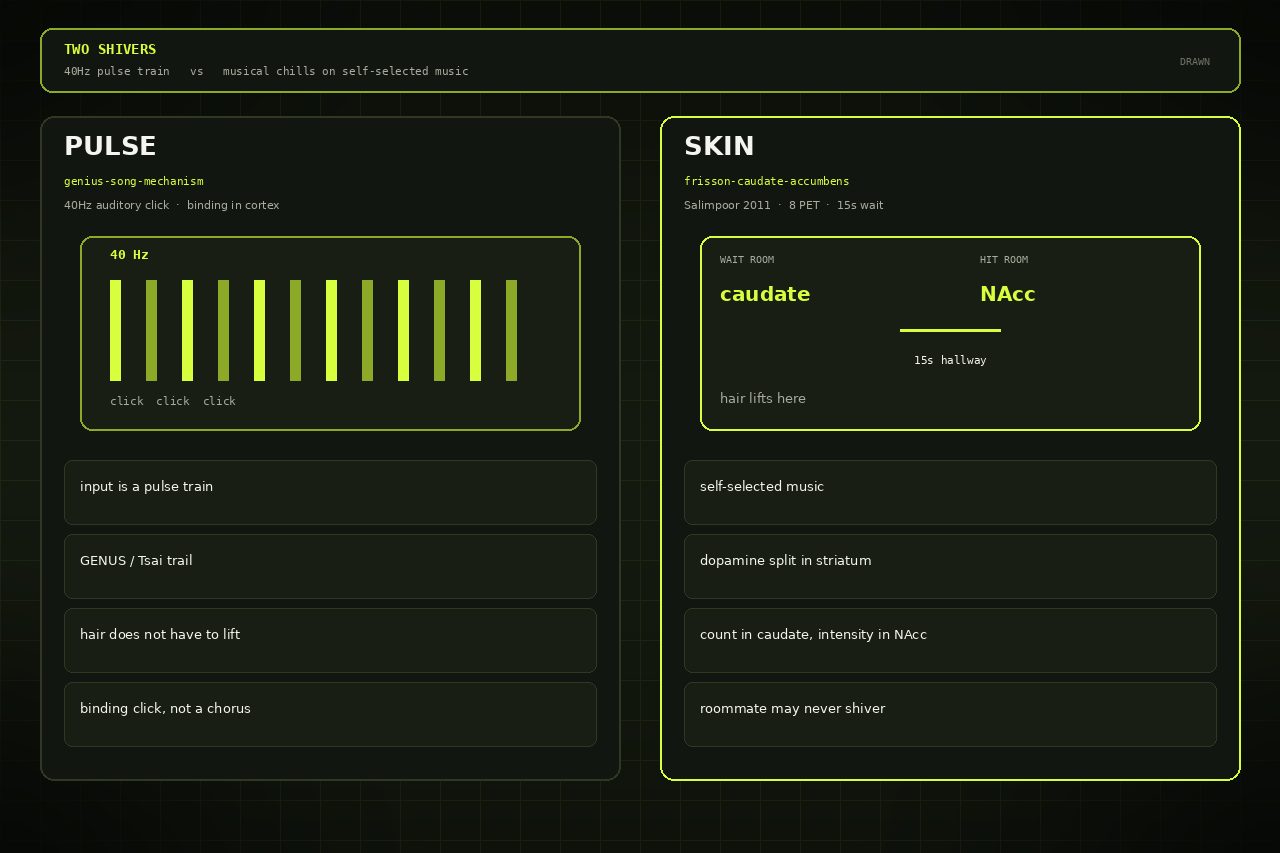
Searchers bring 40Hz and Genius Song when they want a feeling on command. A pulse train is a binding click in cortex. This page is hair, hallway, hit.
Martorell and Tsai published the 40Hz auditory trail. The Genius Song mechanism page already walks that pulse-train file. This URL owns the caudate wait. You can run a 40Hz track and never lift a hair. You can lift a hair on a song that never saw 40Hz.
Stack them in one week if you want both inputs. Quote Salimpoor if you want the hallway. Quote Tsai if you want the click. Mixing the playlists is a personal experiment. Calling the mix eight PET listeners is how a thumbnail lies.
Timestamp the wait, then the hit
Pick a track that used to raise hair. Headphones. Sit. Mark chest noise 1 to 10. Play it once.
Write two times. First, when you feel the hallway, the "it's coming." Second, when hair actually lifts, if it does. If the first time never arrives, you ran a like without a wait. If hair never lifts, you still had a pleasure rating. Write that too. Fail in the notebook. That is the whole test.
If the chest is already loud, sit first. Lengthen the exhale until that 1-to-10 drops a point. Then play the track. That sit is Protocol 01. Free. Then log whether the hallway showed up.
Log the shiver. Then sit if the chest is loud.
Don't chase eight PET listeners. Chase whether your own wait and hit separated on a track you already know, written down at two times, even if the second time never arrives. The Library is the paid archive if you want more named sits after the log exists.
What still gets asked
Why doesn't my roommate shiver?
Bignardi 2026 found familial relatedness explaining up to 29% of chill-proneness scores in 15,606 genotyped Lifelines adults. Common SNPs carried about a quarter of that. Your roommate can sit still and still be telling the truth.
Can a 40Hz track copy this?
A 40Hz pulse is a binding click in cortex. This shiver is dopamine splitting across two striatal rooms on a song you already love. You can run both in a week. They do not copy each other.
Do I need a PET scanner to know I felt it?
No. Hair is a home instrument. Breath is a home instrument. A timestamp finishes the log. The scanner locked the two rooms. Your log checks whether the hallway showed up.
Will any song work?
Salimpoor let each person pick. Someone else's favorite was the neutral control. Bring the track that already raises hair. A random playlist is a different experiment.
Is this a medical page?
No. Eight PET listeners and a 2026 genetics survey are literature. If a shiver arrives with panic, call a doctor, not another track.
Where the numbers live
Salimpoor, V.N., Benovoy, M., Larcher, K., Dagher, A., and Zatorre, R.J. "Anatomically distinct dopamine release during anticipation and experience of peak emotion to music." Nature Neuroscience 2011;14(2):257-262. DOI 10.1038/nn.2726. PMID 21217764. 217 screened. 10 selected. 8 PET after 2 discarded for discomfort. Ages 19-24, mean 20.8. Mean 3.7 chills/excerpt (SD 2.8). Pleasure vs neutral t(49)=25.0. Intensity vs pleasure r=0.71. Anticipation = 15 s. Right caudate 14, −6, 20, t=3.2. Right NAcc 8, 10, −8, t=2.8. Chills count vs caudate r=0.71. Intensity vs NAcc r=0.80. Pleasure vs NAcc r=0.84. NAcc BOLD vs pleasure with chills excluded: 67%, t(19)=6.18. doi.org/10.1038/nn.2726 · europepmc.org/article/MED/21217764
Blood, A.J., and Zatorre, R.J. "Intensely pleasurable responses to music correlate with activity in brain regions implicated in reward and emotion." PNAS 2001;98(20):11818-11823. DOI 10.1073/pnas.191355898. PMID 11573015. PMC58814. n=10, 5 female 5 male, ages 20-30, ≥8 years music training. Chills in 77% of own-music scans. HR t=3.02, EMG t=2.41, RESP t=3.82. Mean chill intensity 4.5/10. Left ventral striatum rCBF vs intensity r=0.49. doi.org/10.1073/pnas.191355898 · PMC58814
Salimpoor, V.N., Benovoy, M., Longo, G., Cooperstock, J.R., and Zatorre, R.J. "The rewarding aspects of music listening are related to degree of emotional arousal." PLoS ONE 2009;4(10):e7487. DOI 10.1371/journal.pone.0007487. PMID 19834599. Arousal companion. Chills as a timed marker. doi.org/10.1371/journal.pone.0007487 · europepmc.org/article/MED/19834599
Bignardi, G., Admiraal, D., Eising, E., and Fisher, S.E. "Genetic underpinnings of chills from art and music." PLoS Genetics 2026;22(2):e1012002. Published 18 Feb 2026. DOI 10.1371/journal.pgen.1012002. Self-report n=35,114. GREML n=15,606. Familial relatedness up to 29% of chill-proneness variance. Aesthetic-music rg=0.58. Openness PGI n=220,015, r² 0.3% / 0.1%. doi.org/10.1371/journal.pgen.1012002 · MPI news write-up