Quantum eraser · Kim 2000 · Ma 2013 · 8 ns sort

Delayed-choice quantum eraser: Kim 2000, eight nanoseconds late

JM Thomas · 16 August 2026

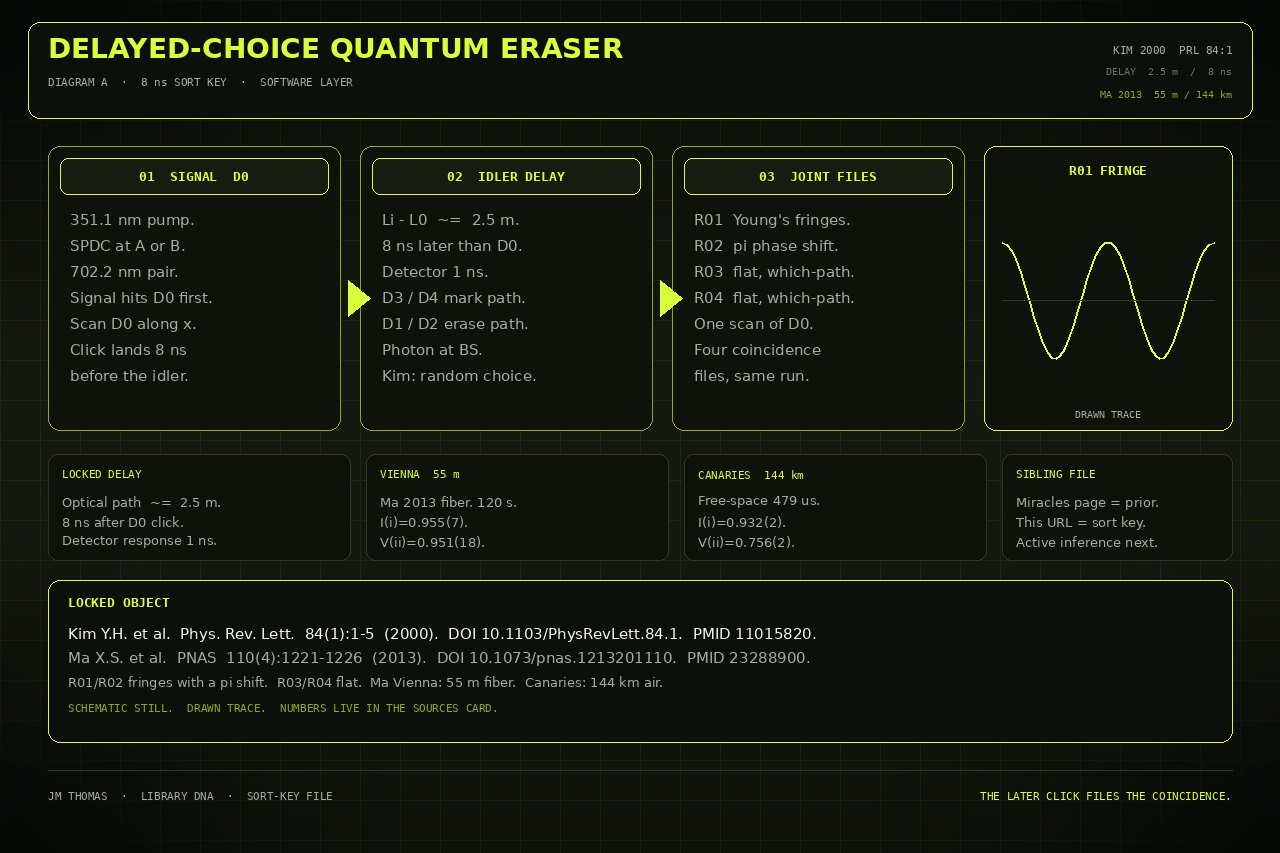
Kim, Yu, Kulik, Shih, and Scully parked a 2.5 meter delay on the idler arm so D0 clicked about 8 nanoseconds before D1 through D4. I opened the 1999 arXiv PDF of Delayed Choice Quantum Eraser, later Phys. Rev. Lett. 84, 1-5, DOI 10.1103/PhysRevLett.84.1, PMID 11015820. Joint rates R01 and R02 drew Young's fringes. R03 and R04 stayed flat. The later click sorted which file you kept.

Dark lime drawing of delayed-choice quantum eraser as an 8-nanosecond sort key. Kim 2000. Ma 2013. Drawn still.
Signal D0, idler delay, four joint files. Drawn still. Kim 2000 and Ma 2013.

I sat with quant-ph/9903047 and with Ma, Kofler, Zeilinger and the rest, PNAS 2013, 110(4):1221-1226, DOI 10.1073/pnas.1213201110, PMID 23288900. Vienna ran 55 meters of fiber. The Canaries ran 144 kilometers of air. Last month an Amritsar group posted a standard-mechanics treatment, arXiv 2608.02185, 3 August 2026. Those are the files this URL uses.

The hunger is live. @scitechgirl posted the experiment on 24 July 2026 and pulled 153 likes. @emrenalbant90 wrote on 26 July, 177 likes, that today's decision leaves yesterday alone, and that the past stays open until the later measurement. Hacker News argued it under a 20 July double-slit video. r/informaq posted the 2026 preprint on 4 August. Reality Engineering already treated observation as a cut. This page names the 8-nanosecond sort.

Reality behaves like software. Volume 7 already said the mind sets parameters that constrain which possibility collapses. Kim measured a smaller object: which coincidence file you keep depends on which basis the later detector measures. A photon at a beam splitter made Kim's "choice." Ma used a quantum random number generator. Honest from the first graf. The lab object is a measurement basis. The Library hunger is still the same hunger: a world that answers intent. Protocol 01 can wait until the count has earned the next hour.

Wheeler parked the question after the photon had left

John Archibald Wheeler, 1978, Mathematical Foundations of Quantum Theory. A photon from a distant star. Insert the last beam splitter, or leave it out, after the photon is already inside the apparatus. Wave file or particle file, decided late. A gedanken. No trial n.

Wheeler wanted the last mirror moved after the light had already traveled. "We, now, by moving the mirror in or out have an unavoidable effect on what we have a right to say about the already past history of that photon." That sentence is the caption the reels still steal. He was naming a right to say. He was sitting in a 1978 essay, not in a coincidence circuit.

Scully and Drühl, Phys. Rev. A 25, 2208, 1982, added the eraser. Which-path information can sit in an entangled twin. Measure the twin one way, the interference stays gone. Measure it the other way, the fringes come back in the joint counts. The 1982 paper is a proposal. Kim built the table.

The useful noun is complementarity. Path knowledge and fringe knowledge trade. Wootters and Zurek already wrote the inequality in 1979. Kim put a delay on the twin so D0 finished first. That delay is the whole trick people still argue about at 2 a.m.

Two and a half meters of extra cable

Yoon-Ho Kim, Rong Yu, Sergei P. Kulik, Yanhua Shih, Marlan O. Scully. Delayed "Choice" Quantum Eraser. Phys. Rev. Lett. 84(1):1-5. Published 3 January 2000. DOI 10.1103/PhysRevLett.84.1. PMID 11015820. Optical delay Li minus L0 about 2.5 m, so any information from photon 2 arrived at least 8 ns after photon 1 had already registered at D0. Detector response 1 ns. Photon-pair coincidence. No human trial n.

University of Maryland, Baltimore County, for Kim, Yu, Kulik, and Shih. Texas A&M and Max-Planck Institut für Quantenoptik for Scully. I opened the arXiv PDF, quant-ph/9903047, submitted 13 March 1999. The n below is the apparatus n that page locked. Coincidence rates. Path lengths. Wavelengths. I left the missing human n missing.

A 351.1 nm argon-ion pump hit a double slit, then a type-II BBO crystal in two regions, A and B. Each region could birth a 702.2 nm orthogonally polarized signal-idler pair. SPDC region width about 0.3 mm. Center-to-center about 0.7 mm. A Glan-Thompson prism split signal from idler. The signal, photon 1, went through a lens to D0 on the Fourier plane. D0 scanned along x on a step motor. The idler, photon 2, entered an equal-path interferometer: prism, BSA, BSB, two mirrors, then a 50-50 beamsplitter BS.

D1 and D2 sat at the two output ports of BS. Those clicks mixed the paths. D3 and D4 sat on the which-path arms. Those clicks marked A or B. Coincidence circuits paired each of those four with D0, giving joint rates R01, R02, R03, R04. All four recorded during one scan of D0. Same apparatus. Same run. Four files.

The delay was the headline they designed. Li minus L0 about 2.5 m. Eight nanoseconds later than D0. Compared with a 1 ns detector, that is a delayed erasure. Kim's "choice" was a photon at a beam splitter, random, after D0 had already clicked. Read that twice. A wish did not throw the switch. A photon did.

Four coincidence files, one scan of D0

Figures 3 and 4 of the PDF are the wave file. R01 against the x coordinate of D0: a standard Young's double-slit interference pattern. R02: the same family of fringes, shifted by pi. The sign flip sits in the beamsplitter algebra. Transmission versus reflection. Kim wrote R01 proportional to cos squared of (x pi d / lambda f), R02 to sin squared, then the sinc envelope once the slits have finite width a.

Figure 5 is the particle file. R03, joint detection between D0 and which-path D3, against the same x. Flat. Absence of interference, clearly demonstrated, their words. R04 looked the same, a small shift of the center. One amplitude in the joint wavefunction. No second path to interfere with.

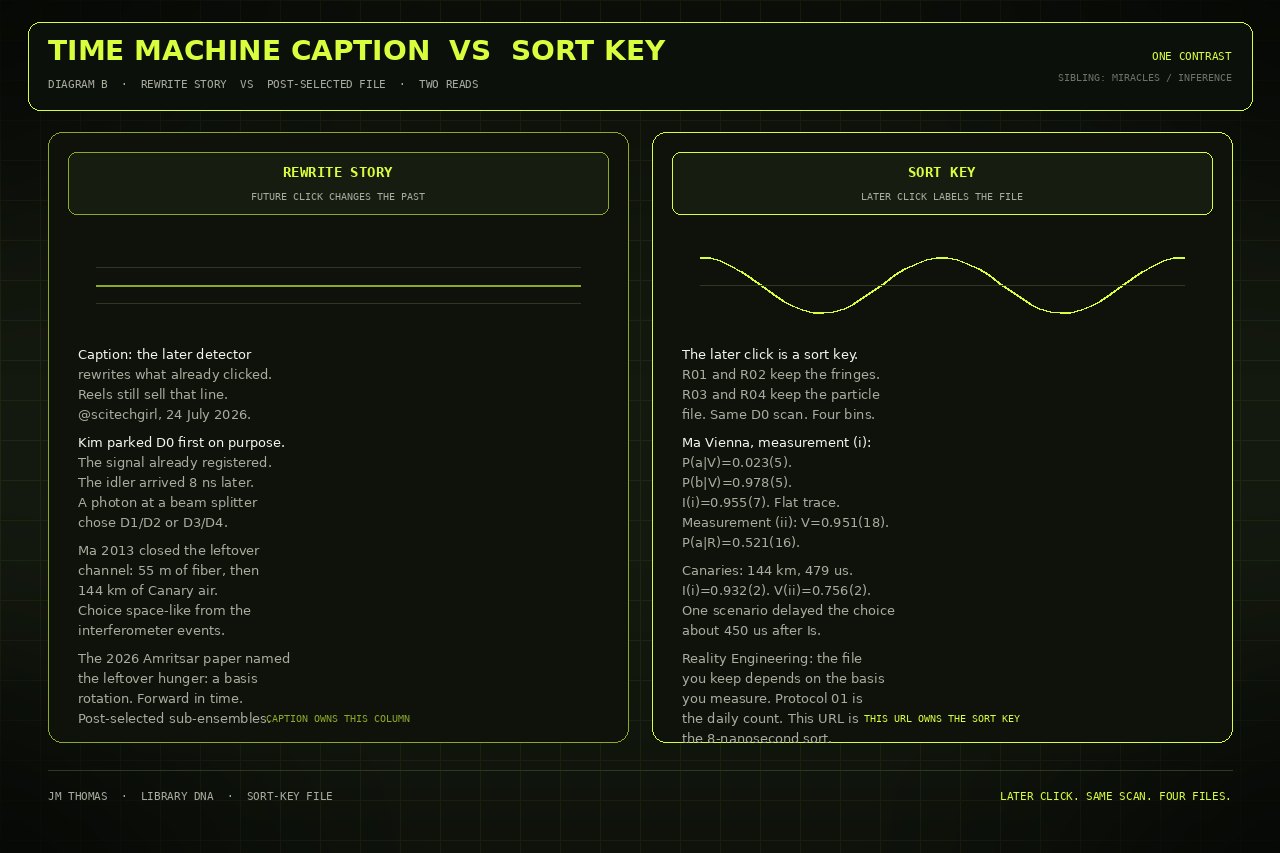
That is the whole experimental claim, compressed. You can watch wave-like and particle-like behavior with the same machine if you keep the coincidence tag. Dump the tag, and the four files collapse into one smear. The smear has no fringe. The caption that says "the future rewrote the past" is a caption about a sorted spreadsheet. D0 already clicked. The later click labeled the row.

We don't believe. We measure.

Kim also wrote the honest limit of the 2000 table. The "choice" sat in the future light cone of the pair emission and of the D0 click. A leftover channel, in principle, that the emission or the signal measurement could have influenced the later routing. Ma closed that channel thirteen years later.

Fifty-five meters, then one hundred forty-four kilometers

Xiao-song Ma, Johannes Kofler, Angie Qarry, Nuray Tetik, Thomas Scheidl, Rupert Ursin, Sven Ramelow, Thomas Herbst, Lothar Ratschbacher, Alessandro Fedrizzi, Thomas Jennewein, Anton Zeilinger. Quantum erasure with causally disconnected choice. Proc. Natl. Acad. Sci. U.S.A. 2013;110(4):1221-1226. DOI 10.1073/pnas.1213201110. PMID 23288900. PMC3557028. Vienna: 55 m fiber. Canaries: 144 km free space. I opened the arXiv HTML, 1206.6578.

Hybrid entanglement: path of the system photon, polarization of the environment photon. Measure the environment in H/V, and you keep welcher-weg information. Measure it in R/L, and you erase that information and the system photon shows complementary fringes, conditioned on R versus L. The choice of basis sat in a quantum random number generator. Einstein locality: space-like separation between the choice and the interferometer events, so no subluminal or luminal signal could run from one to the other.

Vienna, 2007 table. Measurement (i), environment in V: P(a|V) = 0.023(5), P(b|V) = 0.978(5), summed over about 120 s of coincidences with path b or a blocked. Welcher-weg parameter I(i) = 0.955(7). Almost full path knowledge. Scan the relative phase, and the trace stays flat. Twenty seconds per point.

Measurement (ii), environment in R: P(a|R) = 0.521(16), P(b|R) = 0.478(16), same 120 s style. I(ii) = 0.077(22). Visibility V(ii) = 0.951(18), defined as (Cmax minus Cmin) / (Cmax plus Cmin), conditioned on Det 4. L gives the pi-shifted fringe. Coincidence rate about 5 kHz. Singles about 50 kHz. Polarization visibilities, background included: 98.0% in H/V, 96.9% in R/L. Six space-time scenarios. Same numbers inside the error bars.

Canaries, 2008. La Palma to Tenerife, about 144 km of air, about 479 microseconds of flight. Interferometer path about 0.5 m. One scenario put the choice about 450 microseconds after the interferometer events in the source frame, more than five orders of magnitude past Kim's 8 ns. Another required a hypothetical superluminal signal at about 96 times c. After background subtraction, I(i) = 0.932(2) and V(ii) = 0.756(2) in scenario II. Attenuation of the free-space link about 33 dB in the main text, 35 dB on the auxiliary laser in the supplement. Independent time tags on both sides, GPS clocks, coincidences reconstructed after the run.

Ma's last sentence is the one the Library can use without stealing a time machine. Any account of one photon has to take the whole apparatus, both photons, and it can only make sense after complementary information has been recorded. The file is the pair. The later basis labels the file.

August 2026 named the sort key

Vipul Badhan, Pranvi, Samreet Dhillon, Bindiya Arora. A Standard Quantum Mechanical Treatment to Rationalize the Delayed-Choice Quantum Eraser. arXiv 2608.02185. Submitted 3 August 2026, v2 on 4 August. Guru Nanak Dev University, Amritsar. Theory paper. No trial n. I opened the HTML.

They mapped Kim onto an extended Mach-Zehnder with entangled-pair sources in both arms, then onto a two-way Stern-Gerlach, then onto a ball-and-box game. The routing of the idler toward D3/D4 versus D5/D6 is a choice of mutually unbiased bases. The joint state already holds the correlations. Future idler clicks are a filtering key for post-selection. Asking how the earlier signal "knew" the later basis is the illegitimate question. Kastner 2019 already said the delayed-choice quantum eraser neither erases nor delays. The 2026 paper put that in a setup that copies Kim's operations, including the simultaneous interference and anti-interference sub-ensembles.

r/informaq posted the preprint on 4 August 2026. That is last-30. The hunger and the paper arrived in the same window. The paper does not baptize a vision board. It names a basis rotation. Keep that. The software layer is still real. Which file you keep depends on which question you ask the twin.

Two-panel drawing: rewrite-the-past caption on the left, later-click sort key on the right. Drawn still.
Rewrite caption on the left. Sort key on the right. Drawn still. Numbers live in the sources card.

The later click files the coincidence

Take the three files and park them on one sentence. Wheeler asked late. Kim delayed the idler 8 ns and split the D0 scan into four coincidence rates. Ma moved the choice outside every light cone that could have whispered to the interferometer. The 2026 treatment called the leftover mystery a basis rotation.

Reality Engineering still holds. Observation is an operation. A measurement basis is a question you put to a pair. The pair answers with a joint file. You do not get to read R01 and R03 as two histories of the same row. You get to keep one label per coincidence. That is a smaller claim than "intent rewrote Tuesday." It is also a harder claim, because the numbers sit in PRL and PNAS.

Kim's switch was a photon. Ma's switch was a QRNG. If you want a human hand on a basis, you are off these PDFs. The Library still has a place for that hunger. Volume 7 treated visualization as a strange attractor on probabilities. This URL owns the lab sort. The attractor lives in the member volumes and in the live instruments. A coincidence circuit does not enroll your wish. It does prove that the file you keep depends on the question you ask after the first click.

Lust for a time-machine caption is the aisle. The extract is a sort key. Record the date if you run a visualization window. Binary outcome. Thirty days is the example in Volume 1. The delayed-choice table is the proof that post-selection is a physical operation, not a vibe. Mixing those two into one reel is how the caption gets away with it.

Active inference lives next door

One contrast, then a wall. A miracle is an update the old model called impossible. Crowley named magick as change in conformity with Will. Friston named Active Inference: sample the inputs you expect, or act until the world matches the prior. That page owns the prior that action is obliged to fulfil.

This URL owns the later detector. Same hunger for a life that answers. Different machine. A prior is a generative model you install. A delayed-choice eraser is a coincidence tag you keep. You can hold a precise intended state. The Kim table still sits in a basement in 1999 Maryland, with a 2.5 m delay and four files. Orch-OR, on its own page, is the microtubule hardware. Remote viewing, on its own page, is a Stargate protocol. Three files. Three clocks.

A count you can fail in a chair

You will not get a 5 kHz coincidence trace from a kitchen table. You can get a 1 to 10 on whether a chosen scene felt settled, and a binary on whether you took the action that scene required. That is a chair number. It is the kind a day can actually produce.

Protocol 01 is free and daily. Four-count inhale, eight-count exhale, seven minutes. Write the number before you start, write it after you stop. The nerve still has to carry the current. The eraser is the lab file. The count is the morning stack. Run both if you want a week you can fail in public with yourself.

The Library of Biological Wizardry holds the rest of the sequence, the ledger, and the live instruments, and it can wait until the count has earned the next hour. No initiate password. A basis, a night, a number.

Run the count, then name the basis

Four in, eight out, seven minutes, a number before and a number after. That is the daily stack. The Kim table already named the sort. The Library is the rest of the map, and you can walk there when you want the next file.

This is an educational mechanism page by JM Thomas. A clinician owns diagnosis, treatment, cure, and prevention of any disease. Kim 2000 is a photon coincidence study. Ma 2013 is a locality test on entangled pairs. The 2026 arXiv paper is a theory treatment. Wheeler 1978 is a gedanken. Talk to a clinician if unusual distress or dissociation is on the table.

FAQ

Short answers you can lift. Drawn stills. Educational page.

What is a delayed-choice quantum eraser?

A two-photon coincidence experiment. The signal photon hits D0 first. The idler photon hits a later detector that either marks which path or mixes the paths. Kim 2000 used a 2.5 m delay, about 8 ns, so the later click arrived after D0 had already registered.

What did Kim 2000 actually record?

Four joint rates while D0 scanned. R01 and R02 showed Young's double-slit fringes with a pi phase shift between them. R03 and R04 stayed flat. Phys. Rev. Lett. 84(1):1-5. DOI 10.1103/PhysRevLett.84.1. PMID 11015820. Photon pairs, no human trial n.

Did the later click rewrite the past?

Kim sorted already-recorded D0 clicks into four coincidence files. The 2026 Amritsar treatment, arXiv 2608.02185, called that a choice of mutually unbiased measurement bases. Forward in time. Post-selected sub-ensembles.

What did Ma 2013 add?

Einstein locality. Vienna: 55 m fiber, P(a|V)=0.023(5), I(i)=0.955(7), V(ii)=0.951(18), 120 s path integrals, 20 s per fringe point. Canaries: 144 km free space, 479 us flight, I(i)=0.932(2), V(ii)=0.756(2). PNAS 110(4):1221-1226. PMID 23288900.

Was the choice a human wish?

Kim let a photon at a beam splitter pick D1/D2 or D3/D4. Ma used a quantum random number generator, space-like from the interferometer. Neither paper enrolled a manifestation trial. The lab object is a measurement basis.

How does this sit next to Active Inference?

The miracles page owns the prior that action is obliged to fulfil. This URL owns the later detector that labels which coincidence file you kept. Same hunger for a world that answers. Two machines.

Where do I get a daily number?

Protocol 01. Four-count inhale, eight-count exhale, seven minutes. Write a 1 to 10 before and after. The eraser is a lab file. The count is the daily stack.

Is this medical advice?

Educational mechanism page by JM Thomas. A clinician owns diagnosis and treatment. Kim 2000 is a photon coincidence study. Ma 2013 is a locality test. The 2026 arXiv paper is a theory treatment. Wheeler 1978 is a gedanken.

Files I opened

Kim, Y.-H., Yu, R., Kulik, S.P., Shih, Y.H., and Scully, M.O. "Delayed 'Choice' Quantum Eraser." Phys. Rev. Lett. 2000;84(1):1-5. DOI 10.1103/PhysRevLett.84.1. PMID 11015820. I opened the arXiv PDF, quant-ph/9903047. Optical delay about 2.5 m, 8 ns after D0. Detector 1 ns. Pump 351.1 nm. SPDC 702.2 nm. Regions A/B width 0.3 mm, center 0.7 mm. R01/R02 Young's fringes with a pi shift. R03/R04 flat. Photon-pair coincidence. No human trial n. doi.org/10.1103/PhysRevLett.84.1 · arxiv.org/abs/quant-ph/9903047

Ma, X.-S., Kofler, J., Qarry, A., Tetik, N., Scheidl, T., Ursin, R., Ramelow, S., Herbst, T., Ratschbacher, L., Fedrizzi, A., Jennewein, T., and Zeilinger, A. "Quantum erasure with causally disconnected choice." Proc. Natl. Acad. Sci. U.S.A. 2013;110(4):1221-1226. DOI 10.1073/pnas.1213201110. PMID 23288900. PMC3557028. I opened the arXiv HTML, 1206.6578. Vienna 55 m fiber: P(a|V)=0.023(5), P(b|V)=0.978(5), I(i)=0.955(7), V(ii)=0.951(18), about 120 s path integrals, 20 s per fringe point, coincidences about 5 kHz. Canaries 144 km: 479 us flight, I(i)=0.932(2), V(ii)=0.756(2) in scenario II. doi.org/10.1073/pnas.1213201110 · arxiv.org/abs/1206.6578 · europepmc.org/article/MED/23288900

Badhan, V., Pranvi, Dhillon, S., and Arora, B. "A Standard Quantum Mechanical Treatment to Rationalize the Delayed-Choice Quantum Eraser." arXiv 2608.02185, submitted 3 August 2026, v2 4 August 2026. Theory. No trial n. Mutually unbiased bases. Forward-in-time post-selection. I opened the HTML. arxiv.org/abs/2608.02185

Scully, M.O., and Drühl, K. "Quantum eraser: A proposed photon correlation experiment concerning observation and 'delayed choice' in quantum mechanics." Phys. Rev. A 25, 2208-2213 (1982). Proposal. No trial n. Named from Kim's reference list and from the 2026 paper's bibliography.

Wheeler, J.A. "The 'past' and the 'delayed-choice' double-slit experiment." In Mathematical Foundations of Quantum Theory, ed. A.R. Marlow (Academic Press, 1978), 9-48. Gedanken. No trial n. Named from Ma 2013 and from the 2026 paper.