remote viewing · stargate · crv
Remote viewing is sitting with a sealed target. You describe a place you cannot see.
You wanted to see a place that was not in the room.
A viewer sits with a sealed target and a coordinate, then says what form they notice. Form means shape and layout. A sealed target is a place or a picture the viewer has not seen. A coordinate is an address for that target. You stay in the chair. Keep the remote viewing name.
What is remote viewing?
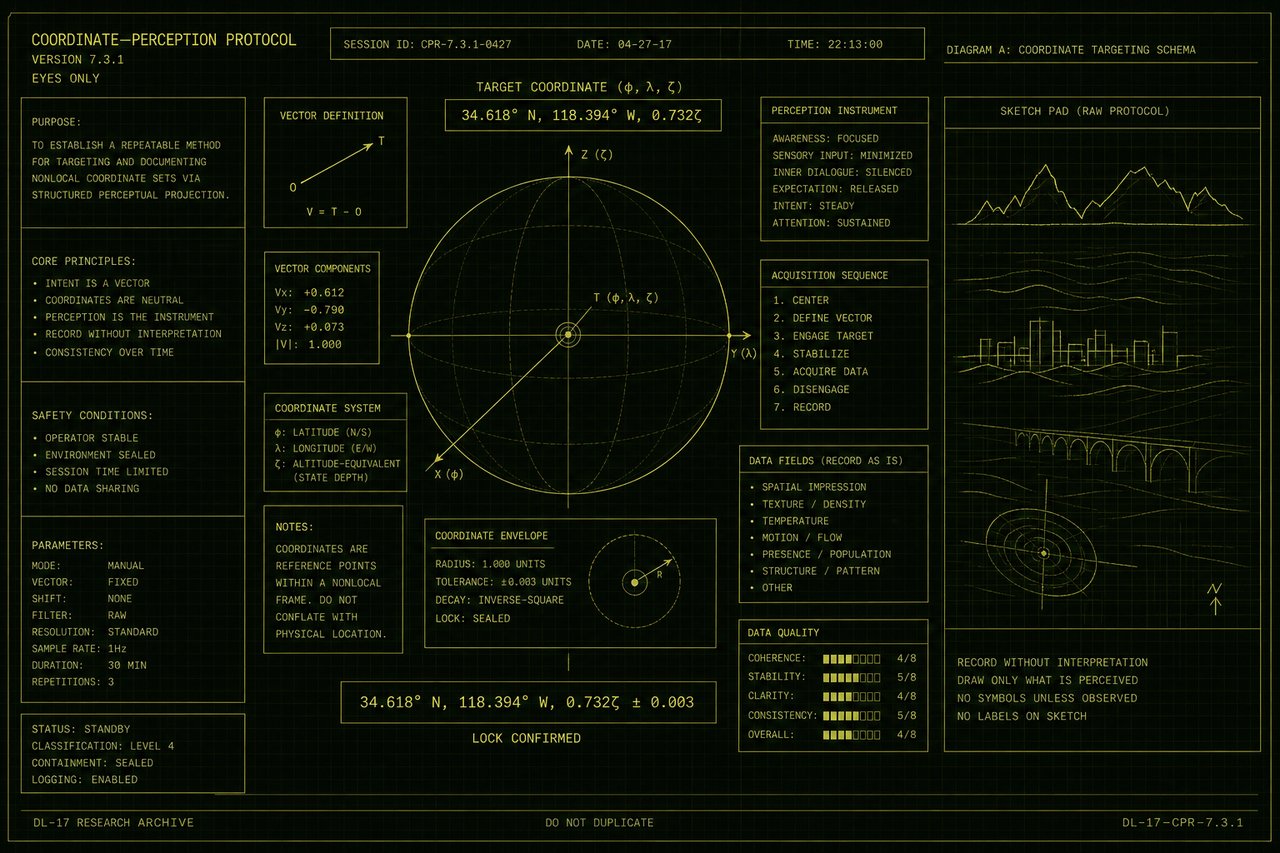
Remote viewing is a practice where a viewer sits with a sealed target and a coordinate, then reports form, which means shape, layout, and texture you could draw. The viewer does not get the photo first, and does not get the street name first. You stay in the chair. A session is one time the viewer sits and reports form, and nobody opens the target until someone scores that session.
A score means a judge later compares the report with the real place or the real picture, and that is how a session can be checked. People come to this work because they want to see a place that is not in the room.
What is CRV, or coordinate remote viewing?
CRV is coordinate remote viewing. That is Ingo Swann's method at SRI. SRI is Stanford Research Institute, the lab that ran the early work. Hal Puthoff and Russell Targ worked there with Swann.
A coordinate is an address for a sealed target, and you use that address to name the place or the picture. You sit, take the address, and describe form. If someone handed you the photo, they already handed you the answer, so you keep the target sealed so a judge can score the session later.
What is Stargate?
Stargate is the US program that funded that SRI work, and Puthoff, Targ, and Swann ran the early sessions with that funding. The CIA, which is the Central Intelligence Agency, later asked people to look at that same set of sessions.
What did Targ and Puthoff run in 1974?
Russell Targ and Hal Puthoff published in Nature in 1974. Nature is a science journal. The paper is called "Information transmission under conditions of sensory shielding," and sensory shielding means the viewer cannot see or hear the target the ordinary way.
They ran 13 drawing experiments across 7 days, and they also ran 10 shielded-room experiments in the Geller series. That series is the set of shielded-room trials named for Uri Geller. They also ran Pat Price remote-scene trials, which were sessions where Pat Price described scenes far from the room. People drew, and people described remote scenes, while the viewers could not see or hear the target the ordinary way.
What did the 1976 IEEE paper report?
Puthoff and Targ published again in 1976 in Proc. IEEE. IEEE is a big engineering journal. Proc. IEEE means Proceedings of the IEEE, the collected papers from that journal. The paper is called "A perceptual channel for information transfer over kilometer distances."
They reported more than fifty controlled lab experiments, and they measured the distances in kilometers. A kilometer is a unit of length that equals about six-tenths of a mile. They named a perceptual channel, which means a way a person can pick up information when the target is far from the chair.
What did Jessica Utts look at in 1995?
Jessica Utts wrote "An Assessment of the Evidence for Psychic Functioning" in 1995. The American Institutes for Research, or AIR, asked her to look at the Stargate file for the CIA. AIR is a research group. The Journal of Parapsychology, a journal that publishes research on psychic functioning, reprinted that assessment in 2018.
Utts looked at the whole program. That is a program-level assessment, which means she reviewed the Stargate file as a whole, the set of sessions the program already had. She did not run one new trial with one person.
What did the 2023 CIA remote viewing follow-up look at?
Escolà-Gascón and colleagues published a follow-up in Brain and Behavior in 2023. Brain and Behavior is a science journal. They looked at 634 sessions from the CIA remote viewing file, and 347 of those sessions used a coordinate while 287 used a picture.
People who do coordinate remote viewing use an address. People who do image remote viewing use a picture as the thing they work from. Utts looked at the program, and this later group looked at 634 sessions from the same set of files.
Is remote viewing the same as astral travel?
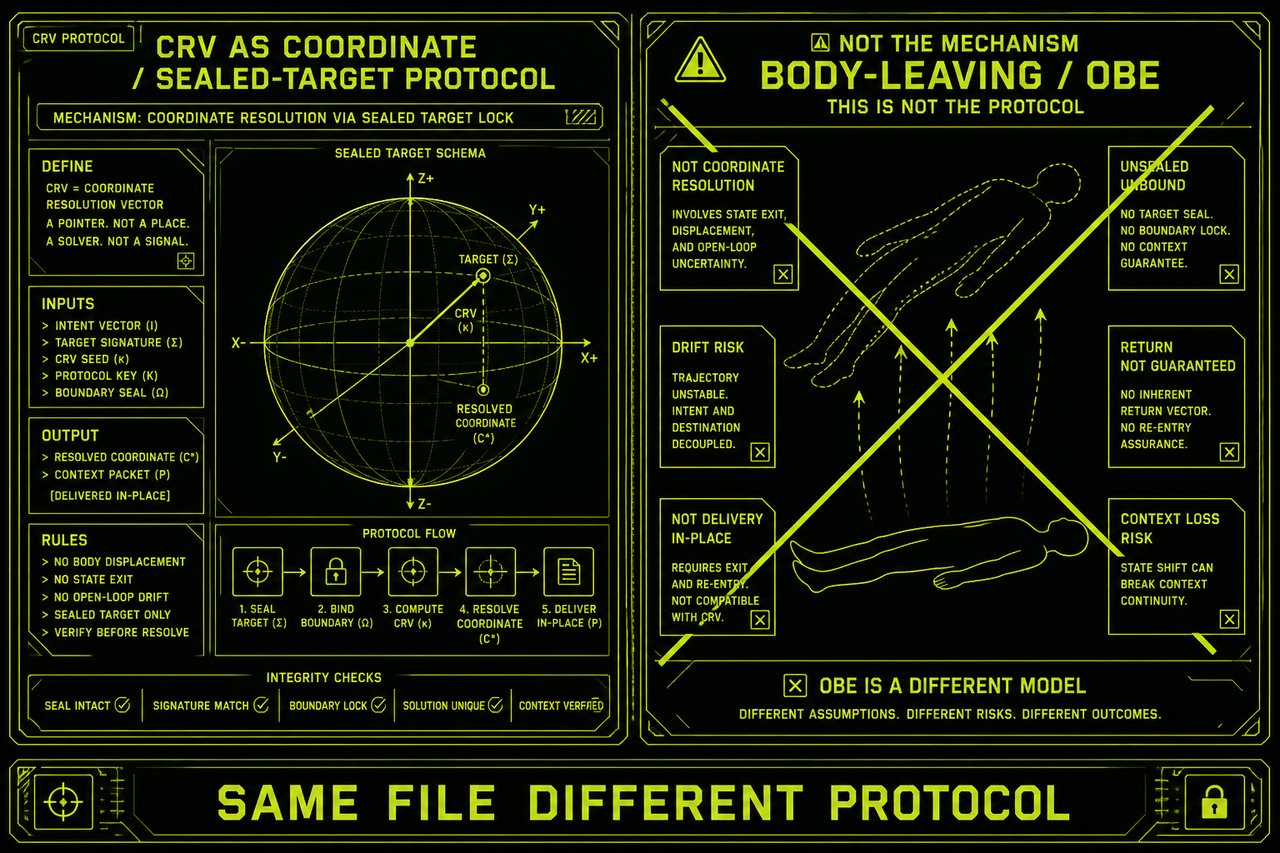
Astral travel is a different practice, and in that practice people talk about leaving or traveling. Remote viewing is sitting in a chair with a sealed target. You can keep both. If you want the travel page, open the astral projection page.
If sitting with a sealed target, or the idea of seeing a place you cannot see, distresses you, talk to a clinician.
What do you do with this now?
You wanted to see a place that was not in the room. Keep the remote viewing name.
Sit down, take the address, and describe the form you notice. The target stays sealed until someone scores the session.
Sources
Targ, R., Puthoff, H. "Information transmission under conditions of sensory shielding." Nature 1974, volume 251, pages 602-607. 13 drawing experiments across 7 days. 10 shielded-room experiments in the Geller series, plus Pat Price remote-scene trials. Sensory shielding. Drawings. Remote scenes. doi.org/10.1038/251602a0
Puthoff, H.E., Targ, R. "A perceptual channel for information transfer over kilometer distances." Proc. IEEE 1976, volume 64, issue 3, pages 329-354. More than fifty controlled lab experiments. Kilometer distances. A perceptual channel. doi.org/10.1109/PROC.1976.10113
Utts, J. "An Assessment of the Evidence for Psychic Functioning." AIR/CIA Stargate evaluation, 1995. Journal of Parapsychology reprint 2018. Program-level assessment. She reviewed the whole file.
Escolà-Gascón, Á., Houran, J., Dagnall, N., Drinkwater, K., Denovan, A. "Follow-up on the U.S. Central Intelligence Agency's (CIA) remote viewing experiments." Brain and Behavior 2023, article e3026. 634 sessions (347 coordinate remote viewing plus 287 image remote viewing). Two later looks at the same file family. doi.org/10.1002/brb3.3026