Mechanism · Astral · Grid Cells · Body of Light

Astral projection is a name for running the spatial map without the body.

JM Thomas · Paris, Tennessee · 15 August 2026

Theosophists named leaving the body. Place cells say you are here. Grid cells say the metric. Horner saw a six-fold signal when people closed their eyes and imagined the path. Blanke moved the self with an electrode at the angular gyrus. That mapping is a translation, not a scan of Monroe's other locale. The stills on this page are schematic. I will not sell you a passport from a rat maze.

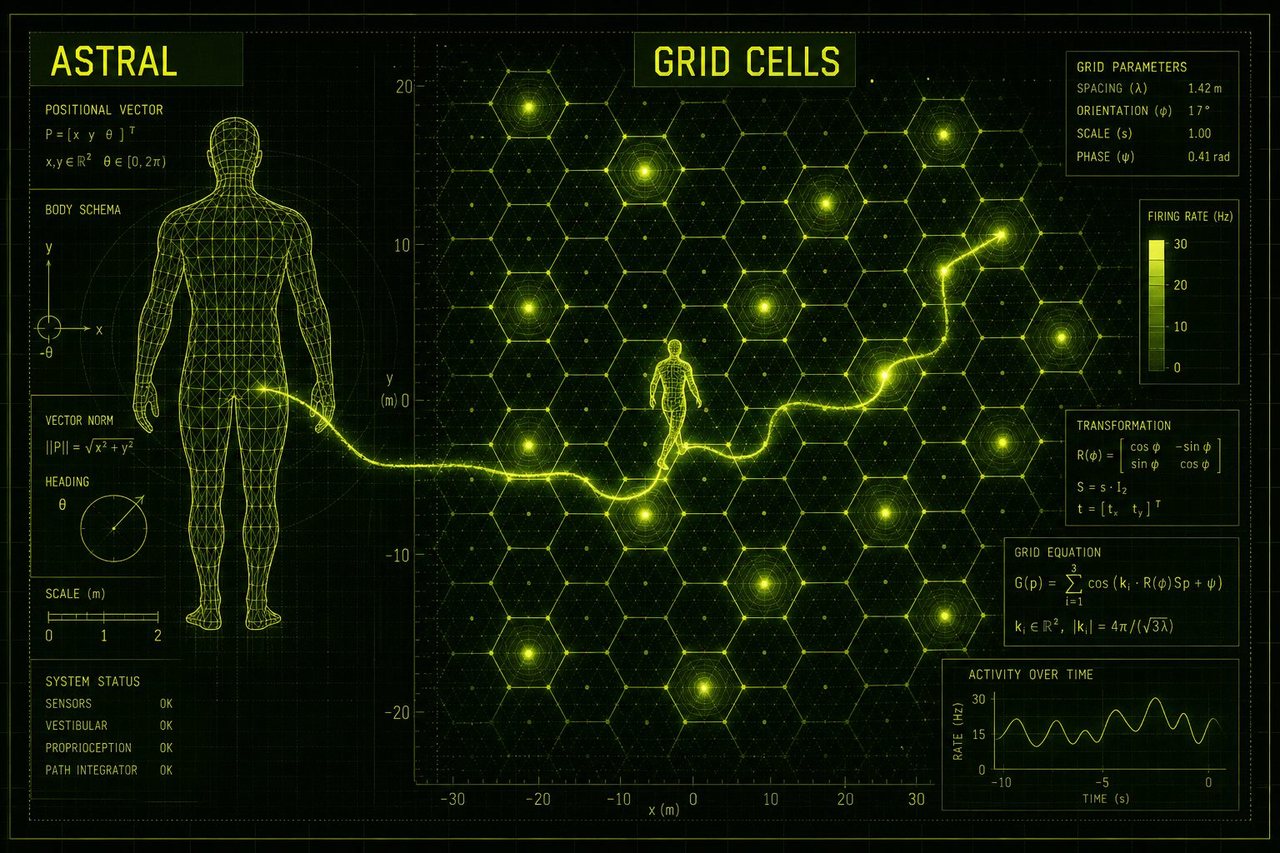
Dark lime schematic: a wireframe body of light labeled ASTRAL navigating a hexagonal GRID CELLS lattice. Schematic still, not a recording.
Body of light on a hexagonal lattice. Schematic still. Not a Hafting recording. Do not quote the art numbers as grid spacing.

I write from Paris, Tennessee. People ask me if astral projection is real. They ask if the body of light is a ghost or a trick. They paste a screenshot of a silver cord. Those are hardware questions. I will answer the hardware. I will not baptize a vision with a hexagonal firing field.

Reality Engineering is the science of making reality respond to intent. A map that runs without the feet is not a hole in physics. The gatekeeper told you the traveler was a child, then rented access to "leaving the body" as a mystery. The people who sat down to travel were not stupid. They lacked an entorhinal electrode.

What is astral projection?

Astral projection is an old name for an intentional out-of-body experience: consciousness reported as traveling in a subtle body, often called the astral body or body of light. Theosophists coined and promoted the English phrase. Egyptians had the ba. Monroe later popularized OBE. The old map is a traveler. The lab map is a spatial code you can run without walking.

The English phrase is Theosophical. Nineteenth-century occultists took the older astral body, the intermediate body of light between soul and flesh, and named a practice: project it. Leadbeater's The Astral Plane and Powell's The Astral Body made the traveler a curriculum. Crowley called the constructed double the body of light. Egyptians already had the ba hovering over the corpse. Taoist internal alchemy built a pearl and circulated it. Monroe, in 1971, renamed the event an out-of-body experience and split Locale I (this room) from locales that do not match the street. I am not here to audit Monroe's journals. I am here to name the map. A traveler. In space. That is not a joke. That is a claim about the substrate of location.

This week the forums are still arguing protocols and silver cords. That hunger is not a bug. Related reading: the Akashic records are a name for a vacuum that is not empty. That page is the space the map sits in. This page is the map you run inside it.

What are place cells?

Place cells are hippocampal neurons that fire when the animal is in a particular location. O'Keefe and Dostrovsky reported them in Brain Research in 1971. A place cell is a you-are-here pin. A grid cell is the graph paper. Together they are the positioning system that later won a Nobel. They are not a verdict on whether your Tuesday vision was 'real.'

John O'Keefe and Jonathan Dostrovsky, Brain Research, November 1971. Freely moving rat. Hippocampus. Certain cells discharged when the animal was in a particular place. O'Keefe later called them place units and argued the hippocampus was building an inner map, not just echoing the eyes. In 2014 that work shared a Nobel with May-Britt Moser and Edvard Moser. A you-are-here pin is not a soul. It is the first half of the positioning system the old traveler was already using without a name for the pin.

What are grid cells?

Grid cells are neurons in the medial entorhinal cortex that fire whenever the animal is at any vertex of a repeating triangular grid spanning the environment. Hafting, Fyhn, Molden, Moser and Moser reported them in Nature in 2005. Neighbouring cells share orientation and spacing. The map is anchored to landmarks but persists in darkness, which is why they talked about path integration. A grid is a metric. It is not a passport stamp for another planet.

Torkel Hafting, Marianne Fyhn, Sturla Molden, May-Britt Moser, Edvard I. Moser. Nature, 2005, volume 436, pages 801 to 806. Dorsocaudal medial entorhinal cortex. A cell fires at every vertex of a regular grid of equilateral triangles spanning the surface of the environment. Neighbouring grids share orientation and spacing. Phases differ. Spacing increases from dorsal to ventral. The map anchors to landmarks and keeps its structure in darkness. They wrote that grid cells may be part of a generalized, path-integration-based map of the spatial environment. Path integration is dead reckoning: update position from your own motion when the landmarks go dark. That sentence is the whole occult lesson, in lab clothes. The traveler always said the map persisted when the room went away.

Joshua Jacobs, Christoph Weidemann, Itzhak Fried, Michael Kahana and colleagues recorded single neurons from fourteen epilepsy patients navigating a virtual world from bed. Nature Neuroscience, 2013. Cells with grid-like spiking in the human brain. Doeller, Barry and Burgess, Nature 2010: a speed-modulated six-fold fMRI signal in a human memory network, strongest in right entorhinal cortex, while people explored virtual space. Humans have the graph paper. Rats were not a special case.

Did anyone scan an astral traveler?

No. Jacobs recorded grid-like firing in epilepsy patients doing virtual navigation in bed. Doeller saw a six-fold fMRI signal while people explored a virtual world. Horner saw a similar six-fold signal when the same people closed their eyes and imagined the path. That is imagined navigation in a circular arena, not Monroe's Locale II. Translation is not a scan.

Horner, Bisby, Zotow, Bush and Burgess. Current Biology, 21 March 2016. Twenty-six people. A circular virtual arena. They learned object locations, then on each trial oriented, closed their eyes, and imagined moving the path. Then they actually walked it. Entorhinal cortex showed a six-fold signal during real virtual movement versus sitting still. The same orientation showed up during the imagination period versus sitting still. Four-fold and eight-fold controls were quiet. The paper's claim is modest and huge: grid cells may move the viewpoint of imagination. That is the closest lab object I will put under the word astral. It is not Monroe on Locale II. It is not a Theosophist on the mental plane. It is a viewpoint that left the feet and kept the metric.

In 2025 the Moser group reported that grid activity does not only sit on "here." Vollan, Gardner, Moser and Moser, Nature: left-right-alternating theta sweeps into the surrounding map, about ten times a second, probing space the body does not yet occupy. The map looks ahead. The old traveler said the same thing with different nouns. I will not launder a 2025 sweep into a silver cord. I will also not pretend looking-ahead is a new idea the aisle invented.

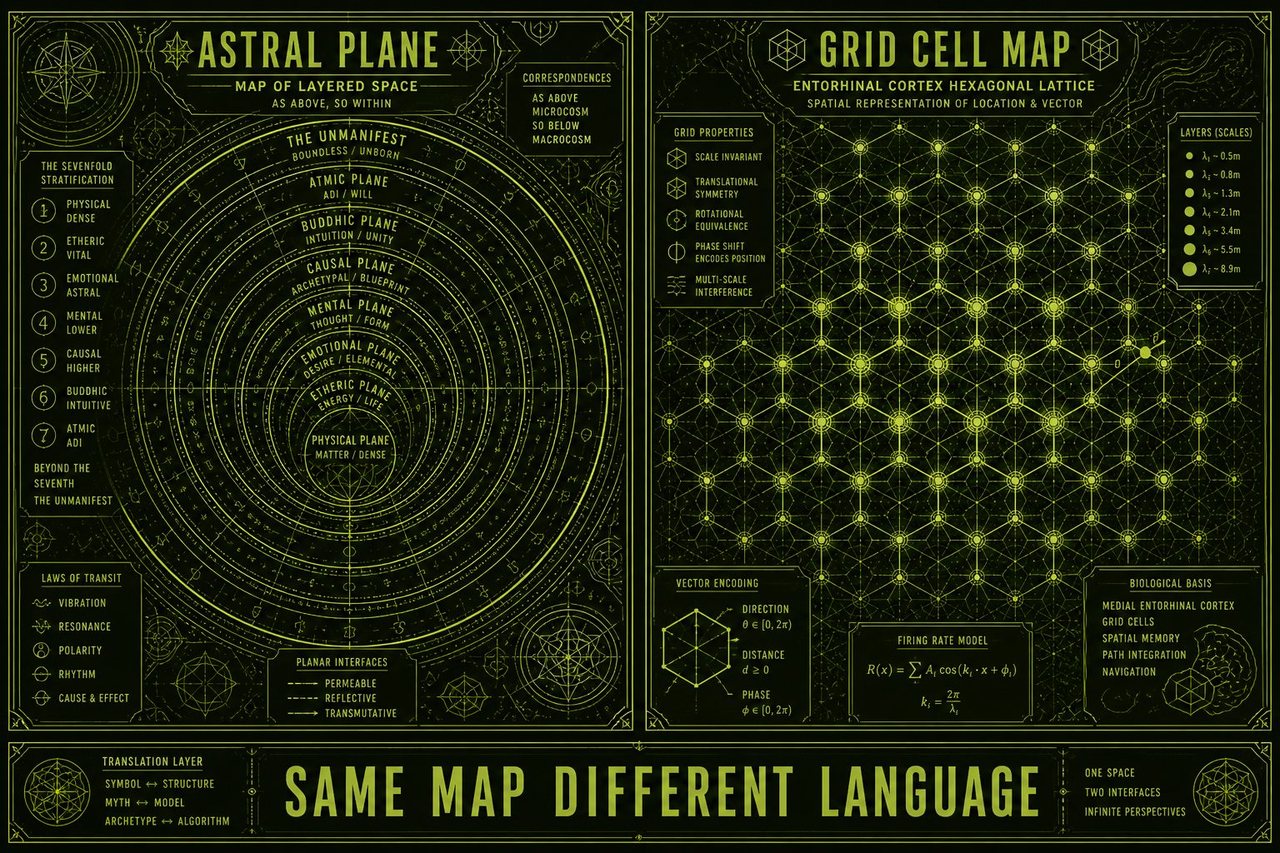
Two-panel schematic: an old layered ASTRAL PLANE map versus a hexagonal GRID CELL MAP. Footer: SAME MAP DIFFERENT LANGUAGE. Schematic still, not a recording.
Astral plane versus grid-cell map. Schematic still. Footer is the claim. Plane labels on the art are not a dataset.

What does the temporoparietal junction have to do with leaving the body?

Blanke electrically stimulated the right angular gyrus in an epilepsy patient and repeatedly induced a feeling of floating about two metres above the bed. Later work put the out-of-body cluster at the temporoparietal junction, where body, vision, and vestibular signals have to agree on where 'I' is. Ehrsson induced an out-of-body illusion in healthy people with cameras and a stick. A mismatch at the assembly point moves the self. That is hardware, not a joke.

Olaf Blanke, Stephanie Ortigue, Theodor Landis, Margitta Seeck. Nature, 19 September 2002. Right angular gyrus. Focal electrical stimulation in a patient being evaluated for epilepsy. Repeated induction of an out-of-body experience: consciousness seeming detached, a remote viewing position. Initial stimulations at 2.0 to 3.0 milliamperes. The patient described floating about two metres above the bed, close to the ceiling. Arm and leg transformations. Whole-body displacements. Their read: failure to integrate complex somatosensory and vestibular information. Later, Blanke and Arzy put the cluster at the temporoparietal junction. TMS over TPJ in healthy people impaired imagined own-body transformations, not imagined object rotations. The assembly point is where body, vision, and inner ear vote on where "I" is. When the votes disagree, the self moves.

Henrik Ehrsson, Science, 2007. Healthy people. Goggles fed by cameras behind them. A stick on the chest they could not see, and a stick in the camera's chest they could. They reported sitting in the corner watching themselves. A hammer swung at the illusory chest produced a stress response. Lenggenhager's group, the same season, had people drift toward the illusion when asked to walk back to where they had been. You do not need a yogic siddhi to relocate the self. You need a mismatch at the junction. The old map called that junction the assembly point. I will keep the old noun. I will not pretend a stick and a camera are a full astral curriculum.

The body of light is a simulated self

Library DNA says it in one line: the body of light is a simulated self navigating the grid-cell map. That is the translation. Crowley built a second body by visualization and breath, then transferred attention into it. Horner had people close their eyes and move a viewpoint along a remembered heading. Blanke moved the viewpoint by scrambling the vote at TPJ. Three instruments. One claim: location is computed, and the computer can run a copy.

The gatekeeper offers you two lies. One: nothing leaves, so stop talking. Two: everything leaves, so buy the cord. The hardware is narrower. Place cells pin. Grid cells metric. TPJ binds the pin to the flesh. Imagination can drive the metric with the flesh still in the chair. That is enough miracle for a Tuesday. It is not a proof you visited a dead relative on a sub-plane. Mixing those stacks is how the aisle gets away with it.

NameWhat it actually isWhat it is not
Astral projection / OBEOld name for a traveler whose viewpoint left the fleshA scanned itinerary of Locale II
Place cellsHippocampal you-are-here pins (O'Keefe 1971)A soul
Grid cellsEntorhinal triangular metric (Hafting 2005; Jacobs 2013 in humans)A passport
Imagined navigationSix-fold entorhinal signal with eyes closed (Horner 2016)Proof of another planet
TPJ / angular gyrusAssembly point where body, vision, and vestibular votes bind "I"A joke about floating

Run the brake first.

A screaming nerve writes noise into any map you then try to run. Protocol 01 is free. Four-count inhale. Eight-count exhale. Seven minutes. A number before and a number after. That is the hardware check. The Library of Biological Wizardry is the rest of the stack if the method earns the next hour. No depth electrode. No initiate password. A write, then a measurement.

What should I run if I want a number?

Start with Protocol 01, the free Neural Recalibration. Four-count inhale, eight-count exhale, seven minutes, a number before and a number after. A screaming nerve does not make a cleaner map. You do not need a depth electrode for the first test. If the method earns it, the Library of Biological Wizardry is the rest of the stack. The map is already running. The brake is how you stop screaming into it.

You will not get Horner's scanner in your kitchen. You can get a 1 to 10 on your own state before and after a seven-minute brake. That is the first instrument. Related reading: raising kundalini is recruiting the vagus. The trunk, then the traveler. Hardware, then the map the hardware already runs. Related reading: a sigil is data compression. Encode. Release. Stop watching the pot. The same rule applies to a viewpoint you are trying to move. Lust for result is a TPJ that will not let go of the chair.

FAQ

Short answers you can lift from this page. Visible text matches the FAQ schema exactly. The stills are schematic. None of this is medical advice.

What is astral projection?

Astral projection is an old name for an intentional out-of-body experience: consciousness reported as traveling in a subtle body, often called the astral body or body of light. Theosophists coined and promoted the English phrase. Egyptians had the ba. Monroe later popularized OBE. The old map is a traveler. The lab map is a spatial code you can run without walking.

What are grid cells?

Grid cells are neurons in the medial entorhinal cortex that fire whenever the animal is at any vertex of a repeating triangular grid spanning the environment. Hafting, Fyhn, Molden, Moser and Moser reported them in Nature in 2005. Neighbouring cells share orientation and spacing. The map is anchored to landmarks but persists in darkness, which is why they talked about path integration. A grid is a metric. It is not a passport stamp for another planet.

What are place cells?

Place cells are hippocampal neurons that fire when the animal is in a particular location. O'Keefe and Dostrovsky reported them in Brain Research in 1971. A place cell is a you-are-here pin. A grid cell is the graph paper. Together they are the positioning system that later won a Nobel. They are not a verdict on whether your Tuesday vision was 'real.'

Did anyone scan an astral traveler?

No. Jacobs recorded grid-like firing in epilepsy patients doing virtual navigation in bed. Doeller saw a six-fold fMRI signal while people explored a virtual world. Horner saw a similar six-fold signal when the same people closed their eyes and imagined the path. That is imagined navigation in a circular arena, not Monroe's Locale II. Translation is not a scan.

What does the temporoparietal junction have to do with leaving the body?

Blanke electrically stimulated the right angular gyrus in an epilepsy patient and repeatedly induced a feeling of floating about two metres above the bed. Later work put the out-of-body cluster at the temporoparietal junction, where body, vision, and vestibular signals have to agree on where 'I' is. Ehrsson induced an out-of-body illusion in healthy people with cameras and a stick. A mismatch at the assembly point moves the self. That is hardware, not a joke.

What should I run if I want a number?

Start with Protocol 01, the free Neural Recalibration. Four-count inhale, eight-count exhale, seven minutes, a number before and a number after. A screaming nerve does not make a cleaner map. You do not need a depth electrode for the first test. If the method earns it, the Library of Biological Wizardry is the rest of the stack. The map is already running. The brake is how you stop screaming into it.

Is this medical advice?

No. This page is an educational mechanism explainer by JM Thomas. It is not a diagnosis, treatment, cure, or prevention of any disease. Named papers are literature, not a promise about your Tuesday. Spontaneous out-of-body states can be medical. If they distress you, talk to a clinician.

Sources I actually opened

O'Keefe, J., Dostrovsky, J. "The hippocampus as a spatial map. Preliminary evidence from unit activity in the freely-moving rat." Brain Research 34:171-175 (Nov 1971). Place cells. doi.org/10.1016/0006-8993(71)90358-1

Hafting, T., Fyhn, M., Molden, S., Moser, M.-B., Moser, E.I. "Microstructure of a spatial map in the entorhinal cortex." Nature 436:801-806 (2005). Grid cells in dMEC. Persists in darkness. doi.org/10.1038/nature03721

Doeller, C.F., Barry, C., Burgess, N. "Evidence for grid cells in a human memory network." Nature 463:657-661 (2010). Six-fold fMRI signal during virtual navigation, strongest in right entorhinal cortex. doi.org/10.1038/nature08704

Jacobs, J., Weidemann, C.T., Miller, J.F., et al. "Direct recordings of grid-like neuronal activity in human spatial navigation." Nature Neuroscience 16:1188-1190 (2013). Single-unit grid-like firing in epilepsy patients doing virtual navigation from bed. doi.org/10.1038/nn.3466

Horner, A.J., Bisby, J.A., Zotow, E., Bush, D., Burgess, N. "Grid-like processing of imagined navigation." Current Biology 26:842-847 (21 Mar 2016). n=26. Six-fold entorhinal signal during imagined paths, similar orientation to virtual movement. Not a scan of an astral traveler. doi.org/10.1016/j.cub.2016.01.042 · PMC4819517

Blanke, O., Ortigue, S., Landis, T., Seeck, M. "Stimulating illusory own-body perceptions." Nature 419:269-270 (19 Sep 2002). Right angular gyrus stimulation. Repeated OBE: floating about two metres above the bed. doi.org/10.1038/419269a

Blanke, O., Arzy, S. "The out-of-body experience: disturbed self-processing at the temporo-parietal junction." The Neuroscientist 11:16-24 (2005). TPJ as the bind for self-location. doi.org/10.1177/1073858404270885

Ehrsson, H.H. "The experimental induction of out-of-body experiences." Science 317:1048 (2007). Camera-and-stick illusion in healthy people. doi.org/10.1126/science.1142175

Vollan, A.Z., Gardner, R.J., Moser, M.-B., Moser, E.I. "Left-right-alternating theta sweeps in entorhinal-hippocampal maps of space." Nature (2025). Grid activity probing surrounding locations, not only "here." Named as looking-ahead, not as a silver cord. doi.org/10.1038/s41586-024-08527-1

Nobel Prize in Physiology or Medicine 2014 press release. O'Keefe, Moser, Moser. Place cells and grid cells as a positioning system. nobelprize.org/.../2014/press-release

Wikipedia, "Astral projection." Theosophical coinage. Egyptian ba. Crowley body of light. Monroe OBE / Locale I. Scientific reception: no evidence of a consciousness that makes observations of the physical universe independent of neural activity. Used here as the old map, not as a lab protocol. en.wikipedia.org/wiki/Astral_projection

Monroe, R. Journeys Out of the Body (1971). Named as the popularizer of OBE and Locale I versus other locales. Not a grid-cell paper.

Leadbeater, C.W. The Astral Plane (1896); Powell, A.E. The Astral Body (1927). Named as the Theosophical curriculum for the traveler. Not Casimir. Not Hafting.