akasha · records · empty space
They wanted the Akashic records to be a real place. Empty space still had a pull.
You type Akashic records at a desk, or you open the book that uses that name.
A lamp on the desk is enough, and daylight from the window is enough if that is what you have.
You want a place a life can be kept.
The Akashic records are a later library name you use when you want that place to be real, a space that can keep a life the way a shelf keeps a book.
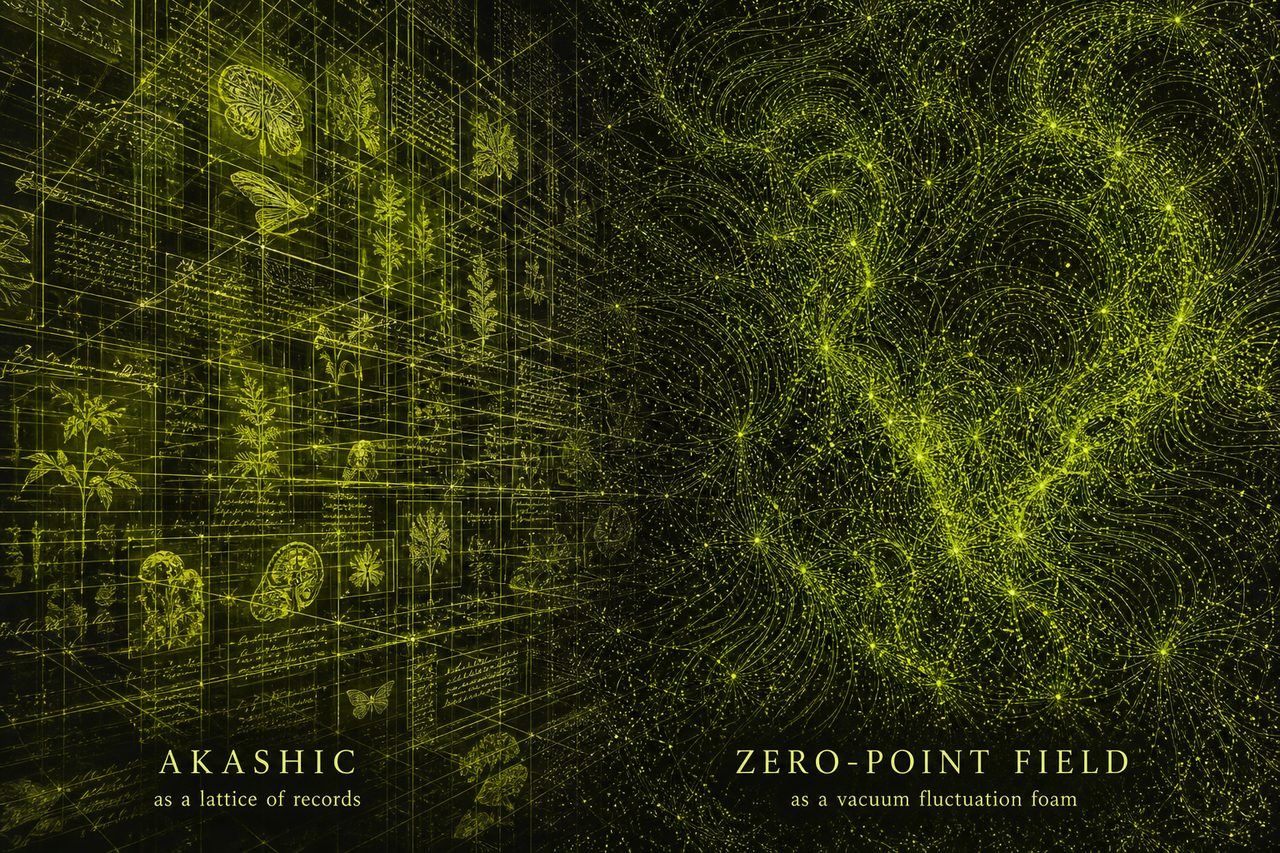
The desk search is for a place a life can be kept
Akasha, also written Akasa, is an old Sanskrit word for space, sky, or aether. Sanskrit is an old language from India. Aether is an old word people used for the stuff they thought filled the sky.
Henry Steel Olcott wrote A Buddhist Catechism in 1881, and he used the spelling Akasa when he said that everything has come out of Akasa and that no thing ever comes out of nothing.
You can read that old word at wikipedia.org/wiki/Akasha.
A later school used a library name for that space
Theosophy is a later spiritual school that used the library name Akashic records. People in that school wanted a place where a life could be kept.
Helena Blavatsky wrote about tablets in that school. She did not use the phrase Akashic records.
Charles Leadbeater used the library idea in a book called Clairvoyance in 1899. You can keep wanting a library in space.
Open wikipedia.org/wiki/Akashic_records if you want that later name.
Hendrik Casimir wrote that two metal plates attract
People call a space empty when they cannot see anything in it. A vacuum is that space people call empty.
Hendrik Casimir wrote in 1948 that two conducting plates attract, which means two metal faces that can carry an electric current pull toward each other when you set them close in a space people call empty.
The Casimir effect is the name for that pull. He said the force on each bit of plate area falls as one over the distance to the fourth, so the pull gets much weaker as you move the plates apart.
The write-up is at wikipedia.org/wiki/Casimir_effect.
Lamoreaux hung a bar to measure the pull
Lamoreaux ran that measurement in 1997 at the University of Washington. He used a torsion pendulum, which is a hanging bar that twists so you can measure a tiny pull, and he set that bar across a very small gap.
The result sat close to the number Casimir's rule pointed to. A later correction note, called an erratum, came out in 1998. The leftover cells sit in the sources card.
Read Lamoreaux's 1997 paper at doi.org/10.1103/PhysRevLett.78.5.
The zero-point field is leftover energy in empty-looking space
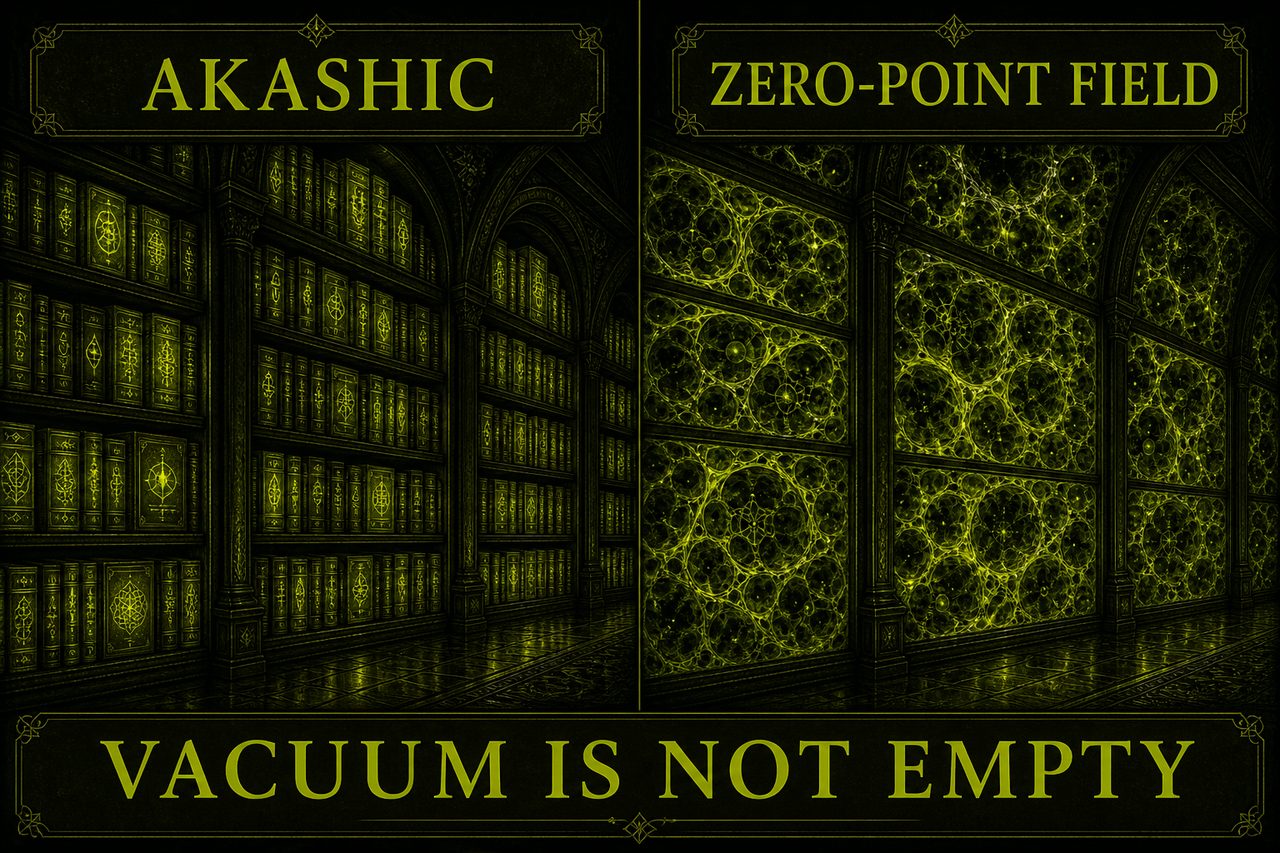
The zero-point field is leftover energy in space even when the space looks empty. People who study that energy still talk about a vacuum, the space they call empty.
You can keep wanting that space to keep more than a hole.
Laszlo wrote a book that treats the field as a map
Ervin Laszlo wrote Science and the Akashic Field in 2004 for Inner Traditions, and he treated his A-field as an information-conserving mapping, a way to keep what a life puts into space so the picture does not vanish.
A mapping is a way to carry one picture onto another. He wrote a book you can still hold. Keep that translation.
The book page is at innertraditions.com/books/science-and-the-akashic-field.
Cayce used a loose coil of thread for time and space
Edgar Cayce spoke in a reading numbered 416-2 in 1934, and a reading here is a spoken session he gave. He used the language skein of time and space.
A skein is a loose coil of thread, so he was talking about time and space as something wound together. You can still keep that language.
A public page on Cayce is at wikipedia.org/wiki/Edgar_Cayce.
Jaffe is a neighbor who said a plate pull does not print a Tuesday
Jaffe wrote in 2005 about the Casimir effect and the quantum vacuum. A quantum vacuum is the same space people call empty, looked at as energy that stays there.
He is a neighbor on this page. A measured pull between plates does not print a Tuesday. You can still want space that remembers.
That 2005 paper is at doi.org/10.1103/PhysRevD.72.021301.
Aura and chakra pages can stay open
People who also want a glow around a body can open the aura page. People who already work with chakras can keep the chakras page.
Stay here if you want the records to be a real place.
If the records search or this page brings unusual distress, talk with a clinician you already trust. This page is educational.
You can still want the records to be a real place
You typed Akashic records because you wanted a real place. Empty space still had a pull.
The plate pull does not hand you a Tuesday from a life. You can still want space that remembers.
Keep the library name. Read the plate story as a measured pull. Those two facts can sit on the same desk.
Sources
Casimir, H.B.G. On the attraction between two perfectly conducting plates. Proceedings of the Koninklijke Nederlandse Akademie van Wetenschappen 51:793-795 (1948). Two conducting plates attract. Force per unit area falls as one over distance to the fourth. wikipedia.org/wiki/Casimir_effect
Lamoreaux, S.K. Demonstration of the Casimir Force in the 0.6 to 6 μm Range. Physical Review Letters 78:5 (1997). Torsion pendulum, University of Washington, 0.6 to 6 micrometer, about 5 percent. Erratum 1998. doi.org/10.1103/PhysRevLett.78.5
Jaffe, R.L. Casimir effect and the quantum vacuum. Physical Review D 72:021301 (2005). Neighbor only. A measured pull between plates does not print a Tuesday. doi.org/10.1103/PhysRevD.72.021301
Wikipedia. Akasha. Sanskrit: space, sky, aether. wikipedia.org/wiki/Akasha
Wikipedia. Akashic records. Theosophical library. Blavatsky tablets without the phrase. Leadbeater, Clairvoyance (1899). wikipedia.org/wiki/Akashic_records
Olcott, H.S. A Buddhist Catechism (1881). Akasa, Nirvana, eternal. Everything has come out of Akasa. No thing ever comes out of nothing. wikipedia.org/wiki/A_Buddhist_Catechism
Laszlo, E. Science and the Akashic Field. Inner Traditions (2004). A-field as an information-conserving mapping. Book. Keep that translation. innertraditions.com/books/science-and-the-akashic-field
Cayce, E. Reading 416-2 (1934). Language: skein of time and space. A skein is a loose coil of thread. wikipedia.org/wiki/Edgar_Cayce