orch-or · microtubules · quantum consciousness
Orch-OR puts awareness in tiny tubes inside a brain cell. Hameroff and Penrose named that idea.
You wanted consciousness to have a place in the body.
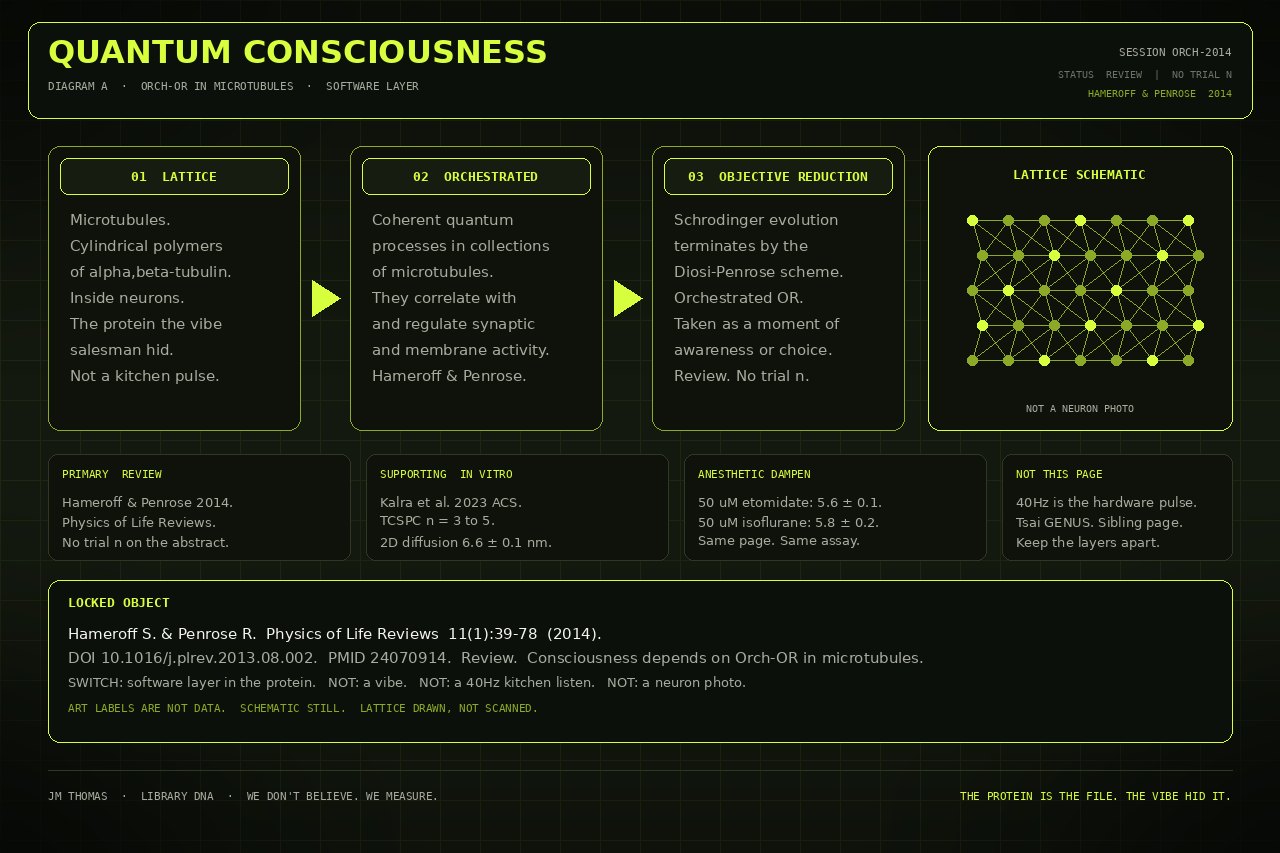
Orch-OR is orchestrated objective reduction, the name Stuart Hameroff and Roger Penrose gave in 2014 when they put awareness in microtubules, which are tiny tubes inside a brain cell. A neuron is a brain cell, quantum is the smallest scale of energy, and objective reduction is a proposed ending of a quantum process. They said that ending is a moment of awareness or choice. They named that place.
What is Orch-OR?
People use the name Orch-OR for orchestrated objective reduction, the process Hameroff and Penrose placed in microtubules inside brain cells, with living cells timing and organizing that process and objective reduction as the proposed ending. They take that ending as a moment of awareness or choice.
A review is a paper that walks through a claim and answers critics, and the 2014 paper is a review that enrolls nobody. The letter n is how many people sat in a counted group, and that review prints no trial n.
What is a microtubule?
A microtubule is a tiny tube inside a brain cell, built from a protein called tubulin, and Hameroff and Penrose put the process on those tubes. You came here because you wanted consciousness to have a place, and they pointed at that tube.
What did Hameroff and Penrose write in 2014?
Stuart Hameroff and Roger Penrose published in 2014 in Physics of Life Reviews, a journal that prints papers on how living systems work, and they called the paper "Consciousness in the universe: a review of the 'Orch OR' theory." The paper is volume 11, issue 1, pages 39 to 78.
They said consciousness depends on biologically orchestrated coherent quantum processes in collections of microtubules within brain neurons, which means the small-scale energy stays in step, and they said those processes end by the Diosi-Penrose scheme of objective reduction, the ending they proposed. They take that ending as a moment of awareness or choice.
They also suggested that beat frequencies of faster microtubule vibrations could be a source of EEG correlates, and EEG is a record of brain electrical activity. A beat frequency is the slower pulse you get when two faster shakes are close in speed, and they marked that line as a suggestion. You can read the Europe PMC abstract.
What did Kalra measure in microtubules?
Aarat P. Kalra and colleagues published "Electronic Energy Migration in Microtubules" in 2023 in ACS Central Science, a chemistry journal, as volume 9, issue 3, pages 352 to 361.
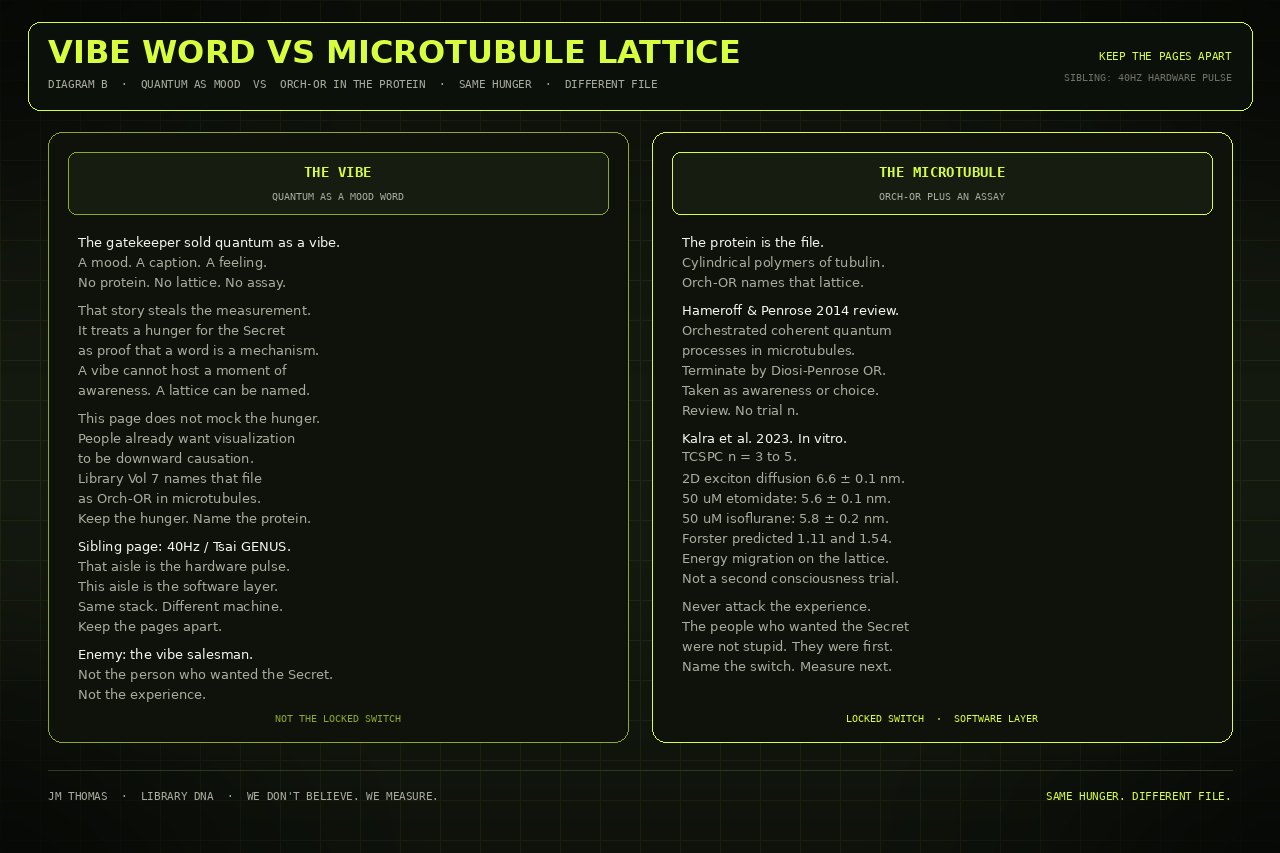
They ran the test in vitro, which means in a dish, not in a living person, and they used time-correlated single photon counting, a way to time tiny flashes of light that they shorten to TCSPC. They ran that count 3 to 5 times.
An exciton is a packet of energy that can hop along the tube, and a nanometer is a billionth of a meter, so when they printed a 2D exciton diffusion length of 6.6 plus or minus 0.1 nanometers in microtubules you can picture how far that packet moved. The results text also writes 6.64 plus or minus 0.1 nanometers for the same condition, and this page keeps both printings.
They measured a shorter hop on loose tubulin that was not built into a tube yet, and that free GTP tubulin printed 4 plus or minus 0.1 nanometers, while a fourteen-protofilament tube, a tube built with fourteen long rows, printed 6.1 plus or minus 0.1 nanometers.
They also ran Forster simulations, which are computer guesses about how far the energy should hop, and those guesses printed 1.11 nanometers and 1.54 nanometers. Kalra called microtubules effective light harvesters, which means the tubes moved energy well in the dish. You can read the full paper at PMC.
What did the sleep medicines do in that dish?
An anesthetic is a medicine that can put you to sleep, and etomidate and isoflurane are two of those medicines Kalra used in the dish. At 50 micromolar etomidate they measured 5.6 plus or minus 0.1 nanometers, and at 50 micromolar isoflurane they measured 5.8 plus or minus 0.2 nanometers, with a micromolar being a tiny dose in the liquid.
Kalra ran a dish assay. They watched energy hop along the tubes, and they did not run a consciousness trial. You can still want consciousness to have a place, and the dish is a supporting look at the same tubes.
Is Orch-OR the same as 40 Hz?
Forty hertz, written 40 Hz, is a sensory pulse on a sibling page, and hertz is how many times something happens in one second. GENUS is a lab method that uses light and sound at 40 Hz, so open the 40 Hz page if you want that pulse.
Jack Tuszynski and a colleague named Roeloffs had a 2026 BioSystems paper announced as in press around 31 July 2026. This page does not have a DOI for that paper, so it stays a mention only.
If these ideas bring unusual distress, talk to a clinician, because this page is educational. The 2014 paper is a review. Kalra is a dish assay.
What do you do with this now?
You wanted consciousness to have a place in the body. Keep the Orch-OR name.
They pointed at the tiny tubes inside a brain cell. You can still want consciousness to have a place.
Sources
Hameroff, S., and Penrose, R. "Consciousness in the universe: a review of the 'Orch OR' theory." Physics of Life Reviews 2014;11(1):39-78. DOI 10.1016/j.plrev.2013.08.002. PMID 24070914, review, no trial n. Orchestrated coherent quantum processes in neuronal microtubules terminating by Diosi-Penrose objective reduction. That ending is taken as a moment of awareness or choice. Beat frequencies of faster microtubule vibrations suggested as a possible EEG source. europepmc.org/article/MED/24070914
Same article via DOI. doi.org/10.1016/j.plrev.2013.08.002
Kalra, A.P., et al. "Electronic Energy Migration in Microtubules." ACS Central Science 2023;9(3):352-361. DOI 10.1021/acscentsci.2c01114. PMID 36968538. PMC10037452, in vitro, TCSPC n = 3 to 5. 2D exciton diffusion 6.6 ± 0.1 nm (results text also 6.64 ± 0.1 nm). 50 μM etomidate 5.6 ± 0.1 nm, 50 μM isoflurane 5.8 ± 0.2 nm, Forster simulations 1.11 nm and 1.54 nm, free GTP tubulin 4 ± 0.1 nm, 14-protofilament 6.1 ± 0.1 nm. Kalra called microtubules effective light harvesters. ncbi.nlm.nih.gov/pmc/articles/PMC10037452/
Same Kalra article via DOI. doi.org/10.1021/acscentsci.2c01114
Tuszynski and Roeloffs. 2026 BioSystems paper announced as in press around 31 July 2026. No DOI on this page, mention only, no n.