Mechanism · Physiological Sigh · Vagus · Brainstem Circuit

The physiological sigh is a brainstem circuit you can fire on command.

JM Thomas · Paris, Tennessee · 15 August 2026

A physiological sigh is a named brainstem circuit you can fire on command. Two inhales. One long exhale. That is how breath grabs the vagus on this page. Li 2016 is a mouse circuit. Balban 2023 is the human RCT. Huberman popularized. He did not discover it. Translation, not a scan of a clip. We don't believe. We measure. The stills on this page are schematic.

Dark lime schematic of a physiological sigh drawn as a brainstem circuit. Schematic still, not a scan.
Physiological sigh drawn as a brainstem circuit you can fire. Schematic still. Do not quote leftover art text, liters, seconds, or waveform numbers as data.

I write from Paris, Tennessee. People send me a clip and ask if the double inhale is a hack. They want the HOW without turning a brainstem circuit into a personality upgrade. Those are hardware questions. I will answer the hardware. I will not hang a lab on a reel. I will not tell you the people who already sighed under load were stupid.

The gatekeeper said the sigh was a leftover. A leak. Something the body did when you were tired or sad. Empty theater. The aisle said the opposite lie. Hang one name on the pattern. Skip the circuit. Call it discovered last Tuesday. Both hid the mechanism. Feldman and Krasnow mapped a switch. Li named the peptides. Balban measured a month of five-minute drills in healthy volunteers. Huberman carried the pattern into public. He did not invent the switch. Reality Engineering is the science of making reality respond to intent. A calmer nerve is the clean line so intent can land. Yesterday's leftover is today's engineering when you name the circuit.

What is a physiological sigh, in this stack?

A physiological sigh is a named brainstem circuit you can fire on command. Two inhales. One long exhale. That is how breath grabs the vagus on this page. Translation, not a scan of a Huberman clip. The stills are schematic. Do not quote art liters, seconds, or waveform numbers as data.

A sigh, in this stack, is not a mood. It is not a brand. It is a named transform: a normal breath becomes a double inflate and a long dump. Li and colleagues wrote that sighs occur spontaneously every few minutes to reinflate alveoli. Sighing increases under hypoxia, stress, and certain psychiatric conditions. That is the old physiology sitting under the new clip. Hering-Breuer and pulmonary stretch already had a story about lung volume talking back to the brainstem. I name that as old physiology. It is not a new trial. It is not Balban. It is not a human scan of a podcast.

Two inhales. One long exhale. Nose in. A second sip. Slow mouth out. That is the pattern Balban ran as cyclic sighing. I will keep those nouns. I will not invent liters from a still. I will not invent a second count from a waveform drawing. Form is form. The job is the switch. You can fire it on command because the circuit that turns a normal breath into a sigh is already in the brainstem. Command here means you start the pattern. It does not mean you designed the peptides.

Related reading: raising kundalini is recruiting the vagus. That page owns the trunk. Four-count inhale. Eight-count exhale. Gerritsen. Lehrer. Laborde. Protocol 01. This page is a different switch. Breath to vagus via the sigh circuit. I will not clone that article. One short mapping. The trunk is the line. The sigh is a named way to grab it. Keep the pages apart or you will mash two mechanisms into one aisle sentence.

Related reading: the cold that grabs the vagus is on the face, not in the tub. A different switch. Face cold, not a sigh circuit.

The stills are schematic. They are not a scan. They are not a spirometer printout you can quote as data. If a reel told you the pattern was invented on camera, that reel skipped the mouse circuit.

What is the sigh circuit?

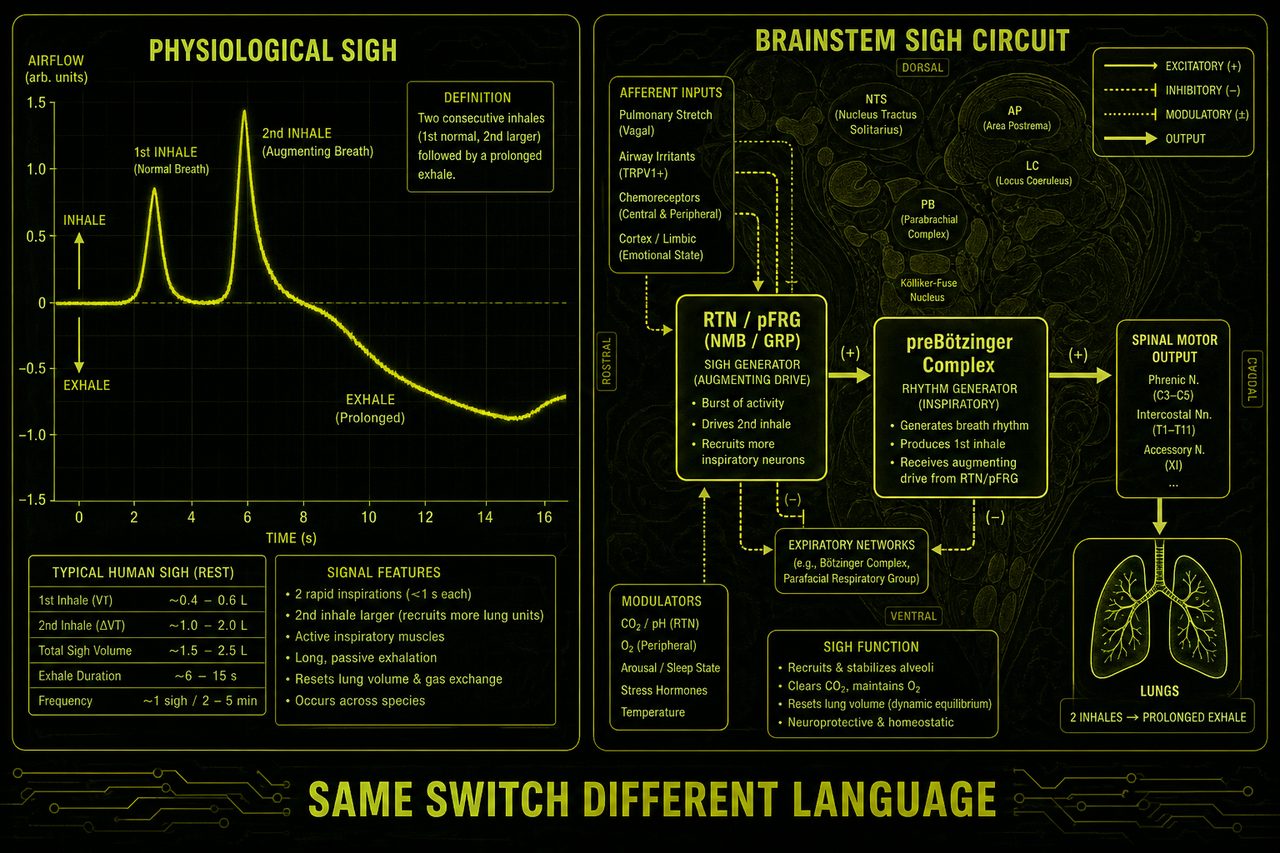
Li, Janczewski, Yackle and colleagues mapped a peptidergic sigh control circuit in the mouse in 2016. RTN/pFRG small subpopulations express Nmb or Grp and project to preBotC. preBotC expresses NMB and GRP receptors in overlapping subsets of about 200 neurons. Introducing either neuropeptide into preBotC induced sighing. Inhibition of both receptors abolished basal sighing. Ablating those neurons eliminated basal and hypoxia-induced sighing and left breathing otherwise intact initially. This is murine. It is not a human fMRI of a clip.

Li, Janczewski, Yackle, and colleagues. Nature, 2016. The peptidergic control circuit for sighing. I am using their result, not a shop label. Mouse. I will say mouse every time this section wants to sound like a human scan. It is not a human scan. It is a circuit paper. RTN/pFRG small subpopulations express Nmb or Grp. They project to preBotC. preBotC expresses NMB and GRP receptors in overlapping subsets of about 200 neurons. That is the hardware they isolated. I did not invent the 200. I did not hang it on a still.

What did they do with those peptides. Introducing either neuropeptide into preBotC, or onto slices, induced sighing. Elimination or inhibition of either receptor reduced basal sighing. Inhibition of both abolished it. Ablating the receptor-expressing neurons eliminated basal and hypoxia-induced sighing, and left breathing otherwise intact initially. Read that last clause twice. They could take the sigh off the animal and leave the rest of the breath online, at least at first. That is what a named circuit looks like. Not a mood. A switch you can delete.

They propose these overlapping peptidergic pathways are the core of a sigh control circuit that can integrate physiological and perhaps emotional input to transform normal breaths into sighs. That sentence is the translation key. Physiological input. Perhaps emotional input. Transform. Normal breath into sigh. The old map said a sigh just happens. The lab map said a small peptidergic loop can force the transform. I will not upgrade "perhaps emotional" into a human fMRI. I will not say Li imaged a clip. Feldman and Krasnow's lab is the house that paper sits in. Huberman popularized. Different jobs.

Honest line, again. Murine. The receptors, the peptides, the ablation, the hypoxia test: mouse. A human can still fire the pattern. A human trial can still measure mood and breathing rate. Those are not the same claim as "we scanned your preBotC while you watched the reel." If you need a human number, wait for Balban. If you need the circuit noun, stay with Li. Do not launder one into the other.

The aisle already grabbed the double inhale and tried to sell it as a discovery. The gatekeeper already called the sigh empty. Both hid the mechanism. NMB. GRP. preBotC. Those nouns were sitting in Nature while the aisle printed a name.

What did the human trial measure?

Balban, Neri, Kogon, Weed, Nouriani, Jo, Holl, Zeitzer, Spiegel, and Huberman ran a remote RCT of 111 healthy volunteers. Five minutes a day for one month. Cyclic sighing, box-style equal times, inhale-emphasized cyclic hyperventilation, and a mindfulness meditation control. Controlled breathing groups: daily increase in positive affect of 1.91 PANAS points versus 1.22 for mindfulness, about one-third greater. Cyclic sighing had the greatest daily improvement in positive feelings. The effect increased as the study went on. All three controlled breathing interventions decreased anxiety and negative mood. No heart-rate changes in any group. Cyclic sighing significantly lowered resting breathing rate, more than mindfulness or the other breathing groups, slower throughout the day. Respiratory rate inversely correlated with change in positive affect. They did not report HRV going up. People with moderate to severe psychiatric conditions were not in this preliminary study.

Balban, Neri, Kogon, Weed, Nouriani, Jo, Holl, Zeitzer, Spiegel, and Huberman. Cell Reports Medicine, 17 January 2023. Brief structured respiration practices enhance mood and reduce physiological arousal. NCT05304000. I opened the paper and the Stanford Medicine writeup. I am using the Stanford numbers the way they were written, not a content-farm rewrite.

Four arms. Cyclic sighing: long exhalations, nose in, second sip, slow mouth out. Box-style equal times. Inhale-emphasized cyclic hyperventilation. Mindfulness meditation control: aware of breath, do not control it. Hear the enrollment before you hang the trial on a diagnosis. Healthy volunteers. Preliminary. Remote.

I will stop on anxiety at decreased. I will not invent a 40 percent drop. The writeup did not hand me that sticker. Greatest daily improvement in positive feelings is the word I have for the sigh arm. The effect increased as the study went on.

No heart-rate changes observed in any group. They did not hand you an HRV win. Do not say Balban found HRV went up. They did not. If you want vmHRV, that is Laborde on slow breath, a different pile.

Cyclic sighing significantly lowered resting breathing rate, more than mindfulness or the other breathing groups, slower throughout the day. Respiratory rate inversely correlated with change in positive affect. Rate down. Positive affect up. Not a heart-rate story.

Huberman is on this paper. That is a fact. It is not a discovery claim. Popularization is a third job.

Two-panel schematic: physiological sigh versus the sigh circuit. Footer SAME SWITCH DIFFERENT LANGUAGE. Schematic still, not a scan.
Physiological sigh versus the sigh circuit. Schematic still. Footer SAME SWITCH DIFFERENT LANGUAGE. Do not quote art liters, seconds, or waveform numbers as data.

How breath grabs the vagus on the long exhale

Gerritsen and Band name long exhale as respiratory vagal stimulation. The trunk is already named on the kundalini page. This page is a different switch. The sigh circuit fires two inhales and one long exhale. The long out-breath is the grab. Laborde and colleagues meta-analyzed 223 studies of voluntary slow breathing and found vmHRV up during a session, after one session, and after multi-session work. Slow breath is the trunk. The sigh is a different circuit. Do not dump those numbers as if Balban measured them.

Gerritsen and Band. Frontiers in Human Neuroscience, 2018. Breath of Life: The Respiratory Vagal Stimulation Model of Contemplative Activity. I cite them as the vagus bridge. Long exhale as respiratory vagal stimulation. One short mapping. The trunk is already named on the kundalini page. This page is a different switch. I will not rewrite 4-in/8-out as the hero mechanism. I will not clone Gerritsen's whole model onto this URL. The grab on this page is the long dump after the double inflate.

Why the long exhale matters here. The sigh circuit's visible act is two in, one long out. The peptides live in the brainstem. The vagus is the wandering trunk that hears lung stretch and slows the line. Old physiology already had pulmonary stretch talking back. Gerritsen named the contemplative version as respiratory vagal stimulation. I am stacking those nouns, not inventing a new nerve. The double sip is how you load the inflate. The long out is how you grab the trunk. That is the DNA bridge this page was saved for. Breath to vagus via the sigh circuit. Unused on the kundalini URL. Used here.

Laborde and colleagues, 2022. 223 studies. vmHRV up during a session, after one session, and after multi-session work. Slow breath is the trunk. The sigh is a different circuit. I will not paste Laborde into Balban. Different question. Different stack.

Related reading: a mantra is an input to the amygdala. Another switch. A voiced syllable. A 2011 pilot fMRI. Schematic stills that are not scans. Input versus circuit. Different jobs.

I am not treating Polyvagal as statute. Porges named a model. This page does not need that model to stand. Cranial nerve X exists without a brand. Long exhale as a vagal grab exists without a brand. If a reel used polyvagal as a law, that reel skipped the papers I actually opened.

What the mapping is not

No. Feldman and Krasnow mapped the circuit. Li 2016 is the mouse paper. Huberman popularized the pattern and is a co-author on Balban 2023. He did not discover the switch. The aisle hung his name on a circuit other labs already named. Translation, not a scan.

No. Protocol 01 is the daily four-count inhale, eight-count exhale brake. The kundalini page owns that trunk, Gerritsen, Lehrer, Laborde, and rVNS. This page is the unused DNA bridge: breath to vagus via the sigh circuit. A different switch. The sigh is not kundalini. A calmer nerve is the clean line so intent can land.

Four refusals. It is not Huberman-discovered. Feldman and Krasnow mapped. Li 2016 is the mouse circuit. Huberman popularized and co-authored the human month. Different jobs. It is not HRV proof. Balban did not report HRV going up. No heart-rate changes in any group. If you want vmHRV, read Laborde on slow breath and keep it on the trunk page. It is not a 4/8 rewrite. Protocol 01 stays 4-in/8-out. This page stays two in, one long out. It is not a scan. The stills are schematic. Li is murine. Balban is remote self-report plus wearables, not a picture of your preBotC.

Two enemies. The gatekeeper who hid the mechanism by calling the sigh a leftover. The aisle that hung one popular name on a circuit other labs already named. The missing noun was the problem. Sigh control circuit. Cyclic sighing. Respiratory vagal stimulation.

The stills say SAME SWITCH DIFFERENT LANGUAGE. That footer is the claim. It is not a dataset. Schematic still. The left panel is the pattern you can fire. The right panel is the circuit noun. Keep the picture as a picture. Do not quote leftover art text from the hero still. I am ignoring it on purpose.

Name the switch first.

NameWhat it actually isWhat it is not
Physiological sighA named brainstem transform: two inhales, one long exhale, fireable on commandA leftover mood. A Huberman invention. A scan
Sigh circuitPeptidergic control loop, mouse, Li 2016. Nmb/Grp to preBotC. About 200 overlapping receptor neuronsA human fMRI of a clip
Cyclic sighingBalban 2023 arm. Nose in, second sip, slow mouth out. Five minutes a day, one month, 111 healthy volunteersA 40 percent anxiety sticker. An HRV win
Long exhaleRespiratory vagal stimulation (Gerritsen 2018). The grab on this pageA rewrite of Protocol 01
Slow breath trunkLaborde 2022. 223 studies. vmHRV up during, after one session, after multi-session. Owned on the kundalini pageA Balban result
Protocol 01Daily four-count inhale, eight-count exhale. Seven minutes. A number before and afterThe sigh circuit

Name the switch first.

A screaming nerve will not let intent land. Protocol 01 is free. Four-count inhale. Eight-count exhale. Seven minutes. A number before and a number after. That is the daily stack. This page is the short circuit you can fire on command. The Library of Biological Wizardry is the rest of the stack if the method earns the next hour. No initiate password. A sequence, then a measurement. We don't believe. We measure.

What should I run if I want a number?

Protocol 01 is the daily four-count inhale, eight-count exhale stack. Seven minutes. A number before and a number after. This page is the short circuit: two inhales, one long exhale, on command. Start with Protocol 01 if you want a number you can fail in a chair. If the method earns it, the Library of Biological Wizardry is the rest of the stack. We don't believe. We measure.

You will not get a preBotC trace from a kitchen chair. You can get a 1 to 10 on your own state, and a binary on whether you ran a sequence you can start and leave. That is the first instrument. The daily stack is Protocol 01. Four in. Eight out. Seven minutes. Write the number before. Write it after. The short circuit is the pattern on this page. Two inhales. One long exhale. Fire it when you want the named switch, not when you want to rewrite the daily brake.

Do not mash them. If you turn the sigh into your only practice and skip the count you can fail, you are back in weather. If you turn Protocol 01 into a double-sip and call it the same paper, you laundered two mechanisms. The Library is Reality Engineering. A calmer nerve is the clean line so intent can land. You do not need the archive to test the first layer. Related reading: the trunk, the brake, the 4/8 stack. Related reading: another switch, voiced, imaged in a small pilot. A physiological sigh is a brainstem circuit you can fire on command. Translation, not a scan.

FAQ

Short answers you can lift from this page. Visible text matches the FAQ schema exactly. The stills are schematic. None of this is medical advice.

What is a physiological sigh, in this stack?

A physiological sigh is a named brainstem circuit you can fire on command. Two inhales. One long exhale. That is how breath grabs the vagus on this page. Translation, not a scan of a Huberman clip. The stills are schematic. Do not quote art liters, seconds, or waveform numbers as data.

What is the sigh circuit?

Li, Janczewski, Yackle and colleagues mapped a peptidergic sigh control circuit in the mouse in 2016. RTN/pFRG small subpopulations express Nmb or Grp and project to preBotC. preBotC expresses NMB and GRP receptors in overlapping subsets of about 200 neurons. Introducing either neuropeptide into preBotC induced sighing. Inhibition of both receptors abolished basal sighing. Ablating those neurons eliminated basal and hypoxia-induced sighing and left breathing otherwise intact initially. This is murine. It is not a human fMRI of a clip.

What did the human trial measure?

Balban, Neri, Kogon, Weed, Nouriani, Jo, Holl, Zeitzer, Spiegel, and Huberman ran a remote RCT of 111 healthy volunteers. Five minutes a day for one month. Cyclic sighing, box-style equal times, inhale-emphasized cyclic hyperventilation, and a mindfulness meditation control. Controlled breathing groups: daily increase in positive affect of 1.91 PANAS points versus 1.22 for mindfulness, about one-third greater. Cyclic sighing had the greatest daily improvement in positive feelings. The effect increased as the study went on. All three controlled breathing interventions decreased anxiety and negative mood. No heart-rate changes in any group. Cyclic sighing significantly lowered resting breathing rate, more than mindfulness or the other breathing groups, slower throughout the day. Respiratory rate inversely correlated with change in positive affect. They did not report HRV going up. People with moderate to severe psychiatric conditions were not in this preliminary study.

How does breath grab the vagus on the long exhale?

Gerritsen and Band name long exhale as respiratory vagal stimulation. The trunk is already named on the kundalini page. This page is a different switch. The sigh circuit fires two inhales and one long exhale. The long out-breath is the grab. Laborde and colleagues meta-analyzed 223 studies of voluntary slow breathing and found vmHRV up during a session, after one session, and after multi-session work. Slow breath is the trunk. The sigh is a different circuit. Do not dump those numbers as if Balban measured them.

Did Huberman discover the physiological sigh?

No. Feldman and Krasnow mapped the circuit. Li 2016 is the mouse paper. Huberman popularized the pattern and is a co-author on Balban 2023. He did not discover the switch. The aisle hung his name on a circuit other labs already named. Translation, not a scan.

Is the physiological sigh the same as Protocol 01 or kundalini?

No. Protocol 01 is the daily four-count inhale, eight-count exhale brake. The kundalini page owns that trunk, Gerritsen, Lehrer, Laborde, and rVNS. This page is the unused DNA bridge: breath to vagus via the sigh circuit. A different switch. The sigh is not kundalini. A calmer nerve is the clean line so intent can land.

What should I run if I want a number?

Protocol 01 is the daily four-count inhale, eight-count exhale stack. Seven minutes. A number before and a number after. This page is the short circuit: two inhales, one long exhale, on command. Start with Protocol 01 if you want a number you can fail in a chair. If the method earns it, the Library of Biological Wizardry is the rest of the stack. We don't believe. We measure.

Is this medical advice?

No. This page is an educational mechanism explainer by JM Thomas. It is not a diagnosis, treatment, cure, or prevention of any disease. It is not for psychiatric diagnosis. Balban 2023 enrolled healthy volunteers. People with moderate to severe psychiatric conditions were not in that preliminary study. If breath practice distresses you, talk to a clinician.

Sources I actually opened

Li, P., Janczewski, W., Yackle, K. et al. "The peptidergic control circuit for sighing." Nature 530:293-297 (2016). Mouse. Peptidergic sigh control circuit. Murine. Not a human fMRI of a clip. doi.org/10.1038/nature16964

Balban, M.Y., Neri, E., Kogon, M.M., Weed, L., Nouriani, B., Jo, B., Holl, G., Zeitzer, J.M., Spiegel, D., Huberman, A.D. "Brief structured respiration practices enhance mood and reduce physiological arousal." Cell Reports Medicine 4(1):100895 (17 Jan 2023). PMID 36630953. PMC9873947. NCT05304000. Remote RCT. 111 healthy volunteers. Five minutes a day, one month. I am not inventing a 40 percent anxiety drop. I am not saying they found HRV went up. doi.org/10.1016/j.xcrm.2022.100895

Stanford Medicine. "Cyclic sighing can help breathe away anxiety." 9 February 2023. Official writeup for the numbers I used. med.stanford.edu/news/insights/2023/02/cyclic-sighing-can-help-breathe-away-anxiety.html

Gerritsen, R.J.S., Band, G.P.H. "Breath of Life: The Respiratory Vagal Stimulation Model of Contemplative Activity." Front. Hum. Neurosci. 12:397 (2018). Long exhale as respiratory vagal stimulation. Cited as the vagus bridge. The trunk is named on the kundalini page. This page is a different switch. doi.org/10.3389/fnhum.2018.00397

Laborde, S. et al. "Effects of voluntary slow breathing on heart rate and heart rate variability: a systematic review and a meta-analysis." Neurosci. Biobehav. Rev. (2022). 223 studies. vmHRV up during, after one session, and after multi-session work. Slow breath is the trunk. The sigh is a different circuit. Do not dump these numbers as if Balban measured them. doi.org/10.1016/j.neubiorev.2022.104711