cold face · diving reflex · vagus
Cold on the face is what slows the heart. Labs used a mask, not a tub.
You wanted a cold switch that would calm you down.
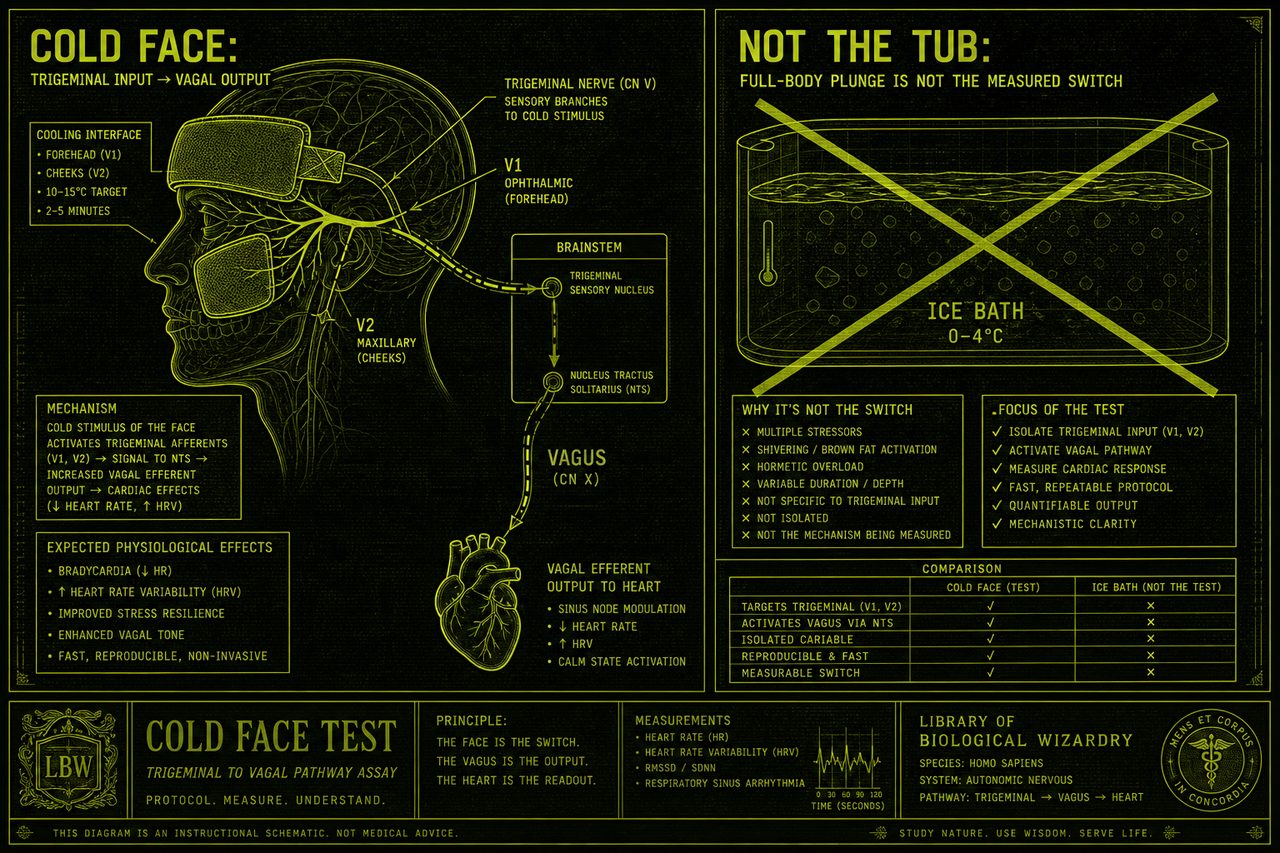
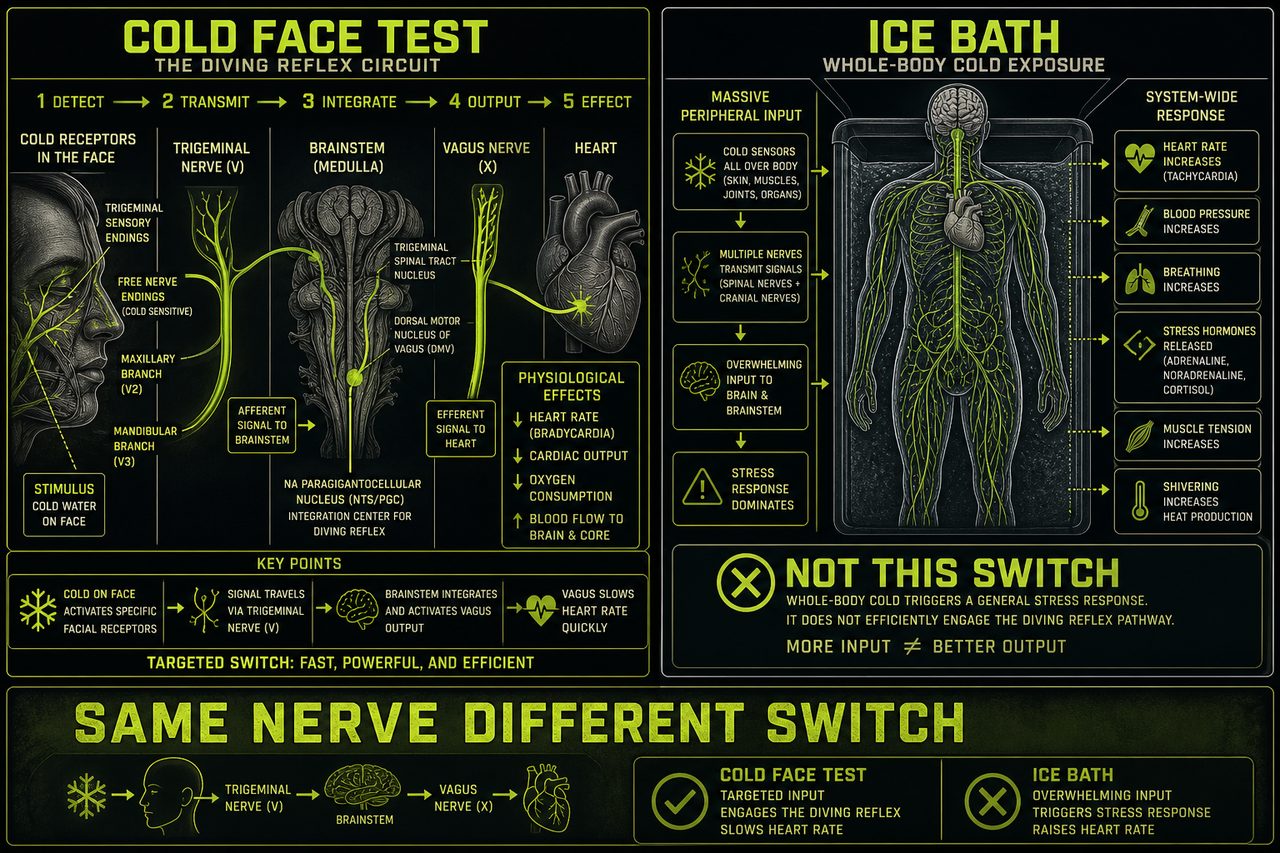
The Cold Face Test is cold on the face that can slow the heart through the diving reflex. The diving reflex is the body slowing the heart when the face meets cold water. The vagus is the long nerve that slows the body. In 2022, Richer and colleagues put a cooling mask on people's faces, and people recovered faster after hard math. You can still get in a tub if you want.
What is the Cold Face Test?
The Cold Face Test, or CFT, is a lab test that puts cold on the face so the heart can slow down. The trigeminal nerve is the face nerve that feels cold and touch. When that nerve feels cold, the signal goes to the brainstem, the bottom of the brain that runs automatic jobs like the heartbeat, and then the vagus can send a slower beat to the heart. Bradycardia is the name for a slower heart.
Khurana's group named that face-to-brainstem-to-vagus path in 1980. Richer's later group measured the heart and a stress hormone, and they did not cut a nerve to watch the path.
Lindholm and Lundgren wrote about the diving response in animals that breathe air, including people. Richer cited that old map, and they did not run a tub trial.
How does cold on the face slow the heart?
You put cold on the face, the face nerve feels that cold, and the vagus can then slow the heart. Richer's people sat in a chair with a mask. Kinoshita's people used cold water on the face.
Khurana and Wu timed a Cold Face Test in 2006. People's hearts started to slow within a few seconds, and the slowest beat came later in the first minute. That timing came from an older Cold Face Test, before Richer's math trial.
What did the 2022 mask study find?
Richer and colleagues published in Scientific Reports in 2022. They brought in 28 young healthy volunteers. Most were women, and they were about 20 years old. The group put people into two groups by chance, and each person stayed in one group.
They used the MIST, the Montreal Imaging Stress Test, a hard math stress task. After they set three people aside, 25 people remained. Twelve people got the Cold Face Test, and thirteen people were the control group, the group that did not get the cold mask.
People sat upright and breathed as they liked. The group put a cooling mask over most of the face, with holes so people could see and breathe. They set the mask at minus 1 degree Celsius for two minutes. Celsius is the scale that sets ice at zero, so that setting is just below freezing. They set a colder mask at minus 14 on top so the first mask would not warm up too fast.
Did people recover faster after the hard math?
Both groups were equally stressed while they did the arithmetic, so people still felt the math. After the task, the Cold Face Test group recovered better. People in that group showed different heart rates and HRV from the control group. HRV is how much the time between heartbeats changes. They also showed a lower cortisol response, and they made less cortisol overall. Cortisol is a stress hormone.
People in the control group had a resting heart rate that drifted up as the math rounds went on. People in the Cold Face Test group kept about the same resting heart rate. People recovered after the work.
What did Kinoshita find with cold water on the face?
Kinoshita's group ran a tiny study in 2006 with eight healthy people and published it in Circulation Journal. They used wavelet HRV, a way to watch how the time between beats changes from moment to moment.
People put their faces toward an empty basin, into warm water, or into cold water. Sometimes they held their breath, and sometimes they kept breathing.
People's time between beats got longer only when they used cold water on the face and held their breath. People's HRV score that tracks a quieter heart went up when they used cold water on the face, with a breath hold or without one. People did not get that change from warm water or from an empty basin. Eight people is a tiny group, and they used a face.
Can I still take a cold plunge?
Yes, keep the plunge if you like it. The labs that named this path put cold on the face. Richer's people sat in a chair with a mask, and Kinoshita's people used cold water on the face.
A physiological sigh is two breaths in and one long breath out, and you can read that pattern on its own page. Some people also use four counts in and eight counts out, the kundalini 4/8 breath. If you want those, open the physiological sigh page or the kundalini page.
This page is not medical advice. Richer enrolled young healthy volunteers, and Kinoshita worked with eight healthy people. Skip a face-cold test if you have heart disease or a problem with the nerves that run the heart without you thinking about it. Do not hold your breath underwater. Shallow-water blackout is real, which means you can pass out in water that is not deep. If face cold, a slow heart, or a mask distresses you, talk to a clinician.
the other handle
The vagal brake has more than one handle.
Cold on the face is one way to pull it. There is another handle that needs no ice: breath. Protocol 01 is seven minutes, four counts in and eight counts out, with a before and after score you write down yourself.
Sources
Richer R, Zenkner J, Kuderle A, Rohleder N, Eskofier BM. “Vagus activation by Cold Face Test reduces acute psychosocial stress responses.” Sci Rep 12:19270 (10 Nov 2022). Recruited 28 young healthy (82% female, age 20.1 ± 2.5, BMI 21.3 ± 2.4), randomized between-subjects, MIST = Montreal Imaging Stress Test. After exclusions: 25 remaining (12 CFT, 13 Control). Exclusions were one non-responder (slight tachycardia), one S0 cortisol 21.0 nmol/L outlier, and one HR > 3 sigma. Cooling mask covering most of the face with openings for eyes, nose, mouth, mask at -1 C for the 2-minute CFI subphase, additional cooling mask -14 C on top, sit upright, spontaneous breathing. They did not dunk anyone. Both groups equally stressed during the arithmetic. CFT showed better recovery: significant (p < 0.05) differences in HR(V), significant (p < 0.05) lower cortisol response to MIST and less overall cortisol secretion in CFT. Peak bradycardia vs preceding BL: 26.6% ± 18.8% (MIST1), 23.9% ± 16.6% (MIST2), 20.1% ± 12.3% (MIST3). Control baseline HR drifted up across MIST phases, CFT stayed roughly constant, recovery after the task. doi.org/10.1038/s41598-022-23222-9
Kinoshita T, Nagata S, Baba R, Kohmoto T, Iwagaki S. “Cold-water face immersion per se elicits cardiac parasympathetic activity.” Circ J 70:773-776 (2006). PMID 16723802. n=8 healthy, wavelet HRV. Protocols: empty basin ± breathing, warm-water face immersion ± breathing, cold-water face immersion ± breathing. R-R interval significantly greater only for protocol 6 (cold-water FI + breath hold) vs protocol 1 (empty basin, breathing). lnHF significantly greater for protocols 5 AND 6 (cold-water FI with and without breath hold) vs protocol 1. Warm water and empty basin did not. Tiny n. Face immersion. doi.org/10.1253/circj.70.773
Khurana RK, Wu R. “The Cold Face Test: A non-baroreflex mediated test of cardiac vagal function.” Clin Auton Res 16:202-207 (2006). Onset of bradycardia 5.6 s average, peak about 35.8 s, HR decrease 22.5% ± 9.0%. Prior CFT physiology, before Richer's trial. doi.org/10.1007/s10286-006-0332-9
Khurana RK et al. “Cold Face Test in the assessment of trigeminal-brainstem-vagal function.” Ann Neurol 7:144-149 (1980). Named the trigeminal-brainstem-vagal arc. Richer's n did not dissect the nerve. doi.org/10.1002/ana.410070209
Lindholm P, Lundgren CE. Diving response in air-breathing vertebrates. Old physiology, cited by Richer. They did not run a plunge trial.