Silva Method · Bremner 1972 · awake alpha · n=20
Silva Method: Bremner 1972, ten subjects at alpha
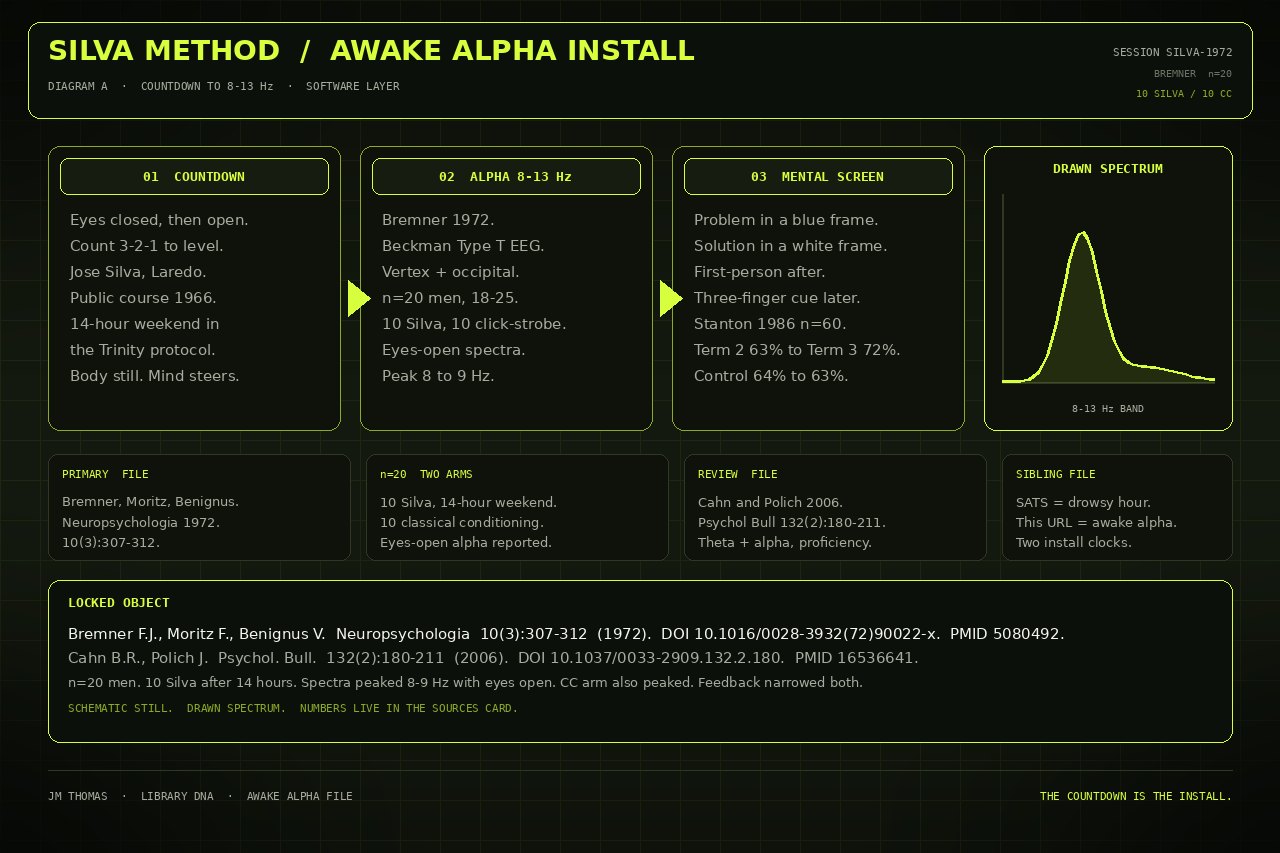
Jose Silva taught a countdown into 8-13 Hz while you stayed awake enough to steer a picture. I opened the Europe PMC record of Bremner with Moritz plus Benignus, Neuropsychologia 10(3):307-312, DOI 10.1016/0028-3932(72)90022-x, PMID 5080492. Twenty men. Ten after a 14-hour Silva weekend. Eyes-open spectra peaked near 8-9 Hz.
I sat with the UltraMind reprint of that Method and Results section, the Europe PMC DOI lock, and the Cahn and Polich 2006 PDF, Psychological Bulletin 132(2):180-211, PMID 16536641. Stanton 1986 sat in a house reprint: n=60, Term 2 to Term 3 marks. Maycock 1988 sat in an ERIC PDF, ED318750, n=15. Those are the files this URL uses.
The hunger is live. Silva Method Malaysia ran 21-22 July 2026 in Kuala Lumpur. ReDefine Wellness listed a Life plus Intuition immersion in Singapore, 1-4 August. silvamethod.com still had live classes on 13-21 August, 16 August, and 20-23 August. Richard Siena taught the same stack in Bowling Green, Kentucky, in July. Buyers are paying for a weekend that puts a picture on a mental screen at alpha. This page names the 1972 spectra.
Reality behaves like software. Volume 7 already said visualization acts as a strange attractor that constrains which possibility collapses. Silva built a daytime install for that hunger: drop resistance the way a radio man drops resistance in a wire, park a scene on a screen, retrieve it later with three fingers. Protocol 01 can wait until the count has earned the next hour.
Laredo started with Ohm's law
Jose Silva, radio repairman, Laredo, Texas. U.S. Army Signal Corps electronics instructor. Public course 1966. He treated the brain the way he treated a circuit. Lower the resistance. More current. Alpha, in his table, sat at 7-14 cycles per second. Beta sat at 14-21 and higher.
I opened silvamethod.com/research for the house origin story, then I went looking for a journal n. The house page is a brochure. Bremner is the journal. Keep them in that order in your head.
Silva started on his own children in the 1940s, hunting school grades and a quieter mind. He counted people down. He asked them to stay conscious at the frequency most people only graze at lights-out. He later named that the basic plane level. Dynamic meditation, in the later Spanish EEG writeup, meant imagery at that level, not an empty sit.
The useful object is simple. A countdown. A still body. A picture you steer. Then a cue you can fire in a hallway. The ESP module that rode along in the same weekend is a separate claim, and Bremner parked it in one sentence: some time is also spent in what best can be described as ESP exercises. He measured alpha. He left the remote diagnosis unmeasured.
Ohm's law is a technician's metaphor. It is also how a manifestation buyer already thinks. Reduce the noise. Install the scene. See if the world answers. The Library hunger is the same hunger. This URL just names the awake clock.
Twenty volunteers, a weekend, a Beckman Type T
Frederick J. Bremner, F. Moritz, Vernon Benignus. EEG correlates of attention in humans. Neuropsychologia 1972, 10(3):307-312. Trinity University, San Antonio. Mind Science Foundation support. n=20 volunteer male college students, ages 18 to 25, two groups of 10.
Europe PMC locked the DOI and the PMID. The abstract field was empty. I opened the UltraMind reprint that quotes the Method, Treatment of Results plus Discussion from that paper. The n below is the n that reprint locked. Jose Silva ran the weekend. David L. Carlson helped prepare the manuscript. Shah 1971 is the course citation they used.
A University Committee for Humane Treatment of Humans as Experimental Subjects signed off. Each man filled a protocol sheet: last alcohol or drugs, epilepsy history, prior hypnosis, Yoga, or alpha conditioning. A consent statement. Baseline EEG with no feedback, eyes closed, then eyes open, about 30 minutes in the chamber. Closed-circuit television on the face. If the baseline was dirty, they ran it again.
Then the split. One group of 10 took a 14-hour weekend of the Jose Silva Mind Control Method. Deep relaxation. Group hypnosis-like procedures. ESP exercises named and left undescribed. The next week they came back for 20 minutes of EEG, eyes closed and eyes open, practicing the Silva technique. Another session with auditory biogenic feedback under the same instructions.
The other 10 ran classical conditioning. Fifty trials a session. A half-second click as CS. Ten-second interval. Then a Grass PS2 strobe set at that man's eyes-closed alpha frequency, one second as UCS in the programmer, ten seconds of strobe in the writeup. Irregular intertrial interval. Experimenter started a trial when the man looked relaxed. Sessions repeated until he produced alpha, or until the experimenter was convinced he could not. Final 50 trials with feedback. All classical-conditioning data they reported were eyes open.
Hardware: Beckman Type T electroencephalograph. Stainless steel electrodes, subcutaneous, vertex and occipital. Alpha filtered at 8-13 Hz and, when feedback was on, piped back as an analog tone in earphones. Digital Equipment Corporation logic programmer. Ampex SP 300 eight-track analog tape. IBM 360/44 after A-D conversion. Spectral analysis after Walter 1968. Epochs were 10 consecutive seconds. Eyes-open data only in the published figures they discussed.
Spectra that peaked at eight and nine Hertz
Both arms moved. Classical conditioning produced a peak at 8 to 9 Hz on the middle line of Figure I. Baseline had been broad and flat. Feedback narrowed the spectra again. The Silva arm, Figure II, also produced alpha after treatment. Bremner wrote that the Silva subjects were quite capable of producing the Alpha rhythm following treatment, although not in the quantity demonstrated by the CC subjects.
Read that twice. The weekend worked. The click-strobe arm produced more alpha. Honest from the first graf. A buyer who wants "Silva beat Pavlov" does not get that sentence. A buyer who wants "a 14-hour countdown can put 8-13 Hz on an eyes-open trace" does.
Both groups showed a downward frequency shift. The Silva baseline already had elevated 10 to 12 Hz, so the relative shift was messy to compare. Feedback did the same thing in both cases: another shift, a narrower bump. Hart 1968 had already warned that a man left in a dim quiet room will increase alpha if you wait. Bremner answered with shape of spectrum and frequency shift, not raw amplitude. He still asked for more controls. I left that ask on the table.
Kamiya's autocontrol work sat in the reference list. Knott and Henry 1941. Williams 1940. Jasper and Shagass 1940. The paper is an attention model paper first. Expectancy was the animal subset they already had, hippocampal theta, peaked spectra after a CS predicted a UCS. Internal focus was the human add-on: no exteroceptive stimulus, EEG changes after instructions to generate mental imagery. Silva was the method they used to load that subset.
We don't believe. We measure.
Internal focus as the named subset
Bremner already had expectancy, counter-expectancy, orientation, then arousal, then non-focus from the animal papers. Internal focus was the human-only box. Absence of an outside click. Presence of an instruction. EEG change. He wanted a noun that did not require the word consciousness.
The companion note, Internal focus as a subset of attention, Neuropsychologia 10(4):467-469, DOI 10.1016/0028-3932(72)90010-3, is the short follow-on Silva International still pairs with 307-312. Publisher fetch blocked on this pass. I name the DOI because the 1972 volume printed both. The n lives in 10(3).
That naming is the whole gift for a Reality Engineering reader. You can stop arguing about whether alpha "means" intuition. You can ask a narrower question. Did the instruction to run a mental image, with no strobe, move the occipital spectrum? In ten men after 14 hours, Bremner said yes, with a smaller bump than the strobe arm, and a shift in the same direction.
The later Spanish hospital writeup, Oliveros, Ortiz, Selman, Arrigain, San Carlos Clinic Hospital, Madrid, 1985, is the house's second EEG claim: eleven Silva graduates, higher median alpha power at occipital and temporal sites in dynamic meditation versus basal. I did not open a journal PDF with a DOI for that table. Academia hosts a 2005 Selman reprint. n=11 stays labeled as a house-cited hospital file until a DOI lands. Bremner remains the lock.
Cahn and Polich mapped fifty years of alpha
B. Rael Cahn, John Polich. Meditation states and traits: EEG plus ERP plus neuroimaging studies. Psychological Bulletin 2006, 132(2):180-211. DOI 10.1037/0033-2909.132.2.180. PMID 16536641. I opened the USC-hosted PDF. Review. No Silva-branded trial n.
They sorted practices along a concentrative-to-mindfulness line. TM sat in the concentrative family with a witnessing add-on. Silva is concentrative by that map: a countdown, a screen, a repeated cue. The review's reliable EEG sentence is the one this page needs. Theta and alpha activation related to proficiency of practice. Overall slowing. Anterior cingulate cortex and dorsolateral prefrontal areas in the imaging summary.
They also printed the caveat. Alpha rises with relaxation. Selection bias can fake a trait. Some studies show no alpha state effect. Frontal midline theta shows up in ordinary sustained attention, Gevins 1997, Mizuki 1980. A Qigong split in Pan 1994 put frontal midline theta on the concentrative form and not on the passive form. Dunn 1999, with novices, found the opposite pattern and more global theta in plain rest, which they read as drowsiness.
So the honest bridge is narrow. Silva's claim that a trained person can sit in 8-13 Hz with eyes open and run an image is the same family Cahn and Polich spent 31 pages collating. Proficiency tracks theta and alpha. The review does not baptize remote diagnosis. It also does not erase Bremner's weekend.
Sleep Stage I already carries theta. Cahn and Polich spent a section separating meditation from that descent. Meditation-related theta often keeps or raises alpha. Stage I drops alpha by about half. Coherence tends to rise in meditation and fall in drowsiness. Silva's own marketing table puts alpha next to light sleep. Bremner's protocol asked for eyes open. That is the distinction this URL keeps: awake enough to steer, slow enough to load.
Three fingers, sixty students, nine points
H.E. Stanton. The Three-Fingers Technique: A means of accelerating learning? Journal of the Society for Accelerative Learning and Teaching 1986, 11(3):193-201. n=60 second-year high-school students, 34 boys, 26 girls. I opened the UltraMind reprint that quotes the design and the Term 2 / Term 3 averages. Journal PDF blocked this pass.
Sixty students, eight subjects in common. Term 2 averages used to pair them. One of each pair at random into experimental, the other into control. Start of Term 3, experimental group learned the three-fingers cue and used it on written material and class talk. A week before Term 3 exams, they ran the cue again as a test-taking drill. Then new averages on the same eight subjects.
Experimental: 63% Term 2, 72% Term 3. Control: 64% Term 2, 63% Term 3. Nine points up versus one point down. The reprint also says "more than 14 percent" over the previous average. I kept the raw percents in the same breath as the derived line, because those are the numbers the reprint printed.
The cue itself is small. Tips of thumb plus first two fingers of either hand. Loaded while relaxed, so the later pinch is supposed to drop you toward the same level. Stanton called it a simple conditioned trigger. He also said it uses relaxation plus suggestion plus imagery, and so sits near many operational definitions of hypnosis. That sentence is useful. It keeps the mechanism in ordinary psychology. A pinch that was paired with a state.
George Maycock, Appalachian State, 1988, ERIC ED318750. I opened the PDF. Fifteen college students. One week before a final, 15 minutes of lecture plus 15 minutes of relaxation, three-fingers trigger installed. After the exam, a Likert sheet. Eighty percent called the relaxation helpful. Thirteen of 15 used the cue during the exam. Of those 13, eight felt less anxiety than on prior tests, three the same, two more anxious. Seven felt sure the grade went up. Six were unsure. Thirty minutes of class time. Questionnaire, no control arm, no locked score delta. Attitude file. I left it as an attitude file.
A retrieval cue is the Library's "Enter" key in cheap clothing. Volume 1 already compressed a sentence, loaded it, released it. Three fingers are the hallway version. You do not need a weekend to pinch your hand. You do need a state the pinch was paired with. Bremner measured a state. Stanton measured marks after the pinch. Maycock measured how the pinch felt.
The drowsy hour lives next door
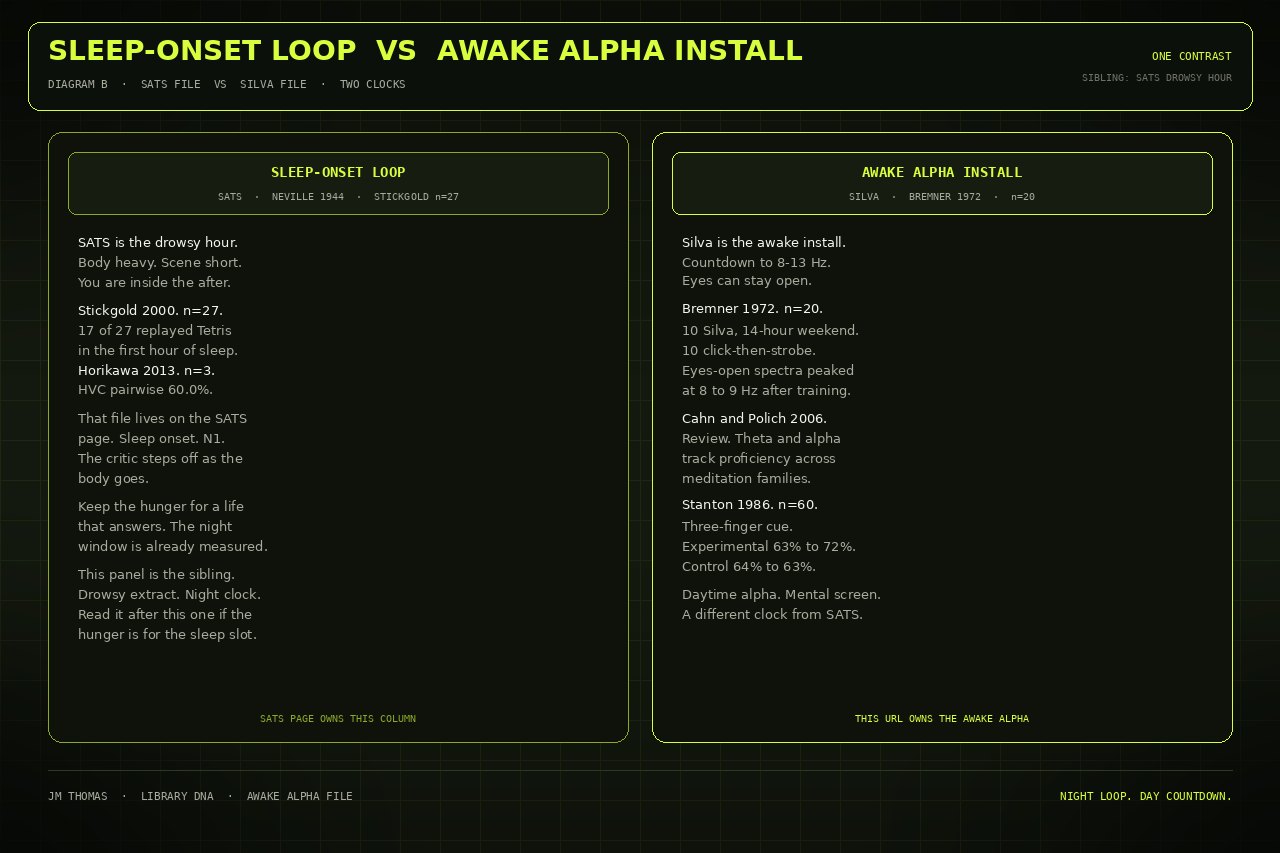
One contrast, then a wall. SATS is Neville's state akin to sleep, the drowsy-hour install Stickgold measured in 27 people. Falling tiles in the first hour. Horikawa later decoded the pictures at sleep onset. That URL owns N1. This URL owns the eyes-open countdown.
Same hunger for a life that answers. Two clocks. SATS asks you to go heavy and loop the after until sleep takes the body. Silva asks you to stay steer-able, put the after on a mental screen, then pinch three fingers when you need the file in daylight. You can run both. Mixing the clocks in one sitting is how people fall asleep on a "daytime" session and then blame the method.
A vision board, on its own page, is an outcome picture you stare at while the critic is still on duty. Kappes and Oettingen already measured energy drop from positive fantasies. Silva's screen is supposed to be occupied from the inside, at alpha, then released. Gateway, on its page, is a difference tone in the ears. Silva is a count in the head. Hemi-Sync is McDonnell's 1983 memo plus Dabu-Bondoc's n=20/20/20. Three files. Three delivery methods. Yoga nidra plants a sankalpa when the story-self goes quiet. Fialoke 2024. Another clock.
The ESP weekend exercises stay off this lock. Remote viewing has its own Stargate page. Bremner named those exercises and then plotted 8-13 Hz. I plotted what he plotted.
Seven minutes still owns the morning
You cannot take a Beckman Type T home. You can take a 1 to 10 on whether the countdown actually landed, and a binary on whether you ran the screen from the inside. Chair numbers. A week can produce them.
Protocol 01 is free and daily. Four-count inhale, eight-count exhale, seven minutes. Write the number before you start, write it after you stop. The nerve still has to carry the current. Silva is the alpha install. The count is the morning stack. Run both if you want a week you can fail in public with yourself.
The Library of Biological Wizardry holds the rest of the sequence, the ledger, and the live instruments, and it can wait until the count has earned the next hour. No initiate password. A countdown, a screen, a pinch, a number.
Run the count, then the countdown
Four in, eight out, seven minutes, a number before and a number after. That is the daily stack. Later, one short after-scene on a mental screen at the level Bremner peaked. This page named the awake clock. The Library is the rest of the map, and you can walk there when you want the next file.
This is an educational mechanism page by JM Thomas. A clinician owns diagnosis and treatment of any disease. Bremner 1972 is an EEG attention study in twenty men. Cahn and Polich 2006 is a meditation review. Stanton 1986 is a school-mark study in sixty students. Maycock 1988 is a fifteen-student questionnaire. Talk to a clinician if unusual distress, dissociation, or a psychiatric history is on the table.
FAQ
Short answers you can lift. Drawn stills. Educational page.
What is the Silva Method?
Jose Silva's mental training system, public from 1966. A countdown into 8-13 Hz alpha while you stay conscious, then a mental screen and a three-finger retrieval cue. Bremner 1972 measured the alpha arm in ten of twenty men.
What did Bremner 1972 actually record?
Eyes-open EEG spectra after training. Neuropsychologia 10(3):307-312. DOI 10.1016/0028-3932(72)90022-x. PMID 5080492. n=20 male students, two groups of 10. Silva arm: 14-hour weekend. Classical-conditioning arm: click then strobe. Both peaked near 8-9 Hz.
Did the Silva group beat the click-strobe group?
No quantity win. Bremner wrote that Silva subjects produced alpha after treatment, though not in the quantity the classical-conditioning subjects showed. Both arms shifted frequency downward. Feedback narrowed both spectra.
What is the three-fingers technique?
A conditioned trigger. Thumb plus first two fingers of either hand, loaded at the relaxed level, later used as a retrieval cue. Stanton 1986, Journal of the Society for Accelerative Learning and Teaching 11(3):193-201, n=60 high-school students. Experimental averages 63% to 72%. Control 64% to 63%.
How does Silva sit next to SATS?
SATS owns the drowsy hour. Stickgold 2000 n=27. This URL owns the awake countdown. Bremner measured eyes-open alpha after a weekend. Two clocks. Same hunger for a life that answers.
Did Cahn and Polich test Silva graduates?
They reviewed meditation EEG plus ERP plus imaging across families. Psychological Bulletin 2006, 132(2):180-211. PMID 16536641. Theta and alpha tracked proficiency. Anterior cingulate and dorsolateral prefrontal changes. No Silva-branded trial n in that review.
Where do I get a daily number?
Protocol 01. Four-count inhale, eight-count exhale, seven minutes. Write a 1 to 10 before and after. Silva is the alpha install. The count is the daily stack.
Is this medical advice?
Educational mechanism page by JM Thomas. A clinician owns diagnosis and treatment. Bremner 1972 is an EEG attention study. Cahn and Polich 2006 is a review. Stanton 1986 is a school-mark study. Maycock 1988 is a 15-student questionnaire.
Files I opened
Bremner, F.J., Moritz, F., and Benignus, V. "EEG correlates of attention in humans." Neuropsychologia 1972;10(3):307-312. DOI 10.1016/0028-3932(72)90022-x. PMID 5080492. I opened the Europe PMC record (DOI and PMID, empty abstract) and the UltraMind reprint of Method plus Results plus Discussion. n=20 male students 18-25, two groups of 10. Silva: 14-hour weekend. CC: click-strobe, 50 trials. Beckman Type T. Vertex and occipital. Alpha 8-13 Hz. Eyes-open spectra. Silva produced alpha after treatment, less quantity than CC. Both shifted down. Feedback narrowed both. doi.org/10.1016/0028-3932(72)90022-x · europepmc.org/article/MED/5080492 · silvamethodultramind.com/brain-wave-control
Bremner, F.J., and Moritz, F. "Internal focus as a subset of attention." Neuropsychologia 1972;10(4):467-469. DOI 10.1016/0028-3932(72)90010-3. Companion note named on Silva research pages and in the 1972 volume. Publisher fetch blocked this pass. n lives in 10(3). doi.org/10.1016/0028-3932(72)90010-3
Cahn, B.R., and Polich, J. "Meditation states and traits: EEG plus ERP plus neuroimaging studies." Psychological Bulletin 2006;132(2):180-211. DOI 10.1037/0033-2909.132.2.180. PMID 16536641. I opened the USC-hosted PDF. Review. Theta and alpha related to proficiency. ACC and DLPFC in the imaging summary. No Silva-branded trial n. doi.org/10.1037/0033-2909.132.2.180 · europepmc.org/article/MED/16536641 · Cahn Polich PDF
Stanton, H.E. "The Three-Fingers Technique: A means of accelerating learning?" Journal of the Society for Accelerative Learning and Teaching 1986;11(3):193-201. I opened the UltraMind reprint quoting n=60 (34 boys, 26 girls), paired on Term 2 marks, experimental 63% to 72%, control 64% to 63%. Journal PDF blocked this pass. silvamethodultramind.com/higher-test-scores
Maycock, G. "The Three-Fingers Technique: Does It Reduce Test Anxiety?" Appalachian State University, 1988. ERIC ED318750. I opened the PDF. n=15 college students. 15-minute lecture plus 15-minute relaxation. 13 of 15 used the cue during the exam. 8 of those 13 reported less anxiety. Questionnaire. No control arm. files.eric.ed.gov/fulltext/ED318750.pdf
Silva International research page, origin story and house citations, fetched 16 August 2026. Brochure. Used for Laredo / 1966 / Ohm's law framing. Lab n taken from Bremner, not from this page. silvamethod.com/research