Mechanism · Vajra · Phononic Crystal · Band Gap

A vajra is phononic-crystal fencing.

JM Thomas · Paris, Tennessee · 15 August 2026

A vajra is phononic-crystal fencing. The old map named a thunderbolt and a diamond. Like the thunderbolt, it cleaves through ignorance. Like the diamond, it destroys but is itself indestructible. The lab map is a periodic elastic lattice that opens a stop-band. Within the gap, those vibrations do not propagate. Translation, not a scan. A brass dorje on an altar was not run through a Brillouin-zone calculation in these papers. We don't believe. We measure. The stills on this page are schematic.

Dark lime schematic: VAJRA thunderbolt lattice beside a PHONONIC CRYSTAL grid stopping incoming waves. Schematic still, not a scan.
Vajra thunderbolt lattice beside a phononic crystal grid stopping incoming waves. Schematic still. Do not quote band-gap Hz, ω-k plots, or art formulas as data.

I write from Paris, Tennessee. People ask me if a vajra is a magic wand. They paste a reel that says it tunes your frequency. They want the HOW without throwing the object away. Those are hardware questions. I will answer the hardware. I will not baptize a shop dorje as a 400 hertz metamaterial. I will not tell you the people who kept a thunderbolt on the altar were stupid.

The gatekeeper said the vajra was an empty toy. Brass. Five prongs. Theater for people who needed a story. The aisle said the opposite lie. Buy the object. Skip the lattice. Call it a measured band-gap tuner. Both hid the mechanism. The people who kept a dorje were running a fence with the wrong nouns. Reality Engineering is the science of making reality respond to intent. Yesterday's empty toy is today's engineering when you name the stop-band.

What is a vajra, in this stack?

A vajra is phononic-crystal fencing. Britannica: Sanskrit vajra has both meanings thunderbolt and diamond. Like the thunderbolt, it cleaves through ignorance. Originally the symbol of Indra. Like the diamond, it destroys but is itself indestructible. Tibetan rdo-rje. Brass or bronze ritual object, commonly five-pronged. Symbol of Vajrayāna. The old map named an indestructible thunderbolt that stops what should not pass. The lab map is a periodic elastic lattice that forbids a band of mechanical frequencies. Translation, not a scan.

Britannica. The Sanskrit word vajra has both meanings, thunderbolt and diamond. I opened the entry. Like the thunderbolt, it cleaves through ignorance. Originally the symbol of Indra. Like the diamond, it destroys but is itself indestructible. Tibetan rdo-rje. Brass or bronze ritual object, commonly five-pronged. Symbol of Vajrayāna. That is the old map I will keep. I am not adding a Hertz number to it. I am not turning the five prongs into a filling fraction. Form is form. The job is the fence.

A fence is a thing that stops what should not pass. The old map already had that job. Thunderbolt: it cuts. Diamond: it does not break. You do not need to mock the nouns to hear the job. You need to stop pretending the job was empty. The gatekeeper used toy as a weapon. If the object does not look like a lab lattice, it is nothing. Britannica does not say nothing. Britannica says thunderbolt and diamond. Indra held that symbol. Vajrayāna kept it. The brass or bronze object on an altar is the hardware of that map. Commonly five-pronged. That is a description. It is not a band-structure sample.

Related reading: a ritual is entropy-reduction tech. Structure as a constraint. That page is the sequence. This page is an object that sits in some of those sequences. A constraint on the next act is one kind of fence. A lattice that forbids a band of mechanical frequencies is another. Same family of claim. Different hardware. I will not clone the ritual article here. One short mapping. Keep the form. Name the stop.

The stills will draw a thunderbolt lattice beside a grid that stops incoming waves. Those stills are schematic. They are not a scan of a dorje. They are not a Brillouin-zone plot you can quote as data. If a reel told you the object tunes you like a radio, that reel skipped the lattice. If a lecture told you the object was an empty toy, that lecture skipped the job.

What is a phononic crystal?

Kushwaha, Halevi, Dobrzynski, and Djafari-Rouhani (1993) published the first full band-structure calculations for periodic elastic composites. For transverse polarization they obtain a phononic band gap which extends throughout the Brillouin zone. A complete acoustic gap may lead to a vibrationless environment. In 1994 they name a spatially periodic composite a phononic crystal. Within the gaps, transverse vibrations, sound, and phonons are forbidden. Forbidden means those vibrations do not propagate. I did not invent filling fractions or a Hertz number for a ritual object.

Kushwaha, Halevi, Dobrzynski, and Djafari-Rouhani. Physical Review Letters, 27 September 1993. Acoustic band structure of periodic elastic composites. I am using their result, not a shop label. They published the first full band-structure calculations for periodic elastic composites. For transverse polarization they obtain a phononic band gap which extends throughout the Brillouin zone. A complete acoustic gap may lead to a vibrationless environment. That last clause is the fence sentence. I will not invent a filling fraction. I will not invent a Hertz number and hang it on a ritual object. The 1993 paper did not hand me a dorje trial. It handed me a gap.

What does forbidden mean. It means those vibrations do not propagate. A wave of that frequency hits the lattice and does not continue as a traveling mode through the crystal. The energy does not get a pass. That is the mechanism. It is not a mood. It is not a personality. It is a gap in the allowed spectrum of the elastic composite. If you can hear only one sentence from this section, hear that. Forbidden is a propagation claim. Inside the gap, the lattice does not support that traveling vibration.

Kushwaha, Halevi, Martínez, Dobrzynski, and Djafari-Rouhani. Physical Review B, 1994. Theory of acoustic band structure of periodic elastic composites. They name a spatially periodic composite a phononic crystal. Within the gaps, transverse vibrations, sound, and phonons are forbidden. I am keeping that name. Phononic crystal. Periodic elastic composite. Band gap throughout the Brillouin zone. The old map said thunderbolt. The lab map said stop-band. Translation, not a scan. One optional sentence from 1994, then we move. They gave the field its noun. Phononic crystal. Use it.

A Brillouin zone is the unit cell of the reciprocal lattice. The lattice repeats in space. A gap throughout that zone means the forbidden band is not a narrow pocket. It is a complete gap for that polarization. That is the 1993 fence sentence in lab nouns.

The stills on this page will look like a grid stopping arrows. Do not quote the art as an ω-k plot. Do not quote a forbidden-frequency label on a still as a dataset. I did not run a dorje through their calculation. They did not either. The job is a vibrationless environment. The method is a phononic band gap throughout the zone. We don't believe. We measure.

What is acoustic metamaterial fencing?

Liu, Zhang, Mao, Zhu, Yang, Chan, and Sheng (2000) describe sonic crystals based on localized resonant structures. Spectral gaps with a lattice constant two orders of magnitude smaller than the relevant wavelength. A 2-centimeter slab breaks the conventional mass-density law of sound transmission by one or more orders of magnitude at 400 hertz. That slab is lead spheres in rubber in epoxy. This is acoustic metamaterial fencing, not a dorje measurement. Do not baptize a shop vajra as a 400 Hz metamaterial.

Liu, Zhang, Mao, Zhu, Yang, Chan, and Sheng. Science, 8 September 2000. Locally Resonant Sonic Materials. Sonic crystals based on localized resonant structures. Spectral gaps with a lattice constant two orders of magnitude smaller than the relevant wavelength. A 2-centimeter slab breaks the conventional mass-density law of sound transmission by one or more orders of magnitude at 400 hertz. That is the exact lab sentence I will keep. I will not move 400 hertz onto a ritual vajra. I will not say Liu measured a dorje. Liu measured a slab.

Honest line. That slab is not a ritual object. The 2000 paper is lead spheres coated in rubber, assembled in an epoxy matrix. Localized resonance. The lattice constant is two orders of magnitude smaller than the wavelength they are stopping. Bragg scattering from a phononic crystal usually wants the period on the order of the wavelength. Local resonance lets you fence a long wave with a small cell. That is acoustic metamaterial fencing. It is not a dorje measurement. The conventional mass-density law said a thin, light panel should not stop 400 hertz well. The resonant slab did. Orders of magnitude. Two centimeters. That is the paper. That is not your altar.

Why this section exists on a vajra page. Because the aisle already grabbed 400 hertz and tried to sell it as a property of the object in the case. That is the second enemy. The first enemy called the object an empty toy. The second hung a Science number on brass that Science did not measure. Both hid the mechanism. The mechanism is fencing. Phononic crystals fence by periodicity and contrast. Locally resonant sonic materials fence by resonators packed smaller than the wavelength. Two lab maps. One job. Stop what should not pass. Neither map is a shop tuner.

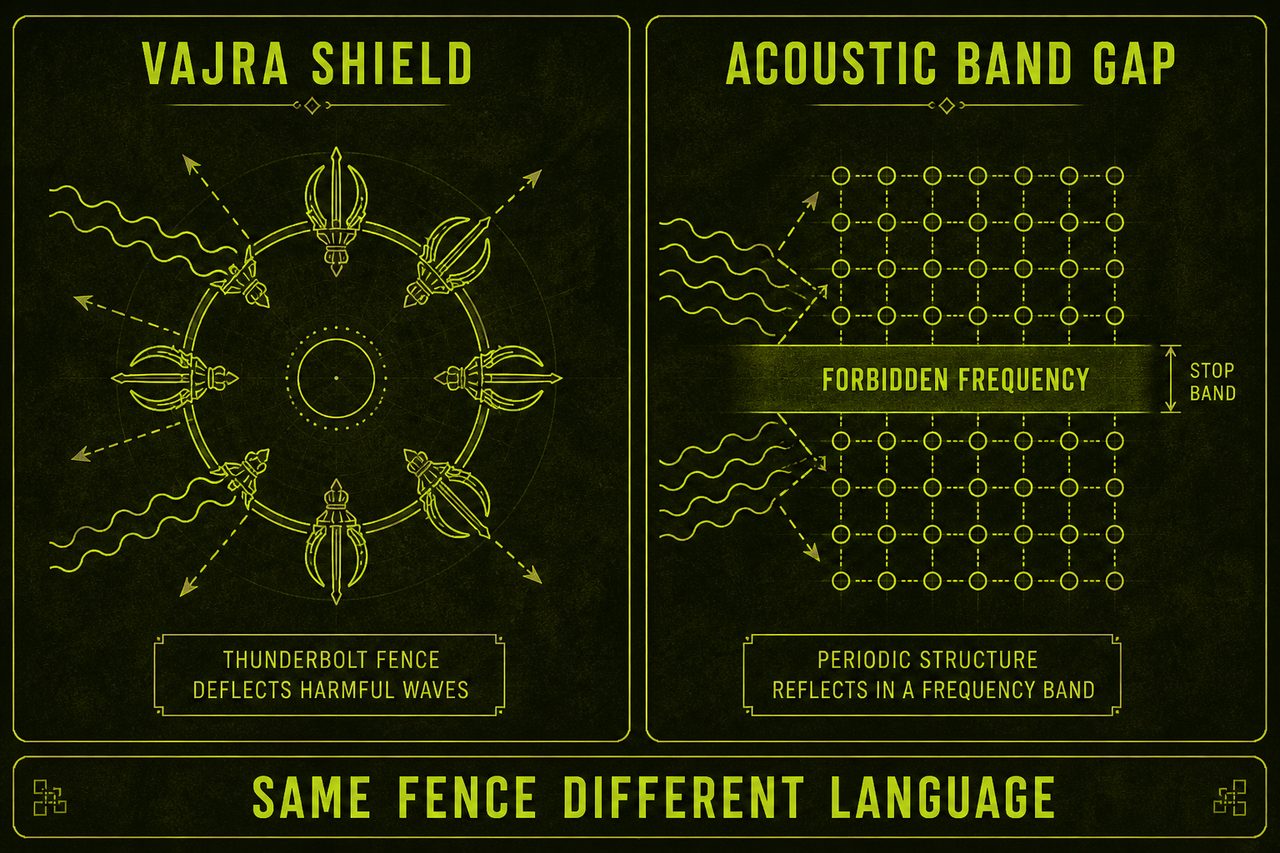
Two-panel schematic: VAJRA SHIELD versus ACOUSTIC BAND GAP. Footer SAME FENCE DIFFERENT LANGUAGE. Schematic still, not a scan.
Vajra shield versus acoustic band gap. Schematic still. Footer SAME FENCE DIFFERENT LANGUAGE. Do not quote band-gap Hz, ω-k plots, or art formulas as data.

Phonon carries sound and heat

Maldovan. Nature, 2013. Sound and heat revolutions in phononics. A phonon is the quasiparticle of mechanical vibration. It is responsible for everyday sound and heat. Phononic properties can control sound and heat. This is a review, not a vajra trial. I am taking that carrier sentence and stopping. The fence is control. It is not a vibe. If a reel told you the object raises your frequency, the reel used frequency as a mood. Maldovan uses frequency as a window of mechanical vibration. Those are not the same word.

Sound is a mechanical wave. Heat, in the solid, is also carried by vibrations of the lattice. Same quasiparticle family. Different frequency window. A phononic crystal can open a gap for one window and leave another open. Maldovan is surveying that control. I am not claiming a dorje dumps heat. I am not claiming a dorje dumps sound. I am naming the carrier. If the old map said the thunderbolt stops what should not pass, the lab map says you can design which mechanical frequencies get a pass. Control. Not a mood. Review, not a trial of an altar object.

Related reading: binaural beats versus isochronic 40 Hz. Sound as input. That page is what you put into the ear. This page is a lattice that can refuse a band of mechanical frequencies. Input is not fence. Do not mix them. A beat in headphones is a drive. A phononic gap is a stop. If you want the drive, go there. If you want the fence, stay here. I will not clone that article. One short mapping. Drive versus stop. Both are hardware. Different jobs.

Related reading: meridians as piezoelectric fascia. Elastic tissue. Piezoelectric fascia is a body lattice, not a brass object. I will not clone that article. One short mapping. Tissue can convert strain to charge. A phononic crystal converts periodicity into a stop-band. Both are elastic. Both are hardware. Different jobs. If you came from the body page looking for a Hertz sticker on a dorje, you will not get one. You will get a fence noun you can carry into both maps.

Light already had the same idea

Yablonovitch. Physical Review Letters, 1987. Inhibited Spontaneous Emission in Solid-State Physics and Electronics. Light has photonic crystals. A periodic dielectric can open a gap for photons. Sound has phononic crystals. Same idea. Different wave. I will not clone the optics paper onto this page. One short graph. If you can forbid a band of light, you can forbid a band of vibration. Then we return to the elastic lattice.

What the mapping is not

No. Translation, not a scan. A brass dorje on an altar was not run through a Brillouin-zone calculation in these papers. The mapping is fence. The old map named an indestructible thunderbolt that stops what should not pass. The lab map is a periodic elastic lattice that forbids a band of mechanical frequencies. The stills on this page are schematic. Do not quote band-gap Hz, ω-k plots, or art formulas as data.

No. Liu 2000 measured a 2-centimeter slab at 400 hertz. That is not a ritual object. The aisle that sells a dorje as a measured band-gap tuner hides the mechanism the same way the gatekeeper hid it by calling the vajra an empty toy. We don't believe. We measure.

Two enemies. The gatekeeper who said the vajra was an empty toy. The aisle that sells a dorje as a measured band-gap tuner. The first hid the job by calling it theater. The second hid the job by hanging a lab number on an object the lab did not measure. I will not join either. The people who kept the object were not the problem. The missing noun was the problem. Stop-band. Phononic crystal. Local resonance. Those nouns were sitting in Physical Review Letters while the gatekeeper called the object empty. Those nouns were sitting in Science while the aisle printed a tuner claim.

I will not tell you to throw the object away. I will tell you what the papers measured, and what they did not. A five-pronged brass ritual object is a five-pronged brass ritual object. A 2-centimeter locally resonant slab is a 2-centimeter locally resonant slab. The fence job can live in both maps without forcing one object to be the other.

The stills say SAME FENCE DIFFERENT LANGUAGE. That footer is the claim. It is not a dataset. Schematic still. The left panel is the old map drawn as a shield. The right panel is the lab map drawn as a gap. Keep the picture as a picture.

NameWhat it actually isWhat it is not
VajraThunderbolt and diamond (Britannica). Indra. Vajrayāna. Five-pronged brass or bronze. Old map of a fence that does not breakA magic wand. A measured 400 Hz tuner
Phononic crystalSpatially periodic elastic composite (Kushwaha 1994). Band gap throughout the Brillouin zone (Kushwaha 1993). Forbidden means those vibrations do not propagateA shop label on a dorje
Band gapA range of frequencies with no propagating mode in the lattice. Transverse vibrations, sound, and phonons forbidden inside (Kushwaha 1994)A Hertz number you can read off a still
Local resonanceSonic crystals with spectral gaps at a lattice constant two orders smaller than the wavelength. 2-cm slab at 400 hertz (Liu 2000)A dorje measurement
Dorje on the altarTibetan rdo-rje. Ritual object. Translation target, not a scanA Brillouin-zone sample from 1993

Name the fence first.

A screaming nerve will not let you hear a stop-band. Protocol 01 is free. Four-count inhale. Eight-count exhale. Seven minutes. A number before and a number after. That is the hardware check. The Library of Biological Wizardry is the rest of the stack if the method earns the next hour. No initiate password. A sequence, then a measurement. We don't believe. We measure.

What should I run if I want a number?

Start with Protocol 01, the free Neural Recalibration. Four-count inhale, eight-count exhale, seven minutes, a number before and a number after. A screaming nerve will not let you hear a fence. If the method earns it, the Library of Biological Wizardry is the rest of the stack. We don't believe. We measure.

You will not get a Brillouin-zone plot from a kitchen dorje. You can get a 1 to 10 on your own state, and a binary on whether you ran a sequence you can start and leave. That is the first instrument. Brake if the nerve is screaming. Then read the fence as a fence. Related reading: a ritual is structure as a constraint. Related reading: elastic tissue, piezoelectric fascia. Related reading: sound as input, not as a stop-band. A vajra is phononic-crystal fencing. Translation, not a scan.

FAQ

Short answers you can lift from this page. Visible text matches the FAQ schema exactly. The stills are schematic. None of this is medical advice.

What is a vajra, in this stack?

A vajra is phononic-crystal fencing. Britannica: Sanskrit vajra has both meanings thunderbolt and diamond. Like the thunderbolt, it cleaves through ignorance. Originally the symbol of Indra. Like the diamond, it destroys but is itself indestructible. Tibetan rdo-rje. Brass or bronze ritual object, commonly five-pronged. Symbol of Vajrayāna. The old map named an indestructible thunderbolt that stops what should not pass. The lab map is a periodic elastic lattice that forbids a band of mechanical frequencies. Translation, not a scan.

What is a phononic crystal?

Kushwaha, Halevi, Dobrzynski, and Djafari-Rouhani (1993) published the first full band-structure calculations for periodic elastic composites. For transverse polarization they obtain a phononic band gap which extends throughout the Brillouin zone. A complete acoustic gap may lead to a vibrationless environment. In 1994 they name a spatially periodic composite a phononic crystal. Within the gaps, transverse vibrations, sound, and phonons are forbidden. Forbidden means those vibrations do not propagate. I did not invent filling fractions or a Hertz number for a ritual object.

What is acoustic metamaterial fencing?

Liu, Zhang, Mao, Zhu, Yang, Chan, and Sheng (2000) describe sonic crystals based on localized resonant structures. Spectral gaps with a lattice constant two orders of magnitude smaller than the relevant wavelength. A 2-centimeter slab breaks the conventional mass-density law of sound transmission by one or more orders of magnitude at 400 hertz. That slab is lead spheres in rubber in epoxy. This is acoustic metamaterial fencing, not a dorje measurement. Do not baptize a shop vajra as a 400 Hz metamaterial.

Did a lab measure a band gap on a ritual dorje?

No. Translation, not a scan. A brass dorje on an altar was not run through a Brillouin-zone calculation in these papers. The mapping is fence. The old map named an indestructible thunderbolt that stops what should not pass. The lab map is a periodic elastic lattice that forbids a band of mechanical frequencies. The stills on this page are schematic. Do not quote band-gap Hz, ω-k plots, or art formulas as data.

Is a shop vajra a measured band-gap tuner?

No. Liu 2000 measured a 2-centimeter slab at 400 hertz. That is not a ritual object. The aisle that sells a dorje as a measured band-gap tuner hides the mechanism the same way the gatekeeper hid it by calling the vajra an empty toy. We don't believe. We measure.

What should I run if I want a number?

Start with Protocol 01, the free Neural Recalibration. Four-count inhale, eight-count exhale, seven minutes, a number before and a number after. A screaming nerve will not let you hear a fence. If the method earns it, the Library of Biological Wizardry is the rest of the stack. We don't believe. We measure.

Is this medical advice?

No. This page is an educational mechanism explainer by JM Thomas. It is not a diagnosis, treatment, cure, or prevention of any disease. Named papers discuss sound, heat, and elastic lattices in physics, not a treatment of anyone reading this. If sound, vibration, or ritual practice distresses you, talk to a clinician.

Sources I actually opened

Britannica. "vajra." Sanskrit vajra has both meanings thunderbolt and diamond. Like the thunderbolt, it cleaves through ignorance. Originally the symbol of Indra. Like the diamond, it destroys but is itself indestructible. Tibetan rdo-rje. Brass or bronze ritual object, commonly five-pronged. Symbol of Vajrayāna. britannica.com/topic/vajra

Kushwaha, M.S., Halevi, P., Dobrzynski, L., Djafari-Rouhani, B. "Acoustic band structure of periodic elastic composites." Phys Rev Lett 71:2022-2025 (27 Sep 1993). First full band-structure calculations for periodic elastic composites. For transverse polarization they obtain a phononic band gap which extends throughout the Brillouin zone. Complete acoustic gap may lead to a vibrationless environment. I did not invent filling fractions or a Hertz number for a ritual object. doi.org/10.1103/PhysRevLett.71.2022

Kushwaha, M.S., Halevi, P., Martínez, G., Dobrzynski, L., Djafari-Rouhani, B. "Theory of acoustic band structure of periodic elastic composites." Phys Rev B 49:2313 (1994). They name a spatially periodic composite a phononic crystal. Within the gaps, transverse vibrations, sound, and phonons are forbidden. doi.org/10.1103/PhysRevB.49.2313

Liu, Z., Zhang, X., Mao, Y., Zhu, Y.Y., Yang, Z., Chan, C.T., Sheng, P. "Locally Resonant Sonic Materials." Science 289(5485):1734-1736 (8 Sep 2000). Sonic crystals based on localized resonant structures. Spectral gaps with a lattice constant two orders of magnitude smaller than the relevant wavelength. A 2-centimeter slab breaks the conventional mass-density law of sound transmission by one or more orders of magnitude at 400 hertz. This is acoustic metamaterial fencing, not a dorje measurement. doi.org/10.1126/science.289.5485.1734

Maldovan, M. "Sound and heat revolutions in phononics." Nature 503:209-217 (2013). Phonon is the quasiparticle of mechanical vibration, responsible for everyday sound and heat. Phononic properties can control sound and heat. Review, not a vajra trial. doi.org/10.1038/nature12608

Yablonovitch, E. "Inhibited Spontaneous Emission in Solid-State Physics and Electronics." Phys Rev Lett 58:2059 (1987). Light has photonic crystals. Sound has phononic crystals. Same idea, different wave. One short analog on this page, not a clone. doi.org/10.1103/PhysRevLett.58.2059