Future self · continuity · year 70

The later owner of this paycheck showed up in the mirror.

JM Thomas · 17 August 2026

A later owner has a claim on this week's money. The claim gets louder when that owner has a face in a mirror.

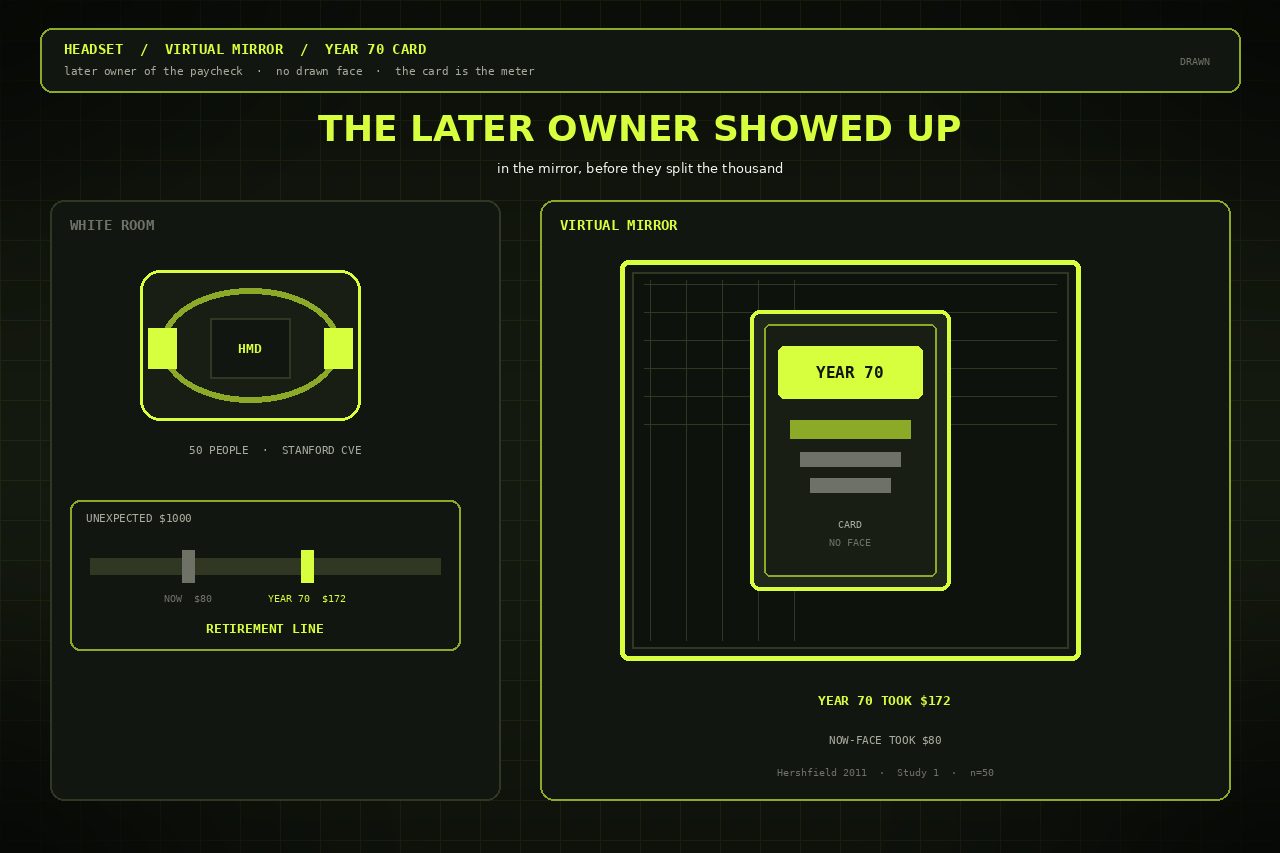
Dark lime drawing of a headset, a virtual mirror holding a YEAR 70 card, and a retirement slider at $172 versus $80. No face.
Headset. Virtual mirror. YEAR 70 card. The retirement line sits at $172.

Fifty people walked into a white room at Stanford. A headset. A virtual mirror. One arm saw their now-face. The other arm saw year 70. Then they split an unexpected thousand four ways. Year 70 took $172 for retirement. The now-face took $80.

I kept a prize car on the fridge for a year. The later owner of the rent never got a look. The collage stayed in the kitchen. The paycheck stayed with Tuesday.

The paycheck has a later owner

Saving is a transfer to a person who does not vote yet. Continuity is how much that person still feels like you.

Parfit wrote the legal fact first. One identity. One set of assets. The boy who starts smoking at sixteen and shrugs at the cough at sixty-six is treating year 70 like a stranger. Hershfield put that sentence in a headset.

On a scan, the later self can light the same strip as another person. Ersner-Hershfield, Wimmer, and Knutson, 2009, Social Cognitive and Affective Neuroscience. Eighteen people, ages 18 to 23. Five more dropped for motion. Trait words. Current self. Future self, ten years out. Current other. Future other. A week later they chose real money now versus later. Right rACC rose more for the current self than for the later self, t(17) = 2.94, p < .01. The size of that gap tracked how steeply they discounted, r(16) = 0.47, p < .05. DOI 10.1093/scan/nsn042. PMID 19047075.

Stanford put year 70 in a headset

Study 1. Collaborative virtual environment. A mirror two meters behind you that tracked six degrees of freedom.

Hershfield, Goldstein, Sharpe, Fox, Yeykelis, Carstensen, Bailenson. Journal of Marketing Research, 2011. 48(SPL):S23-S37. DOI 10.1509/jmkr.48.SPL.S23. PMID 24634544. FaceGen built the mesh. An artist grayed the hair. Each person saw the assigned face for 60 to 75 seconds, then answered a short script so the avatar stuck.

Fifty people. Thirty-three women. Mean age 20.13. Course credit or $10. After the headset they imagined an unexpected $1,000 and split it four ways: a gift, a retirement fund, a fun occasion, a checking account.

$172 of the unexpected thousand

Year 70 put $172 toward retirement. The now-face put $80. More than double. One-tailed p = .035.

Means: $172, SD $214, versus $80, SD $130. t(48) = 1.83, p = .035 one-tailed, d = 0.519. Negative emotion did not rise on the year-70 arm (2.52 versus 2.62, t(48) = 0.33, p = .75). The retirement gap held after they controlled for that mood.

Study 2 tried to hide the ask. Twenty-one people. Own aged avatar versus someone else's aged avatar. Then a fake end-of-session, then three money tasks under a cover story. Saving sat higher on the own-face arm across the three tasks, F(1,19) = 4.14, p = .056. That one is thin. Keep it as a mask check, not the headline.

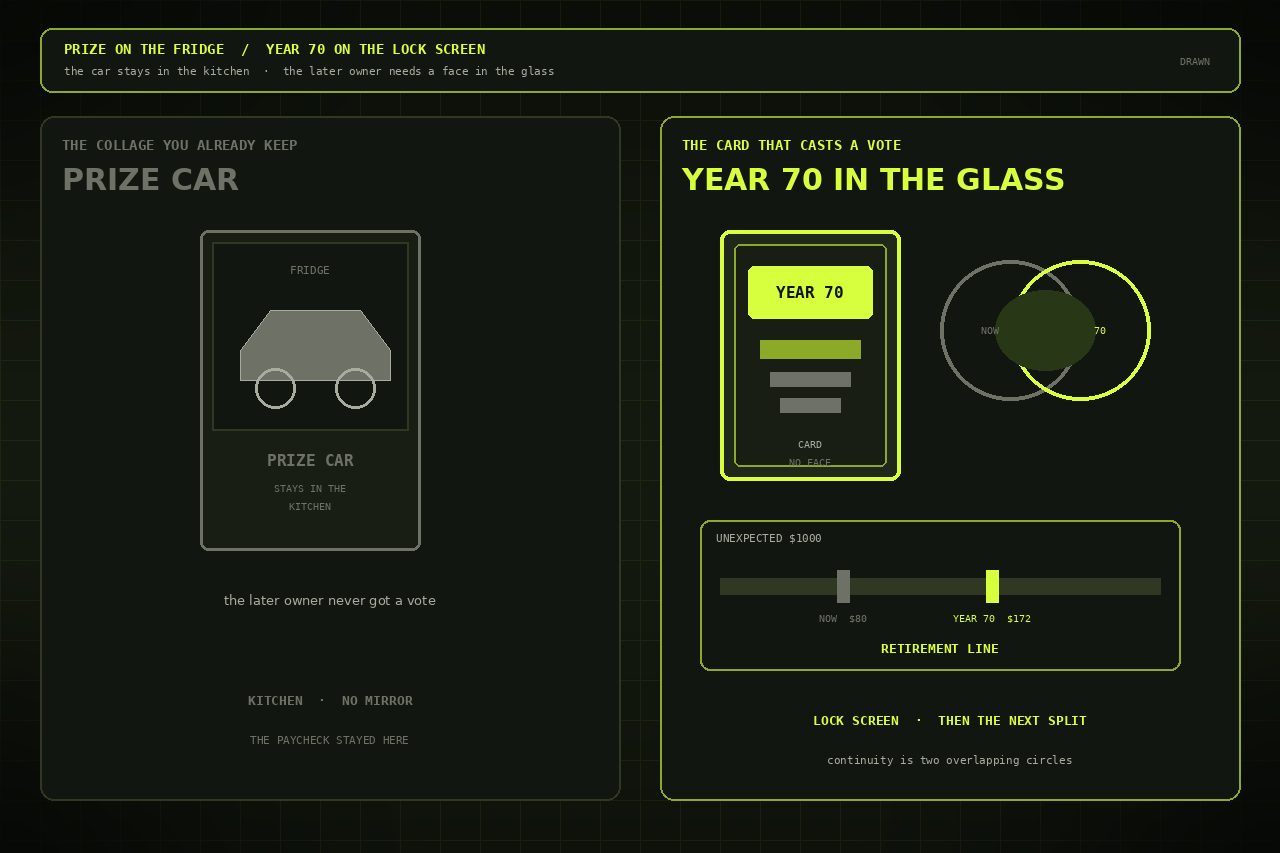
Dark lime split. Left a prize car taped to a fridge. Right a YEAR 70 card, two overlapping circles, and a retirement slider at $172 versus $80.
Left: prize car on the fridge. Right: YEAR 70 card, then the next split.

A slider on a home screen

Studies 3a and 3b dropped the headset. Photos. A slider. Current income on the left. Retirement income on the right.

Study 3a, forty-two students, twenty-one per arm. The future-self face smiled as retirement rose. Allocation: 6.76% versus 5.20%. t(38) = 2.38, p = .023, d = 0.771. Two outliers left the future-self arm. The gap was 1.56 points of pay.

Study 3b took the smile off so people could not chase the happy mouth. Neutral faces. Mechanical Turk. Ages 18 to 35. Final sample 18 future, 20 current. Allocation: 6.17% versus 4.41%. t(36) = 2.28, p = .029, d = 0.742. Continuity on the overlapping-circle scale: 4.39 versus 3.25. t(36) = 1.97, p = .057, d = 0.64. Continuity carried the allocation when they put both in the same regression.

Two circles that overlap

The Future Self-Continuity Scale is a pair of Euler circles. You pick how much now and later still share a middle.

That scale comes from Ersner-Hershfield, Garton, Ballard, Samanez-Larkin, and Knutson, 2009, Judgment and Decision Making 4(4):280-286. Higher overlap went with more patience in the lab and more assets in life. Study 3b used the same circles as the mediator.

Pataranutaporn, Winson, Yin, and Hershfield later built a chat with an age-60 character. IEEE Frontiers in Education, 2024. DOI 10.1109/fie61694.2024.10893443. Preregistered N = 344. Anxiety fell. Continuity rose. I am not quoting a mean I do not have in front of me. The sit is a conversation, not a headset.

The fridge car stays in the kitchen

A prize collage keeps the eyes on a car. Year 70 needs a face in the glass before the next split.

The vision-board page already ran the collage problem. A car on the fridge does not give the later owner a vote. The letter page writes from a Tuesday that went well. This page puts year 70 in the glass and then asks where the next dollar goes.

Use the twenty-minute letter when you want a dated page. Use this sit when you want the later face to cast a vote on a real split.

Put year 70 on the lock screen

Age a photo you already have, or print YEAR 70 on a card and tape it to the glass you unlock. Before the next split, look at that card for one minute. Then write the percent you would send forward.

Do that on the morning you actually move money. Hershfield measured the look and the split in the same hour. Duration past that hour is unknown. The lock screen is how you keep the later owner in the room.

If the look makes the chest loud, sit until that clamp lets go, then look again. The Library keeps the other sits if you want them later.

Questions the slider still leaves

Does a phone photo count, or only a headset?

Study 1 used a headset and a virtual mirror. Studies 3a and 3b used photos on a home screen. A lock-screen card labeled YEAR 70 is the home version of the mirror.

What if the aged photo just makes me sad?

Study 1 scored fifteen emotions after the headset. Negative mood did not rise on the year-70 arm, and the retirement gap held after they controlled for it. Sadness is not the lever they measured.

How long does the slider stay moved?

Every sit in the 2011 file measured the split during or right after the look. Duration past that hour is unknown. The useful clock is the next real split, which is why the card belongs on the lock screen.

What number do I write after I look?

Write the percent or the dollar line you would send to year 70, then the same line after the card has been on the lock screen for a week. Continuity is the pair of overlapping circles from 1 to 7.

Is this a medical page?

Retirement allocations and a continuity scale. Literature. If chest pain or panic arrives, call a doctor, not another aged photo.

Numbers from the four studies

Hershfield H.E., Goldstein D.G., Sharpe W.F., Fox J., Yeykelis L., Carstensen L.L., and Bailenson J.N. "Increasing saving behavior through age-progressed renderings of the future self." Journal of Marketing Research 2011;48(SPL):S23-S37. DOI 10.1509/jmkr.48.SPL.S23. PMID 24634544. Study 1 n=50 (33 women, mean age 20.13). Retirement allocation $172 (SD 214) vs $80 (SD 130). t(48)=1.83, p=.035 one-tailed, d=0.519. Study 2 n=21, own aged avatar vs other aged avatar, three money tasks F(1,19)=4.14, p=.056. Study 3a n=42 (21/21), 6.76% vs 5.20%, t(38)=2.38, p=.023, d=0.771, two outliers excluded from future-self arm. Study 3b final n=38 (18/20), 6.17% vs 4.41%, t(36)=2.28, p=.029, d=0.742. Continuity 4.39 vs 3.25, t(36)=1.97, p=.057, d=0.64. doi.org/10.1509/jmkr.48.SPL.S23 · pubmed.ncbi.nlm.nih.gov/24634544 · anderson.ucla.edu PDF

Ersner-Hershfield H., Wimmer G.E., and Knutson B. "Saving for the future self: Neural measures of future self-continuity predict temporal discounting." Social Cognitive and Affective Neuroscience 2009;4(1):85-92. DOI 10.1093/scan/nsn042. PMID 19047075. Analyzed n=18 (10 men, 8 women, ages 18-23). Five excluded for motion. Right rACC current vs future self t(17)=2.94, p<.01. Current-future self difference vs discounting r(16)=0.47, p<.05. doi.org/10.1093/scan/nsn042 · pmc.ncbi.nlm.nih.gov/articles/PMC2656877

Ersner-Hershfield H., Garton M.T., Ballard K., Samanez-Larkin G.R., and Knutson B. "Don't stop thinking about tomorrow: Individual differences in future self-continuity account for saving." Judgment and Decision Making 2009;4(4):280-286. Continuity scale used as the mediator in Study 3b. cambridge.org JDM 2009

Pataranutaporn P., Winson K., Yin P., Lapapirojn A., Ouppaphan P., Lertsutthiwong M., Maes P., and Hershfield H.E. "Future You: A conversation with an AI-generated future self reduces anxiety, negative emotions, and increases future self-continuity." IEEE Frontiers in Education 2024. DOI 10.1109/fie61694.2024.10893443. Preregistered N=344. Anxiety down, continuity up. Means not quoted here. doi.org/10.1109/fie61694.2024.10893443