Awe walk · small self · sidewalk frame

They walked the same block. The selfies got smaller.

JM Thomas · 17 August 2026

Vastness on a weekly outdoor loop shrinks the body in the photograph. The canopy and the pavement take the pixels.

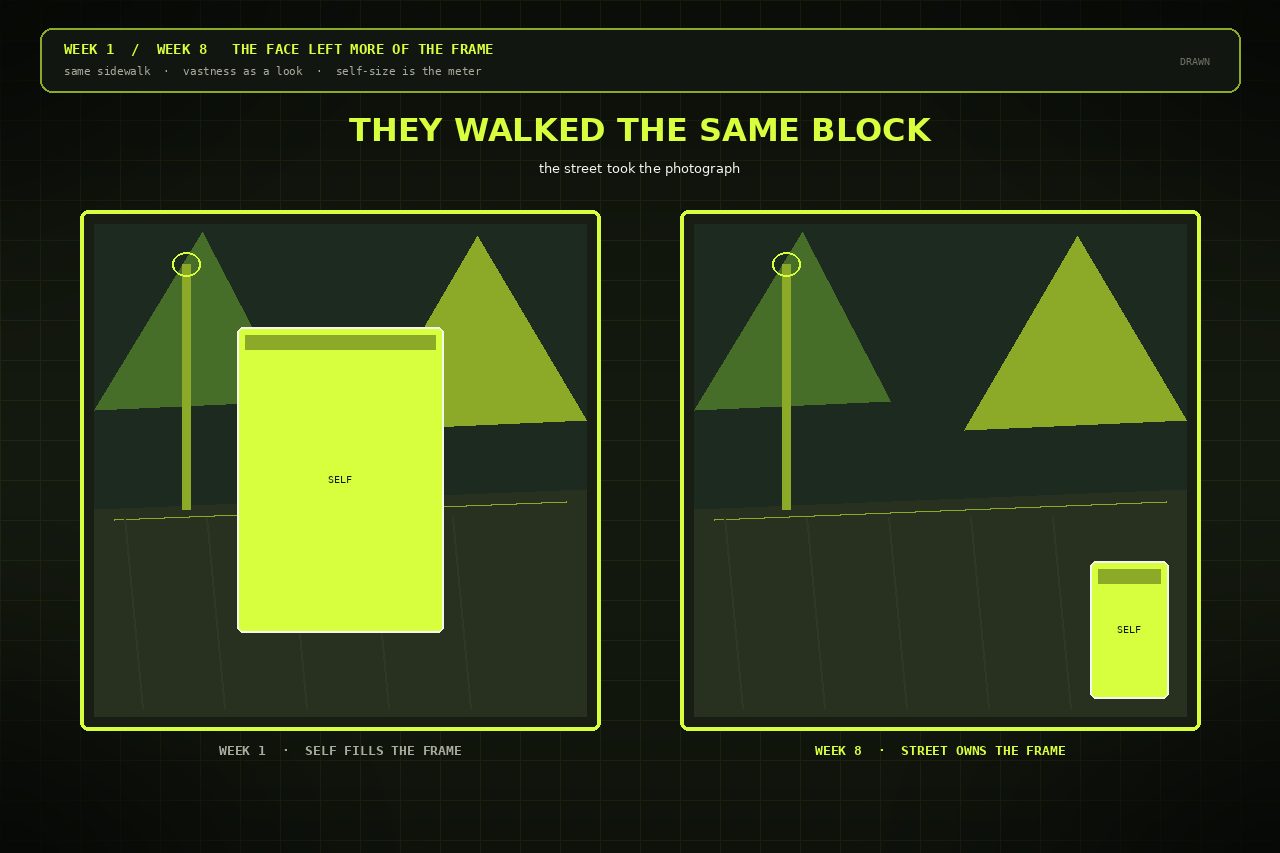
Dark lime drawing of two photo frames. Week 1 a lime SELF block fills the sidewalk. Week 8 the block sits at the edge and the canopy owns the frame.
Week 1 fills the shot. Week 8 gives the canopy the pixels.

Sixty older adults. One outdoor loop a week. One arm hunted for size and novelty. Matlab counted how many pixels still belonged to the torso. That fraction fell. Daily distress fell with it. The GAD-7 stayed put.

The gratitude app I keep on the table still wants three lines. Coffee. The list. The list again. Tonight the meter is a canopy, a long pavement, and how little of the shot is still you.

Vastness is a look you can take on the same sidewalk

Awe arrives when something is large and you cannot sort it yet. The look can happen on a block you already own.

Sturm told one arm to tap a childlike wonder and, if they could, to pick a new locale so the eye had to work. Physical vastness. Novelty. A tree canopy counts. A long street counts. A flower you walked past for years and never stopped for counts.

The other arm walked the same minutes with no extra outlook. Both groups went outdoors alone, light to moderate pace, phones down except for the pictures. The walk was the control. The look was the difference.

They measured the self in the photograph

Three pictures per walk. Before, during, after. Self-size was the share of pixels that belonged to the body.

Matlab turned each upload into black for self and white for everything else, then divided those black pixels by the whole frame so the lab had a fraction instead of a vibe. The number is a fraction. A shrinking fraction means the sidewalk, the trees, and the sky took the frame.

Coders blind to the arms scored smile intensity with Action Unit 12. That is a second meter, from the mouth, on the same pictures. Tonight you can skip the face and still use the frame: how much of the shot is the block.

UCSF walked them for eight weeks

Recruited sixty. Analyzed fifty-two. Twenty-four on the look. Twenty-eight on the plain walk. Ages 60 to 90. Median 75.

Sturm, Datta, Roy, Sible, Kosik, Veziris, Chow, Morris, Neuhaus, Kramer, Miller, Holley, Keltner. Emotion, 2022. 22(5):1044-1058. Online first 21 September 2020. DOI 10.1037/emo0000876. PMID 32969669. NCT03550144. Hillblom Healthy Aging Network, UCSF.

One outdoor walk a week, fifteen minutes on the instruction sheet they took home. Actual duration ran longer, about 38 minutes on the look arm and 47 on the plain arm, because people kept going once they were already outside. The plain arm took more walks, 18.9 against 7.5. That extra mileage worked against the look. The look still moved the photo.

The face slid toward the edge

Group by time on self-size: b = -0.13, 95% CI -0.24 to -0.03, p = .02. More awe walks, smaller self.

Smile intensity rose on the same pictures, group by time b = 0.03, 95% CI 0.01 to 0.06, p = .01. Walk-time awe sat higher on the look arm, t(50) = 2.67, p = .01. Feeling part of something larger during the walk rose with time on that arm, b = 0.02, p = .01.

Daily awe outside the walk did not climb. The look stayed on the sidewalk. What leaked into the rest of the day was compassion, admiration, amusement. Each extra awe walk added 0.05 units to daily prosocial emotion.

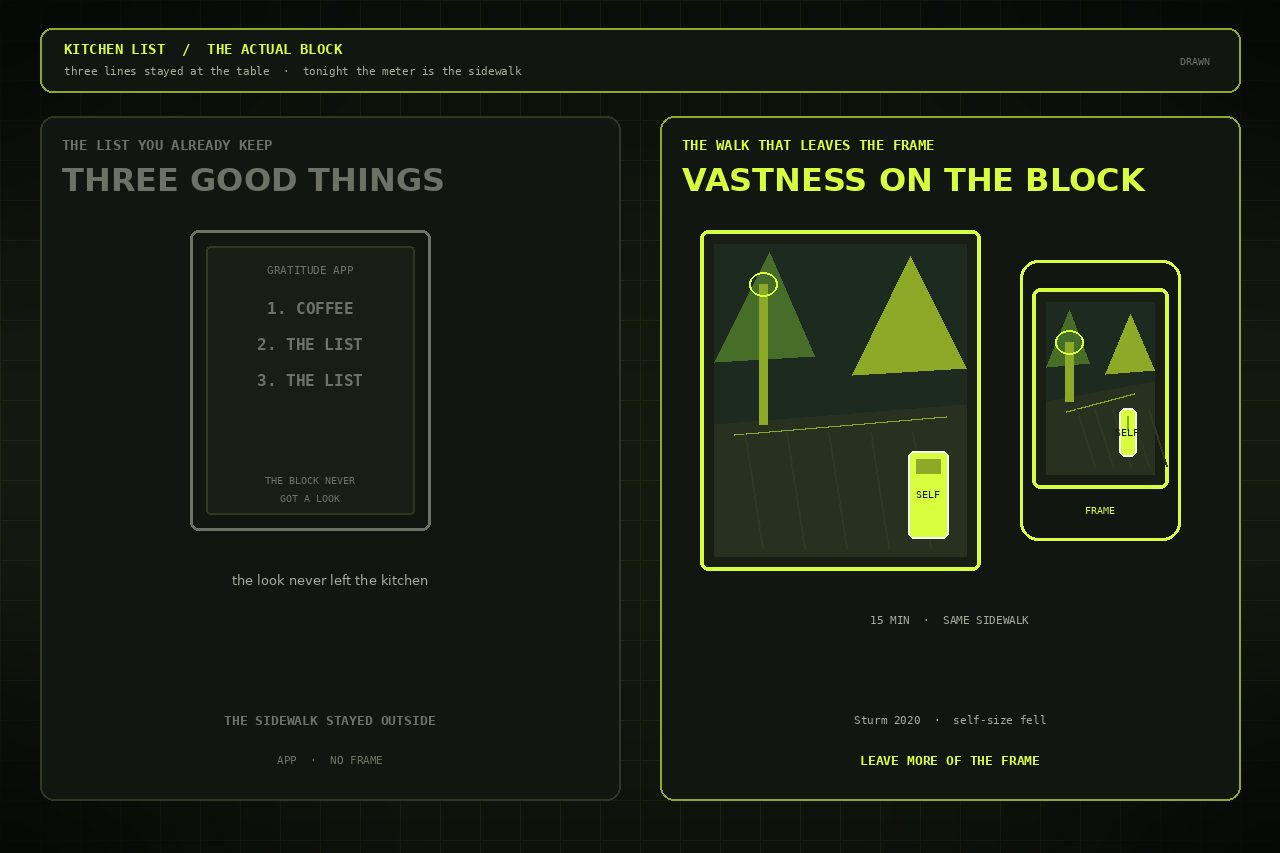
Dark lime split. Left a gratitude app listing three good things. Right a sidewalk photo frame with a small SELF block at the edge.
Left: three lines at the table. Right: fifteen minutes on the actual block.

Daily distress fell. The GAD-7 did not.

Daily sadness and fear dropped more on the look arm. Anger, anxiety, and annoyance did not. Trait scales stayed flat.

Group by time on daily distress: b = -0.004, p = .03. Daily prosocial emotion: b = 0.004, p = .03. Daily joy outside the walk did not differ. Helpful acts did not differ.

GAD-7 change: 0.0 versus 0.6, p = .17. CES-D change: 0.2 versus -0.1, p = .64. Life satisfaction change: 0.5 versus 0.4, p = .96. Scores started low. The file printed the miss. A scripting reel that sells an awe walk as a depression cure is selling a line the PDF refused.

Distress also started a little higher on the look arm. Regression to the mean can eat part of that drop. Sturm wrote that caveat in the discussion. Keep it.

Walk plus outlook, then 22,811 people

Wilkie 2026 stacked 183 well-being trials. Combined exercise plus a psychological outlook sat at SMD 0.73. Nature alone did not beat a quiet control.

Wilkie, Fisher, Geidel, Goodall, Kamil, Davies, Kemp. Nature Human Behaviour, 2026. 10:715-726. DOI 10.1038/s41562-025-02369-1. 22,811 adults, no diagnosed condition in the inclusion rule. Combined exercise-psychological SMD 0.73, 95% CI 0.27 to 1.20. Mindfulness, compassion, single positive-psychology, yoga, and exercise sat between 0.41 and 0.49. Nature-based sits were not significantly above control. Risk of bias ran moderate to high. Funnel plots looked asymmetric. Sensitivity checks still held the direction.

That stack is a map of many sits, not a second UCSF walk, and it should be read as a map. The UCSF sit is a walk plus an outlook. That pairing is the cell that sat at 0.73. A park with no look is the cell that missed.

The vision-board page already ran the prize collage. A car on the fridge keeps the eyes in the kitchen. Tonight the eyes go to the actual block until the self occupies less of the frame.

Leave more of the frame tonight

Pick a sidewalk you already walk. Fifteen minutes. Light pace. Phone down except for three shots of the street, the canopy, and one new detail. Look for something large you cannot sort yet.

Do that once a week for eight weeks if you want Sturm's clock. Tonight is week one. Leave the gratitude app on the table. The meter is how much of the photograph is the block.

If the walk makes the chest loud, sit until that clamp lets go, then start the fifteen minutes. The Library keeps the other sits if you want them later.

The kitchen list can stay in the drawer

Do I need a mountain or a canyon?

Sturm sent people to any outdoor setting, urban or rural. Vastness can be a tree canopy, a long street, or one new detail on a block you already walk. Novelty helps. A plane ticket does not.

Can I keep the gratitude list and add this?

You can. Three lines stay in that app. Tonight the meter is fifteen minutes on the sidewalk and how much of the frame the street owns.

Is this the same as a vision board walk?

A prize collage keeps the car in the kitchen. Tonight you look at the actual block until the self occupies less of the photo. Use the vision-board page for the collage problem.

What if I cannot walk fifteen minutes?

The lab asked for a light to moderate outdoor pace. Sit on a stoop and look for vastness if the legs will not go. The look is the sit. The sidewalk is the preferred meter.

Is this a medical page?

Daily emotion ratings and photo measurements. Literature. The GAD-7 and CES-D did not move. If chest pain or panic arrives, call a doctor, not another walk.

Counts from the photographs

Sturm V.E., Datta S., Roy A.R.K., Sible I.J., Kosik E.L., Veziris C.R., Chow T.E., Morris N.A., Neuhaus J., Kramer J.H., Miller B.L., Holley S.R., and Keltner D. "Big smile, small self: Awe walks promote prosocial positive emotions in older adults." Emotion 2022;22(5):1044-1058. DOI 10.1037/emo0000876. PMID 32969669. NCT03550144. Recruited n=60. Analyzed n=52 (24 look, 28 plain walk) with at least two walks. Ages 60-90, median 75. Weekly outdoor walk, 15-minute instruction, eight weeks. Self-size group x time b=-0.13, 95% CI -0.24 to -0.03, p=.02. Smile intensity group x time b=0.03, 95% CI 0.01 to 0.06, p=.01. Walk awe t(50)=2.67, p=.01. Daily prosocial group x time b=0.004, p=.03. Daily distress group x time b=-0.004, p=.03. Each extra awe walk +0.05 daily prosocial. GAD-7, CES-D, and SWLS change NS. Plain arm took more walks (18.9 vs 7.5). doi.org/10.1037/emo0000876 · pubmed.ncbi.nlm.nih.gov/32969669 · escholarship.org/uc/item/4c62428x

Wilkie L., Fisher Z., Geidel A., Goodall I., Kamil S., Davies E., and Kemp A.H. "A systematic review and network meta-analysis of randomized controlled trials of well-being-focused interventions." Nature Human Behaviour 2026;10:715-726. DOI 10.1038/s41562-025-02369-1. 183 trials. n=22,811. Combined exercise-psychological SMD 0.73, 95% CI 0.27 to 1.20. Mindfulness, compassion, single positive-psychology, yoga, and exercise SMD 0.41 to 0.49. Nature-based NS vs control. Moderate-to-high risk of bias. Funnel-plot asymmetry noted. doi.org/10.1038/s41562-025-02369-1 · nature.com/articles/s41562-025-02369-1