EMDR · future crash picture · gray circle
They used EMDR on a crash that had not happened. The picture felt less intense.
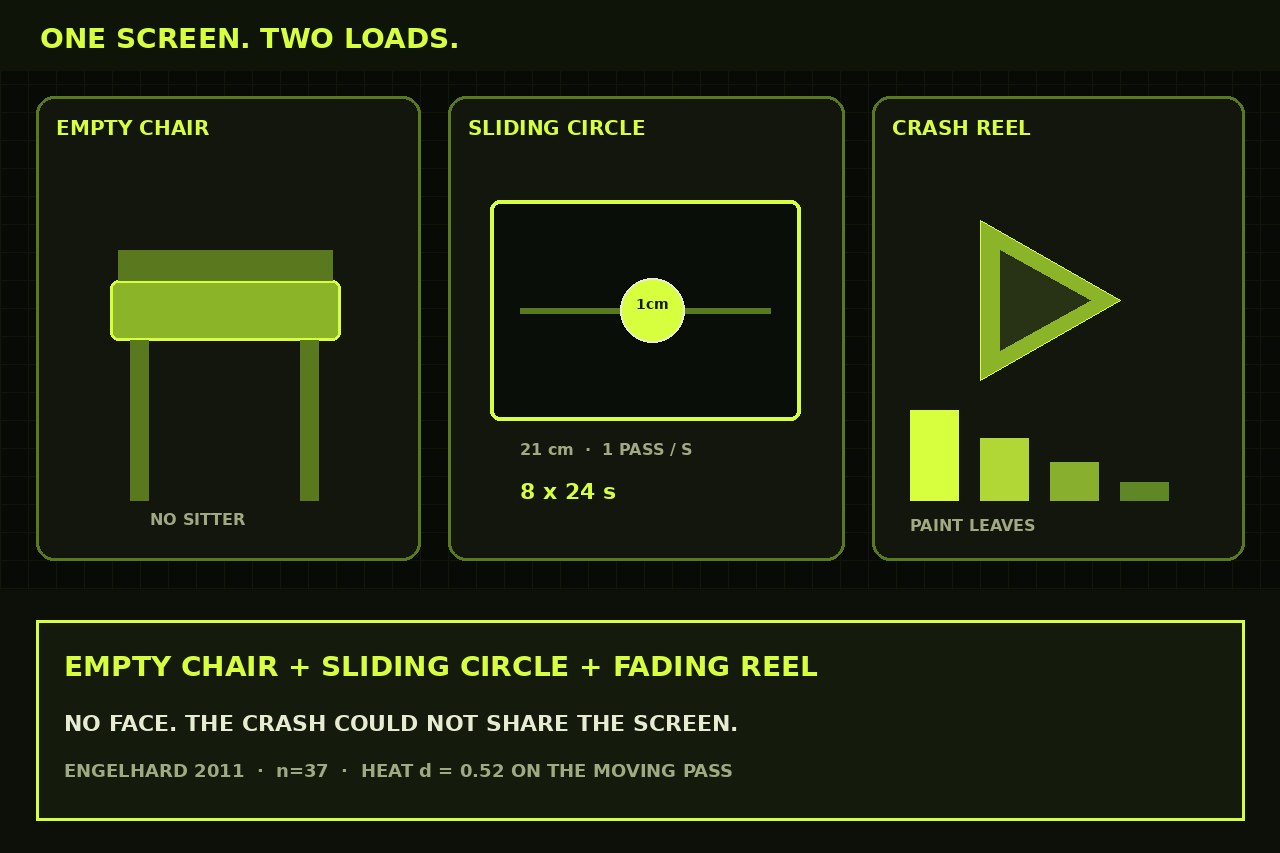
You face a screen and your eyes follow a gray circle as it slides.
The crash picture is already in your mind. You brought it with you, the one that keeps playing even though the wreck has not happened, and you hold that picture while the circle moves from one side of the screen to the other.
Office light is fine. The chair is fine.
EMDR is watching a moving spot while you hold a picture. People also call that eye movement desensitization. You came because you want that moving spot to change a crash that has not happened yet.
Face the screen and follow the circle
You sit down in front of the screen. Your eyes track a light gray circle as it slides. You keep the crash picture in mind the whole time.
Hold the picture. Follow the circle. That is the pass they used.
The room can stay lit. You do not need a dark wake or a special chair for this.
They brought a crash that had not happened
A future crash picture that keeps playing is the thing this lab asked people to hold. Once you have that picture, people also call it a flashforward.
Engelhard and the Utrecht team ran this work in 2011 and printed it in the Journal of Anxiety Disorders so you can find the same file if you want the lab sheet later.
They asked healthy women to bring pictures they already had. Nobody staged a crash. The women already saw those pictures in their own minds. Some of those pictures were wrecks. Some were other bad futures.
They screened hundreds of people and enrolled 42 healthy women. 37 finished. Most were around 22. This was an analogue lab test, which means they ran it with healthy people in a room, not as a clinic visit.
Read the paper at doi.org/10.1016/j.janxdis.2011.01.009 and at pubmed.ncbi.nlm.nih.gov/21376527.
A moving circle and a parked circle
They ran eight tracking passes. Each pass lasted 24 seconds, and they took a 10-second break between those passes so the eyes could rest.
One pass used a moving circle, a light gray circle about a centimeter wide that slid 21 centimeters across the screen, one move each second. The other pass used a parked circle, the same gray circle sitting still.
People held the picture during both. After each set of passes they marked how intense the feeling was and how clear the picture looked.
Working memory is the small mental space you use to hold a picture and track a spot at the same time. The team wanted that small space to do both jobs at once.
The feeling dropped after the moving passes
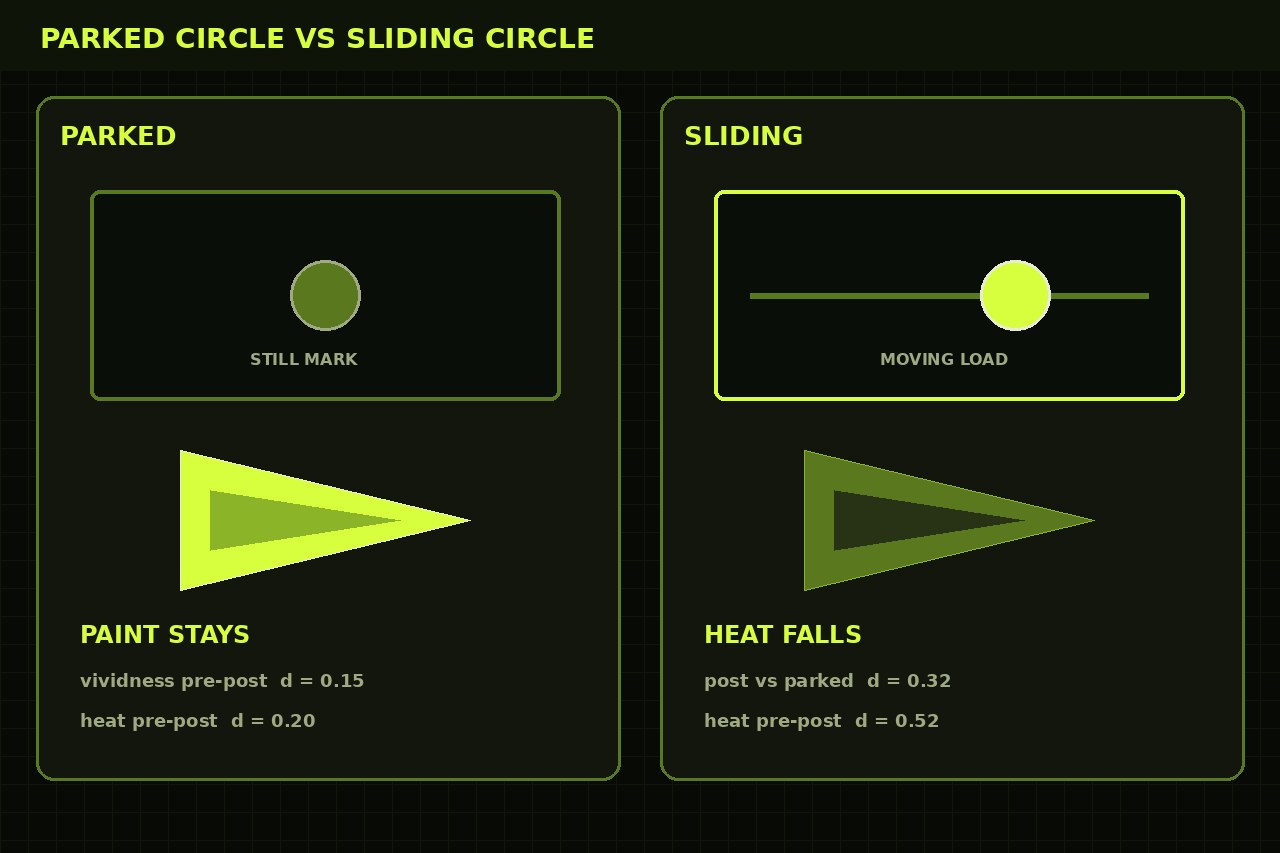
After the moving-circle passes, the feeling dropped. After the parked-circle passes, that same drop missed the cut the team used.
After both sets, people marked less feeling after the moving circle than after the parked one. The paper printed those leftover cells in the sources card.
You can still want the moving spot to change the picture.
The picture looked less clear
After the passes, the picture looked less clear after eye movements than after the parked circle.
The paper printed those leftover cells in the sources card below. The women marked the picture themselves. A lower mark means the picture looked less sharp.
Keep the nearby practices
If you already use SATS, keep it. SATS is an hour people use when they want a scene to feel real.
A 40 Hz listen is for waking hours if you want sound in the ears. Keep that too.
If you want a page about a standing class that moved a sheet after a plan was already in place, open the qigong page.
You wanted the moving spot to change the picture
You wanted the moving spot to change a crash picture that had not happened. After the moving passes, the feeling dropped and the picture looked less clear.
That is the view you can use now. You do not have to let that crash picture stay as loud as it feels this afternoon.
Hold the picture. Follow the gray circle. Check if the picture still hits as hard.
If unusual distress shows up, or you need trauma care, talk to a clinician. This page is educational.
Sources
Engelhard I.M., van den Hout M.A., Dek E.C.P., Giele C.L., van der Wielen J-W., Reijnen M.J., van Roij B. “Reducing vividness and emotional intensity of recurrent flashforwards by taxing working memory: An analogue study.” Journal of Anxiety Disorders 2011, 25(4):599-603. DOI 10.1016/j.janxdis.2011.01.009. PMID 21376527. Utrecht University. Screened 625, enrolled 42 healthy women, final n=37, mean age 21.7 SD 2.8. Eight 24-second tracking passes, 10-second breaks, 1-cm light gray circle, 21-cm horizontal travel, one movement per second vs stationary control. VAS 0-100 vividness and emotionality. Moving emotionality pre-post t(36)=3.07, p under 0.01, d=0.52. Parked emotionality t(36)=1.28, p above 0.05, d=0.20. Post emotionality moving vs parked t(36)=2.01, p under 0.05, d=0.32. Vividness condition by time F(1,36)=4.14, p under 0.05. Post vividness eye movements vs parked t(36)=2.37, p under 0.05, d=0.37. Pre-post vividness miss t(36)=1.23, p=0.11, d=0.26. Analogue study. Healthy women. Flashforwards they already had. doi.org/10.1016/j.janxdis.2011.01.009 · pubmed.ncbi.nlm.nih.gov/21376527