432 Hz · 440 Hz
432 Hz is the same song, tuned a little lower than 440.
You put on a song you already know. Someone tuned it so the note A sits at 432 instead of 440.
You already like that lower sound, or you would not be reading this. Shop pages say the drop from 440 to 432 is a universe secret. I want to tell you what people measured.
What is 432 Hz?
Sound is a shake in the air, and hertz is how many times that shake happens in one second, so 432 hertz means the air shakes 432 times each second. A lower count sounds a little lower.
Concert pitch is the note A that a band or orchestra tunes to so everyone matches. If the piano and the guitar do not share the same A, the song sounds sour. Some people set that A at 432 hertz, and that is 432 Hz music. The words and the tune stay. The starting note sits a little lower than the common setting. You can keep liking it.
What is 440 Hz?
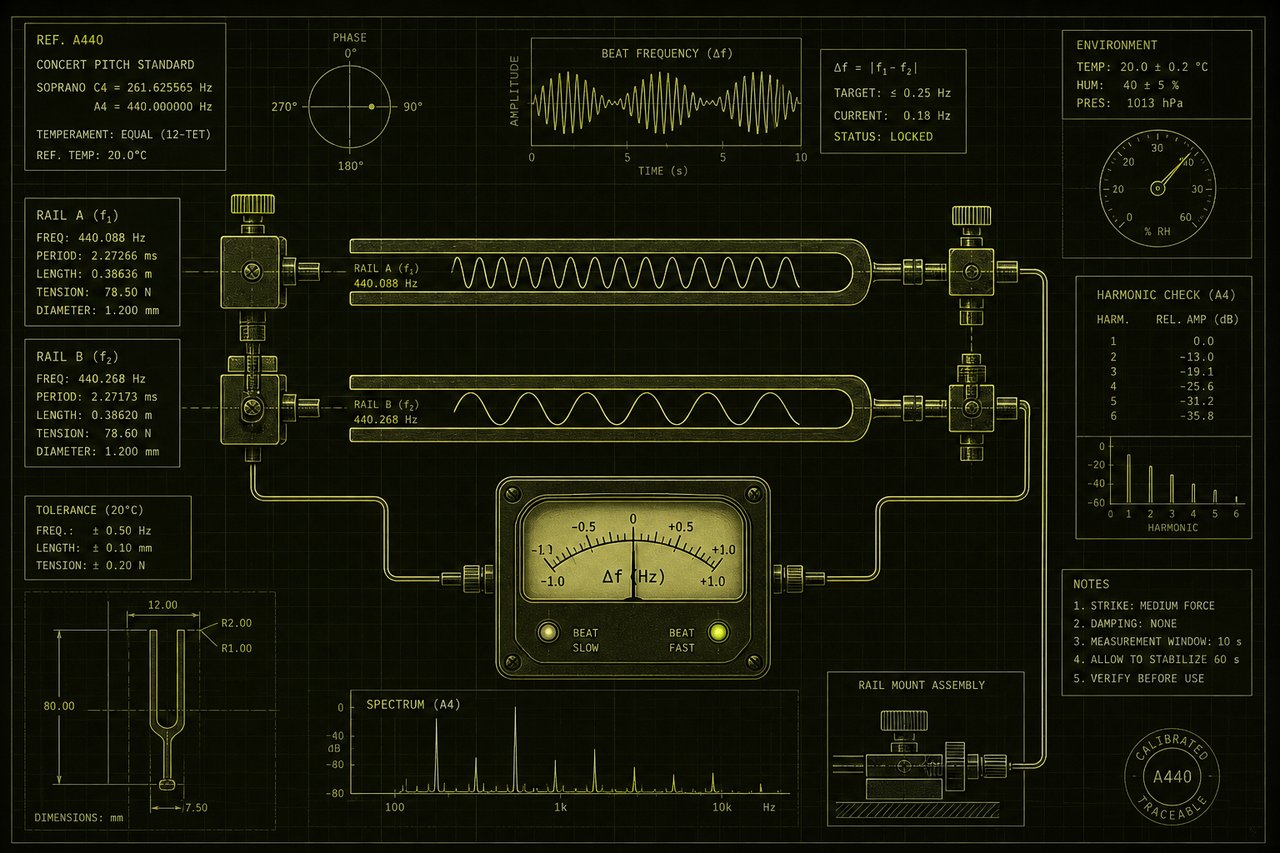
440 hertz is the other number for that same note A. Most bands and phone tuners use it. In 1939 a standards group picked 440 so rooms could match, and a later standard called ISO 16 wrote that number down. ISO is a group that writes shared rules so people in different countries can match.
If you press play on a normal track, you are probably hearing 440.
What is the difference?
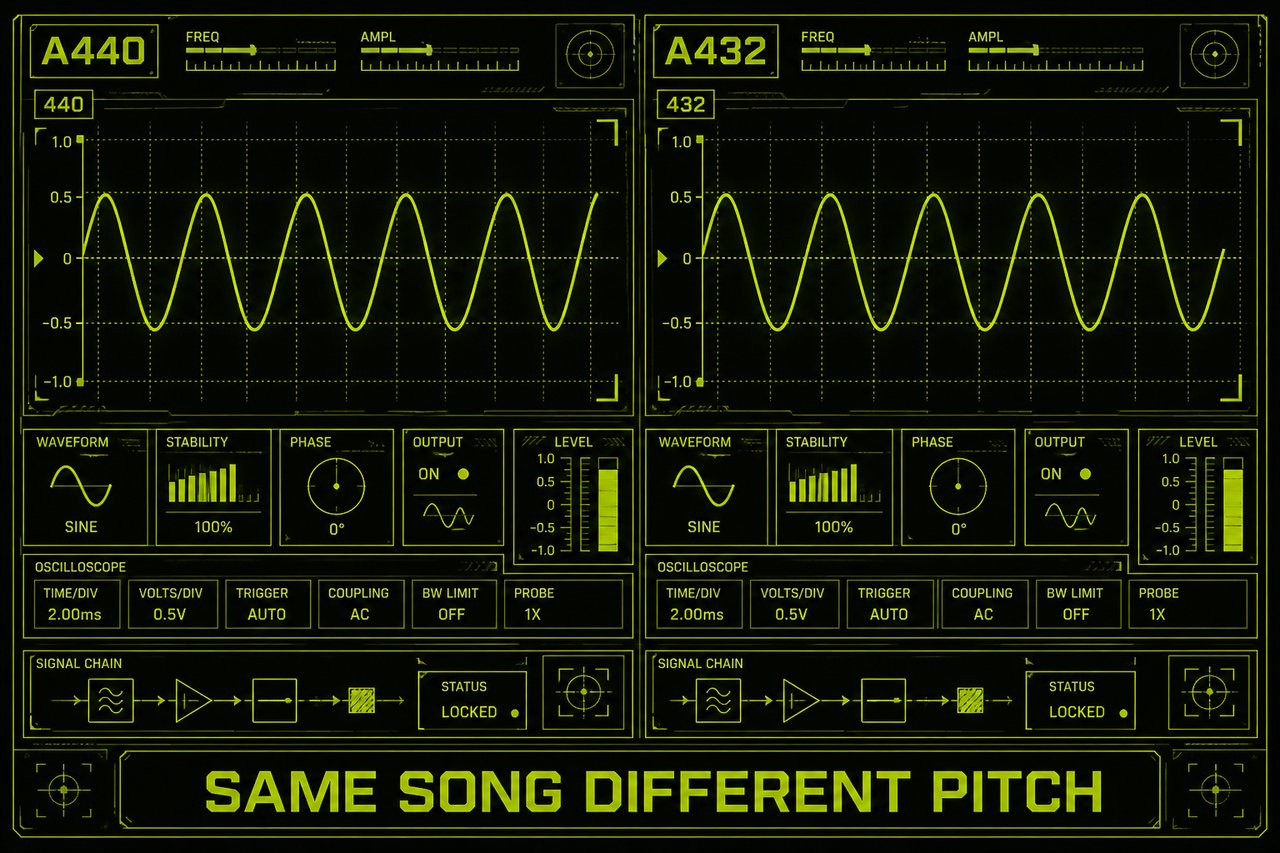
Both numbers name the same A. 440 is the common standard and 432 is a little lower, with a gap of eight shakes a second. When A drops, the other notes drop with it, so you still hear the same song and the whole track just sits a little lower.
Shop pages like to talk about eight hertz, which is just 440 minus 432. Some pages call those eight shakes a universe secret. You can want the lower tuning without buying that story.
In May 2026, The Independent ran remarks from Susan Rogers, a record producer who called the claim that 432 is the frequency of the universe nonsense. That is news coverage, and it does not tell you what your pulse does when you listen.
If you already use binaural beats, each ear gets a different tone. This page is about the note A on a whole song.
What did people measure?
Diletta Calamassi and her group asked people to sit with the same tracks for twenty minutes, one pass at 432 and the other pass at 440. They used the same songs on purpose so the tune itself could not be the difference. Thirty-six people signed up and three left, so thirty-three finished. People heard both versions and did not know which was which, which researchers call a double-blind cross-over. They hid the labels so a person could not pick the version they wanted to win.
Pulse is how many times the heart beats in one minute, and you can feel that count on your wrist. After the 432 versions, pulse was down 4.79 beats per minute, about five fewer beats each minute. Blood pressure stayed about the same, and breathing rate moved a little, but they said the breathing change was too small to trust. They measured a body, and they never tested DNA.
Aravena and his group played music for people having a tooth pulled. Forty-two people sat in the rooms, fifteen on 432 and fifteen on 440, while twelve sat in quiet. Both music rooms cut dental worry more than silence. They scored that worry with a questionnaire dentists use for fear of the chair. Cortisol is a stress hormone you make more of when you are wound up, and you can measure it in spit. Spit cortisol was lower after 432 than after 440.
Calamassi came back later with nurses who work in the emergency room, people who already have a hard shift. Fifty-four people walked through the rooms, and the group assigned the music at random eighty-three times. They used STAI, a worry questionnaire, and worry scores fell after the music. They also fell after a plain break with no music. Only the 432 room also dropped breathing rate by 2.714 breaths and the top blood-pressure number by 3.821. The top number is the first one you hear on a cuff, the squeeze from the heart. A break already lowers the worry score.
Di Nasso and his group played 432 for a hundred people during a long repair inside a tooth. The other group sat in silence, and they never ran 440. That paper compares 432 to quiet, so you cannot use it as a 432-versus-440 win.
Does 432 heal DNA?
These papers measured pulse and spit, and they never opened a cell to look at DNA.
People still make big claims, and you can keep the track you like. The DNA claim is a separate story from what they measured.
What should you try tonight?
Keep the 432 track if you already like it, and if you want a number of your own, play the same song both ways. Write your pulse before you start, and write it again when the song ends.
One minute on your wrist is enough, so use 432 on one night and 440 on another, with the same song and the same chair, and then you have two numbers that belong to you.
You do not need a lab for that, and you do not need to drop the 432 track if a shop promised more than a pulse change.
What do you do with 432 now?
You came here because you already like that lower sound. You wanted the drop from 440 to 432 to mean something big. That is a fair thing to want.
The people who ran the tests measured a body in a chair. Pulse slowed. The stress hormone in spit dropped. Nobody in those tests looked at DNA.
Keep the 432 track. If you want a number of your own, play the same song both ways and write your pulse before and after. You can keep the lower tuning without believing a shop that sold you a universe secret.
Sources
Calamassi, D., & Pomponi, G.P. “Music Tuned to 440 Hz Versus 432 Hz and Health.” Explore 15(4):283-290 (2019). Double-blind cross-over, 36 enrolled, 3 dropout, 33 finished. Same tracks for 20 minutes at 432 vs 440. Heart rate −4.79 bpm, p=0.05. Blood pressure was too small a change to call. Breathing rate p=0.06. They did not measure DNA. doi.org/10.1016/j.explore.2019.04.001
Aravena, P.C., Almonacid, C., & Mancilla, M.I. “Effect of music at 432 Hz and 440 Hz on dental anxiety and salivary cortisol.” Journal of Applied Oral Science (2020). 42 people (15/15/12) during tooth extraction. Both musics cut Corah dental-anxiety versus silence. Salivary cortisol lower at 432 than 440. doi.org/10.1590/1678-7757-2019-0601
Calamassi, D., et al. “Music tuned to 432 Hz versus music tuned to 440 Hz for reducing stress in emergency nurses.” Acta Biomedica (2022). Emergency nurses. 54 people and 83 randomizations. STAI fell in all three arms. Only 432 dropped breathing rate −2.714 and systolic blood pressure −3.821. A break lowers STAI as well. doi.org/10.23750/abm.v93iS2.12915
Di Nasso, L., et al. “Influences of 432 Hz music on the perception of anxiety during endodontic treatment.” Journal of Endodontics (2016). 100 people. Control is silence, not 440, so do not treat this as a 432-versus-440 win. doi.org/10.1016/j.joen.2016.05.015
ISO 16 / 1939 ISA. A=440 is the standard concert pitch, which is standards history. iso.org/standard/3601.html
Associated Press / The Independent, 28 May 2026. Susan Rogers called the universe-frequency claim nonsense, which is coverage rather than a mechanism paper. independent.co.uk/life-style/health-and-families/432-hertz-music-alternate-tuning-b2985296.html