schumann resonance · 7.83 hz · earth cavity
Schumann resonance is a pulse the Earth already has. Lightning rings it in the sky.
You wanted the Earth to have a pulse you could feel.
Lightning rings a pulse in the space between the ground and the charged layer of sky. People call that pulse Schumann resonance. Hertz, written Hz, is how many times something cycles in one second, so when people write the first ring near 7.83 Hz they mean about eight cycles each second. That ring is electromagnetic, which means it is a field, and a magnetometer is a tool that measures a magnetic field, which is the kind of tool that reads this pulse. You can still listen to a 7.83 Hz file if you want.
What is Schumann resonance?
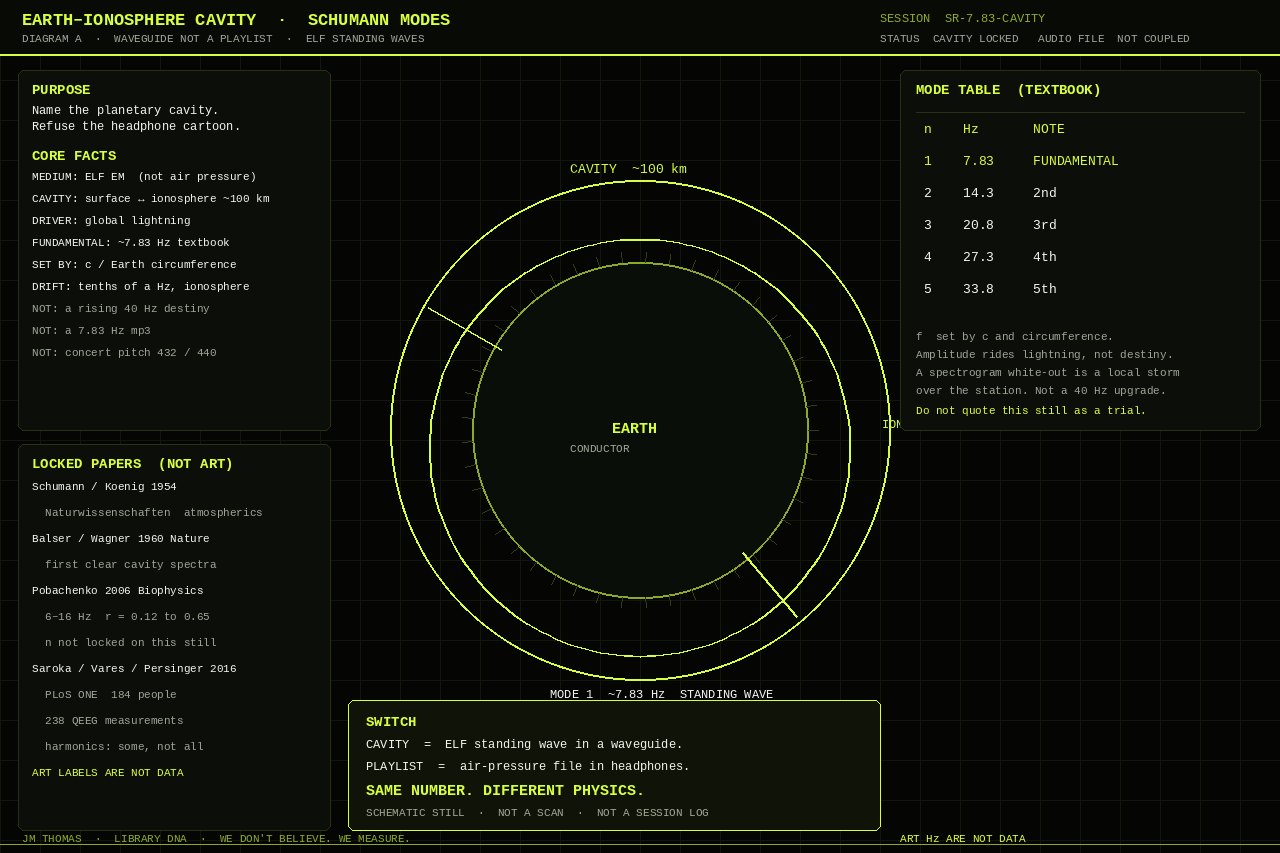
Schumann resonance is a set of standing waves around the planet, and a standing wave is a wave that fits the space and stays. The ionosphere is the charged layer of sky. The cavity, also called a waveguide, is the space between the ground and that sky layer, and lightning is the pump that puts energy into that room. ELF means extremely low frequency, which is a slow electromagnetic wave, a field that cycles only a few times each second.
W.O. Schumann wrote the theory in 1952 in a journal called Z. Naturforsch, and he described a conducting-sphere cavity, which is a ball that electricity can move on. The Earth is that ball. He described an air layer and a charged sky around that ball, and lightning keeps putting energy into that room. A wave that fits the trip around the planet stays in the room. People who wanted the Earth to have a pulse were already pointing at a real cavity.
Why is Schumann resonance near 7.83 Hz?
Hertz is cycles per second. Light goes around the planet in a set time, and a wave that fits that trip once lands near 7.83 Hz because the speed of light and the size of the planet set that fit. People write the textbook number near 7.83 because that is the size of the room. The planet already rings that number.
Schumann and Koenig wrote in 1954 about atmospherics at the lowest frequencies, which are radio pops from lightning. They watched those slow pops. The 1952 paper names the theory of the cavity, and Schumann and Koenig listened to the lightning that pumps it.
Who first measured Schumann resonance?
M. Balser and C.A. Wagner published in Nature in 1960, and Nature is a science journal. They worked at Lincoln Laboratory at MIT, the Massachusetts Institute of Technology, and they pulled the cavity spectrum out of the radio noise. A spectrum is the set of frequencies in a signal. Their paper is the first Nature record of that cavity, and they cited Schumann's 1952 theory as the map they used.
People who wanted a pulse they could feel can keep that name. Balser and Wagner pulled that pulse out of radio noise at their lab.
Do brain waves move with Schumann resonance?
S.V. Pobachenko, A.G. Kolesnik, A.S. Borodin, and V.V. Kalyuzhin published in Biophysics in 2006, and they watched the cavity and the brain at the same time. That is synchronized monitoring, which means two records taken together, and they watched the 6 to 16 Hz band. An EEG is a record of brain electrical activity.
Cross-correlation is how much two records rise and fall together, and their cross-correlation ran from 0.12 to 0.65. They marked that range at alpha 0.95, a cutoff they used for the match. A low number means the two records barely moved together, and a higher number means they moved together more. They saw that match follow solar and geomagnetic activity, which is weather from the sun and weather in Earth's magnetic field. Saroka later called the sample small. They did not write how many people sat.
What did Saroka find in people's brain records?
Kevin Saroka, David Vares, and Michael Persinger published in PLoS ONE in 2016, an open science journal, and they took 238 measurements from 184 people. QEEG is a quantitative EEG, a numbered record of brain electrical activity.
They could see the first, second, and third Schumann harmonics in averaged QEEG profiles in some people, not all. A harmonic is a higher ring of the same cavity. An averaged profile is a record they stacked so they could see a shared shape. In later sessions, the two records lined up for about 300 milliseconds, and a millisecond is one thousandth of a second, so that time is three-tenths of a second.
Can I still listen to a 7.83 Hz file?
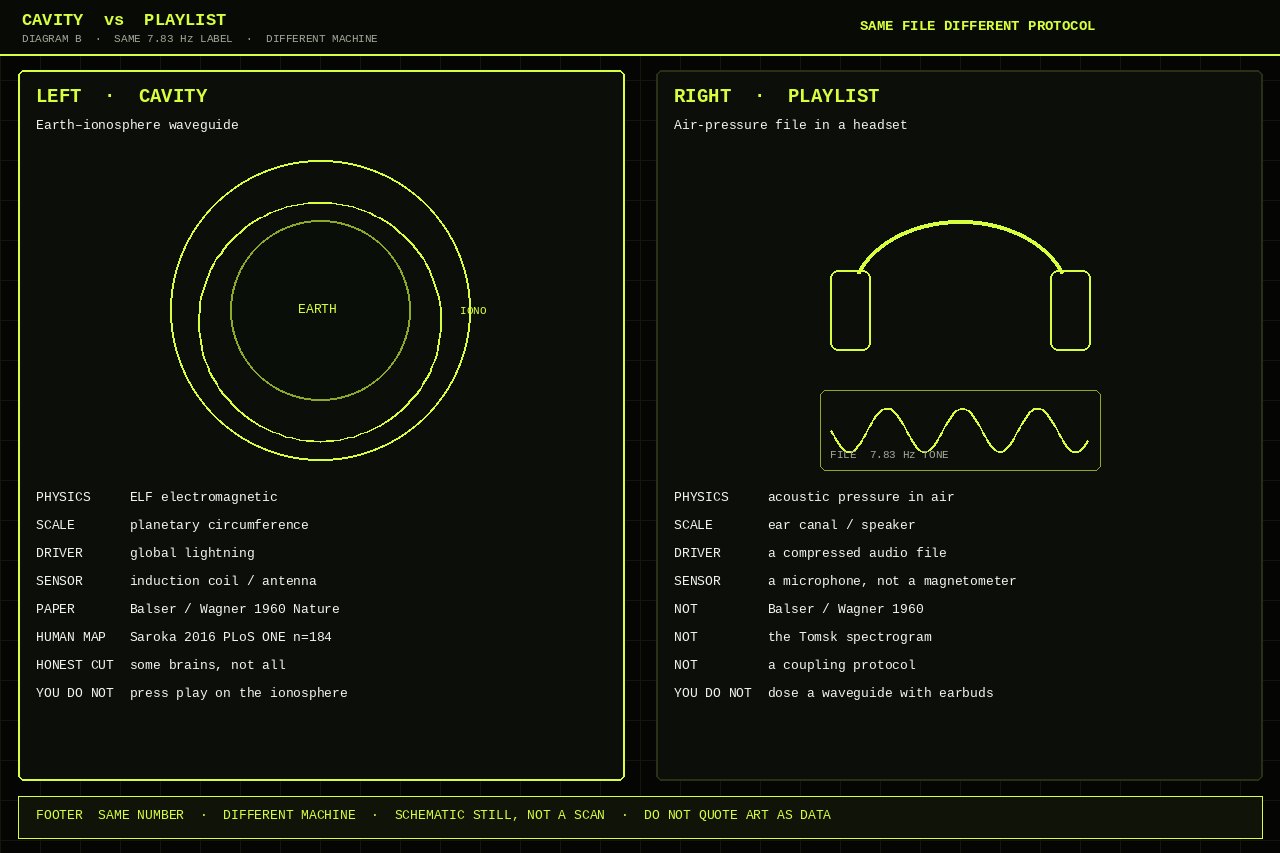
Yes. You can still put the file on if you like the sound. Headphones play air pressure, which is sound that moves your eardrum, while Schumann resonance is electromagnetic in a cavity. A magnetometer reads that cavity. You can play a file with the same number. The planet already rings that cavity without the file.
Is Schumann resonance the same as 432 Hz?
432 Hz and 440 Hz are two ways people tune the note A, and concert pitch is the note orchestras use to tune. You can read that story on the 432 Hz page. 40 Hz is forty cycles a second, a different brain-wave story, and you can open the 40 Hz page if you want it. Schumann resonance is a cavity the planet already rings.
If thinking about Earth pulses or brain records distresses you, talk to a clinician.
What do you do with this now?
You wanted the Earth to have a pulse you could feel. Keep calling it the Earth's pulse.
The number near 7.83 Hz is a cavity the planet already rings. You can still listen to a 7.83 file if you want. Headphones move air against your eardrum. The cavity is an electromagnetic field in the sky. The pulse you wanted is already ringing up there.
Sources
Schumann, W.O. "Über die strahlungslosen Eigenschwingungen einer leitenden Kugel, die von einer Luftschicht und einer Ionosphärenhülle umgeben ist." Z. Naturforsch. 1952, volume 7A, page 149. Theory of the conducting-sphere cavity. Cited as the theory paper by Balser and Wagner 1960.
Schumann, W.O., Koenig, H. Atmospherics at the lowest frequencies. Naturwissenschaften 1954.
Balser, M., Wagner, C.A. "Observations of Earth-ionosphere cavity resonances." Nature 1960, volume 188, pages 638-641. Lincoln Laboratory, MIT. First Nature extraction of the cavity spectrum from the noise. doi.org/10.1038/188638a0
Pobachenko, S.V., Kolesnik, A.G., Borodin, A.S., Kalyuzhin, V.V. "The contingency of parameters of human encephalograms and Schumann resonance electromagnetic fields revealed in monitoring studies." Biophysics 2006, volume 51, pages 480-483. Synchronized monitoring in the 6-16 Hz band. Cross-correlation 0.12 to 0.65 at alpha 0.95. Contingency tracked solar and geomagnetic activity. Saroka later called the sample small. How many people sat stays open here. doi.org/10.1134/S0006350906030225
Saroka, K.S., Vares, D.E., Persinger, M.A. "Similar spectral power densities within the Schumann resonance and a large population of quantitative electroencephalographic profiles." PLoS ONE 2016, volume 11, issue 1, article e0146595. 238 measurements from 184 individuals. First, second, and third Schumann harmonics were discernible in averaged QEEG profiles in some but not all participants. Real-time coherence in the follow-on sessions lasted about 300 ms. doi.org/10.1371/journal.pone.0146595