tai chi · Parkinson's · Oregon
Tai chi improved Parkinson's balance more than a weight vest.
You wanted the lean you can keep when you step.
Tai chi is slow practice that shifts your weight. Parkinson's is a disease that makes it hard to start and keep a step. A weight vest is a vest you wear so the load climbs. Keep the tai chi name.
What is tai chi?
Tai chi is slow practice that shifts your weight. You move slowly, and you feel where your weight sits before you take the next step. People use that word for many forms. This page uses the word the way this Oregon class used it.
You wanted the lean you can keep when you step. People who practice those slow shifts can learn that lean before they walk.
What is Parkinson's?
Parkinson's is a disease that makes it hard to start and keep a step. Idiopathic Parkinson's means the disease started on its own, not from another known cause. Hoehn and Yahr is a 1-to-4 stage of how far Parkinson's has gone.
What is a weight vest?
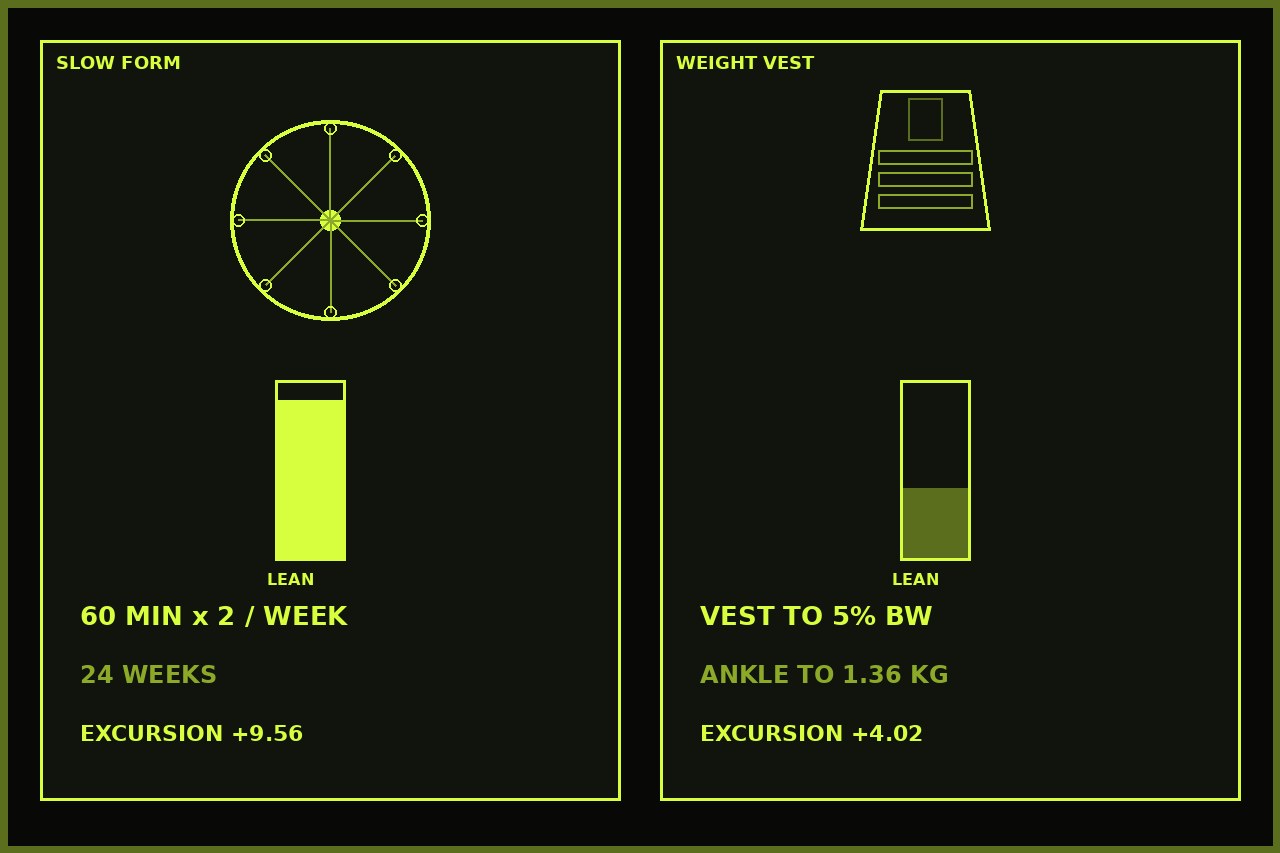
A weight vest is a vest you wear so the load climbs. In this file, people in the resistance class wore progressive weighted vests toward 5 percent of body weight, plus ankle weights. People who wore the vest still built strength.
Does tai chi improve Parkinson's balance more than a weight vest?
Fuzhong Li, Peter Harmer, Kathleen Fitzgerald, Elizabeth Eckstrom, Ronald Stock, Johnny Galver, Gianni Maddalozzo, and Sara Batya published this paper in 2012. The journal is the New England Journal of Medicine, a medical journal. They ran the same trial in Eugene, Corvallis, Salem, and Portland, Oregon. The people who scored the tests did not know which class a person had joined. You can read the paper at doi.org/10.1056/NEJMoa1107911.
The title of the paper is “Tai Chi and Postural Stability in Patients with Parkinson's Disease.”
Doctors enrolled 195 older adults with idiopathic Parkinson's, ages 40 to 85. Doctors used Hoehn and Yahr stages 1 to 4. Eighty-four percent were stage 2 or higher. The median stage, the middle number, was 2.5. People needed 24 or higher on the Mini-Mental State Examination, a short thinking test.
They picked people by chance. Sixty-five people joined tai chi. Their average age was 68. Sixty-five people joined resistance, the vest class. Their average age was 69. Sixty-five people joined stretching. Their average age was 69. People met for 60 minutes, two times a week, for 24 weeks. That is 48 sessions. People came to a median of 39 sessions. One hundred seventy-six people finished.
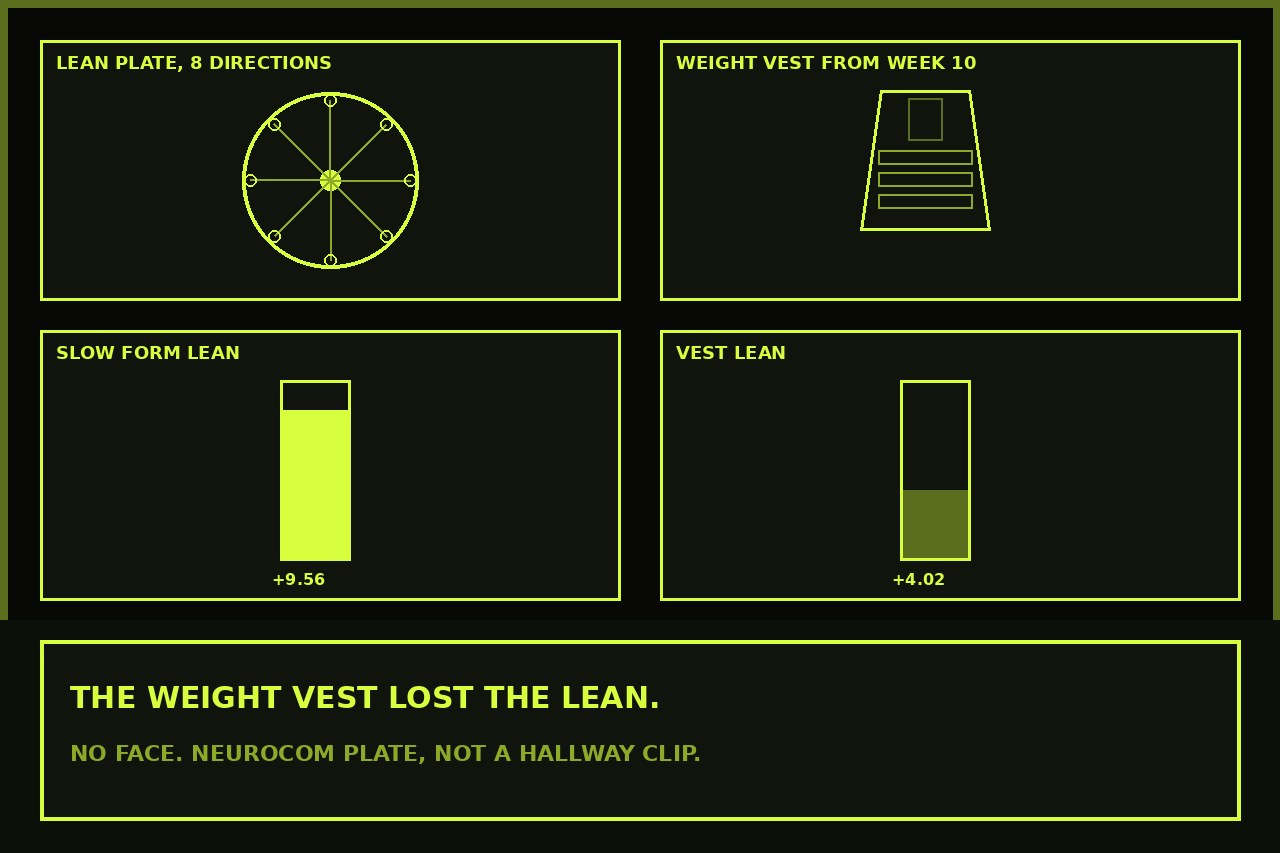
The NeuroCom Balance Master is the plate that measured the lean. The team used that plate at 6 months.
What is maximum excursion?
Maximum excursion is how far you can lean without falling. People who practiced tai chi moved from 64.05 to 73.62, a gain of 9.56, with a p value under 0.001. A p value tells you how often a gap this big would show up if the groups were the same. People who wore the vest moved from 64.02 to 68.03, a gain of 4.02, with a p value of 0.02. People who stretched dropped 2.41. People who practiced tai chi gained 5.55 more than people who wore the vest. The 95 percent confidence interval, the range the team printed for that gap, was 1.12 to 9.97, and the p value was 0.01. People who practiced tai chi gained 11.98 more than people who stretched, with a p value under 0.001.
What is directional control?
Directional control is how straight that lean travels. People who practiced tai chi gained 8.02, with a p value under 0.001. People who wore the vest dropped 2.43, with a p value of 0.35. People who stretched dropped 3.37. People who practiced tai chi gained 10.45 more than people who wore the vest, with a p value of 0.002.
People who practiced tai chi also took longer steps. Stride length is how long one step is. People who practiced tai chi gained 10.3 centimeters. People who wore the vest gained 4.3 centimeters. Functional reach is how far you can reach forward without taking a step. People who practiced tai chi gained 5.0 centimeters. People who wore the vest gained 2.2 centimeters.
Did people who wore the vest still get stronger?
People who wore the vest still built strength. Knee extension torque is how hard you can straighten your knee. People who wore the vest gained 14.6 on that score. People who practiced tai chi gained 13.9. The two groups did not differ in a meaningful way on that score.
UPDRS-III is a motor score doctors use for Parkinson's. People who practiced tai chi dropped 6.42 on that score. People who wore the vest dropped 5.07. The two groups did not differ in a meaningful way there either.
Did tai chi cut falls in people with Parkinson's?
People logged 381 falls in all, across 76 people. People who practiced tai chi logged 62 falls, a rate of 0.22 per month. People who wore the vest logged 133 falls, a rate of 0.51 per month. People who stretched logged 186 falls, a rate of 0.62 per month. An incidence rate ratio compares how often two groups fall. That ratio was 0.47 for people who practiced tai chi, next to people who wore the vest, with a p value of 0.05 at 24 weeks. At the 3-month follow-up, that ratio was 0.40, with a p value of 0.02.
In class, people fell 2 times in tai chi, 4 times in resistance, and 5 times in stretching. One person in tai chi reported muscle soreness, four people in resistance reported it, and one person in stretching reported it. Nobody had a serious adverse event.
People who took the class knew which class they had joined. The team did not include a group that did no exercise. The team scored people while they were on their Parkinson's medicine.
If you feel unusual distress, or you need Parkinson's care, talk to a clinician, because this page is educational.
If you want the mindfulness page, open the mindfulness page.
Can you still want the lean you keep when you step?
You wanted the lean you can keep when you step. Keep the tai chi name.
People with Parkinson's who practiced tai chi leaned farther on the plate than people who wore the vest. People who wore the vest still built strength. You can still want the lean you keep when you step.
Sources
Li F., Harmer P., Fitzgerald K., Eckstrom E., Stock R., Galver J., Maddalozzo G., Batya S.S. “Tai Chi and Postural Stability in Patients with Parkinson's Disease.” New England Journal of Medicine 2012, 366(6), 511-519. DOI 10.1056/NEJMoa1107911. PMID 22316445. PMC 3285459. ClinicalTrials.gov NCT00611481. Grant NINDS NS047130. Multicenter randomized controlled trial, Eugene, Corvallis, Salem, Portland, Oregon. Outcome assessors blinded. 195 older adults with idiopathic Parkinson's, Hoehn and Yahr 1-4, Mini-Mental State Examination 24 or higher, age 40-85, 84 percent stage 2 or higher, median stage 2.5. Tai Chi n=65 mean age 68, Resistance n=65 mean age 69, Stretching n=65 mean age 69. 60-minute classes, 2 times per week, 24 weeks, 48 sessions. Median attendance 39. 176 completed. NeuroCom Balance Master at 6 months. Maximum excursion: Tai Chi +9.56 (64.05 to 73.62, p under 0.001). Resistance +4.02 (64.02 to 68.03, p=0.02). Stretching -2.41. Tai Chi vs Resistance +5.55 (95% CI 1.12-9.97, p=0.01). Tai Chi vs Stretching +11.98, p under 0.001. Directional control: Tai Chi +8.02, p under 0.001. Resistance -2.43, p=0.35. Stretching -3.37. Tai Chi vs Resistance +10.45, p=0.002. Secondary: stride length +10.3 cm Tai Chi vs +4.3 Resistance. Functional reach +5.0 vs +2.2. UPDRS-III -6.42 vs -5.07 (NS between). Knee extension torque +13.9 vs +14.6 (NS). Vest still built strength. Falls: 381 total, 76 people. Tai Chi 62 falls, 0.22/month. Resistance 133, 0.51/month. Stretching 186, 0.62/month. Tai Chi vs Resistance IRR 0.47, p=0.05 at 24 weeks, 0.40, p=0.02 at 3-month follow-up. In-class falls 2/4/5. Muscle soreness 1/4/1. Zero serious adverse events. Limitations: unblinded participants, no non-exercise control, assessments on-medication only. Resistance used progressive weighted vests toward 5 percent of body weight, plus ankle weights. doi.org/10.1056/NEJMoa1107911 · pubmed.ncbi.nlm.nih.gov/22316445 · PMC3285459 · clinicaltrials.gov/study/NCT00611481
Li F., Harmer P., Liu Y., Eckstrom E., Fitzgerald K., Stock R., Chou L.S. “A randomized controlled trial of patient-reported outcomes with tai chi exercise in Parkinson's disease.” Movement Disorders 2014, 29(4), 539-545. DOI 10.1002/mds.25787. PMID 24375468. PMC 3976742. Secondary analysis of the same NCT00611481 trial. PDQ-8 neighbor. doi.org/10.1002/mds.25787 · pubmed.ncbi.nlm.nih.gov/24375468 · PMC3976742