lion's mane · memory · yokohama
Lion's mane raised memory scores until the pills stopped.
You wanted the word to come back while the bottle lasted.
Lion's mane is a shaggy white mushroom. People also call it Yamabushitake or Hericium erinaceus. The word is a name you already knew and then could not find. Keep the lion's mane name.
What is lion's mane?
Lion's mane is a shaggy white mushroom. The Japanese name in this file is Yamabushitake. The Latin name is Hericium erinaceus. People dry that mushroom and press the powder into tablets.
Baum asked if lion's mane helps the brain in Men's Fitness on 14 August 2026. You can read that neighbor piece at mensfitness.co.uk/features/lions-mane-is-great-for-the-brain-but-does-it-actually-work. You can still want the word to come back while the bottle lasts.
What is mild cognitive impairment?
Mild cognitive impairment means memory scores are already a little low, not dementia. The people in this file were Japanese men and women from fifty to eighty years old. They scored 22 to 25 out of 30 before the pills.
The test in this file is based on HDS-R, a 30-point memory and thinking test used in this file. Doctors used 28 points from that test and added a 2-point clock drawing. People drew a clock worth 2 points, and the full score was 30.
Yokohama is the city where they ran it, at Isogo Central and Neurosurgical Hospital.
Does lion's mane help memory?
Koichiro Mori, with Inatomi, Ouchi, Azumi, and Tuchida, published this paper in 2009 in Phytotherapy Research, a medical journal. Mori worked at the Mushroom Laboratory at Hokuto Corporation in Nagano, and he listed Tohoku University as the place to write him. You can read the paper at doi.org/10.1002/ptr.2634.
They watched people for 22 weeks in all. Doctors used 2 weeks before the pills to see starting scores. People then took tablets for 16 weeks. After that they spent 4 weeks off the pills and came back.
Doctors picked 30 people by chance. Fifteen people got the mushroom, and fifteen people got a placebo, which is a matching tablet with no mushroom. Neither the people nor the doctors knew who got which tablet. One person left at week 4 with stomach discomfort, so doctors then counted 29 people, 14 on the mushroom and 15 on the placebo.
People on the mushroom scored higher as the weeks went on. The team used a test that compares two groups across many weeks. That test is a two-way repeated measures ANOVA. A p value tells you how often a gap this big would show up if the groups were the same. The gap between the groups had a p value under 0.001. The gap across the weeks had a p value under 0.001. The way the groups changed across weeks had a p value under 0.001.
At week 8, week 12, week 16, and after 4 weeks off the pills, people on the mushroom scored higher than people on the placebo.
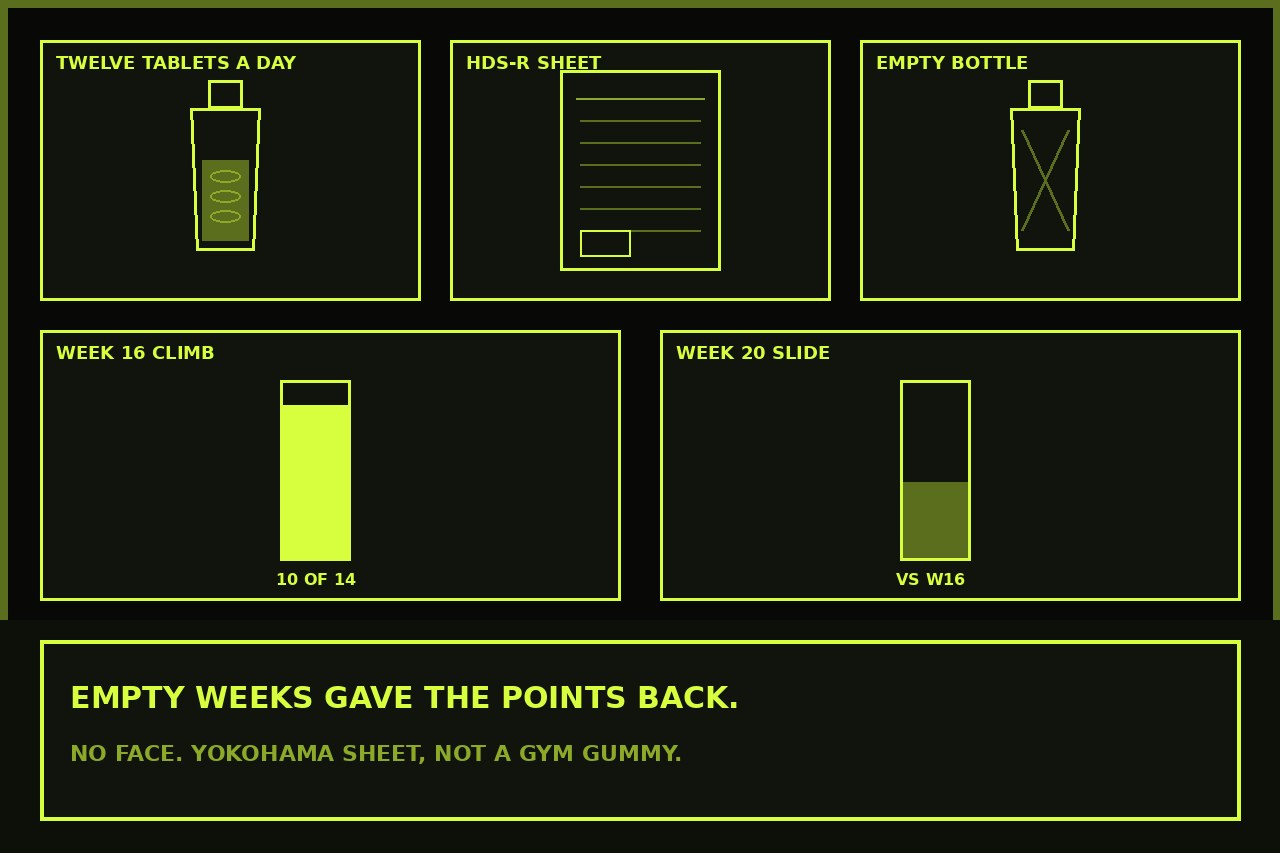
In Figure 2 the authors compared week 16 with the start. Ten of the 14 people on the mushroom gained 3 or more points, which is 71.4 percent. One of the 15 people on the placebo gained 3 or more points, which is 6.7 percent. Three people on the mushroom gained 2 points, and one person on the placebo gained 2 points. One person on the mushroom stayed about the same, and thirteen people on the placebo stayed about the same. Nobody in either group dropped 2 or more points.
How much lion's mane did people take?
The mushroom tablets were 250 milligrams each. A milligram is a tiny unit of weight. Those tablets were 96 percent Yamabushitake dry powder. People took four tablets three times a day. That dose is 3 grams a day. A gram is a thousand milligrams, so 3 grams is 3000 milligrams. Doctors made the placebo from cornstarch, lactose, and caramel.
What happened when people stopped taking lion's mane?
The scores climbed while they took the mushroom. Then people spent 4 weeks with no pills.
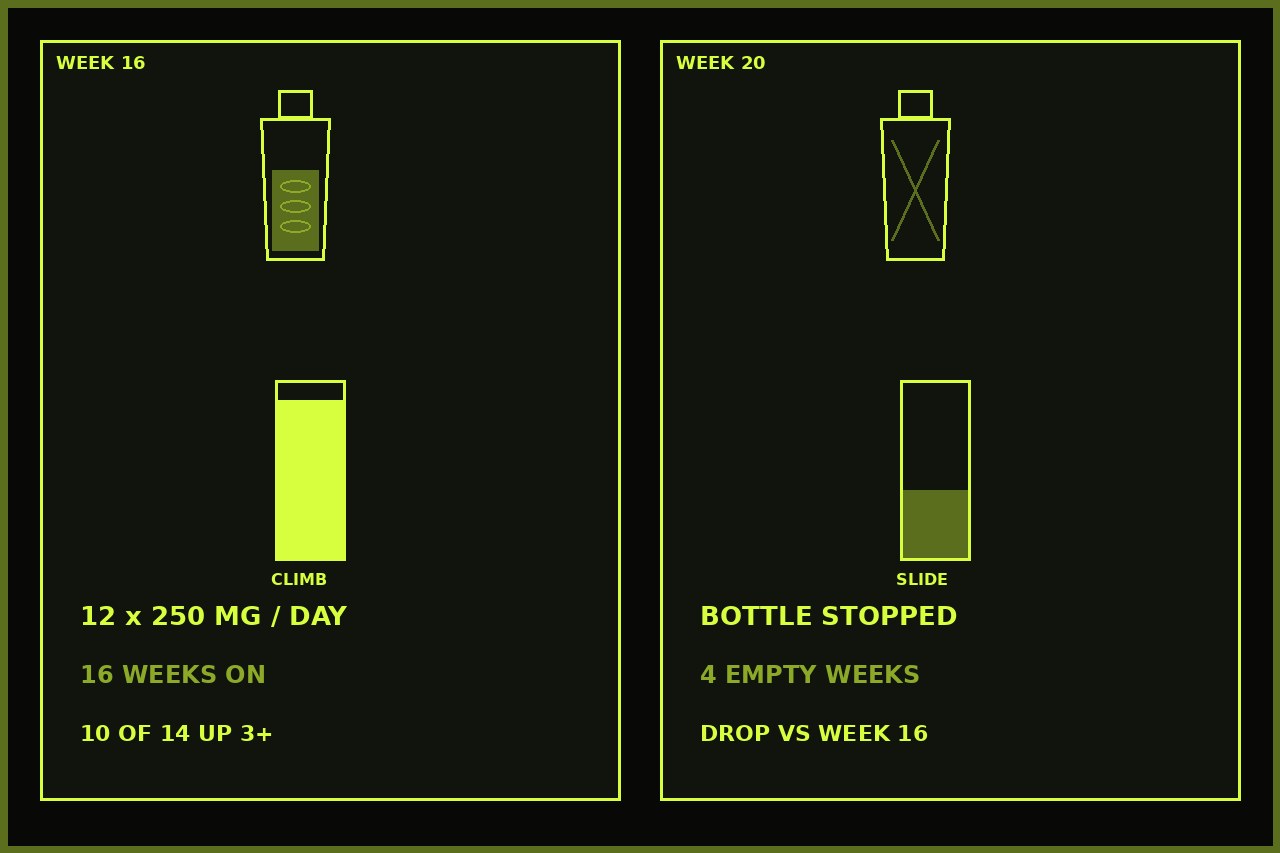
They came back to the clinic and took the same 30-point test. People on the mushroom scored lower after those 4 weeks off the pills, next to their week 16 scores. That drop had a p value under 0.001. Four weeks off the pills and the lift was gone.
People on the mushroom still scored higher than people on the placebo at that return visit. They had gained those points while they took the powder.
Seven people on the mushroom had mild gut days. Six people on the placebo had mild gut days. The authors said the group was small. They showed average scores on a figure and did not print a table of those averages. People on the placebo also scored higher than they had at the start. Hokuto made the tablet in its own lab.
The authors named hericenones and erinacines as NGF promoters in rodent astrocytes. Rodent astrocytes are star-shaped support cells in rats and mice. NGF is a growth signal for nerve cells. The authors left the human-cell lock open, which means they left open whether that same path holds in human cells. Keep that rodent note next to the human scores.
If the mushroom brings unusual distress, talk to a clinician, because this page is educational.
If you want the sauna page, open the sauna page.
Can you still want the word to come back while the bottle lasts?
You wanted the word to come back while the bottle lasted. Keep the lion's mane name.
The scores climbed while they took the mushroom. Four weeks off the pills and the lift was gone. You can still want the word to come back while the bottle lasts.
Sources
Mori K., Inatomi S., Ouchi K., Azumi Y., Tuchida T. “Improving Effects of the Mushroom Yamabushitake (Hericium erinaceus) on Mild Cognitive Impairment: A Double-blind Placebo-controlled Clinical Trial.” Phytotherapy Research 2009, 23, 367-372. DOI 10.1002/ptr.2634. PMID 18844328. Mushroom Laboratory, Hokuto Corporation, Nagano. Isogo Central and Neurosurgical Hospital, Yokohama. Correspondence: Koichiro Mori, Tohoku University. 50-to-80-year-old Japanese men and women with mild cognitive impairment, prelim scores 22 to 25 out of 30 on a scale based on HDS-R. 2 weeks preliminary, 16 weeks intake, 4 weeks follow-up, 22 weeks total. Randomized 30, 15/15. Analyzed 29, 14 mushroom / 15 placebo. One withdrawal at week 4, stomach discomfort. Test food: 250 mg tablets, 96 percent Yamabushitake dry powder, four tablets three times a day = 3 grams a day. Placebo: cornstarch, lactose, caramel. Scale: HDS-R cut to 28 plus 2-point clock drawing, total 30. Two-way repeated measures ANOVA: between-group p under 0.001, between-period p under 0.001, group-by-period p under 0.001. Weeks 8, 12, 16 and 4-week follow-up: mushroom higher than placebo. Mushroom scores rose with intake, then fell in the 4 weeks off the pills vs week 16, p under 0.001. Figure 2 week 16 vs start: 3-or-more-point gain 10 (71.4%) mushroom / 1 (6.7%) placebo. 2-point gain 3 / 1. Unchanged 1 / 13. No 2-or-more-point worsening in either arm. Gut days 7 mushroom / 6 placebo, mild. Limitations: small room, figure means without a printed mean table, placebo rise, sponsor-lab tablet, mechanism unproven in human cells. Hericenones and erinacines named as NGF promoters in rodent astrocytes, human-cell lock left open. Neighbor only. doi.org/10.1002/ptr.2634 · pubmed.ncbi.nlm.nih.gov/18844328 · europepmc.org/article/MED/18844328
Baum S. “Lion's Mane is the brain supplement everyone is talking about -but does it actually work?” Men's Fitness, 14 August 2026. Neighbor only. mensfitness.co.uk/features/lions-mane-is-great-for-the-brain-but-does-it-actually-work