Mechanism · Visual Mandela Effect · Shared False Memory
The Mandela Effect is a shared glitch. The hardware is reconstructive visual memory.
People type Mandela Effect when they want to know if the glitch is real. Prasad and Bainbridge 2022 Psychological Science measured the visual form of that glitch. Experiment 1, N=100 adults. Certain popular icons elicit consistent, specific false memories. The experience is shared. The hardware is reconstructive visual memory. Not a hopped CERN timeline. Translation, not a logo. We don't believe. We measure. The stills on this page are schematic.
I write from Paris, Tennessee. People send me a still and ask if the Mandela Effect is real. They already felt the glitch. They want the measurement without being told they are stupid. Those are hardware questions. I will answer the hardware. I will not attack the experience. I will not sell a hopped timeline as the file.
The gatekeeper said the universe jumped. CERN. A new archive. A file on disk that no longer matches the one you remember. The aisle said the opposite lie. Call the people who felt it delusional. Call a shared reconstruction a joke. Both hid the mechanism. Prasad and Bainbridge named a Visual Mandela Effect and locked it as shared, specific false memory. Reality Engineering is the science of making reality respond to intent. A glitch you can name is a glitch you can stop confusing with a hop. Yesterday's leftover mystery is today's engineering when you name the switch.
What is the Mandela Effect, in this stack?
The Mandela Effect is a shared, consistent false memory for a specific cultural icon. The name is internet weather. The measurement is that strangers land on the same wrong detail. Prasad and Bainbridge 2022 called the visual form of that glitch the Visual Mandela Effect. The hardware is reconstructive visual memory, not a hopped timeline. The stills are schematic. Do not quote leftover art text as data.
Mandela Effect, in this stack, is a search string. It is not a religion. It is not a bloodline. It is the query people type when a popular image in their head does not match the image on the page, and a stranger in another city names the same miss. The name is internet weather. The paper I opened called that weather an internet phenomenon: shared and consistent false memories for specific icons in popular culture. I will keep their sentence. I will not invent a stadium n for the forums that carried the name.
The job is the switch. A visual icon you have seen a hundred times. A memory that is not a file. A reconstruction that lands on the same wrong detail in more than one head. A clip stamped Mandela Effect proof the timeline hopped is not the measured switch on this page. I will not invent view counts for those files. I will not baptize a CERN rumor as a methods line.
Related reading: a miracle is an update the old model called impossible. That page owns prediction-error and Active Inference. This page owns shared reconstructive visual memory. I will not clone that article. One short mapping. Keep the pages apart or you will mash a false memory onto a Will.
The stills are schematic. They are not a logo. They are not a scan you can quote as data. If leftover footer text invents a hopped archive or a brand wordmark, I am ignoring it. Do not quote it. The protocol on this page is the paper I opened: Prasad and Bainbridge 2022, Psychological Science, Visual Mandela Effect as shared and specific false memories.
What is the Visual Mandela Effect?
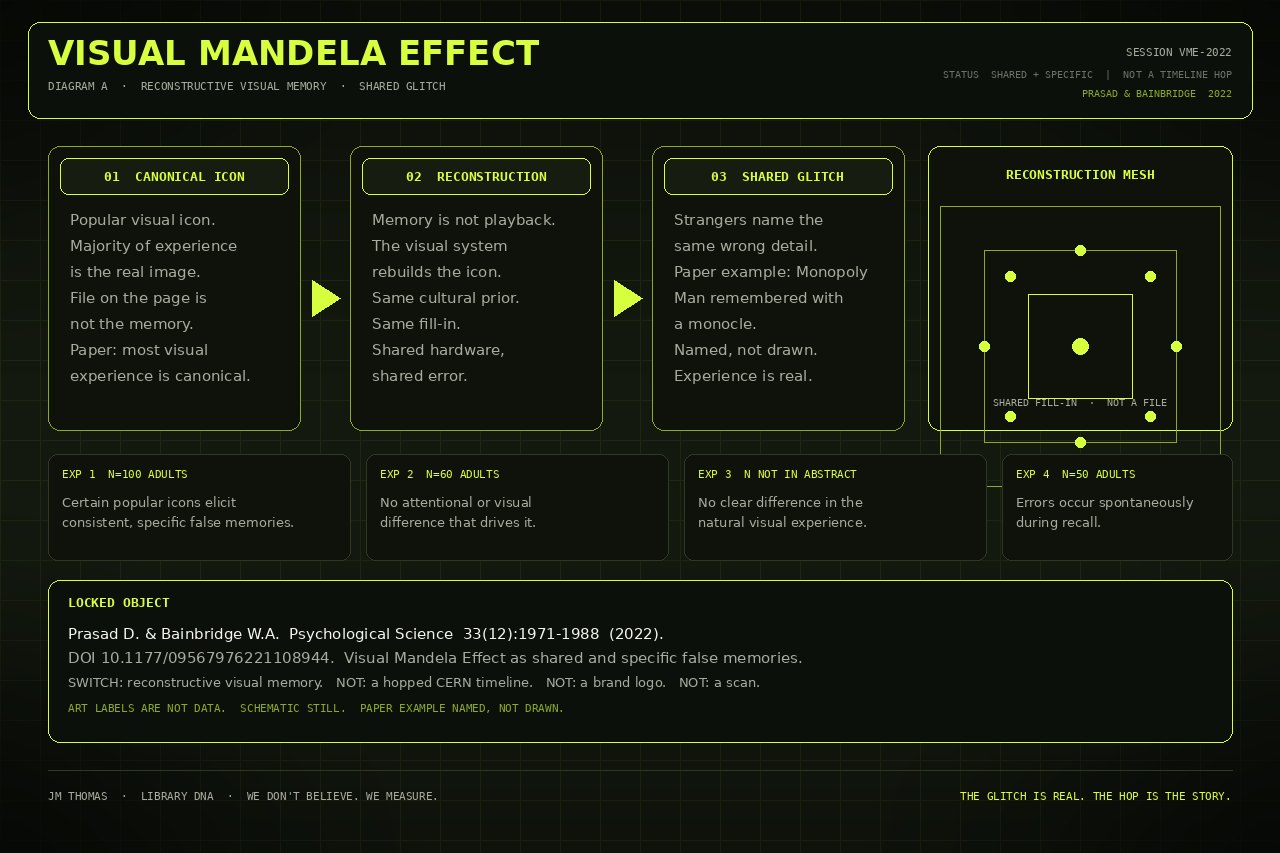
The Visual Mandela Effect is a Mandela Effect specific to visual icons. Prasad and Bainbridge 2022, Psychological Science 33(12):1971-1988. Their own example: the Monopoly Man is falsely remembered as having a monocle. I name that example. I do not draw the logo. Experiment 1, N=100 adults, showed that certain popular icons elicit consistent, specific false memories. The experience is the data. The cartoon is a hopped CERN archive.
The paper's own example is the one I will use. The Monopoly Man is falsely remembered as having a monocle. I name that sentence because they wrote it. I do not draw the man. I do not reproduce a wordmark. I do not hang other aisle icons on this page as if those were the locked file. The aisle has a list. Lists are weather. The locked object is a visual false memory that is shared and specific.
Shared means more than one person makes the same error. Specific means they do not just forget. They land on the same wrong feature. That pair is the whole cut. A private miss is ordinary memory. A shared, specific miss is the Visual Mandela Effect as they defined it. Experiment 1, N=100 adults, is the first lock on that pair.
Visual is the aisle this page owns. People also argue names, dates, and speeches. Those arguments are not this paper. I will not drag a political memory onto a visual-icon file and call it done. The Visual Mandela Effect is a picture in the head that disagrees with the picture on the page, in the same direction, across people.
Honest line. Popular iconography. Adults in a lab task. Not a census of the species. Not a proof that every forum example is the same machine. People already want their own glitch to be in the file. I will name the n they locked and refuse the cartoon that turns one paper into a universal hop.
What did Prasad and Bainbridge 2022 actually measure?
Prasad D. and Bainbridge W.A. The Visual Mandela Effect as Evidence for Shared and Specific False Memories Across People. Psychological Science 2022; 33(12):1971-1988. doi:10.1177/09567976221108944. Experiment 1, N=100 adults: certain images from popular iconography elicit consistent, specific false memories. Experiment 2, N=60 adults: no attentional or visual differences that drive the phenomenon. Experiment 3: no clear difference in the natural visual experience of these images. Experiment 3 n is not in the abstract I opened. I will not invent it. Experiment 4, N=50 adults: the errors also occur spontaneously during recall. Majority of visual experience is the canonical image.
Prasad, Deepasri, and Bainbridge, Wilma A. The Visual Mandela Effect as Evidence for Shared and Specific False Memories Across People. Psychological Science 2022. Volume 33. Issue 12. Pages 1971 to 1988. DOI 10.1177/09567976221108944. Department of Psychology, The University of Chicago. I opened the Association for Psychological Science page and the PsyArXiv record. I am using the n the abstract locked, not a content-farm rewrite.
Experiment 1. N=100 adults. The claim is the one people came here for. Certain images from popular iconography elicit consistent, specific false memories. Not a vague haze. A shared miss on a specific feature. That is the first lock. I will not invent a percent. I will not invent a list of icons beyond the example they wrote in the abstract. The Monopoly Man and the monocle is their sentence. I keep it as a name.
Experiment 2. N=60 adults. Eye-tracking-like methods. They found no attentional or visual differences that drive the phenomenon. Hear that cut. The easy story is that people never looked at the real feature, so they invented it. The paper I opened does not give you that out. The glitch is not a glance you skipped. I will keep that refusal. I will not invent fixation times they did not put in the abstract.
Experiment 3. No clear difference in the natural visual experience of these images. That is the second easy story dying. If the world already showed you the wrong version more often than the right one, the miss would be a training set, not a reconstruction. They did not find a clear difference of that kind. Experiment 3 n is not in the abstract I opened. I will not invent it. The locked sentence is the one they wrote: no clear difference in the natural visual experience.
Experiment 4. N=50 adults. The errors also occur spontaneously during recall. This is the cut that stops a forced-choice cartoon. The miss is not only what happens when you pick among edited stills. It shows up when the person reconstructs the icon from inside. Recall. Spontaneous. Shared. Specific. That is a reconstructive system doing what reconstructive systems do, in public, on a popular picture.
The last sentence of the abstract is the one I will not let the hop salesman steal. These results demonstrate that there are certain images for which people consistently make the same false-memory error, despite the majority of visual experience being the canonical image. Majority canonical. Error still shared. That pair is the hardware. A file-on-disk model has no room for it. A reconstructive model does.
Honest line. Four experiments. Three locked n. One n I will not invent. Abstract, not a methods dump I did not open. Useful. Not a stadium. Not a shop. People already want the glitch to be real. I will keep the experience and the missing n in the same paragraph.
Is the Mandela Effect real?
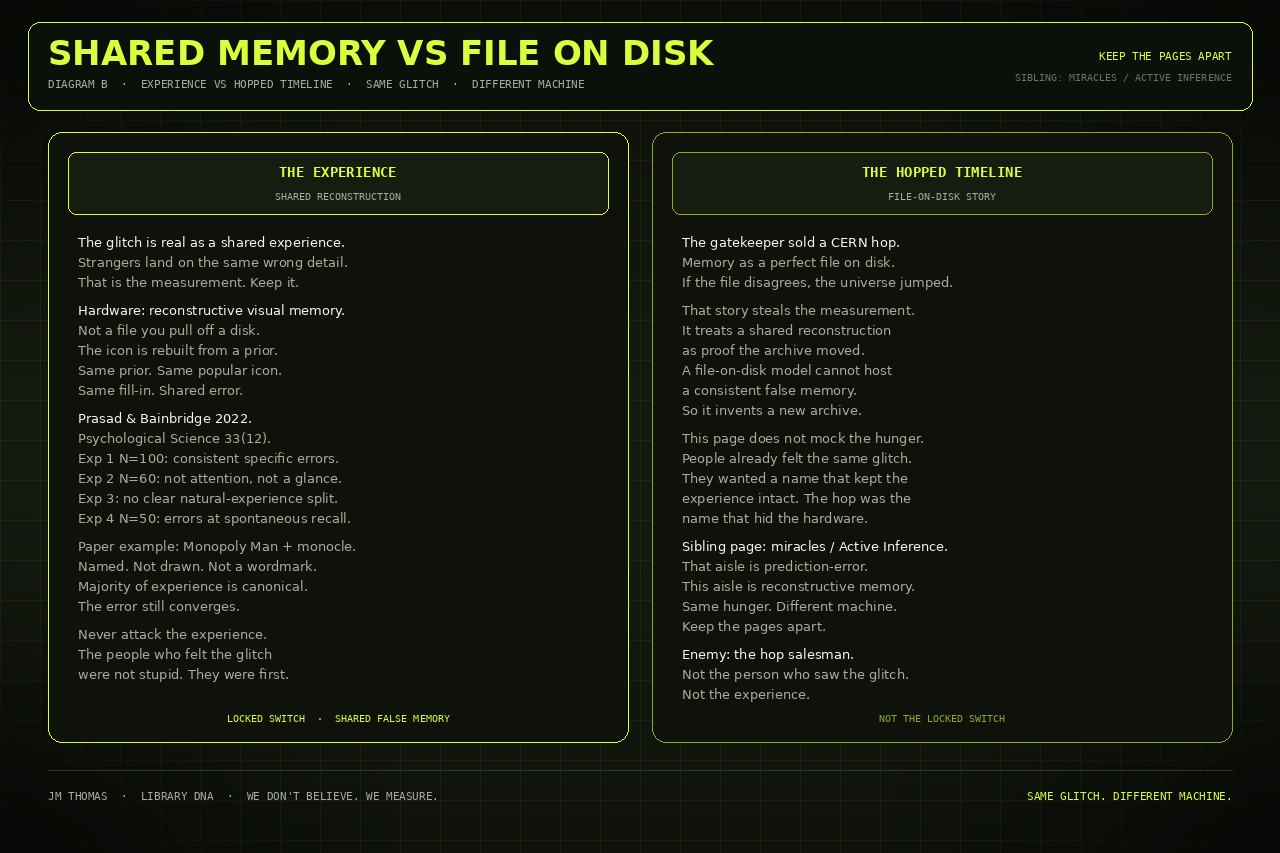
The glitch is real as a shared experience. Strangers name the same wrong detail. That is what Prasad and Bainbridge quantified. Real does not mean the archive hopped. Real means the reconstruction converges. A file-on-disk model of memory cannot host a consistent false memory, so the hop story invents a new archive. Keep the experience. Drop the hop.
Real is the word that starts the fight. I will split it. Real as an experience: yes. You saw the icon one way. A stranger saw it the same wrong way. That agreement is the phenomenon the paper named. Real as a hopped archive: no. That is a story that starts after you assume memory is a file. If the file is perfect, a shared miss can only mean the world moved. The assumption is the trick. The experience was never the problem.
I will not tell you the people who felt it were careless. Experiment 2 already refused the careless-look story. Experiment 3 already refused the "you were trained on the wrong poster" story, at least as a clear difference in natural visual experience. Experiment 4 already refused the "you only err when someone hands you a fake" story. What is left is a reconstruction that converges. That is a stronger fact than a hop, because it does not need a new universe. It needs the hardware you already have.
This is the original cut I will stand on. Visual memory is not playback. It is a rebuild. A popular icon is a high-traffic prior. High-traffic priors are shared. Shared priors, run through the same reconstructive hardware, can land on the same extra feature. A monocle that was never on the page can still be the cheapest completion the prior knows how to draw. I am not quoting a second paper for that sentence. I am naming the mechanism the 2022 title already pointed at: shared and specific false memories across people.
The aisle wants a miracle of physics. The gatekeeper wants a miracle of archives. Both skip the cheaper miracle. The cheaper miracle is that your visual system is a builder, not a vault. Builders improvise. Builders share tools. Shared tools make shared improvisations. That is why the glitch feels like evidence. It is evidence. It is evidence of the builder.
Honest line. Real as shared experience. Not real as a hopped CERN file. People already want both sentences to be the same sentence. I will keep them apart. The people who felt the glitch were first. The hop salesman arrived second, with a story that protected a perfect-file religion.
Is this a hopped timeline?
No. The hardware is reconstructive visual memory. Memory is not a file you pull off a disk. The visual system rebuilds the icon from a prior. Same popular icon. Same cultural prior. Same fill-in. That is why the error is shared and specific. The gatekeeper sold a CERN hop because a perfect-file model has no room for a consistent miss. The enemy is the hop salesman. Not the person who felt the glitch.
A hopped timeline is a file-on-disk story. It says the picture in your head is a perfect copy of a picture that used to exist. If today's picture disagrees, the archive moved. CERN is the brand the aisle hung on that move. I will not invent a paper that measured a collider rewriting a board game. I opened no such file. I opened a memory file.
Here is why the hop sells. If memory were a vault, a shared miss would be a scandal. Vaults do not invent the same extra object in a thousand heads unless the object was in the room. The hop keeps the vault. It moves the room. That is a religious move dressed as physics. It protects the idea that you do not reconstruct. It spends a universe to save a metaphor.
Reconstructive visual memory spends nothing extra. The icon goes in as sensation. The icon comes back out as a rebuild. The rebuild uses whatever prior is cheapest. Popular culture is a cheap prior because everyone paid the same admission. When the cheapest completion includes a monocle, strangers agree. Agreement feels like a photograph. It is a chorus.
I will say this without sneering at the hunger. The people who reached for a hop were trying to keep the experience intact. They were right that the experience is the data. They were right that "you imagined it" is a lazy dismissal. They were sold the wrong machine for a correct observation. That is the gatekeeper's move. Hide the hardware. Sell the cosmology. Charge the mystery a second time.
Two enemies, one of them fake. The fake enemy is the person who felt the glitch. I will not join that attack. The real enemy is the salesman who told you the only way to honor the glitch was to hop the archive. Amateurs believe a shared miss is a new universe. Professionals verify whether the memory system is a vault. We don't believe. We measure.
What I will not do. I will not mock the forums. I will not invent a percent of the internet that believes in CERN. I will not draw a logo and call the drawing a dataset. I will not tell you your memory is worthless. I will tell you what kind of machine it is. A builder. A shared builder. A builder that can be wrong in public, in the same way, on the same icon.
Is this the same as a miracle or prediction error?
No. Related reading: a miracle is an update the old model called impossible. That page owns Active Inference and prediction-error. This page owns shared reconstructive visual memory. One short mapping: both loops use a prior. The Mandela aisle is a memory reconstruction that lands on the same wrong pixel. The miracle aisle is a prior plus an act against surprise. Keep the pages apart or you will mash a false memory onto a Will.
Related reading stays one sentence first: a miracle is an update the old model called impossible. Crowley named magick as change in conformity with Will. Friston named two moves against surprise: update the prediction, or act until the world samples it. That page is the prediction-error aisle. This page is not that aisle. I will not clone Friston onto a false monocle and call it done.
One short mapping, then a wall. Both loops use a prior. A prior is a cheap completion the system already knows how to run. On the miracle page, a precise prior plus an act can host a state the old model called impossible. On this page, a shared prior plus a reconstructive rebuild can host a feature the canonical image never had. Same noun. Different job. Prediction-error is about what you will sample next. Reconstructive memory is about what you pull back from a picture you already saw. Keep the pages apart.
If you mash them, you get a cartoon. The cartoon says every glitch is a manifestation. Or every manifestation is a false memory. Both cartoons are aisle weather. A shared false memory is not proof that intent moved the archive. A precise prior plus an act is not proof that the Monopoly Man wore glass. I named that example because the paper did. I will not baptize it as magick. I will not baptize magick as a memory error.
Related reading stays one refusal on vision boards. Why vision boards fail is intention on a screaming nerve. That page owns the poster that never became an act. This page owns a picture that came back wrong. A board is a prior you hung on a wall. A Visual Mandela Effect is a prior that rebuilt an icon you did not hang. Different machine. Same hunger for a picture that feels more real than the page.
Related reading stays one refusal on sigils. A sigil is data compression. Encode. Release. Stop watching the pot. That page is a compression step you chose. This page is a reconstruction you did not choose. You do not plant a Visual Mandela Effect. It arrives because the prior was already shared. Keep the pages apart or you will tell people they sigilized a board-game mascot.
Honest line. Sibling page: miracles and Active Inference. This page: Visual Mandela Effect as shared false memory. One mapping. No clone. People already want one mechanism to eat the whole Library. I will not feed them that. A stack with one switch is a pamphlet. A stack with named switches is an instrument.
Name the switch first.
| Name | What it actually is | What it is not |
|---|---|---|
| Mandela Effect (query) | The shared-glitch search people type | A hopped CERN archive |
| Visual Mandela Effect | Shared, specific false memory for a visual icon (Prasad and Bainbridge 2022) | A logo. A scan. A brand wordmark |
| Experiment 1 | N=100 adults. Certain popular icons elicit consistent, specific false memories | A stadium poll |
| Experiment 2 | N=60 adults. No attentional or visual difference that drives it | Proof you never looked |
| Experiment 3 | No clear difference in natural visual experience. n not in the abstract I opened | A number I will invent |
| Experiment 4 | N=50 adults. Errors occur spontaneously during recall | A forced-choice trick only |
| Reconstructive visual memory | The hardware. A rebuild from a shared prior | A file on disk |
| Hopped timeline | A file-on-disk story that spends a universe to save a vault | The locked switch |
| Miracles / Active Inference | Owned on the sibling page. Prediction-error aisle | This memory file |
| Protocol 01 | Daily four-count inhale, eight-count exhale. Seven minutes. A number before and after | This memory protocol |
A calmer nerve is the clean line.
A screaming nerve will not let a memory-file land. Protocol 01 is free. Four-count inhale. Eight-count exhale. Seven minutes. A number before and a number after. That is the daily stack. This page is the memory-file switch: shared reconstructive visual memory, not a hopped timeline. The Library of Biological Wizardry is the rest of the stack if the method earns the next hour. No initiate password. A sequence, then a measurement. We don't believe. We measure.
What should I run if I want a number?
This page is the memory-file switch, not the daily number. Protocol 01 is the daily four-count inhale, eight-count exhale stack. Seven minutes. A number before and a number after. Start with Protocol 01 if you want a number you can fail in a chair. If the method earns it, the Library of Biological Wizardry is the rest of the stack. We don't believe. We measure.
You will not get a Visual Mandela Effect trial from a kitchen chair. You can get a 1 to 10 on whether the line is quieter, and a binary on whether you ran a sequence you can start and leave. The daily stack is Protocol 01. Four in. Eight out. Seven minutes. Write the number before. Write it after. This page is the memory-file switch. If you want a number you can fail in a chair, start with Protocol 01.
Do not mash them. If you turn a hop video into your only practice and skip the count you can fail, you are back in weather. The Library is Reality Engineering. A calmer nerve is the clean line so a file map can land. Related reading: a different switch, prediction-error and a prior plus an act. People search Mandela Effect for a verdict. Prasad and Bainbridge measured a shared visual false memory. Translation, not a hop. The glitch is real as an experience. The hardware is the rebuild.
I will leave you with the sentence I came to write. You were not stupid for seeing the same wrong detail as a stranger. You were running the same builder. The salesman who needed a new universe to keep you innocent was protecting a vault that was never there. Name the switch. Keep the experience. Measure the next hour.
FAQ
Short answers you can lift from this page. Visible text matches the FAQ schema exactly. The stills are schematic. None of this is medical advice.
What is the Mandela Effect, in this stack?
The Mandela Effect is a shared, consistent false memory for a specific cultural icon. The name is internet weather. The measurement is that strangers land on the same wrong detail. Prasad and Bainbridge 2022 called the visual form of that glitch the Visual Mandela Effect. The hardware is reconstructive visual memory, not a hopped timeline. The stills are schematic. Do not quote leftover art text as data.
What is the Visual Mandela Effect?
The Visual Mandela Effect is a Mandela Effect specific to visual icons. Prasad and Bainbridge 2022, Psychological Science 33(12):1971-1988. Their own example: the Monopoly Man is falsely remembered as having a monocle. I name that example. I do not draw the logo. Experiment 1, N=100 adults, showed that certain popular icons elicit consistent, specific false memories. The experience is the data. The cartoon is a hopped CERN archive.
What did Prasad and Bainbridge 2022 actually measure?
Prasad D. and Bainbridge W.A. The Visual Mandela Effect as Evidence for Shared and Specific False Memories Across People. Psychological Science 2022; 33(12):1971-1988. doi:10.1177/09567976221108944. Experiment 1, N=100 adults: certain images from popular iconography elicit consistent, specific false memories. Experiment 2, N=60 adults: no attentional or visual differences that drive the phenomenon. Experiment 3: no clear difference in the natural visual experience of these images. Experiment 3 n is not in the abstract I opened. I will not invent it. Experiment 4, N=50 adults: the errors also occur spontaneously during recall. Majority of visual experience is the canonical image.
Is the Mandela Effect real?
The glitch is real as a shared experience. Strangers name the same wrong detail. That is what Prasad and Bainbridge quantified. Real does not mean the archive hopped. Real means the reconstruction converges. A file-on-disk model of memory cannot host a consistent false memory, so the hop story invents a new archive. Keep the experience. Drop the hop.
Is this a hopped timeline?
No. The hardware is reconstructive visual memory. Memory is not a file you pull off a disk. The visual system rebuilds the icon from a prior. Same popular icon. Same cultural prior. Same fill-in. That is why the error is shared and specific. The gatekeeper sold a CERN hop because a perfect-file model has no room for a consistent miss. The enemy is the hop salesman. Not the person who felt the glitch.
Is this the same as a miracle or prediction error?
No. Related reading: a miracle is an update the old model called impossible. That page owns Active Inference and prediction-error. This page owns shared reconstructive visual memory. One short mapping: both loops use a prior. The Mandela aisle is a memory reconstruction that lands on the same wrong pixel. The miracle aisle is a prior plus an act against surprise. Keep the pages apart or you will mash a false memory onto a Will.
What should I run if I want a number?
This page is the memory-file switch, not the daily number. Protocol 01 is the daily four-count inhale, eight-count exhale stack. Seven minutes. A number before and a number after. Start with Protocol 01 if you want a number you can fail in a chair. If the method earns it, the Library of Biological Wizardry is the rest of the stack. We don't believe. We measure.
Is this medical advice?
No. This page is an educational mechanism explainer by JM Thomas. It is not a diagnosis, treatment, cure, or prevention of any disease. Prasad and Bainbridge 2022 locked a visual false-memory file, not a clinical protocol. If unusual memories or distress are on the table, talk to a clinician.
Sources I actually opened
Prasad, D., and Bainbridge, W. A. "The Visual Mandela Effect as Evidence for Shared and Specific False Memories Across People." Psychological Science 2022; 33(12):1971-1988. Experiment 1 N=100 adults. Experiment 2 N=60 adults. Experiment 3 n not in the abstract I opened. Experiment 4 N=50 adults. Paper example: Monopoly Man falsely remembered as having a monocle. Named, not drawn. doi.org/10.1177/09567976221108944
Association for Psychological Science. Journal page for the same article. Abstract locked the four-experiment claims I used. psychologicalscience.org/journals/psychological-science/09567976221108944/
Prasad, D., and Bainbridge, W. A. PsyArXiv preprint of the same title. doi:10.31234/osf.io/nzh3s. Used to confirm the abstract language. Not a second n. osf.io/preprints/psyarxiv/nzh3s