synchronicity · jung · meaningful coincidence
Synchronicity is a meaningful match. An inner thought lines up with an outer event.
You wanted that coincidence to mean something.
Synchronicity is a meaningful coincidence that lines up an inner state with an outer event. A meaningful coincidence is a match that feels like it belongs together. An inner state is a thought or feeling already live in you. An outer event is something that happens outside you. Carl Jung was a psychologist, a person who wrote about the mind, and he gave that match a name. You wanted the coincidence to mean something, and people still use the name he gave it.
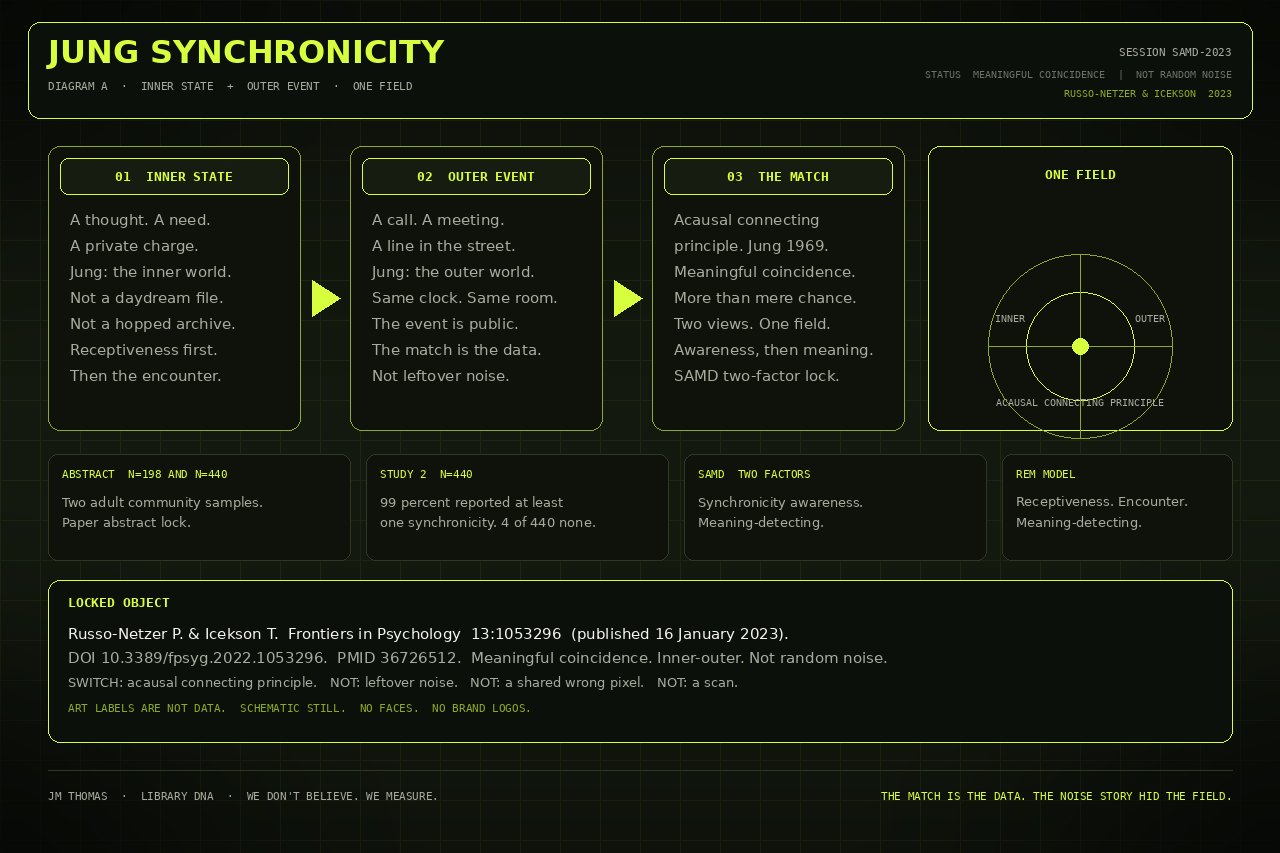
What is synchronicity?
People use the name synchronicity for a meaningful coincidence, which means you see an inner state line up with an outer event. The thought or feeling was already live in you, and then something happened outside you, and you saw the two fit.
Jung called those matches unpredictable occurrences of meaningful coincidence. Unpredictable means you cannot set the clock on when they arrive, and you still notice them when they do. You came here because you noticed.
What did Carl Jung say about synchronicity?
Carl Jung was a psychologist who wrote about the mind. He said the coincidence of events in space and time means something more than mere chance. Coincidence here means two things happening together, and space and time means they share a place and a clock. Mere chance means leftover luck with no meaning attached.
That is the sentence people hold when they want the match to count. Pninit Russo-Netzer and Tamar Icekson printed those sentences in a 2023 paper, so this page uses the sentences they printed. This page uses the sentences they printed, not Jung's 1952 book.
What is a meaningful coincidence?
A meaningful coincidence is an inner state plus an outer event that matches it. The inner state is a thought or feeling already live in you, and the outer event is something that happens outside you. You hold the thought first, then you meet an event that matches that thought.
You see two things happen at the same time all day. People keep this name when the inner state was already live and you see the outer event match it, and you can keep wanting that match to mean something.
What did Russo-Netzer and Icekson measure?
Pninit Russo-Netzer and Tamar Icekson published a paper on 16 January 2023. The journal is Frontiers in Psychology, a journal that prints psychology papers. They published in volume 13 as article 1053296, and that volume is the 2022 volume. Their title is "An underexplored pathway to life satisfaction: The development and validation of the synchronicity awareness and meaning-detecting scale."
They built the SAMD scale, a questionnaire that asks whether you notice those matches and whether you read meaning in them. The scale has two parts: synchronicity awareness, which is whether you notice the match, and meaning-detecting, which is whether you read meaning in it.
Life satisfaction is how content you say your life is. They named noticing those matches as a path toward that contentment. You can read the full paper on Frontiers.
How many people said they had a synchronicity?
The short summary at the top of a paper is the abstract. Their abstract lists two groups of adults, 198 people and 440 people, and the letter n is how many people sat in a counted group.
Study 2 used 440 people, and in that group 99 percent said they had at least one synchronicity. Four of those 440 people said they had none.
The methods section of Study 1, the part that says how they ran that group, names a mixed group of 410 people. That 410 does not match the abstract's 198, so this page keeps both numbers. This page does not combine them into one invented count.
Most people in the big group said they had at least one. You came here hoping that hunger had a name, and a lot of people named one too.
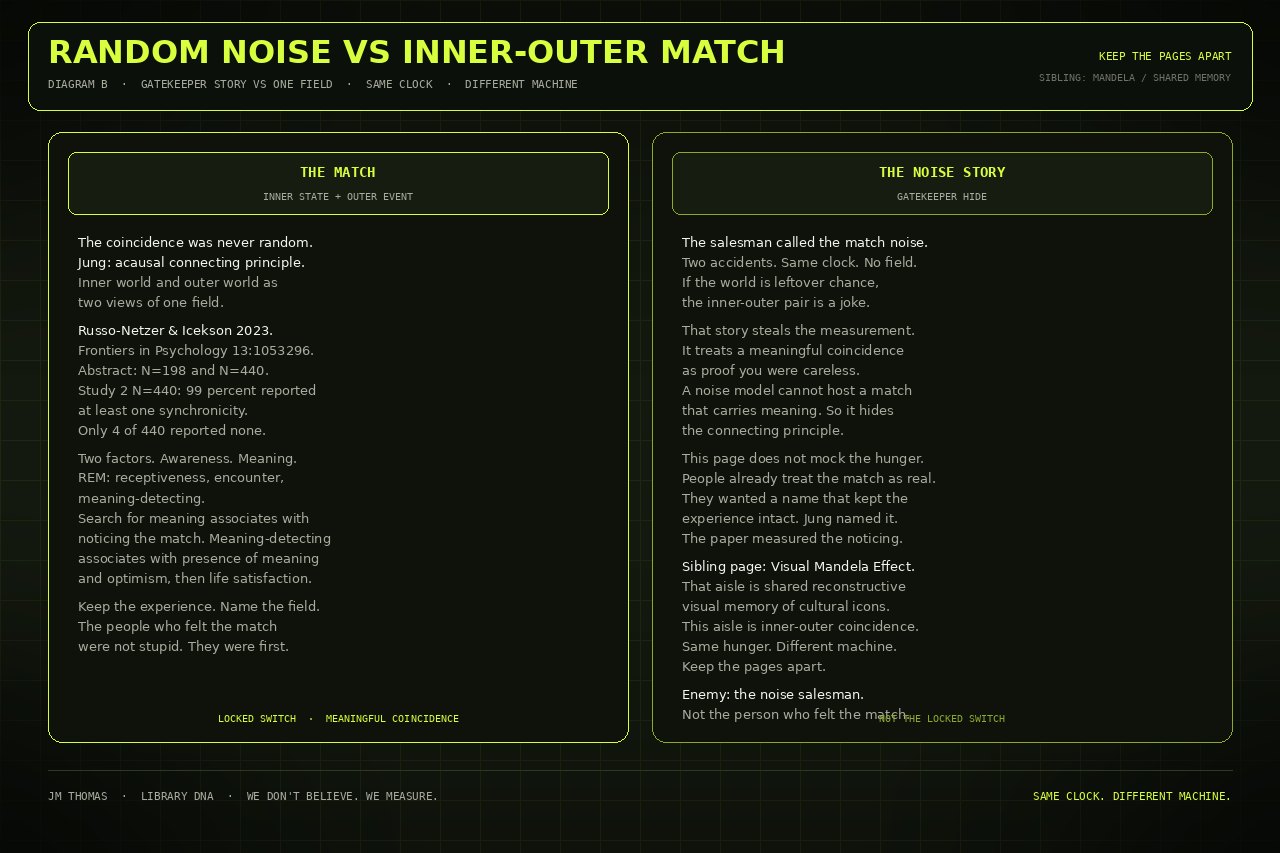
How does synchronicity differ from the Mandela Effect?
The Mandela Effect is a shared wrong picture. Strangers remember the same wrong detail on a logo or a character lots of people know. Open the Mandela page when you want that shared miss.
The miracles page is about a separate question, so leave that question on its own page. Open the miracles page when you want that question.
This page keeps synchronicity as the match between an inner thought and an outer event.
If a coincidence brings unusual distress, ask a clinician for help.
What do you do with this now?
You wanted that coincidence to mean something. Keep the synchronicity name.
Go back to the coincidence you brought here and keep the meaning you already felt.
Sources
Russo-Netzer, P., Icekson, T. "An underexplored pathway to life satisfaction: The development and validation of the synchronicity awareness and meaning-detecting scale." Frontiers in Psychology 2023, 13:1053296. Published 16 January 2023. Volume 13, 2022. Abstract N=198 and N=440. Study 2 N=440: 99 percent reported at least one synchronicity (4 of 440 reported none). Study 1 methods names an integrated sample of 410, and that n does not match abstract N=198. Two-factor SAMD scale. DOI 10.3389/fpsyg.2022.1053296. PMID 36726512. frontiersin.org/journals/psychology/articles/10.3389/fpsyg.2022.1053296/full
Same article via DOI. doi.org/10.3389/fpsyg.2022.1053296
PubMed record PMID 36726512. pubmed.ncbi.nlm.nih.gov/36726512/