red light · collagen · scan
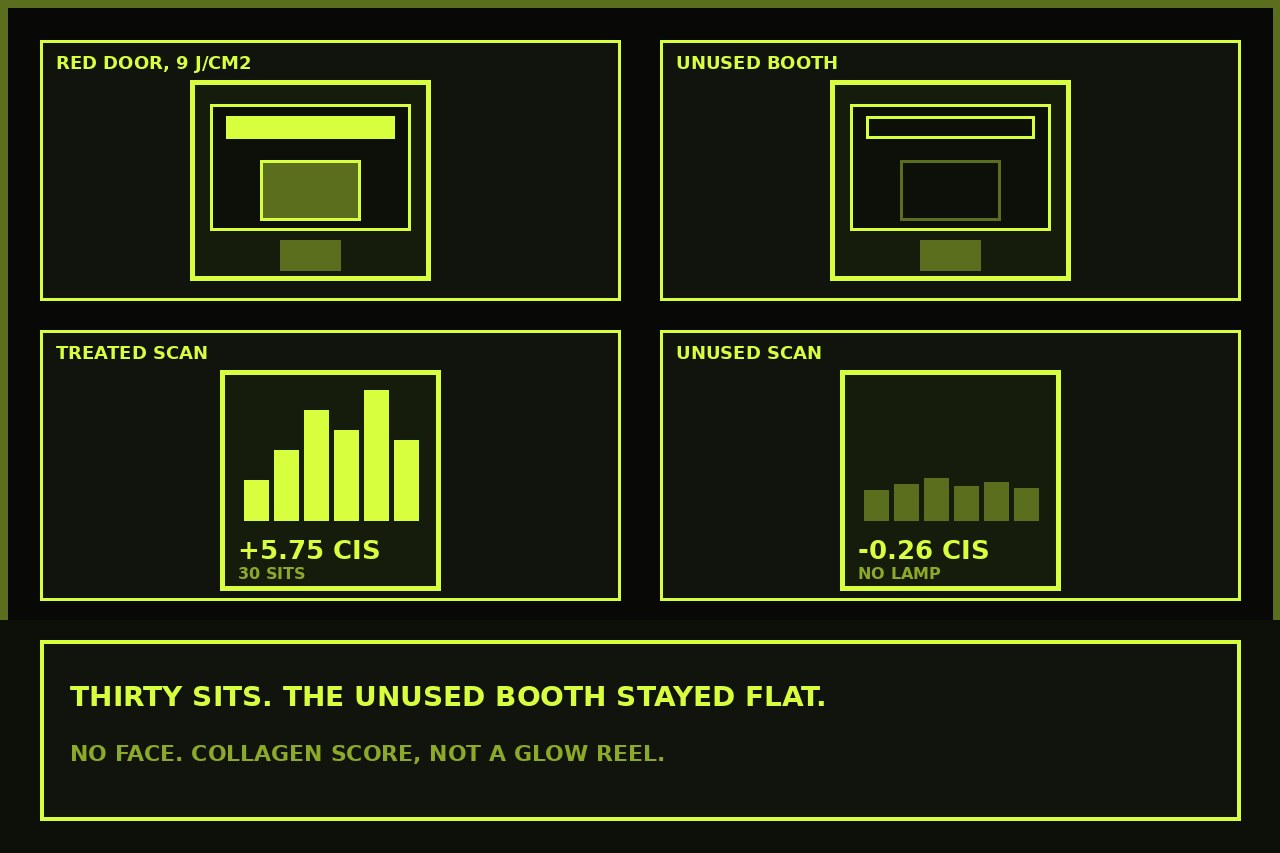
Red light therapy raised collagen scores 5.75.
You wanted the glow to show up on a scan, not just in a mirror.
Red light therapy is lamps that shine red or near-infrared light on the skin, and collagen is the protein that makes skin feel thick. You wanted a sound picture of that protein after the lamp. Keep the red light name.
What is red light therapy?
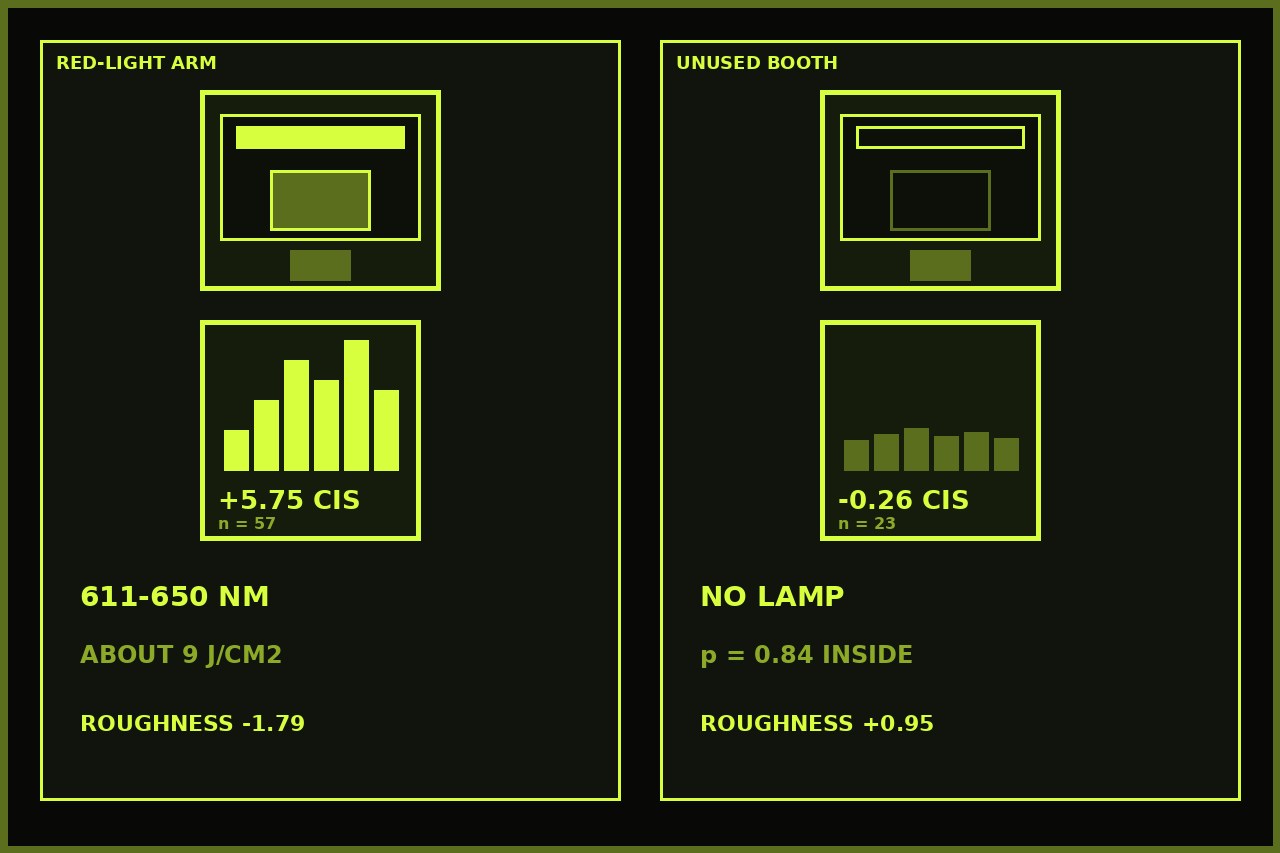
Red light therapy is lamps that shine red or near-infrared light on the skin. A nanometer is how long the light wave is. The Heidelberg red-light lamps used a band from 611 to 650 nanometers, and the wider-band lamps used 570 to 850 nanometers. A joule is a unit of energy on a square of skin. Those Heidelberg lamps put about 9 joules on each square.
You can still want the glow to show up on a scan.
How does red light therapy raise collagen?
Red light hits a part of the cell that makes energy. That part is the mitochondria. An enzyme in that energy part is cytochrome c oxidase, and when red light hits that enzyme, the cells that build collagen can do that work. Those cells are fibroblasts. Fibroblasts lay down collagen, and collagen is the protein that makes skin feel thick.
You wanted that work to show up on a scan.
What did the Heidelberg red light study measure?
Alexander Wunsch and Karsten Matuschka ran the trial in Heidelberg and published it in 2014 in Photomedicine and Laser Surgery. Wunsch worked at Medical Light Consulting in Heidelberg, and JK-International was in Windhagen. The ethics board was Landesarztekammer Baden-Wurttemberg in Stuttgart. Wunsch listed Hirschgasse 11, 69120 Heidelberg. You can read that paper at doi.org/10.1089/pho.2013.3616.
They recruited 144 people, and eight did not show up, so 136 enrolled. People were 27 to 79 years old. They treated 113 people in four lamp units, then combined those units as the red-light group, called RLT, with 57 people, and the wider-band group, called ELT, with 48 people. The unused group, the controls, had 23 people, and 128 people finished.
People in the lamp groups went twice a week for 30 treatments. They took the first scan by February 2012, and they took the last of those 30 visits by June 2012. They came back about six months after that last visit.
The unused group got no lamp. Most of those people already worked at JK, and the clinic did not pick them by chance. There was no sham, which is a fake lamp. Those unused people also skipped the feel-better scores.
The clinic used a DermaLab Combo ultrasound scanner at 20 MHz. An ultrasound scan is a sound picture of the skin, and the clinic got a collagen score from that scan. They also used a Primoslite tool for roughness. Three doctors who did not know the group looked at photos with the Modified Fitzpatrick Wrinkle Scale, a wrinkle scale those doctors already knew.
Did unused people stay near zero?
From the first visit to visit 30, people in the red-light group rose 5.75 on the collagen score. People in the wider-band group rose 6.40. People who got no lamp stayed at minus 0.26, which is near zero. The authors treated the gap between the lamp groups and the unused group as real.
People in the red-light group got smoother by 1.79, and people in the wider-band group got smoother by 1.58. People in the unused group got rougher by 0.95.
The three doctors scored people better, equal, or worse. In the red-light group they scored 40 people better, 8 equal, and 10 worse. In the wider-band group they scored 36 better, 7 equal, and 5 worse. In the unused group they scored 1 better, 5 equal, and 17 worse.
Nobody dropped out for a bad event, and nobody had a severe event. One person used concealer on a small red vessel, called telangiectasia. One 40-year-old had a knee scar that flushed and then healed in a week.
Fifty-two people came back later. They were still up 5.10 on collagen, and still down 0.64 on roughness.
The authors named the limits. There was no sham, which is a fake lamp. The unused group was not picked by chance. They took photos from winter into summer. JK-Holding GmbH paid for the trial and owned the lamps.
How many joules does a red light lamp need?
A joule is a unit of energy on a square of skin. The Heidelberg lamp put about 9 joules on each square, in the 611 to 650 nanometer band. A nanometer is how long the light wave is.
Ryan Helcoski said on Utah Public Radio on 11 August 2026 that a lamp can cost about ten dollars or tens of thousands. You can hear that neighbor piece at upr.org/health/2026-08-11/red-light-therapy-science. A thin home mask often does not put out 9 joules. You can still want the 9-joule lamp, and you can still want the glow to show up on a scan.
If you want the sauna page, open the sauna page. If you want the page where a brain scan rose after people came back, open the gray-matter page.
If the lamp or the skin brings unusual distress, talk to a clinician, because this page is educational.
Can you still want the glow to show up on a scan?
You wanted the glow to show up on a scan, not just in a mirror. Keep the red light name.
The Heidelberg lamp at about 9 joules raised collagen 5.75. The unused group stayed near zero. You can still want the glow to show up on a scan.
Sources
Wunsch A., Matuschka K. “A Controlled Trial to Determine the Efficacy of Red and Near-Infrared Light Treatment in Patient Satisfaction, Reduction of Fine Lines, Wrinkles, Skin Roughness, and Intradermal Collagen Density Increase.” Photomedicine and Laser Surgery 2014, 32(2), 93-100. DOI 10.1089/pho.2013.3616. PMID 24286286. PMC 3926176. Medical Light Consulting, Heidelberg. JK-International GmbH, Windhagen. Alexander Wunsch, Hirschgasse 11, 69120 Heidelberg. Ethics Landesarztekammer Baden-Wurttemberg, Stuttgart. Recruited 144, 8 no-show, enrolled n=136. Treated 113 in four units combined as RLT n=57 and ELT n=48, controls n=23. Completed 128. Age 27-79. Table 1 RLT / ELT / controls: female 49 (86%) / 34 (70.8) / 15 (65.2). Age 46.2 SD 9.0 / 48.6 SD 9.8 / 44.4 SD 10.2. Twice weekly, 30 treatments, t0 by February, t30 by June 2012. Follow-up t30 plus 6 months. Control: no treatment, mainly JK employees, not randomized, no sham, no subjective scores. Dose about 9 J/cm2 in 611-650 nm. RLT 611-650 nm low-pressure. ELT 570-850 nm mid-pressure. DermaLab Combo 20 MHz CIS. Primoslite Ra. Three blinded physicians, Modified Fitzpatrick Wrinkle Scale. Table 3 t30 minus t0: Roughness RLT -1.79 SD 2.46, ELT -1.58 SD 2.22, controls +0.95 SD 1.45 p=0.003, between 0.003. Collagen RLT +5.75 SD 4.54, ELT +6.40 SD 5.17, controls -0.26 SD 5.09 p=0.84, between under 0.001. Expert better/equal/worse: RLT 40 (69%) / 8 (14) / 10 (17). ELT 36 (75) / 7 (15) / 5 (10). Controls 1 (4) / 5 (22) / 17 (74). No dropout for adverse event. No severe event. One telangiectasia concealer. One 40-year-old knee scar, healed 1 week. Long-term n=52: CIS +5.10 SD 7.56, Ra -0.64 SD 3.53. Limitations: no sham, control not randomized, seasonal photography, sponsor-owned lamps. Funded by JK-Holding GmbH. doi.org/10.1089/pho.2013.3616 · pubmed.ncbi.nlm.nih.gov/24286286 · ncbi.nlm.nih.gov/pmc/articles/PMC3926176
Helcoski R. Utah Public Radio, 11 August 2026. Price spread about $10 to tens of thousands. Neighbor only. upr.org/health/2026-08-11/red-light-therapy-science