NASA nap · cockpit rest · Ames

25.8 minutes left a 9-hour hole.

JM Thomas · 17 August 2026

Ames gave 12 pilots a 40-minute seat over water. They slept 25.78 minutes. Day nine still owed about 9 hours.

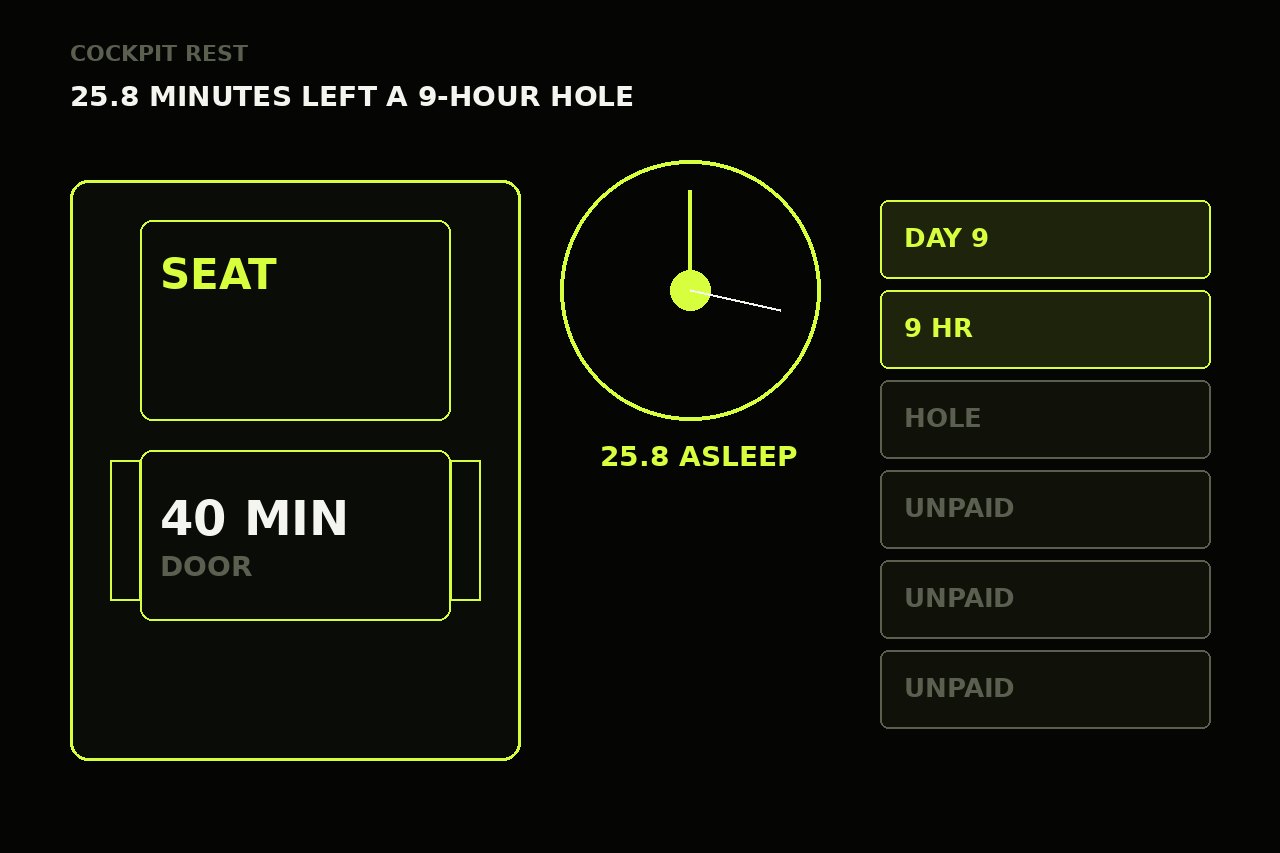
Dark lime drawing of a cockpit seat, a 40-minute clock, and a 9-hour unpaid stack. No face.
Cockpit seat, 40-minute door, unpaid day-nine stack. No face.

A planned cockpit seat cut the last-hour blinks on a Boeing 747 over the Pacific.

Short relief.

The same seat never paid the sleep those crews already owed by the ninth day of the trip.

The compact caption still sells 26

The timer sold a leftover. Ames sold a 40-minute door.

Sleep Foundation refreshed "NASA Nap: How to Power Nap Like an Astronaut" on 6 July 2026 and still told readers the ideal length is 26 minutes, with a 6-minute fall-asleep add-on stacked on top of that sleep.

Catchy.

Nine.com.au called it a resurgence on 3 June 2026 after United's Scott Kirby said he closes the office door for 20 minutes because a tired brain should not be making the call.

A 26-minute timer page updated 16 July 2026 still stamps 54 percent alertness and 34 percent performance on a NASA zone it never measured from the memorandum.

Wrong file.

A Huberman Lab short with Matt Walker on "NASA nap culture" sits at 379,500 views, and Walker quotes a 20 percent alertness bump and a 50 percent task bump from a different NASA nap-culture story than the 747 seat.

The 34 and the 54 live on a 1995 Journal of Sleep Research summary. NASA Technical Memorandum 108839 never printed those percentages. I wanted the seat numbers the memorandum actually kept.

Ames handed them a 40-minute seat

They slept in the seat. Two other people kept the jet.

Rosekind's Ames group printed the rest in Crew Factors in Flight Operations IX, NASA TM 108839, DOT/FAA/92/24, dated September 1994, after four middle legs of a regularly scheduled transpacific Boeing 747 trip flown by line crews who already held the bid.

Ames Research Center sits at Moffett Field, California 94035.

The FAA co-sponsored the work and sanctioned the cockpit rest, and Northwest and United let the observers on the deck.

No one paid the pilots.

Twenty-one line pilots volunteered. Twelve sat in the rest group. Nine sat in the no-rest group. Mean age sat at 38.7 on the rest seats and 38.8 on the no-rest seats.

Twenty men.

One woman, a first officer on the rest side.

The studied legs were Honolulu to Osaka, Osaka to Honolulu, Honolulu to Narita, and Narita to Los Angeles, two westbound day legs and two eastbound night legs on three-person crews with no relief pilot in the bunk.

Cruise over water got a planned 40-minute door, one seat at a time, on a rotation that ended one hour before descent so the landing still had a fresh pair of eyes.

Three minutes to get ready.

Twenty minutes to come back.

The landing pilot picked last, closer to the ground.

Oxford Medilog recorders watched brain waves and eye movements while a 10-minute psychomotor vigilance task sat on the glare shield and a wrist monitor ran the whole trip.

On 42 of 45 readable rest doors, 93 percent, the rest-group pilots slept. Sleep started after 5.55 minutes, spread 5.04. Total sleep sat at 25.78 minutes, spread 9.58. Efficiency against the 40-minute door sat at 64.47 percent, spread 23.94.

A usual daytime nap sits nearer 50 to 55 percent efficiency.

These seats slept harder than that lunch nap you take at the desk when the afternoon already has your name on it.

Harder.

That 64.47 percent efficiency against a 40-minute door is the number a desk timer never shows you, because the caption rounded the leftover sleep and sold the leftover as the recipe Ames never wrote down in the memorandum that spent a year on four middle legs with electrodes on the scalp and a reaction box on the glare shield.

Stage 1 took 30.28 percent of the sleep. Stage 2 took 61.65. Slow-wave sleep took 8.07.

No REM printed on any rest door.

Day legs held more light sleep, 37.30 percent stage 1 against 25.32 at night, while night legs held more slow-wave sleep, 11.56 percent against 4.27 on the day legs, which is the deeper sleep a night body already wants.

Three rest-group pilots missed sleep on one leg each, two of them on the fourth leg.

They slept on the other three.

Day nine still owed a night

The seat was a patch. The hole stayed.

Eighteen of the 21 crews, 86 percent, carried a sleep debt of at least 4 hours by the ninth day of the duty cycle, which is the number this page is here to keep in front of the timer.

The worst hole hit 22 hours.

The average hole sat near 9 hours.

One person gained at least 4. Two stayed even.

The cockpit nap did not move that debt. Rest seats and no-rest seats lost the same hours. Ames wrote that the seat gave acute relief and never gave enough sleep to cancel several days of loss.

Patch, not payment.

Across a 36-hour block, 12 hours of duty plus a 24-hour layover, sleep took 28 percent of the clock. Home days sat nearer 33 percent.

That 5-point cut is the hole.

Of 135 layovers, 77 percent held two or more sleep episodes, and 70 percent held two, so the layover already split the night before anyone sat in the cruise seat.

A long first sleep, 6 to 11 hours, left a short second sleep or none. A short first sleep, under 6 hours, almost always grew a second sleep of 4 to 11 hours.

Write the hours you already owe if you want that week, because a timer that ignores the debt is how a 26-minute caption keeps selling a leftover as a recipe.

Count first.

Ames already told you the seat was an operational countermeasure, a short-acting patch for a cruise hour, and the wrist monitor still printed a 9-hour hole by day nine whether the seat had been used or left empty on purpose, which is why a 26-minute kitchen timer that never counts the week is a different file from the 747 door they actually opened over water.

A 26-minute timer on a 9-hour hole is a different file.

The last hour kept 120 blinks

The no-rest seats blinked through descent.

Ames scored every brain-wave and eye-movement event longer than 5 seconds from about one hour before top of descent through landing, which is the hour a 747 is already pointed at the field.

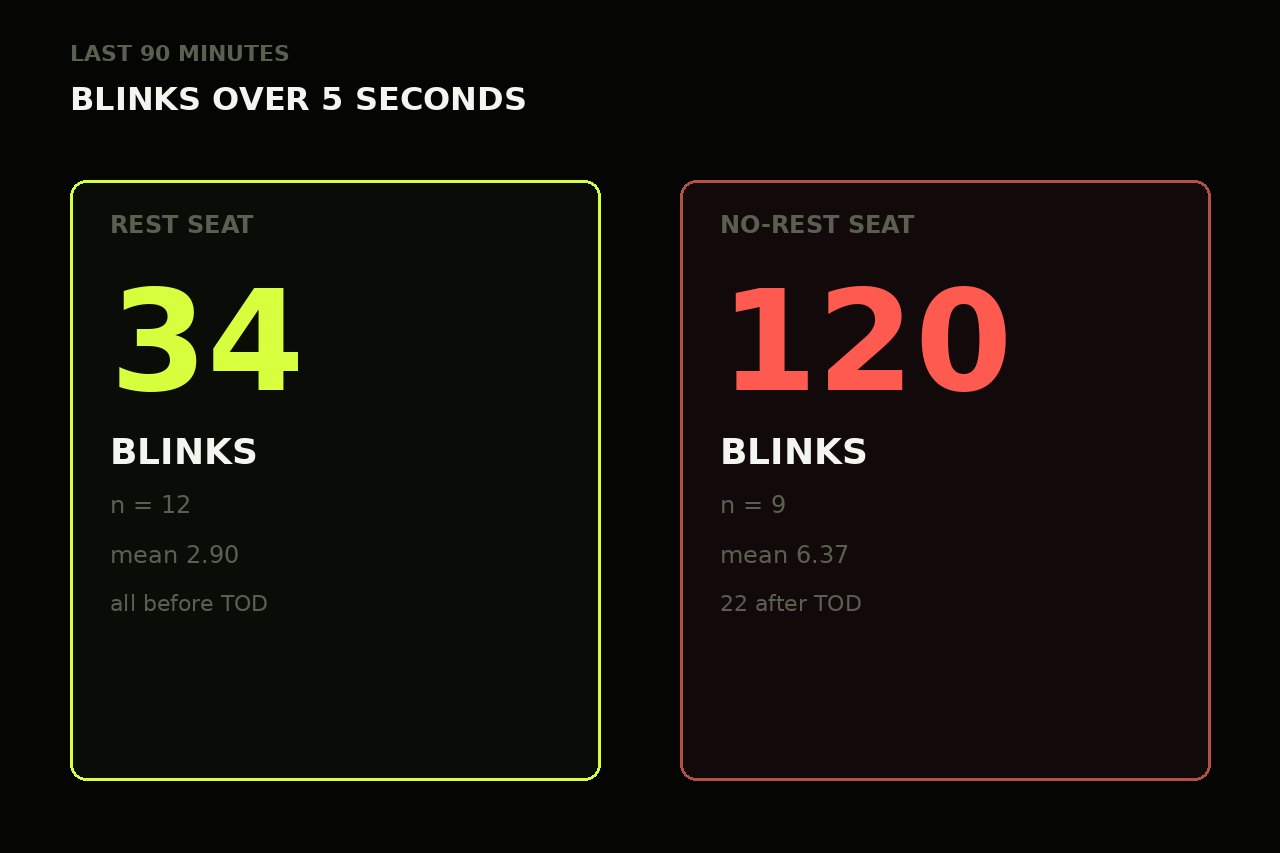
The no-rest seats, nine people, printed 120 of those blinks.

The rest seats, twelve people, printed 34.

At least one blink showed in 78 percent of the no-rest seats and 50 percent of the rest seats.

Mean blinks sat at 6.37, spread 4.04, on the no-rest side against 2.90, spread 2.19, on the rest side, F(1,19) = 6.44, p = .02.

Slow-rolling eye movements sat at 3.72 against 1.95, p = .048.

Ninety-eight of the no-rest blinks landed before top of descent, and 22 of them stayed through descent and landing.

Every rest-group blink sat before top of descent.

Cleaner last hour on the way down.

Still a hole on day nine.

The vigilance box told the same story. All 21 pilots printed 283 lapses, a delay past half a second. In flight the nine no-rest seats printed 124. The twelve rest seats printed 81.

Five of the nine no-rest pilots printed 10 or more in-flight lapses, and two of them printed 45 and 33, which is 38 percent of the no-rest in-flight pile from two tired men.

Three of the twelve rest pilots hit 10.

None of them passed 14.

On night flights the no-rest response speed slowed twice as fast with time on task, while the rest seats held nearer a student who had slept a normal night on the ground.

Dark lime split. Left rest seat 34 blinks. Right no-rest seat 120 blinks. No face.
Left rest seat 34 blinks. Right no-rest seat 120. No face.

The nap missed the feeling.

Subjective alertness dropped on night legs and after the rest door the same way it dropped after the control door, so the rating sheet never saw the blinks the electrodes caught.

Ames named that miss.

Sleepy people under-count how gone they already are.

Four control seats went dark anyway

They were told to keep flying. Four of them slept.

The no-rest group had a 40-minute control clock during cruise and orders to keep usual flight work.

Four of those nine pilots still fell asleep.

Five episodes.

Two of those episodes ran past 10 minutes.

Only stage 1 and stage 2 printed.

A 5.55-minute fall-asleep on the rest seats sits next to the laboratory line for excessive sleepiness, 5 minutes or less, the band Ames called the twilight zone because a healthy person who is that gone is already in trouble.

Unplanned cockpit sleep was already in the older logs. Gander's crew logs had put napping on about 11 percent of available flights, 10 to 130 minutes, mean 46.

This file put a planned door on that leak and then watched the last hour.

Count the hours you already owe.

A 26-minute timer is leftover sleep from a 40-minute door on a three-person 747 that already had two people awake and a researcher watching the clock.

Ames never picked 26 as a kitchen recipe.

The seat cut blinks on the way down. Day nine still owed a night, rest seats and no-rest seats alike.

If you want a short daily count before you set that timer, run Protocol 01. Write the hours first.

What the 747 file still owes

Did Ames pick 26 on purpose?

They opened a 40-minute door. Sleep filled 25.78 minutes of it, spread 9.58. The 26 you see on timers is that leftover, rounded.

Does a seat nap pay a bad night?

No. Eighteen of 21 crews still carried at least 4 hours of debt by day nine, average about 9, and the nap did not split the groups.

What about a two-pilot jet?

This file used three-person Boeing 747 crews with two people awake at all times, a sanctioned rotation, and a researcher who woke the sleeper at a preset clock, so a two-pilot jet with nobody extra in the seat is a different cockpit than the one Ames measured. Ames named the two-person cockpit as untested.

Who paid?

NASA Ames and the FAA. Cooperative agreements NCC-2-599 and NCC-2-641 covered the Pennsylvania and Stanford pieces. The airlines gave the deck. The pilots volunteered with no pay.

Did they feel more awake?

The rating sheet said no. The blinks and the lapses said yes. Ames left that split on the page.

Ames 1994 sheet

Rosekind M.R., Graeber R.C., Dinges D.F., Connell L.J., Rountree M.S., Spinweber C.L., Gillen K.A. "Crew Factors in Flight Operations IX: Effects of Planned Cockpit Rest on Crew Performance and Alertness in Long-Haul Operations." NASA Technical Memorandum 108839. DOT/FAA/92/24. September 1994. NASA Ames Research Center, Moffett Field, CA 94035. University of Pennsylvania School of Medicine / Institute of Pennsylvania Hospital. San Jose State University Foundation. University of California, San Diego. FAA co-sponsored. NTSB support named. Northwest and United Airlines field access. Volunteer line pilots, no pay, identification codes only. n=21, rest group 12 (4 crews), no-rest group 9 (3 crews). Table 2 rest / no-rest: age 38.7 / 38.8, experience 13.4 / 15.2 years, sex 11 men and 1 woman / 9 men. Captains rest 4 age 50.3, no-rest 3 age 52.0. First officers rest 4 age 31.8, no-rest 3 age 40.7. Second officers rest 4 age 34.0, no-rest 3 age 33.7. Total age 41.6, experience 14.2, 20 men 1 woman. B-747 three-person nonaugmented transpacific. Study legs: HNL-OSA 9.5 hr flight, OSA-HNL 6.9, HNL-NRT 8.9, NRT-LAX 9.7. Two day westbound, two night eastbound. Rest: 3 min prepare, 40 min seat, 20 min recovery, one at a time, end 1 hr before descent, landing pilot first choice of slot. Control: 40 min identified, usual work. Measures: Oxford Medilog 9000-II EEG/EOG, PVT, wrist actigraph, logbook, NASA Background Questionnaire. Sleep onset 1.5 min continuous sleep. Rest opportunities 48, physiological loss 3 legs (6 percent). Slept on 42 of 45 (93 percent). Three no-sleep rest legs, later in trip. RG(42) total sleep 25.78 min SD 9.58. RG(24) complete-data 28.45 SD 6.28. Sleep latency RG(42) 5.55 SD 5.04, RG(24) 4.10 SD 2.88. Efficiency RG(42) 64.47 percent SD 23.94, RG(24) 71.12 SD 15.67. Usual daytime nap efficiency named 50 to 55 percent. Stage 1 RG(42) 30.28 percent SD 22.50. Stage 2 61.65 SD 21.63. Slow-wave 8.07 SD 16.22. No REM on any rest door. Day vs night stage 1 RG(42) 37.30 vs 25.32, F p=.02. Slow-wave day 4.27 vs night 11.56, p=.02. Four NRG pilots slept on five control episodes, two over 10 min, stage 1 and 2 only. PVT lapses (RT greater than 500 msec) total 283. In-flight NRG 124 vs RG 81 despite fewer NRG people. Five of 9 NRG had 10 or more in-flight lapses, two at 45 and 33 (38 percent of NRG in-flight lapses). Three of 12 RG had 10 or more, none above 14. Median RT main effect condition F(1,19)=9.19, p under .007. Night NRG slope twice the RG. Last-90-min microevents greater than 5 sec: NRG 120, RG 34. At least one event 78 percent NRG, 50 percent RG. Mean total 6.37 SD 4.04 vs 2.90 SD 2.19, F(1,19)=6.44, p=.02. SEM 3.72 SD 2.31 vs 1.95 SD 1.55, F(1,19)=4.45, p=.048. NRG 98 before TOD, 22 TOD through landing. RG all 34 before TOD. 86 percent (18 of 21) sleep debt at least 4 hr by day 9, worst 22 hr, mean about 9 hr. Nap did not change cumulative debt. Layover sleep 28 percent of 36-hr duty-plus-layover block vs about 33 percent off-duty home. 77 percent of 135 layovers had 2 or more sleep episodes, 70 percent had two. Subjective alertness: nap did not move ratings. Limitations named: one trip pattern, transpacific overwater cruise, middle four legs only, B-747 three-person, two NASA observers on deck, two-person cockpit untested. ntrs.nasa.gov/citations/19950006379 · NASA TM 108839 PDF

Rosekind M.R., Smith R.M., Miller D.L., Co E.L., Gregory K.B., Webbon L.L., Gander P.H., Lebacqz J.V. "Alertness management: strategic naps in operational settings." Journal of Sleep Research 1995, 4(S2), 62 to 66. DOI 10.1111/j.1365-2869.1995.tb00229.x. The 1995 summary that carries the compact 34 percent / 54 percent caption the memorandum itself does not print. doi.org/10.1111/j.1365-2869.1995.tb00229.x