ASMR · Sheffield · finger clip
ASMR dropped heart rate 3.41 beats a minute.
You wanted the tingle to slow the pulse.
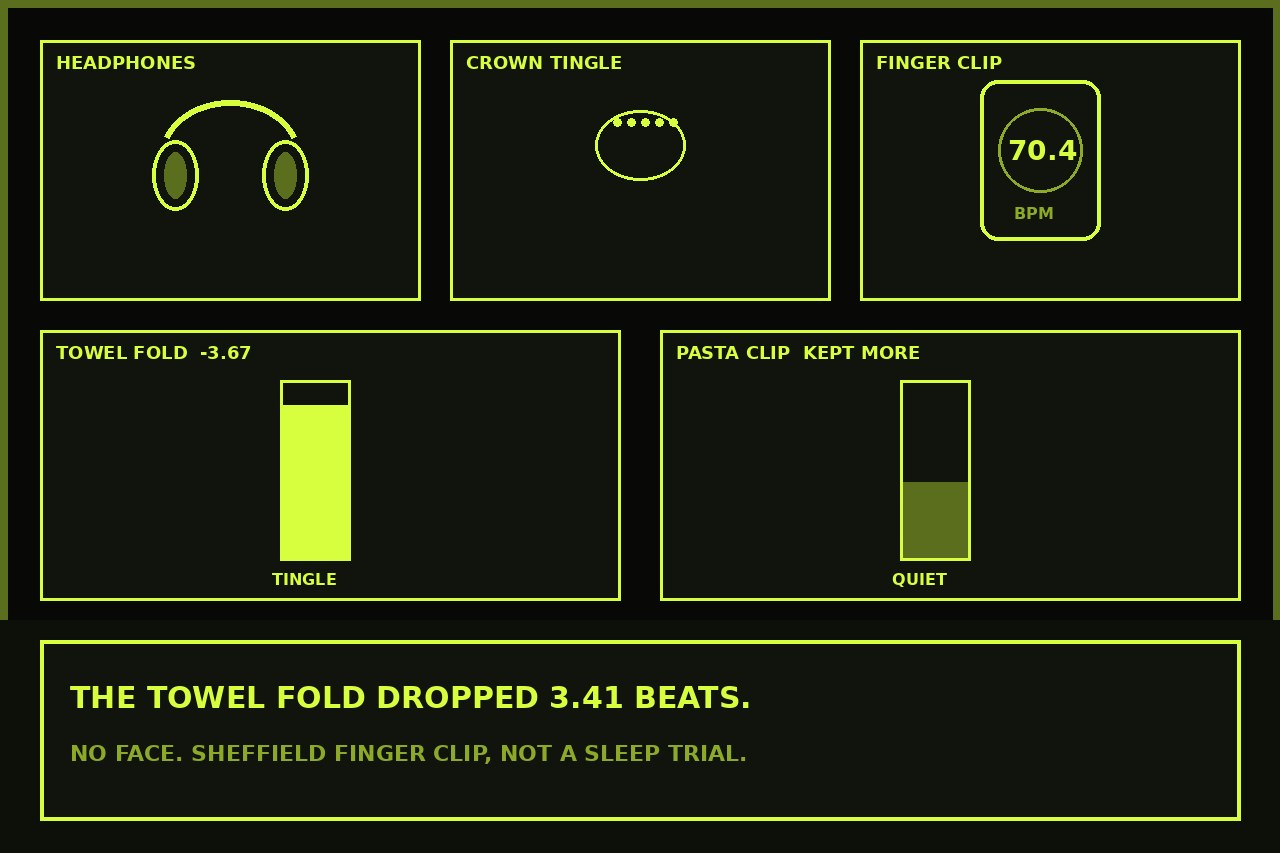
ASMR is a tingle some people feel on the scalp or neck when they watch a quiet clip. A tingle is that crawl people who get ASMR already know. Heart rate is how many times the heart beats in a minute. Giulia Poerio ran this work at the University of Sheffield, and people watched a woman fold laundry or a cook talk at a normal pace. Keep the ASMR name.
What is ASMR?
ASMR is a tingle some people feel on the scalp or neck when they watch a quiet clip. People who get it already know that crawl, and they often name soft speaking or whispering as the start. In the first Sheffield survey, 74 percent named soft speaking and 70 percent named whispering.
What is a tingle?
A tingle is that crawl people who get ASMR already know. It can start on the scalp or the neck when a quiet clip plays, and the people in the lab who already felt it were the ones whose heart rate dropped more on the towel-fold clip.
Does ASMR drop heart rate?
Giulia Poerio, Emma Blakey, Thomas J. Hostler, and Theresa Veltri published this paper in 2018. The journal is PLoS ONE. They ran the work at the University of Sheffield. The Economic and Social Research Council paid for the work with grant ES-J500215-1 to Poerio. You can read the paper at doi.org/10.1371/journal.pone.0196645.
The title of the paper is “More than a feeling: Autonomous sensory meridian response (ASMR) is characterized by reliable changes in affect and physiology.”
They recruited 112 people and matched 56 who get the tingle with 56 who do not. Two people lost data when the equipment failed, so 110 people stayed. Fifty-eight percent were female. Mean age was 26.14, with a spread of 8.63, and ages ran from 18 to 59. People who get the tingle took a three-day break from ASMR clips before they came in.
Each person sat for a three-minute rest first, then watched three-minute clips while the team mixed the order so they did not always watch the towel-fold clip first. The standard clip was a woman folding laundry and talking soft in Russian. The control clip is the cook talking at a normal pace during a cooking demonstration. People who get the tingle also picked a clip of their own.
How did they watch the pulse?
A PPG is a light clip on the finger that watches the pulse. The team used a ProComp5 Infiniti box that took 256 samples a second and put that light on the middle finger. SCL is how well the skin carries a tiny current, and they put those pads on the index finger and the ring finger.
How much did heart rate drop?
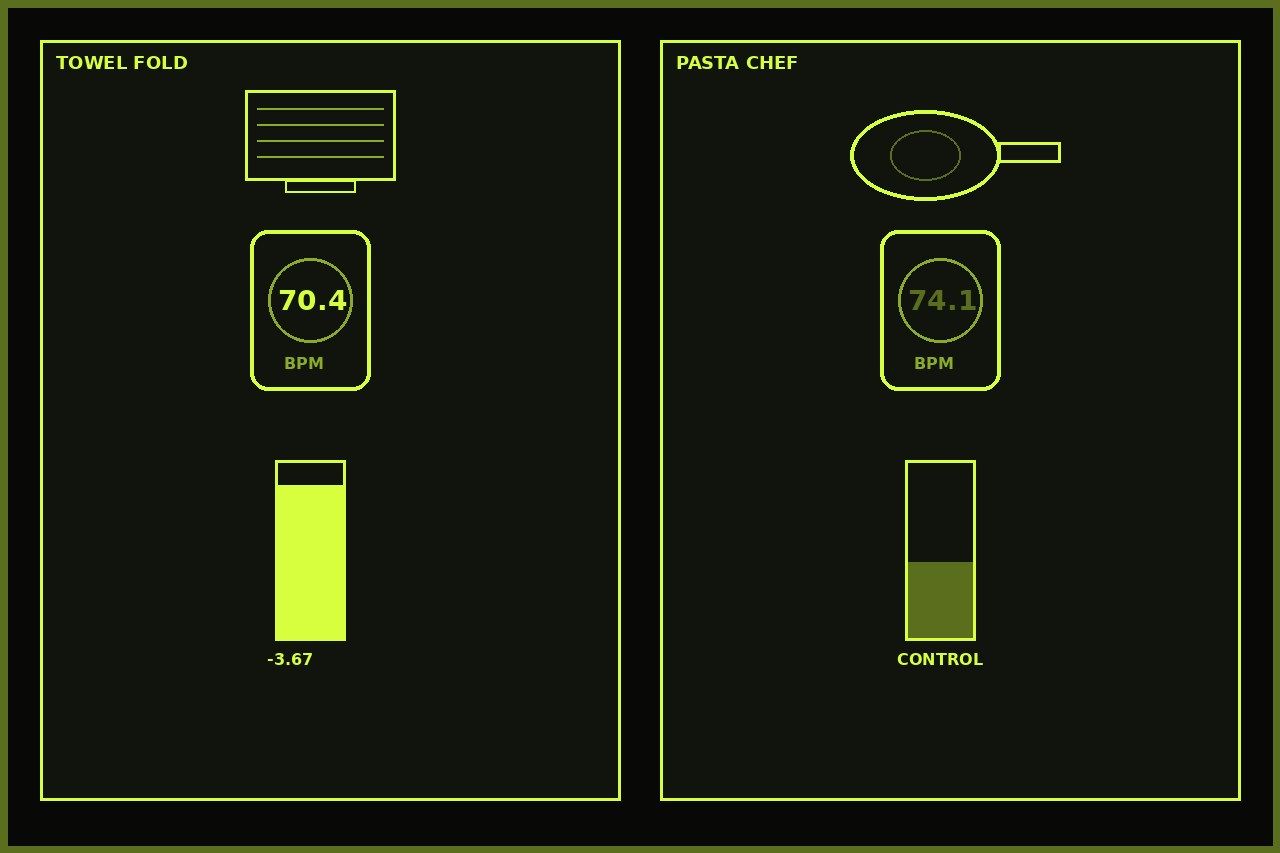
For people who already get the tingle, heart rate was 76.30 at rest, with a spread of 9.40. On the cooking clip it was 74.10, with a spread of 8.84. On the standard towel-fold clip it was 70.43, with a spread of 8.32. On the clip they picked themselves it was 70.95, with a spread of 8.58.
For people who do not get the tingle, those four numbers were 75.91, 73.32, 71.74, and 71.04.
The team had heart-rate data from 53 people who get the tingle and 55 people who do not. The team printed F(1,106)=4.95, p=.028, np2=.05, a mean difference of minus 1.48, and d=0.45. A p value tells you how often a gap this big would show up if the groups were the same. The effect size is a way to say how large a change was.
People who already get the tingle dropped 3.41 beats a minute on the ASMR clips next to their own cooking clip. On the standard towel-fold clip they dropped 3.67, and on the clip they picked themselves they dropped 3.15. Table 3 printed 3.41. The University of Sheffield news page, dated 21 June 2018, printed 3.14.
What happened to the skin reading?
SCL is how well the skin carries a tiny current. For people who get the tingle, that reading was 3.04 at rest, 3.49 on the cooking clip, and 3.76 on the standard clip. For people who do not get the tingle, those three numbers were 2.96, 3.60, and 3.64. The team printed F(1,105)=5.92, p=.017, and d=0.46. The mean rise was 0.30 microsiemens, and microsiemens is the unit for that tiny current.
What did the first Sheffield survey find?
2073 people started the first survey, and the team analyzed 1002. 813 people, 81 percent, already got ASMR, and 189 people did not. People reported a bigger tingle on spoken clips, with a gap of 1.63 and an effect size of 1.04. Soft speaking was named by 74 percent, and whispering was named by 70 percent. Sexual arousal did not split the groups, and that p value was .611.
Do music chills raise heart rate?
Frisson is the chill some people get from music. Grewe and Benedek found that musical chills raise heart rate. People who already get the ASMR tingle dropped heart rate on the towel-fold clip. If you want that music-chill page, open the frisson page.
Did a later sleep paper look at ASMR?
A 2026 SLEEP abstract looked at people who use ASMR clips. Those writers printed a poor sleep profile, and they did not find a tie between usage and better insomnia scores. That abstract is a neighbor. The Sheffield team watched three-minute clips in a lab, not an overnight sleep trial.
If you feel unusual distress, talk to a clinician, because this page is educational.
If you want the hot-flash page, open the self-hypnosis page.
Can you still want the tingle to slow the pulse?
You wanted the tingle to slow the pulse. Keep the ASMR name.
People who already get the tingle dropped 3.41 beats a minute on the towel-fold clip next to their own cooking clip. You can still want the tingle to slow the pulse.
Sources
Poerio G.L., Blakey E., Hostler T.J., Veltri T. “More than a feeling: Autonomous sensory meridian response (ASMR) is characterized by reliable changes in affect and physiology.” PLoS ONE 2018, 13(6): e0196645. DOI 10.1371/journal.pone.0196645. PMID 29924796. PMC 6010208. Department of Psychology, University of Sheffield. Hostler: Manchester Metropolitan. Data: osf.io/9mvwb. Funding: ESRC ES-J500215-1 to Poerio. Study 2: 112 recruited, 56/56 matched, 2 equipment cuts, n=110, 58 percent female, Mage 26.14 SD 8.63, range 18 to 59. ProComp5 Infiniti, 256 samples/s, middle-finger PPG, index-and-ring SCL. 3-minute baseline, 3-minute clips, counterbalanced. Standard clip: woman folding laundry, soft-spoken Russian. Control: cooking demonstration, normal speech. 3-day ASMR fast for responders. Table 3 HR tingle: baseline 76.30 SD 9.40, control 74.10 SD 8.84, standard 70.43 SD 8.32, self-selected 70.95 SD 8.58. Non: 75.91 / 73.32 / 71.74 / 71.04. HR F(1,106)=4.95, p=.028, np2=.05, Mdiff -1.48, d=0.45. Mean tingle drop vs control 3.41 bpm (standard 3.67, self-selected 3.15). HR n=53/55. SCL tingle 3.04 / 3.49 / 3.76. Non 2.96 / 3.60 / 3.64. SCL F(1,105)=5.92, p=.017, d=0.46. Mean rise 0.30 microsiemens. Study 1: 2073 started, analyzed 1002, 813 ASMR (81 percent) / 189 non. Spoken tingle Mdiff 1.63 d=1.04. Soft speaking 74 percent, whispering 70 percent. Sexual arousal p=.611. doi.org/10.1371/journal.pone.0196645 · pubmed.ncbi.nlm.nih.gov/29924796 · PMC6010208 · osf.io/9mvwb
University of Sheffield. “Brain tingles: First study of its kind reveals physiological benefits of ASMR.” 21 June 2018. Relaxing effect in people who already experience the feeling. News printed 3.14. Table 3 printed 3.41. sheffield.ac.uk/psychology/news/brain-tingles-first-study-its-kind-reveals-physiological-benefits-asmr
Music frisson neighbor: musical chills raise heart rate (Grewe, Benedek). People who get ASMR dropped heart rate on the towel-fold clip. Internal neighbor: frisson.
SLEEP 2026 abstract neighbor only. Writers printed a poor sleep profile in ASMR users. Usage did not associate with insomnia-symptom improvement. Three-minute lab is not an overnight sleep trial. NCT07651228 has no results used here. doi.org/10.1093/sleep/zsag091.0463 · clinicaltrials.gov/study/NCT07651228