Transcendental Meditation · PTSD · San Diego
TM worked as well as exposure therapy for PTSD.
You wanted the score to move without saying the worst day again.
TM, or Transcendental Meditation, is a quiet practice with an assigned sound you keep in the mind. PTSD is post-traumatic stress, a set of symptoms after a trauma. Exposure therapy, also called prolonged exposure, is a clinic hour where you say the worst memory out loud in present tense. Keep the TM name.
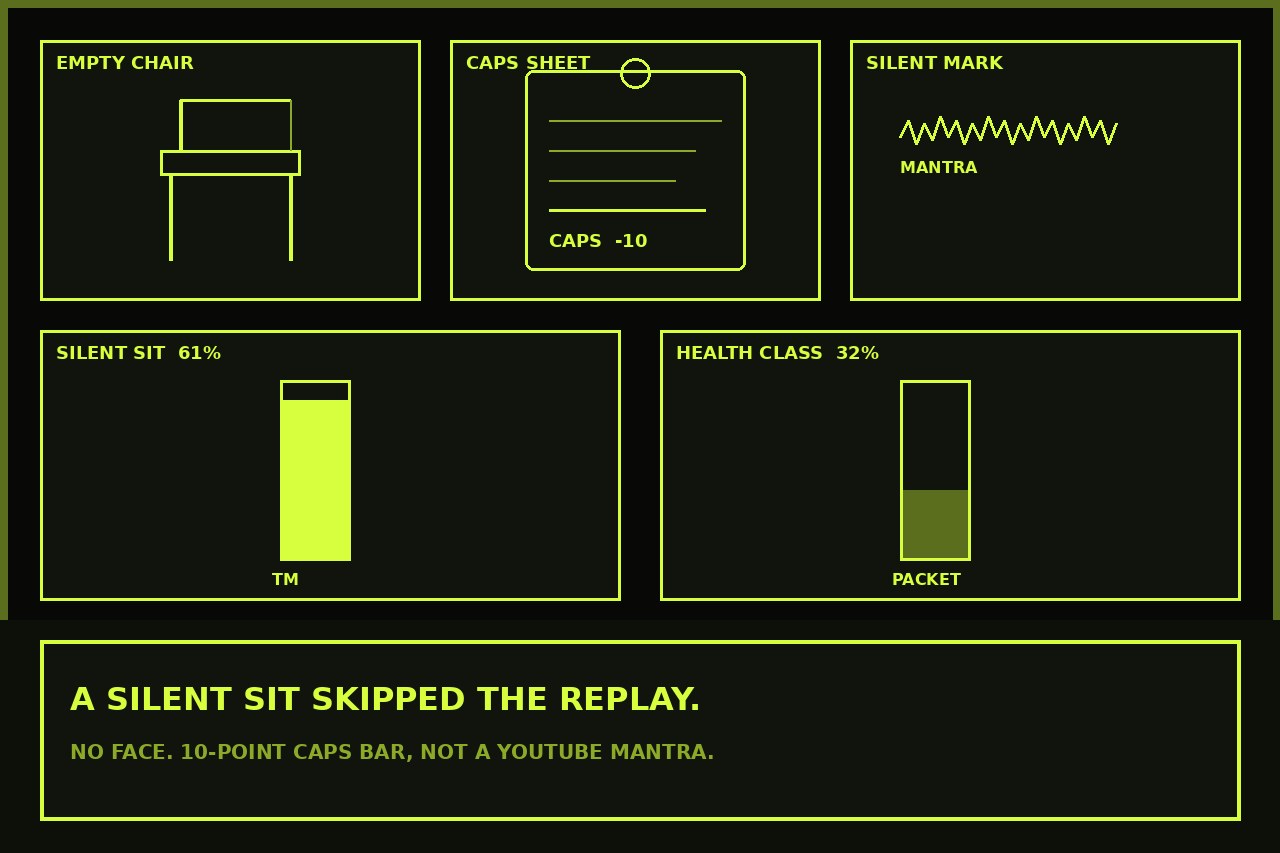
What is Transcendental Meditation?
A teacher gives you that assigned sound, then you sit down, close your eyes, and keep the sound going inside. You do not retell a trauma while you do it. Certified Maharishi teachers taught TM in this trial, and several co-authors worked at Maharishi University of Management in Fairfield.
Veterans who used TM still cleared a drop on CAPS without saying the worst day out loud.
What is PTSD?
PTSD is post-traumatic stress, a set of symptoms after a trauma. A veteran is a person who served. In this trial the veterans had PTSD after active military service. Nightmares and wrecked sleep are the kind of items a clinician marks on the CAPS sheet.
What is exposure therapy?
Exposure therapy, also called prolonged exposure in this trial, is a clinic hour where you say the worst memory out loud in present tense. A clinician sits with you one on one, and you tell that memory again. Exposure is a real room. Veterans in that room still cleared drops on the same CAPS sheet.
What is CAPS?
CAPS is the Clinician-Administered PTSD Scale, the score sheet. A clinician asks about symptoms and writes the marks. The main question in this trial was how much that CAPS score changed at three months. A ten-point drop on CAPS counted as a clinically significant change.
Did TM work as well as exposure therapy for PTSD?
Sanford Nidich, Paul J. Mills, Maxwell Rainforth, Pia Heppner, Robert H. Schneider, Norman E. Rosenthal, John Salerno, Carolyn Gaylord-King, and Thomas Rutledge published this paper in 2018. The journal is The Lancet Psychiatry, a medical journal. They ran the trial at the VA San Diego Healthcare System. You can read the paper at doi.org/10.1016/S2215-0366(18)30384-5.
The title of the paper is “Non-trauma-focused meditation versus exposure therapy in veterans with post-traumatic stress disorder: a randomised controlled trial.”
They recruited from 10 June 2013 to 7 October 2016, screened 814 people, and picked 203 veterans by chance. Sixty-eight joined TM. Sixty-eight joined prolonged exposure. Sixty-seven joined PTSD health education. Mean age was 47. The first CAPS score, before the weeks started, averaged 79.7, with a spread of 17.8. One hundred twenty-eight people, 68 percent, were on PTSD medication. Eighty-three percent were men.
Each group met for 12 sessions over 12 weeks, and people practiced at home each day. Veterans in TM got one 90-minute orientation, then eleven 60-minute sessions, mostly in a small group. Veterans in exposure got twelve 90-minute one-on-one appointments. Thomas Rutledge, a VA psychologist on the team, told the Associated Press he does not practice meditation himself.
Non-inferiority means they asked if TM was not worse than exposure by more than 10 points on CAPS. The difference in mean change, TM next to prolonged exposure, was minus 5.9. The 95 percent confidence interval, the range the team printed for that gap, ran from minus 14.3 to 2.4. The p value was 0.0002. A p value tells you how often a gap this big would show up if the groups were the same. TM met that non-inferiority mark.
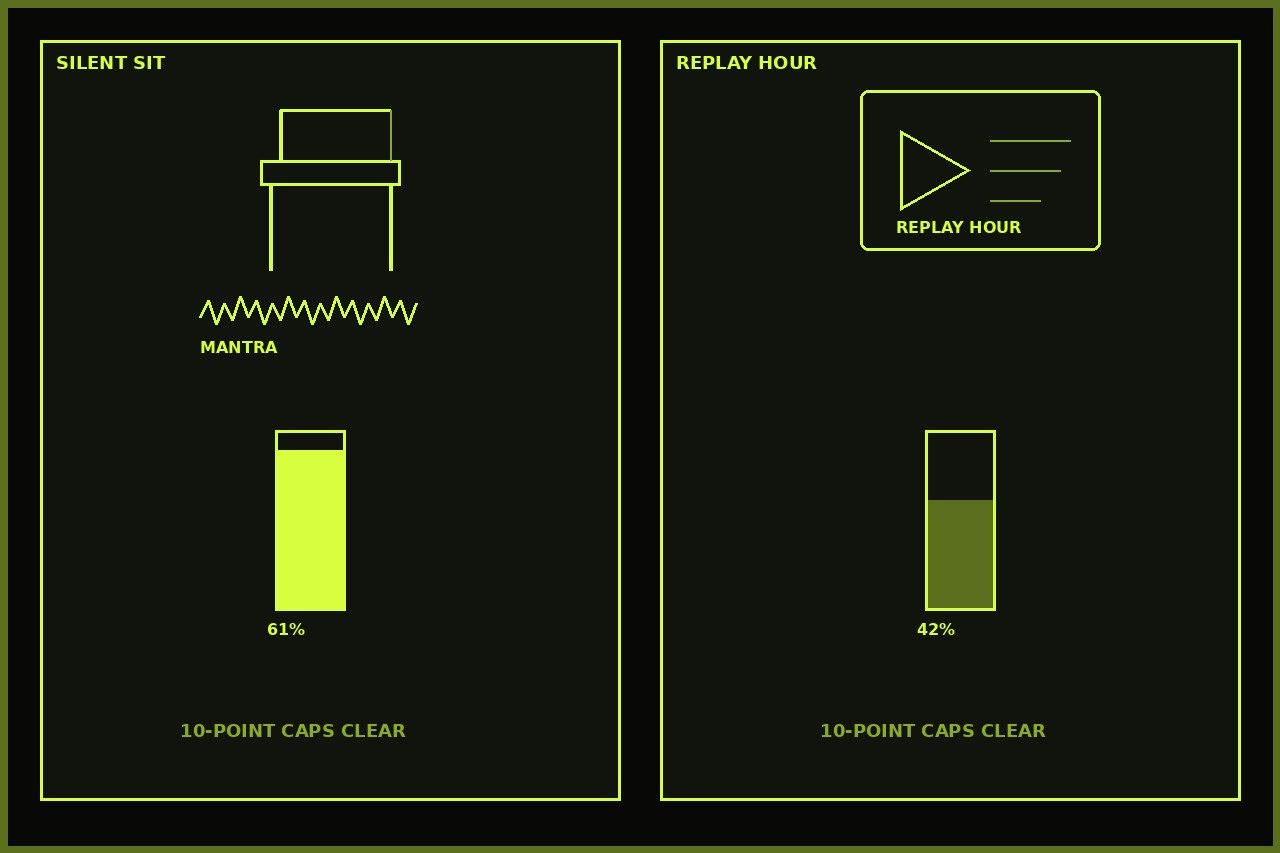
How many veterans cleared a 10-point CAPS drop?
Sixty-one percent of veterans who used TM cleared a 10-point CAPS drop. Forty-two percent of veterans in prolonged exposure cleared that 10-point line. Effect size is a way to say how large a change was. That size ran from 0.90 to 1.2 for TM, and from 0.63 to 0.89 for prolonged exposure.
Veterans who used TM did not have to retell the worst day, while veterans in exposure still said that memory out loud with a clinician. More veterans in TM cleared the 10-point line.
What is PTSD health education in this study?
PTSD health education was the third group. People in that group also met for 12 sessions. Veterans in TM dropped more than veterans in health education. That gap was minus 14.6, with a range from minus 23.3 to minus 5.9, and a p value of 0.0009. Veterans in exposure dropped more than veterans in health education too. That gap was minus 8.7, with a range from minus 17.0 to minus 0.32, and a p value of 0.041. Thirty-two percent of the health education group cleared a 10-point CAPS drop. Effect sizes there ran from 0.14 to 0.34.
People who came to fewer than 8 of the 12 sessions were counted as dropouts, 25 percent in TM and 38 percent in exposure, and the team said that gap was not significant. Schnurr named two limits: the team did not follow people past three months, and one clinician ran 80 percent of the exposure hours. The Department of Defense paid for the work with grants W81XWH-12-1-0576 and W81XWH-12-1-0577.
Did later papers look at TM and PTSD?
Associated Press and NBC News wrote about this trial on 16 November 2018, and Groessl later wrote a 2025 paper on the cost of TM for PTSD. Didukh later wrote a 2026 paper on Ukrainian refugees who practiced TM in Germany, a later different group from the San Diego veterans.
If you feel unusual distress, or you need PTSD care, talk to a clinician, because this page is educational. This page is not a diagnosis.
If you want the forest bathing page, open the forest bathing page.
Can you still want the score to move without saying the worst day again?
You wanted the score to move without saying the worst day again. Keep the TM name.
Veterans who used TM cleared a 10-point CAPS drop as often as veterans in exposure, and more of them cleared that 10-point line. They did not have to retell the worst day. You can still want the score to move without saying the worst day again.
Sources
Nidich S., Mills P.J., Rainforth M., Heppner P., Schneider R.H., Rosenthal N.E., Salerno J., Gaylord-King C., Rutledge T. “Non-trauma-focused meditation versus exposure therapy in veterans with post-traumatic stress disorder: a randomised controlled trial.” The Lancet Psychiatry 2018, 5(12):975-986. DOI 10.1016/S2215-0366(18)30384-5. PMID 30449712. NCT01865123. VA San Diego Healthcare System. Recruited 10 June 2013 to 7 October 2016. Screened 814. Randomized 203: TM 68, prolonged exposure 68, PTSD health education 67. 12 sessions over 12 weeks, daily home practice. TM: one 90-minute orientation then eleven 60-minute sessions, mostly small group. Exposure: twelve 90-minute one-on-one appointments. Certified Maharishi teachers. Several co-authors at Maharishi University of Management, Fairfield. Thomas Rutledge, VA psychologist, told AP he does not practice meditation himself. Primary: CAPS change at 3 months. Non-inferiority margin of 10. Baseline CAPS 79.7 SD 17.8. Mean age 47. 128 (68%) on PTSD medication. 83% men. TM vs PE difference in mean change -5.9, 95% CI -14.3 to 2.4, p=0.0002. Clinically significant 10-point CAPS drop: 61% TM, 42% PE. Effect sizes TM 0.90 to 1.2, PE 0.63 to 0.89. TM vs HE -14.6, CI -23.3 to -5.9, p=0.0009. PE vs HE -8.7, CI -17.0 to -0.32, p=0.041. HE 32% 10-point, effect 0.14 to 0.34. Dropout under 8 of 12: 25% TM vs 38% PE, not significant. Schnurr: no follow-up past three months, one clinician 80% of exposure hours. DoD W81XWH-12-1-0576 and W81XWH-12-1-0577. doi.org/10.1016/S2215-0366(18)30384-5 · pubmed.ncbi.nlm.nih.gov/30449712 · clinicaltrials.gov/study/NCT01865123
Associated Press / NBC News. “Meditation helps veterans with PTSD, Defense Dept. experiment finds.” 16 November 2018. Neighbor news piece on the San Diego trial. Nightmares and wrecked sleep as the kind of CAPS items. nbcnews.com/news/military/meditation-helps-veterans-ptsd-defense-dept-study-finds-n937311
Groessl E.J., Rutledge T.R. “Cost-effectiveness of Transcendental Meditation (TM) for treating Post-Traumatic Stress Disorder (PTSD).” PLOS ONE 2025, 20(2):e0316995. DOI 10.1371/journal.pone.0316995. Published 6 February 2025. Cost neighbor only. TM 1504 dollars / 12 sessions. PE 2822. HE 492. 5-year model TM 42982, PE 46730, HE 45679. Groessl named David Lynch Foundation consulting fees. doi.org/10.1371/journal.pone.0316995
Didukh M.L., Freitag K., Lunov V.E., Maksymenko S.D., Rudenko Y.V. “Reduction in symptoms of posttraumatic stress disorder and depression in Ukrainian refugees practicing Transcendental Meditation.” Clinical and Preventive Medicine 2026, (2):52-65. Neighbor only: 80 Ukrainian refugees in Germany, TM 40 / no-practice 40, 60 days, PCL-5. Later different group. Do not mash into the San Diego two-way. doi.org/10.31612/2616-4868.2.2026.07