forest bathing · shinrin-yoku · Japan
Forest bathing dropped cortisol 15.8 percent.
You wanted the walk under trees to drop the stress hormone.
Forest bathing, also called shinrin-yoku, is time in the woods taking in sights, sounds, and smells. Cortisol is the stress hormone they measured in spit. Keep the forest bathing name.
What is forest bathing?
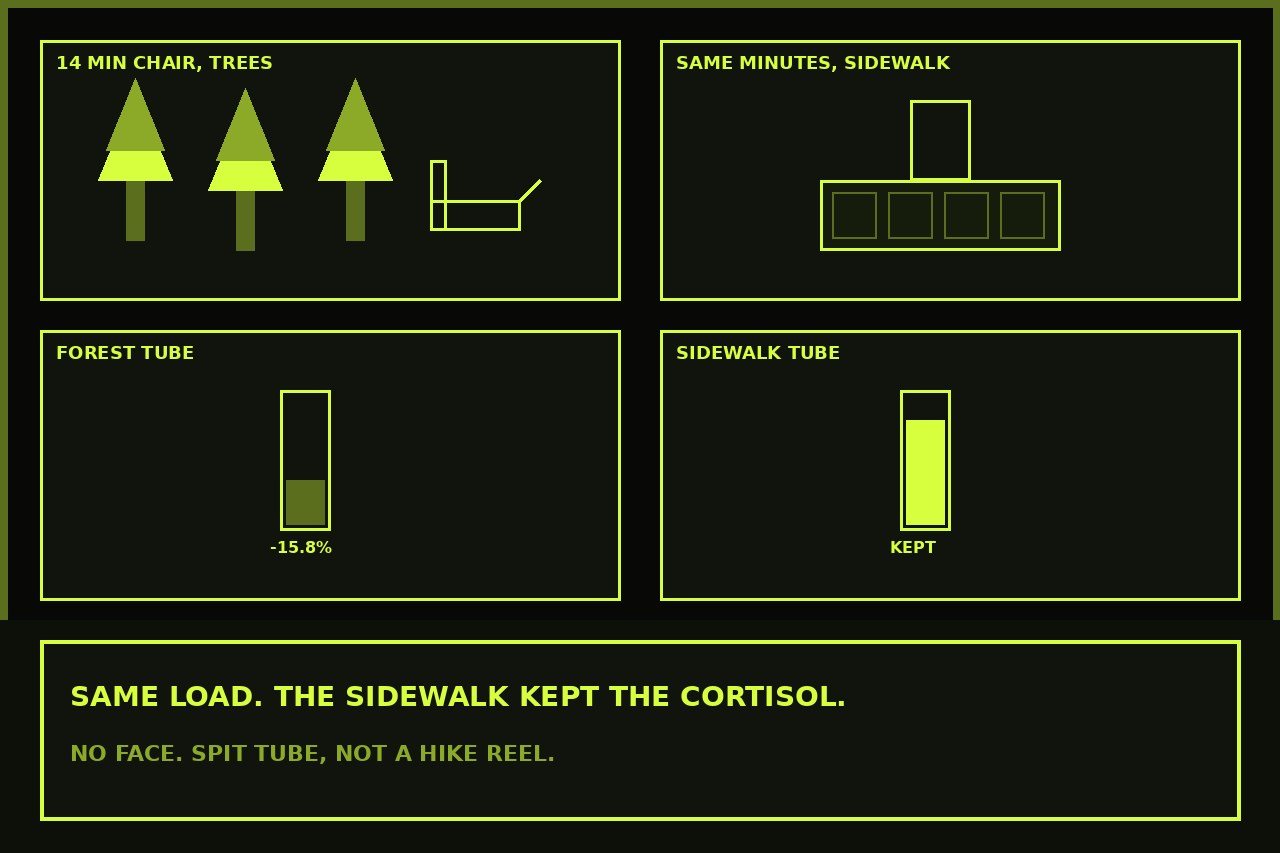
Forest bathing is time in the woods taking in sights, sounds, and smells. You walk or you sit among trees, and you notice what you see, hear, and smell. People use that word for quiet time under trees. This page uses the word the way this Japan file used it.
You wanted the walk under trees to drop the stress hormone. People who walked under those trees had a lower reading on the stress hormone they measured in spit.
What is shinrin-yoku?
Shinrin-yoku is the Japanese name for forest bathing. It means taking in the forest atmosphere. Japan’s Ministry of Agriculture, Forestry, and Fisheries coined that name in 1982.
Julie Corliss at Harvard Health used that same meaning on 3 August 2026. She wrote about time in the woods taking in sights, sounds, and smells. You can read her page at health.harvard.edu/heart-health/the-health-benefits-of-forest-bathing.
What is cortisol?
Cortisol is the stress hormone they measured in spit. Your body makes it when you feel stress. Salivary means from spit. The team asked people to hold cotton in their mouths, then they scored how much of that hormone was in the spit.
Does forest bathing drop cortisol?
Bum-Jin Park, Yuko Tsunetsugu, Tamami Kasetani, Takahide Kagawa, and Yoshifumi Miyazaki published this paper in 2010. The journal is Environmental Health and Preventive Medicine, a medical journal. They worked at the Center for Environment, Health and Field Sciences at Chiba University, and at the Forestry and Forest Products Research Institute in Tsukuba. You can read the paper at doi.org/10.1007/s12199-009-0086-9.
The title of the paper is “The physiological effects of Shinrin-yoku (taking in the forest atmosphere or forest bathing): evidence from field experiments in 24 forests across Japan.”
They ran the work in 24 areas across Japan in 2005 and 2006. Field means they did the work outside. Two hundred eighty healthy male university students joined. Their average age was 21.7, with a spread of 1.5 years. Twelve people joined at each site.
They used a crossover, which means the same people did the forest day and the city day on different days. On day 1, six people went to the forest and six people went to the city. On day 2 they swapped. They slept in identical rooms and ate identical meals. People could not drink alcohol or use tobacco, and the team controlled caffeine.
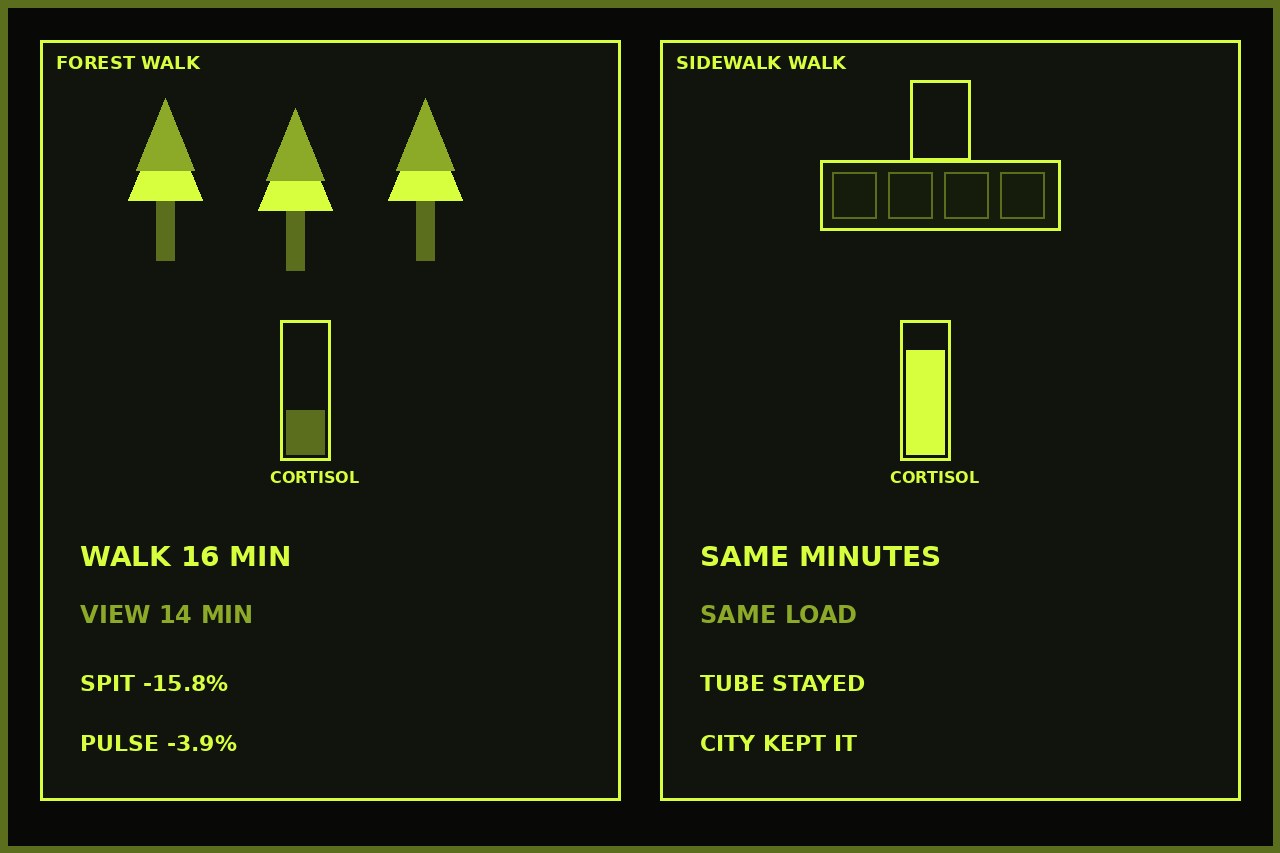
People walked for 16 minutes, with a spread of 5 minutes. People also viewed the place for 14 minutes, with a spread of 2 minutes. Viewing means they sat and looked at the forest or the city.
People who walked in the forest had spit cortisol 15.8 percent lower than they had after the city walk. People who viewed the forest had spit cortisol 13.4 percent lower than they had after they viewed the city. Both gaps had a p value under 0.01. A p value tells you how often a gap this big would show up if the two places were the same.
Did people walk harder in the forest than in the city?
People wore an AC-301A activity monitor. An activity monitor is a device that tracks how hard the body works. The team reported no load split between the sites. People spent the same energy with their legs on the forest walk and the city walk.
What happened to pulse after forest bathing?
Pulse is how many times the heart beats in a minute. After people viewed the forest, pulse was 6.0 percent lower than after they viewed the city. After the forest walk, pulse was 3.9 percent lower than after the city walk. Both gaps had a p value under 0.01.
Systolic pressure is the top number on a blood-pressure cuff. After people viewed the forest, that number was 1.7 percent lower than after they viewed the city. After the forest walk, it was 1.9 percent lower.
What is HRV?
HRV is how the time between heartbeats changes. HF is the slower-breath band of that heart-time signal. After people viewed the forest, that band was 56.1 percent higher than after they viewed the city. After the forest walk, that band was 102.0 percent higher.
The team also scored a ratio called LF/HF on that same heart-time signal. After people viewed the forest, that ratio was 18.0 percent lower than after they viewed the city. After the forest walk, it was 19.4 percent lower.
Did forest bathing change mood?
POMS is a mood sheet people fill out. One hundred sixteen people filled it out after viewing. Seventy-eight people filled it out after walking.
After the forest walk, people marked tension 1.1 points lower and vigor 4.2 points higher. After the city walk, they marked tension 3.2 points higher and vigor 0.2 points lower. They marked fatigue 2.1 points lower after the forest walk and 1.3 points higher after the city walk.
What are the limits of this forest bathing study?
The people were young Japanese men, and the days were short. They did the work in the field, not in a sealed room. The team printed percents next to the city walk, not a raw table of how much hormone was in each tube. They did not take spit the next day.
If you feel unusual distress, talk to a clinician, because this page is educational.
If you want the tai chi page, open the tai chi page.
Can you still want the walk under trees to drop the stress hormone?
You wanted the walk under trees to drop the stress hormone. Keep the forest bathing name.
The forest walk dropped spit cortisol 15.8 percent next to the city walk. The activity monitor said the legs spent the same energy. You can still want the walk under trees to drop the stress hormone.
Sources
Park B.J., Tsunetsugu Y., Kasetani T., Kagawa T., Miyazaki Y. “The physiological effects of Shinrin-yoku (taking in the forest atmosphere or forest bathing): evidence from field experiments in 24 forests across Japan.” Environmental Health and Preventive Medicine 2010, 15(1), 18-26. DOI 10.1007/s12199-009-0086-9. PMID 19568835. PMC 2793346. Center for Environment, Health and Field Sciences, Chiba University. Forestry and Forest Products Research Institute, Tsukuba. Field experiments in 24 areas, 2005-2006. 280 healthy male university students, mean age 21.7 SD 1.5, 12 per site. Ethics: Institutional Ethical Committee of the Forestry and Forest Products Research Institute. Informed consent the day before. Crossover: day 1 six forest / six city, day 2 swap. Identical rooms, identical meals, alcohol and tobacco prohibited, caffeine controlled. Walk 16 SD 5 min. View 14 SD 2 min. Morning measures at lodging before breakfast, then before and after walking, then before and after viewing, one person at a time. AC-301A activity monitor, no load split between sites. Saliva: two absorbent cotton pieces, 2 min, Sarstedt 51.1534, SRL Inc. radioimmunoassay. HRV: AC-301A, Mem-Calc, HF 0.15-0.4 Hz, LF 0.04-0.15 Hz. Cuff: Omron HEM1000, right upper arm. Forest vs city percents from figures: salivary cortisol viewing -13.4, walking -15.8, p under 0.01. Pulse viewing -6.0, walking -3.9, p under 0.01. Systolic viewing -1.7, walking -1.9. Diastolic viewing -1.6, walking -2.1. HF viewing +56.1, walking +102.0. LF/HF viewing -18.0, walking -19.4. POMS viewing n=116, walking n=78, Wilcoxon. Viewing forest vs city: tension -1.1 vs +3.5, depression -0.3 vs +0.1, anger -0.2 vs +1.0, fatigue -3.1 vs +1.8, confusion -1.0 vs +1.8, vigor +1.9 vs -1.9. Walking: tension -1.1 vs +3.2, depression -0.2 vs +0.8, anger -0.2 vs +0.8, fatigue -2.1 vs +1.3, confusion -1.1 vs +1.1, vigor +4.2 vs -0.2. Limitations: young Japanese men, short span, field, percents vs city rather than a raw nanomole table, no next-day saliva. Grant-in-Aid for Scientific Research S: 16107007, MEXT. Term Shinrin-yoku coined 1982 by the Japanese Ministry of Agriculture, Forestry, and Fisheries. doi.org/10.1007/s12199-009-0086-9 · pubmed.ncbi.nlm.nih.gov/19568835 · PMC2793346
Corliss J. “The health benefits of forest bathing.” Harvard Health, 3 August 2026. Neighbor sensory definition: time in the woods taking in sights, sounds, and smells. health.harvard.edu/heart-health/the-health-benefits-of-forest-bathing