Mental practice · motor imagery · first move

Play the first bar with a still hand.

JM Thomas · 17 August 2026

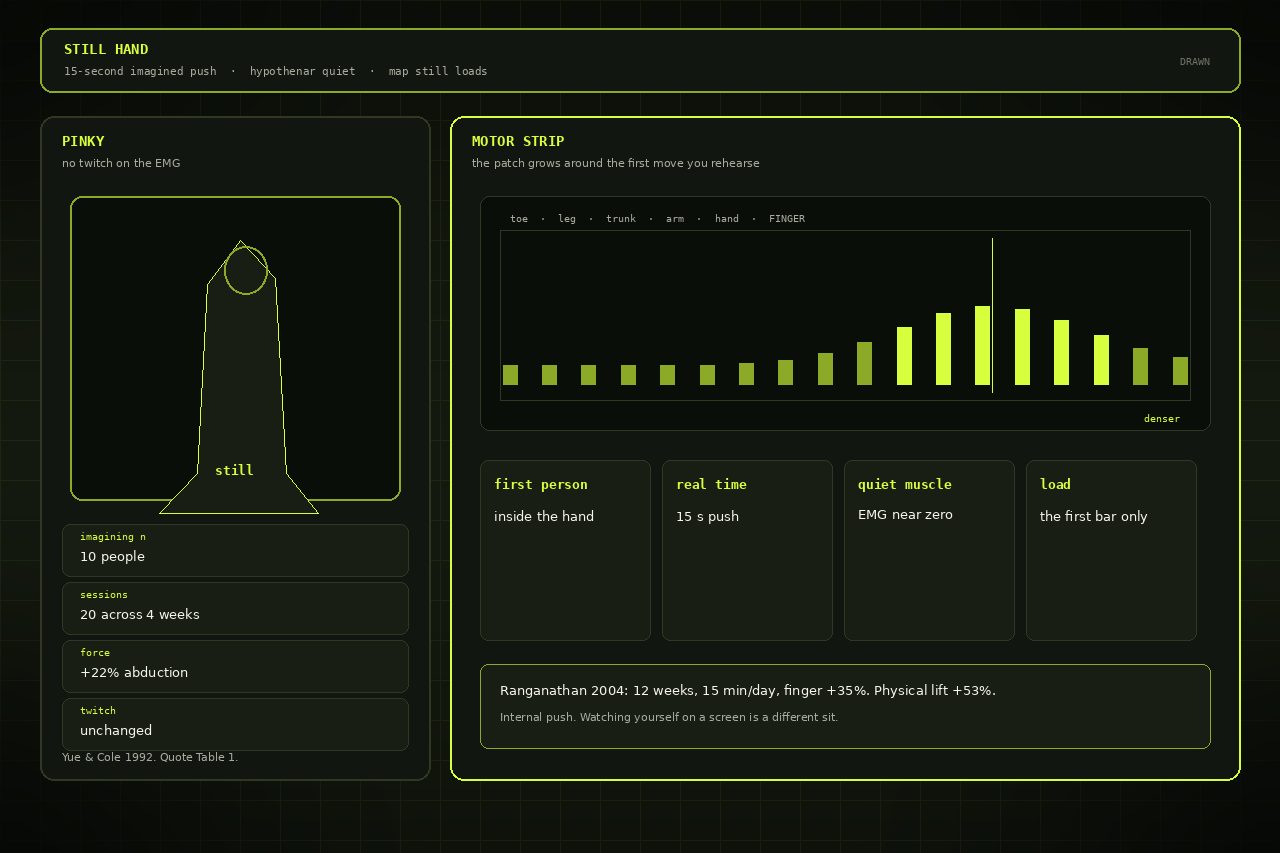
Ten people imagined pushing a little finger for four weeks. The muscle stayed quiet. Abduction force rose 22 percent.

Dark lime drawing of a still pinky beside a denser motor-strip patch for the finger.
Still pinky on the left. Motor strip denser at the finger on the right.

A prize picture shows the finished life. Mental practice loads the first move into the motor strip while the hand stays still, first person, in the same seconds the real act would take.

You already bought the vision board kit. Then you sat there looking at a car. The strip never got a first move to load, so the collage stayed a fridge letter.

The A on the fridge

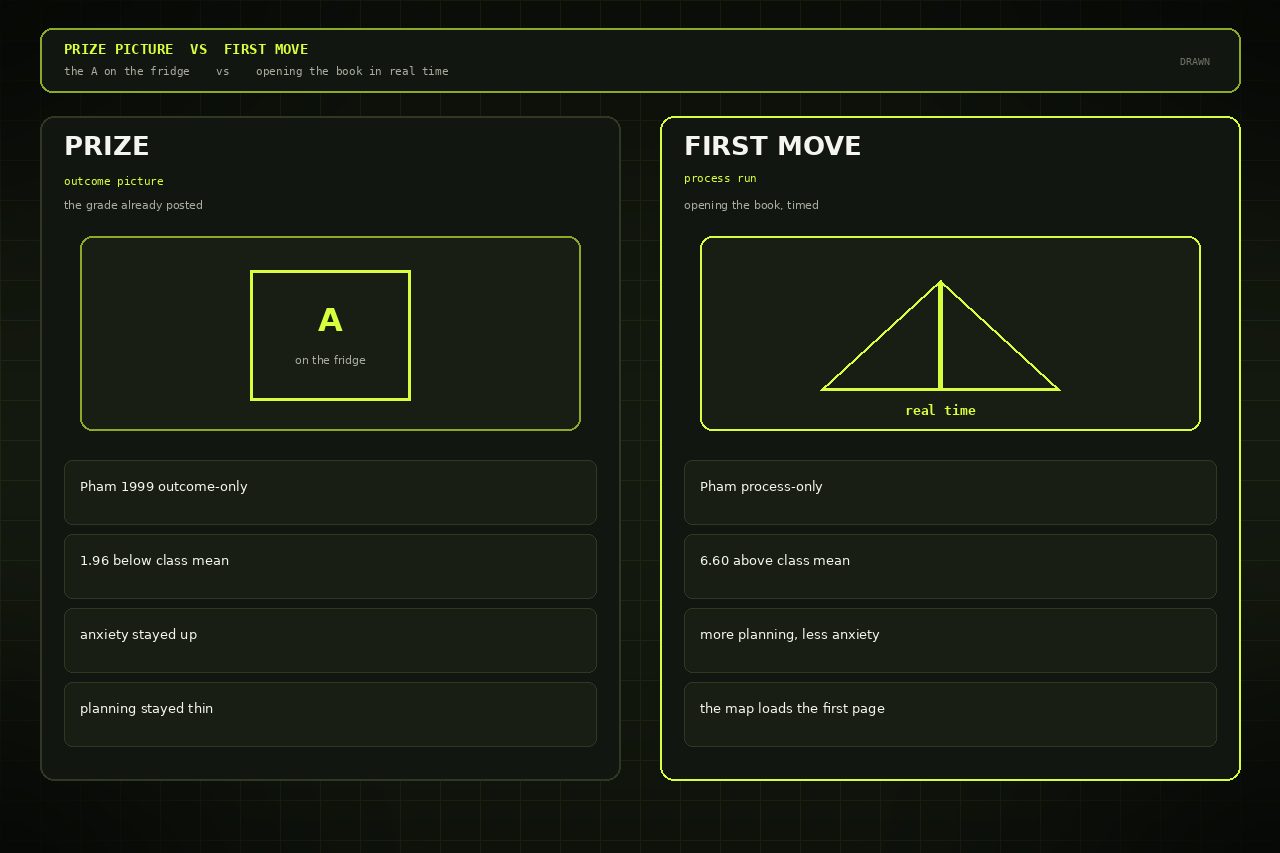
Freshmen who pictured getting the A scored worse than the ones who pictured opening the book.

Pham and Taylor put 101 undergraduates into process, outcome, both, or a self-monitoring control for five to seven days before a midterm. Personality and Social Psychology Bulletin, 1999. DOI 10.1177/0146167299025002010.

Process meant studying: where you sit, what page you open, how long you stay with the book in real time. Outcome meant the grade already posted on the fridge. Process-only landed 6.60 points above the class mean. Outcome-only landed 1.96 below it. Planning rose and anxiety fell, and studying rose with them. The grade followed the run, not the fridge letter.

That is the split. Rehearse the first move. Leave the prize off the tape.

A quiet pinky still gained 22 percent

Yue and Cole trained imagined maximal abduction for four weeks. Force rose. Twitch force did not. The muscle did not grow.

Journal of Neurophysiology, 1992. DOI 10.1152/jn.1992.67.5.1114. PMID 1597701. Thirty healthy adults, ages 21 to 29. Ten to imagining. Ten to real contractions. Ten controls. Three missed the post-test, so post numbers sit at imagining n=10, contraction n=8, control n=9.

Twenty sessions, fifteen imagined pushes a day, twenty seconds of rest after every second trial, each push held about fifteen seconds. Hypothenar EMG stayed quiet on about 80 percent of the monitored days. Left fifth-digit abduction force rose 22.03 percent. Contraction training rose 29.75 percent. Control rose 3.68 percent. Evoked twitch force did not move, and great-toe extension did not move, so the gain was not a whole-body pep talk. The other hand still gained about 10 percent after the imagined arm. The program transferred a little. The muscle on the trained side never had to fire for the gain to show.

Close your eyes. A still little finger. A louder map. That is the picture.

Cleveland ran twelve weeks

Ranganathan trained mental maximal contractions fifteen minutes a day. Finger abduction rose 35 percent. Elbow flexion rose 13.5 percent. Cortical potential rose with the force.

Neuropsychologia, 2004. DOI 10.1016/j.neuropsychologia.2003.11.018. PMID 14998709. Thirty volunteers. Eight mental finger. Eight mental elbow. Eight control. Six later did physical finger lifts. Five finished that arm.

Fifty trials a session, five seconds of imagined push, five seconds of rest. Internal imagery: urge the muscle from inside the limb, and do not watch yourself on a mental TV. Heart rate and systolic pressure rose a little during the mental finger sits, which is how they knew the brain was actually working. EMG during those sits sat near 1.5 percent of a real maximal contraction. At twelve weeks the finger group was up 35 percent. Peak gain hit 40 percent four weeks after training stopped. Physical lifts hit 53 percent with an 8.3 percent bump in muscle volume, so the mental arm had no hypertrophy to lean on. The EEG-derived cortical potential rose with the force. That is the lock on this page. The brain signal got louder. The finger followed.

Elbow gained less. Thirteen and a half percent. Used more in daily life. Less room left. Distal unused muscle takes the load better. Quote that when someone asks why a pinky moved more than a biceps.

Herbert, Dean, and Gandevia ran an eight-week imagined elbow program in 1998 and did not beat control. Ranganathan's group treated that as a cue to switch the sit. Internal push. Heart rate up a little. Blood pressure up a little. A tape that says "imagine producing maximal contractions" from the outside can leave the strip unloaded. The Cleveland sit named the urge from inside the limb.

Dark lime split. Left an A on a fridge. Right an open book timed as a first move.
Left: the A already posted. Right: opening the book in real time.

The keyboard can stay shut

Pascual-Leone mapped finger flexors and extensors with TMS while people learned a five-finger piano exercise. Mental practice of the same run enlarged the maps the way physical practice did.

Journal of Neurophysiology, 1995. DOI 10.1152/jn.1995.74.3.1037. PMID 7500130. Five days of two-hour sits. Physical practice grew the cortical output maps and dropped the activation threshold for the finger muscles in the run. A second experiment put mental practice of the same five-finger run against physical practice, and the maps grew in both. The keyboard can stay shut and the strip still learns the sequence you rehearse.

I already mapped the collage fail on why vision boards fail. That page is a screaming nerve under an outcome picture. This page is the first move the strip can actually hold. Use the board page for the collage. Use this sit for the first move.

First person, real time, first move

Pick one act. Sit. Push it from inside for fifteen minutes. Write a 1-to-10 before and after.

Name the move in one sentence. Opening the laptop. Walking to the gym door. Pressing the first key of the email. The finished book stays off the tape. The parked car stays off the tape.

Chair. Eyes closed if that helps. First person, inside the hand or the foot that starts it, in real time. Feel the weight of the door handle. Feel the first key go down. About fifteen seconds of urged push, then a short rest, then again, until you have fifty trials or a clean fifteen-minute block. Leave the limb still. If EMG were on, it should look nearly flat.

Yue's 22 percent took four weeks. Cleveland's 35 percent took twelve. Tonight you only write whether the block happened. 1-to-10 before. 1-to-10 after. Seven mornings. Yes or no next to the same move. A pretty visualization with no log is another app.

If the jaw clamps before the finger even pushes, sit until the clamp lets go. Then start the fifteen-second push again. That first sit is Protocol 01. Free. The fifteen-minute block still needs a jaw quiet enough to feel the push from inside.

Keep the first move

Write the move in one line tonight. Fifteen minutes. Still hand. Yes or no in the margin. Do that seven times before you shop another visualization. Protocol 01 is the clamp-release sit if the jaw will not drop. The Library waits until that notebook exists.

Questions that keep coming

Is this the same as staring at a vision board?

A board pins a finished life on a wall. Tonight's sit is one timed first move, first person, still hand. The vision-boards page already names the collage fail.

Do I need to feel the muscle twitch?

No. Yue kept hypothenar EMG quiet on most training days. The force still rose. Urge the push from inside. Leave the hand still.

How long before I write anything down?

Write tonight's 1-to-10 after the block. Yue's force number took four weeks. Cleveland's took twelve. The log starts today. The percent waits.

Can I watch myself on a screen in my head?

That is external imagery. Ranganathan's gains came from an internal push that raised heart rate and blood pressure a little. Watching yourself on a mental TV is external imagery.

Is this a medical page?

No. Finger abduction and exam scores are literature. If a sit arrives with panic, call a doctor, not another visualization clip.

Locks

Yue, G., and Cole, K.J. "Strength increases from the motor program: comparison of training with maximal voluntary and imagined muscle contractions." Journal of Neurophysiology 1992;67(5):1114-1123. DOI 10.1152/jn.1992.67.5.1114. PMID 1597701. n=30 assigned (10 imagining, 10 contraction, 10 control); post-test imagining n=10, contraction n=8, control n=9. 4 weeks, 20 sessions, 15 imagined maximal abductions per session. Left fifth-digit abduction +22.03% imagining, +29.75% contraction, +3.68% control. Contralateral imagining +10.45%. Twitch force unchanged. doi.org/10.1152/jn.1992.67.5.1114 · europepmc.org/article/MED/1597701

Ranganathan, V.K., Siemionow, V., Liu, J.Z., Sahgal, V., and Yue, G.H. "From mental power to muscle power - gaining strength by using the mind." Neuropsychologia 2004;42(7):944-956. DOI 10.1016/j.neuropsychologia.2003.11.018. PMID 14998709. n=30 (+6 physical later; 5 finished). Mental ABD n=8 +35% at 12 weeks (peak +40% at week 4 post). Mental ELB n=8 +13.5%. Control n=8 flat. Physical ABD +53%, ADM volume +8.3%. 15 min/day, 5 days/week, 50 trials of 5 s. Internal imagery. MRCP up with force. doi.org/10.1016/j.neuropsychologia.2003.11.018 · pubmed.ncbi.nlm.nih.gov/14998709

Pham, L.B., and Taylor, S.E. "From thought to action: effects of process- versus outcome-based mental simulations on performance." Personality and Social Psychology Bulletin 1999;25(2):250-260. DOI 10.1177/0146167299025002010. n=101 undergraduates. Process-only vs class mean M=6.60. Outcome-only M=-1.96. Process raised planning and studying and cut anxiety. doi.org/10.1177/0146167299025002010

Herbert, R.D., Dean, C., and Gandevia, S.C. "Effects of real and imagined training on voluntary muscle activation during maximal isometric contractions." Acta Physiologica Scandinavica 1998;163(4):361-368. DOI 10.1046/j.1365-201x.1998.00373.x. PMID 9715739. Imagined elbow vs control, no significant split in the file Ranganathan cites. Trial n not quoted on this page. doi.org/10.1046/j.1365-201x.1998.00373.x · europepmc.org/article/MED/9715739

Pascual-Leone, A., Nguyet, D., Cohen, L.G., Brasil-Neto, J.P., Cammarota, A., and Hallett, M. "Modulation of muscle responses evoked by transcranial magnetic stimulation during the acquisition of new fine motor skills." Journal of Neurophysiology 1995;74(3):1037-1045. DOI 10.1152/jn.1995.74.3.1037. PMID 7500130. Five-finger piano exercise, 5 days, TMS maps of finger flexors and extensors. Physical practice enlarged maps and dropped threshold. Mental practice of the same exercise produced similar map growth. doi.org/10.1152/jn.1995.74.3.1037 · europepmc.org/article/MED/7500130