Third-person self-talk · self-distancing · name
Talking to yourself by name calmed the speech.
You wanted the name to calm the speech after I already sat on the card.
Talking to yourself by name, also called third-person self-talk, is when you use your first name instead of I. I-talk is when you use I and me. Self-distancing is when you talk as if you are one chair back from the heat. Heat here is the hard minute of the speech. A podium here is the stand where they talked in front of two evaluators and a camera. Shame is how ashamed they felt after. Replay is how they replayed the speech in their head. Eta squared, also written ηp², is how much of the change the group explained. JPSP is the journal. LPP is a late brain wave from Moser 2017, which is later different work and only a neighbor on this page. Keep the name-talk name.
What is talking to yourself by name?
Talking to yourself by name is when you use your first name instead of I. You still talk to yourself. You just put your first name in the line where I would go.
People already talk to themselves before a hard minute. You wanted that name to calm the speech after I already sat on the card, so keep the name-talk name.
What is I-talk?
I-talk is when you use I and me. People already do this when they talk themselves through a speech, a test, or a hard minute. You can still use I and me. That is a real move people already make.
Keep wanting the name to calm the speech.
What is self-distancing?
Self-distancing is when you talk as if you are one chair back from the heat. Heat here is the hard minute of the speech. You stay in the room. You talk like you can see the speech from one chair back.
Talking to yourself by name is one way people do that. Keep the name-talk name if that is the move you came here for.
Did talking to yourself by name calm the speech?
Kross, with Bruehlman-Senecal, Park, Burson, Dougherty, Shablack, Bremner, Moser, and Ayduk, published this paper in 2014 in JPSP. JPSP is the journal. You can read the paper at doi.org/10.1037/a0035173.
The title of the paper is “Self-talk as a regulatory mechanism: How you do it matters.” It also carries DOI 10.1037/a0035173 and PMID 24467424.
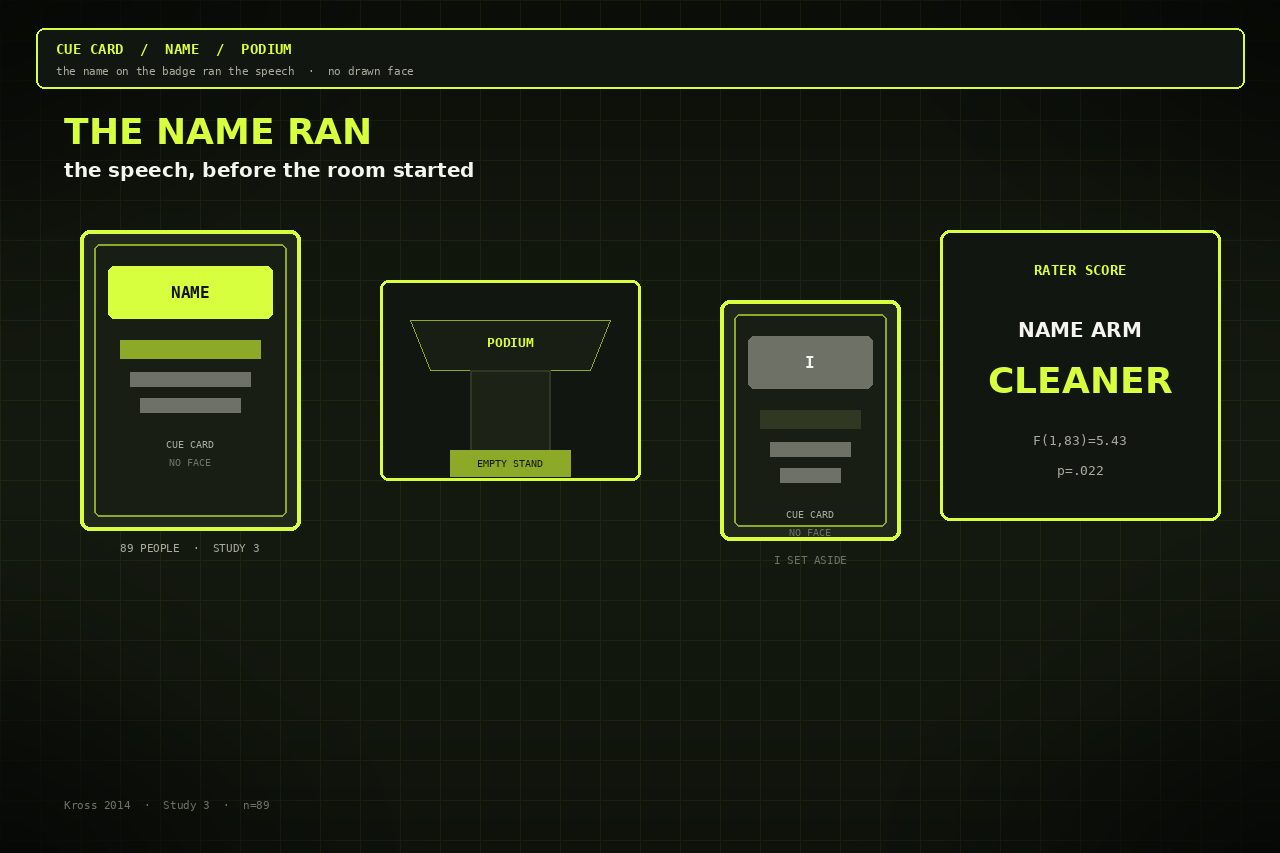
They ran seven studies. The total count was 585 people. Study 3 enrolled 89 people, with 45 people using I and 44 people using their first name.
People got five minutes to prep. Then they talked for five minutes at a podium in front of two evaluators and a camera. A podium here is that stand with the two evaluators and the camera.
Some people used I and me while they prepped. Other people used their first name. Then raters scored the speech.
Raters scored people who used their first name higher than people who used I. That speech score was F(1,83)=5.43, and the p value was .022. Eta squared was .061. Eta squared tells you how much of the change the group explained. A p value tells you how often a gap this big would show up if the two groups were the same.
Keep wanting the name to calm the speech.
Did people feel less shame after they used their name?
Shame is how ashamed they felt after. People who used their first name marked less shame than people who used I. That shame score was F(1,82)=7.70, and the p value was .007.
People who used I still made a real move. Keep the I-talk if you already use I and me. You can still want the name to calm the speech.
Did people replay the speech less in their head?
Replay is how they replayed the speech in their head. People who used their first name replayed the speech less than people who used I. That replay score was F(1,83)=5.47, and the p value was .022.
Keep the name-talk name.
What did Moser print later about a late brain wave?
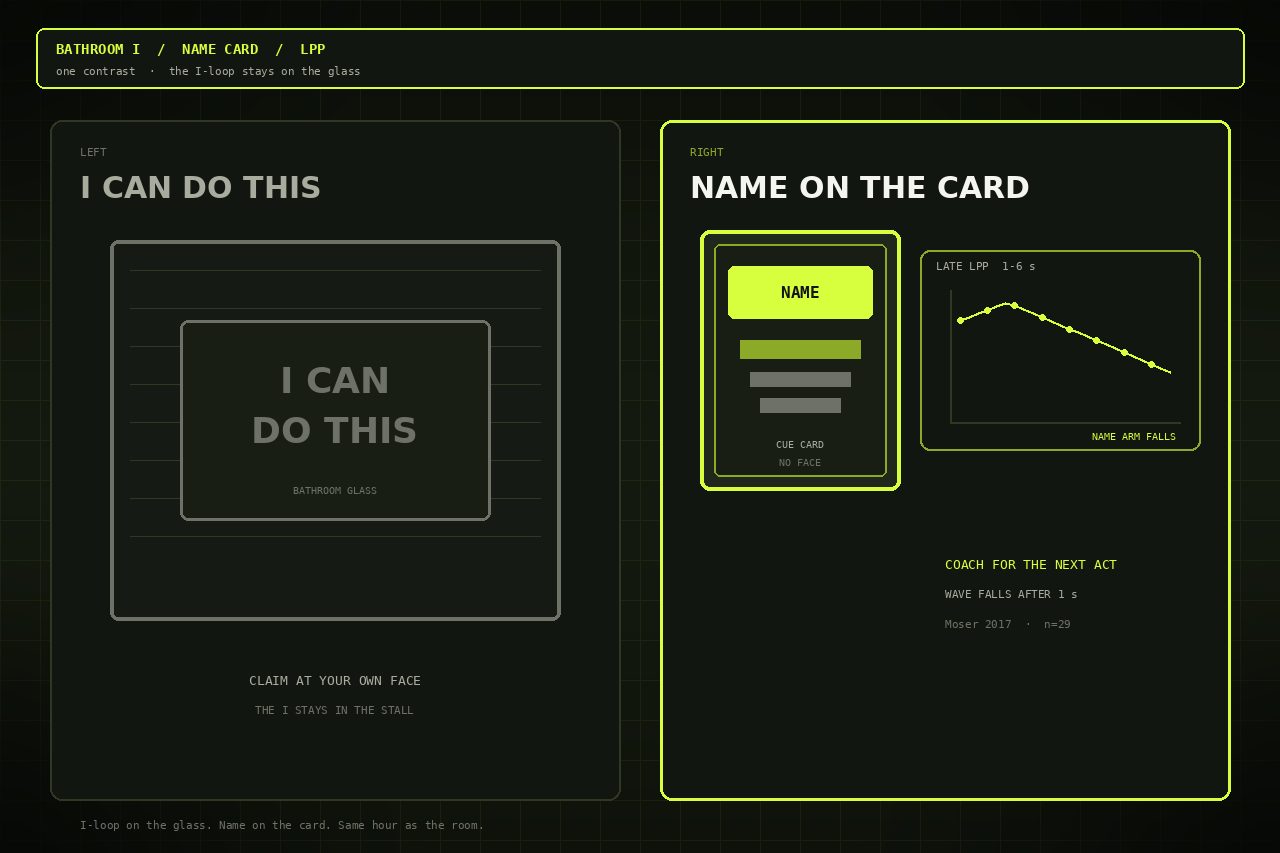
LPP is a late brain wave. Moser printed late LPP and MPFC in 2017. MPFC is a middle front region. That work is later different work, so keep it as a neighbor on this page.
Keep wanting the name to calm the speech.
Can you still talk to yourself with I?
You can still use I and me. I-talk is a real move people already make. People already say I can do this when the minute is hard.
Keep the I-talk if that is the line you already use. You can still want the name to calm the speech after I already sat on the card.
If you feel unusual distress or you need care, talk to a clinician, because this page is educational and not a diagnosis.
If you want a page about a picture that came back after people tried not to think of it, open the white bear page.
Can you still want the name to calm the speech?
You wanted the name to calm the speech after I already sat on the card. Keep the name-talk name.
Raters scored people who used their first name higher than people who used I, F(1,83)=5.43. People who used I still made a real move. You can still want the name to calm the speech.
Sources
Kross E., Bruehlman-Senecal E., Park J., Burson A., Dougherty A., Shablack H., Bremner R., Moser J., Ayduk O. “Self-talk as a regulatory mechanism: How you do it matters.” JPSP 2014;106(2):304-324. DOI 10.1037/a0035173. PMID 24467424. Seven studies, total N=585. Study 3 n=89, 45 I, 44 name. Five minutes to prep, five minutes at a podium in front of two evaluators and a camera. Speech performance F(1,83)=5.43, p=.022, ηp²=.061. Shame F(1,82)=7.70, p=.007. Replay F(1,83)=5.47, p=.022. Moser 2017 late LPP, MPFC, later different work, neighbor. doi.org/10.1037/a0035173 · pubmed.ncbi.nlm.nih.gov/24467424