Ashwagandha · Withania · perceived stress
Ashwagandha cut perceived stress 44 percent.
You wanted the root to drop the stress sheet after a dummy capsule already had sixty days.
Ashwagandha, also called Withania, is a root people take as a capsule. Perceived stress is how stressed life feels, and PSS is a sheet that scores that feeling. A dummy, also called a placebo, is a capsule with no root. KSM-66 is the extract name. Withanolides are the plant compounds they measured. HPLC is the lab method they used to measure those compounds. WHO-5 is a wellbeing sheet. GHQ-28 and DASS are other symptom sheets. Cortisol is the stress hormone a blood test can see. Double-blind means nobody knew who got the root. ug/dL is how they wrote the cortisol number. Keep the ashwagandha name.
What is ashwagandha?
Ashwagandha is a root people take as a capsule. People also call it Withania. Ayurveda is the older Indian medical system that already named this root.
You wanted that root to drop the stress sheet. Keep the ashwagandha name. KSM-66 is the extract name they used. Ixoreal Biomed made that extract from roots only. Withanolides are the plant compounds they measured. HPLC is the lab method they used to measure those compounds. The team printed withanolides at least 5 percent.
What is perceived stress?
Perceived stress is how stressed life feels. PSS is the sheet that scores that feeling. People mark how often life has felt hard, and the team adds those marks. A higher number means life felt more stressed.
People had to score at least 14 on that sheet to join. WHO-5 is a wellbeing sheet. People also had to score 15 or lower on that wellbeing sheet.
How does a dummy capsule work?
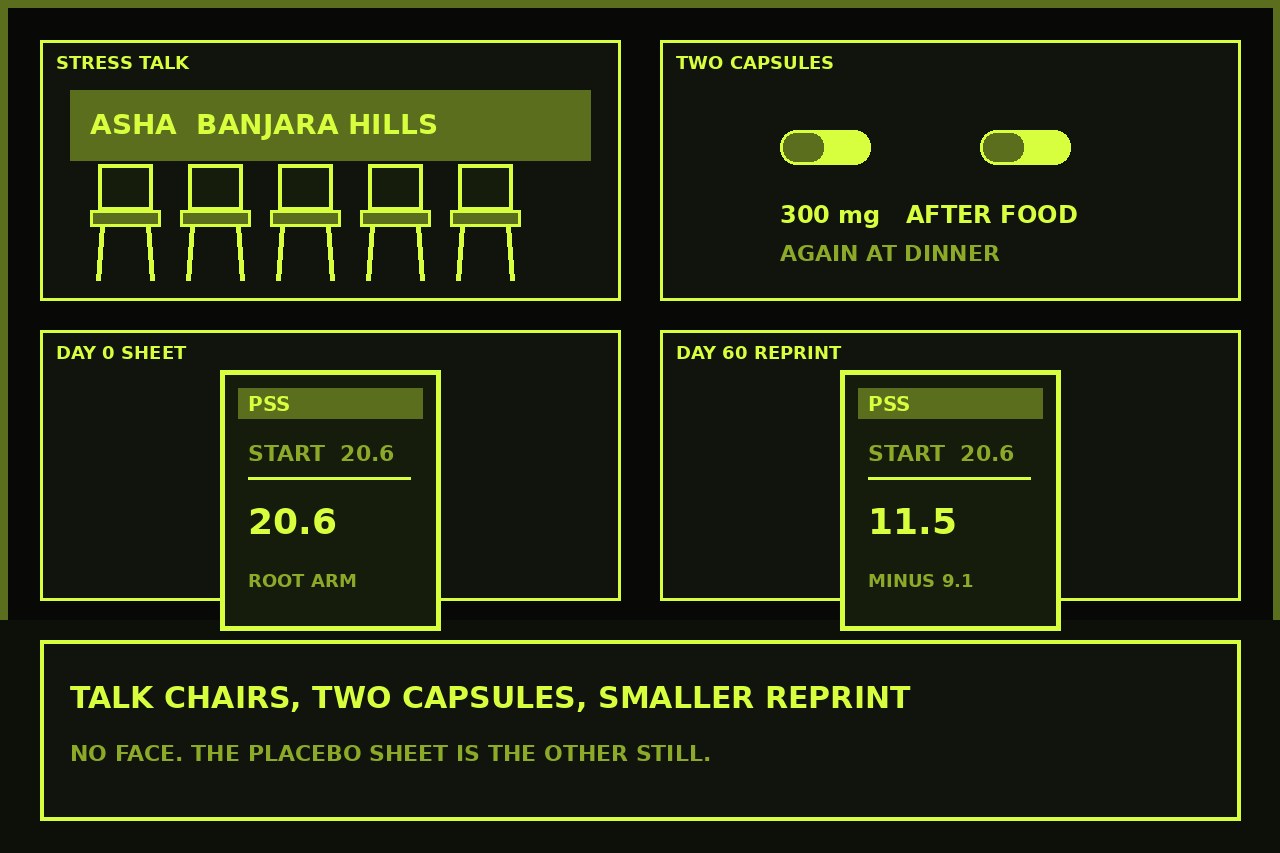
A dummy, also called a placebo, is a capsule with no root. People who got the dummy still took a capsule twice a day after food with water for sixty days. Nobody knew who got the root. That is what double-blind means.
People who took the dummy also moved a little. They dropped 1.4 points on the stress sheet, which is 5.5 percent. Keep that small move. People who took the root still dropped more.
Did ashwagandha cut perceived stress 44 percent?
Chandrasekhar, with Kapoor and Anishetty, published this paper in 2012 in Indian Journal of Psychological Medicine. They ran the work at Asha Hospital in Banjara Hills, Hyderabad. You can read the paper at doi.org/10.4103/0253-7176.106022.
The title of the paper is “A Prospective, Randomized Double-Blind, Placebo-Controlled Study of Safety and Efficacy of a High-Concentration Full-Spectrum Extract of Ashwagandha Root in Reducing Stress and Anxiety in Adults.” It also carries DOI 10.4103/0253-7176.106022, PMID 23439798, and PMC 3573577.
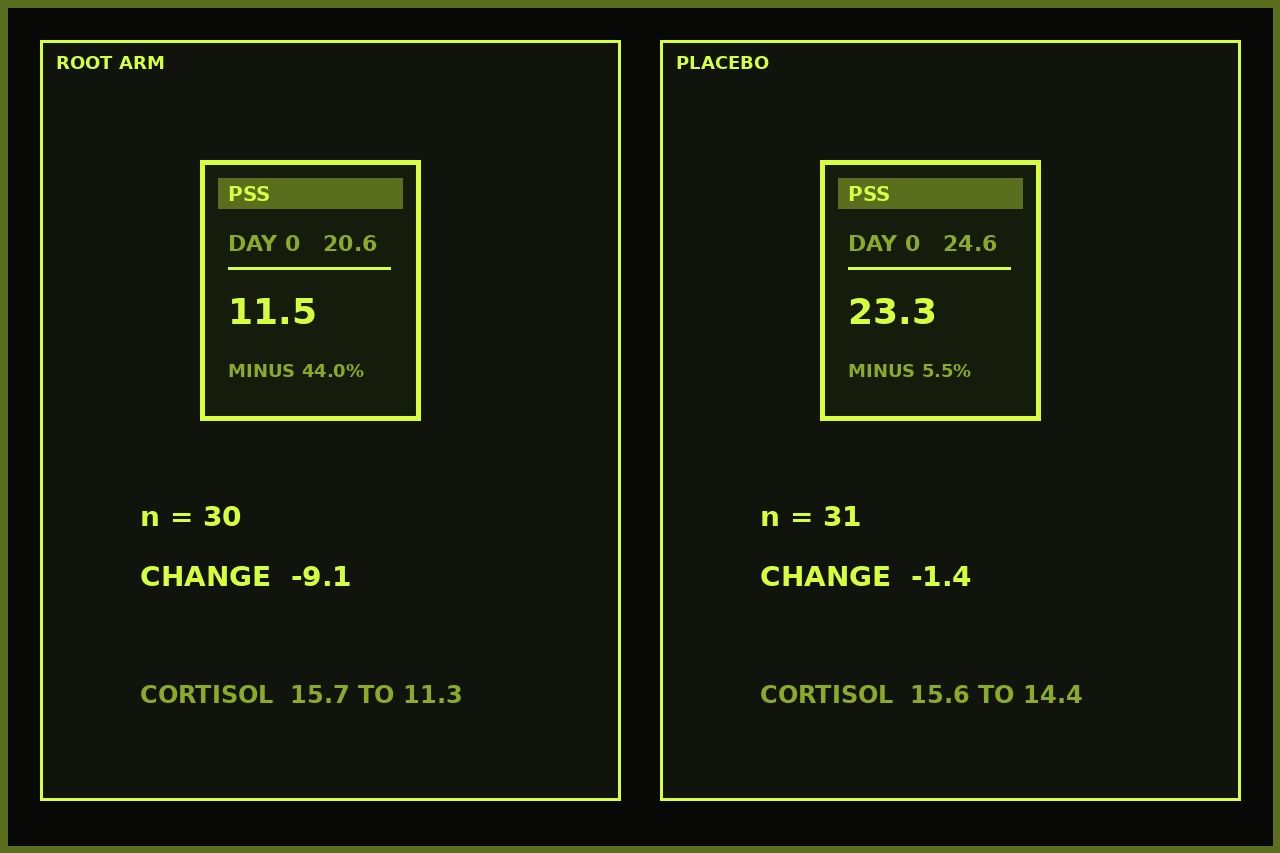
They enrolled 64 people, with 32 people in each group. That group had 41 men and 23 women, ages 18 to 54. After 2 people on the root and 1 person on the dummy were lost, the team counted 61 people for the score. That count is 30 people on the root and 31 people on the dummy.
People who took the root started at 20.6 on the stress sheet, with a spread of 4.8. A spread is how far the scores were from that average. After sixty days those people landed at 11.5, with a spread of 6.2. That change is minus 9.1, with a spread of 8.6, which is minus 44.0 percent.
People who took the dummy started at 24.6, with a spread of 6.7. After sixty days those people landed at 23.3, with a spread of 7.2. That change is minus 1.4, with a spread of 5.3, which is minus 5.5 percent.
The gap between the two groups had a p value under 0.0001. A p value tells you how often a gap this big would show up if the two capsules were the same.
On day zero people on the root already scored 20.6 and people on the dummy scored 24.6. That baseline split had a p value of 0.0094. People on the root still landed at 11.5. You can still want the root to drop the sheet.
How much ashwagandha did people take?
People took a 300 milligram capsule of the root extract. A milligram is a tiny unit of weight. They took one capsule twice a day after food with water for 60 days.
Did ashwagandha drop cortisol?
Cortisol is the stress hormone a blood test can see. ug/dL is how they wrote the cortisol number. People on the root went from 15.7 to 11.3, which is minus 27.9 percent. People on the dummy went from 15.6 to 14.4, which is minus 7.9 percent. The change gap had a p value of 0.002.
What other sheets did people fill out?
GHQ-28 and DASS are other symptom sheets. On GHQ-28, people on the root dropped 72.3 and people on the dummy dropped 2.3. On DASS, people on the root dropped 71.6 and people on the dummy dropped 5.0.
Was ashwagandha safe?
Six people on the root marked a mild event. Five people on the dummy marked a mild event. The team printed Source of Support Nil and Conflict None. Ixoreal supplied the extract.
If you feel unusual distress or you need care, talk to a clinician, because this page is educational and not a diagnosis.
If you want a page about a silent heartbeat count that predicted who stayed on a trading desk, open the heartbeat count page.
Can you still want the root to drop the stress sheet?
You wanted the root to drop the stress sheet after a dummy capsule already had sixty days. Keep the ashwagandha name.
People who took the root dropped the stress sheet 44.0 percent and people who took the dummy dropped 5.5. People on the dummy also moved a little, 1.4 points. On day zero the two groups already split, 20.6 against 24.6, with p=0.0094. You can still want the root to drop the sheet.
Sources
Chandrasekhar K., Kapoor J., Anishetty S. “A Prospective, Randomized Double-Blind, Placebo-Controlled Study of Safety and Efficacy of a High-Concentration Full-Spectrum Extract of Ashwagandha Root in Reducing Stress and Anxiety in Adults.” Indian Journal of Psychological Medicine 2012;34(3):255-262. DOI 10.4103/0253-7176.106022. PMID 23439798. PMC 3573577. Asha Hospital, Banjara Hills, Hyderabad. KSM-66, Ixoreal Biomed, roots only, HPLC withanolides at least 5 percent. Dose 300 mg capsule twice daily after food with water for 60 days. Enrolled n=64, 32 per arm, 41 men 23 women. Efficacy n=61 (30 root, 31 placebo) after 2 root and 1 placebo lost. Age 18-54. Inclusion WHO-5 15 or lower, PSS at least 14. PSS root 20.6 SD 4.8 to 11.5 SD 6.2, change -9.1 SD 8.6, -44.0 percent. Placebo 24.6 SD 6.7 to 23.3 SD 7.2, change -1.4 SD 5.3, -5.5 percent. Between-group p under 0.0001. Baseline split p=0.0094. Cortisol ug/dL 15.7 to 11.3, -27.9 percent vs 15.6 to 14.4, -7.9 percent, change p=0.002. GHQ-28 -72.3 vs -2.3. DASS -71.6 vs -5.0. Adverse 6 vs 5, all mild. Source of Support Nil. Conflict None. Extract supplied by Ixoreal. doi.org/10.4103/0253-7176.106022 · pubmed.ncbi.nlm.nih.gov/23439798 · ncbi.nlm.nih.gov/pmc/articles/PMC3573577