Progressive muscle relaxation · PMR · skin tension
Progressive muscle relaxation dropped skin tension in twenty minutes.
You wanted the squeeze-and-open tape to drop the skin bar after a magazine already had twenty minutes.
Progressive muscle relaxation, also called PMR, is when you squeeze a muscle group, then let it go, then move to the next group. Skin tension, also called skin conductance, is how charged the skin is on the fingers. That charge is a mark of arousal, which means how wound up the body is. People on this page call that reading the skin bar. A magazine control is twenty minutes with TIME and Sports Illustrated and no tape. Toussaint and the team at Luther College in Decorah, Iowa ran this work. Keep the PMR name.
What is progressive muscle relaxation?
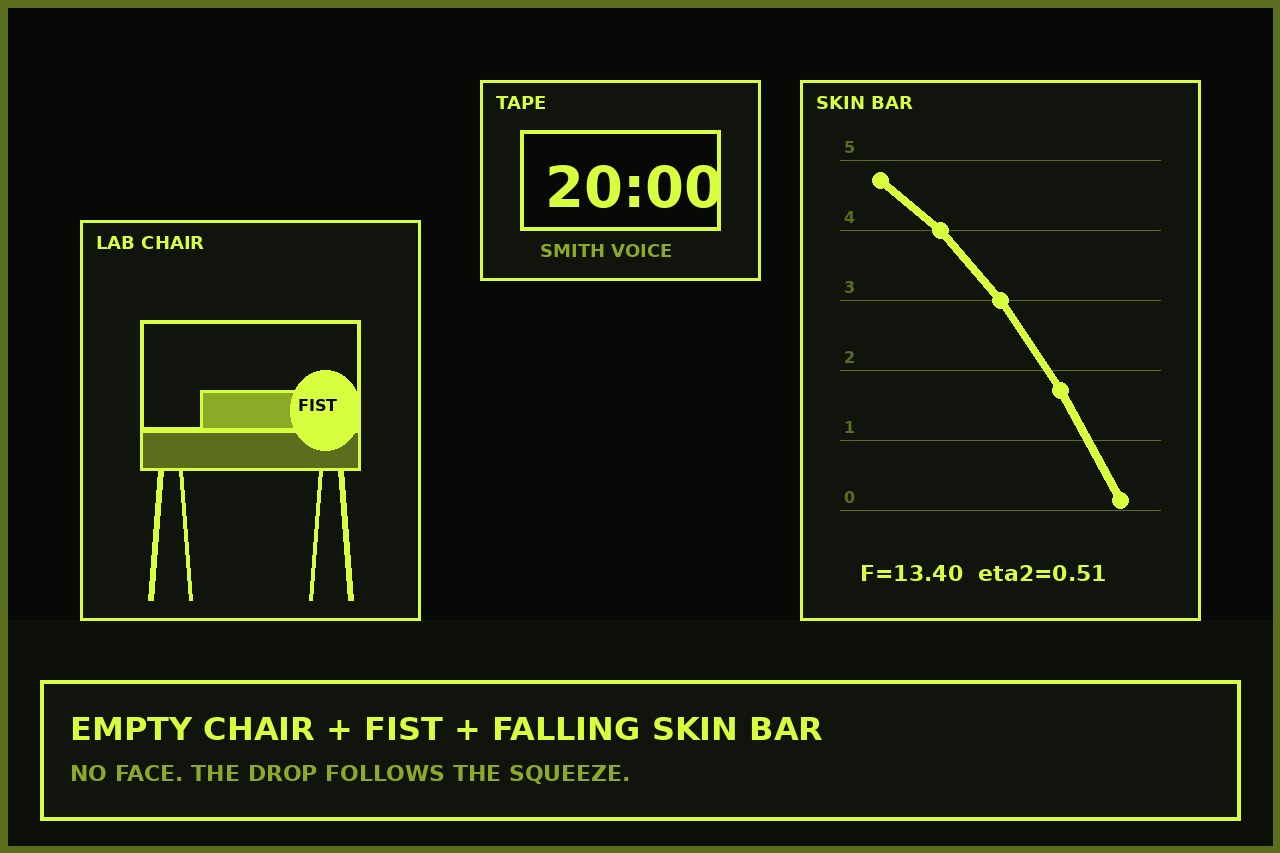
Progressive muscle relaxation, also called PMR, is when you squeeze a muscle group, then let it go, then move to the next group. People also call that squeeze-and-release. In this study, people heard a twenty-minute recorded audio by Dr. Jonathon Smith. You wanted that squeeze-and-open tape to drop the skin bar after a magazine already had twenty minutes. Keep the squeeze-and-open tape.
What is skin tension?
Skin tension, also called skin conductance, is how charged the skin is on the fingers. That charge is a mark of arousal. Electrodermal means the finger sensors. The team put those sensors on the first and second fingers of the nondominant hand. The nondominant hand is the hand a person does not write with. A Biopac MP35 is the box the team used to record the skin. A lower skin bar means the fingers were less charged.
What is a magazine control?
A magazine control is twenty minutes with TIME and Sports Illustrated and no tape. People in that room got the magazines. They did not hear the squeeze-and-open tape. People with magazines also felt more relaxed on the sheet. Keep that room too.
What is the SRSI-3 sheet?
SRSI-3 is a sheet that scores how relaxed you feel. The sheet has 38 items. People mark each item from 1 to 6. The team printed an alpha above 0.90. Alpha tells you how well the items hang together.
Did progressive muscle relaxation drop skin tension?
Toussaint, Nguyen, Roettger, Dixon, Offenbacher, Kohls, Hirsch, and Sirois published this paper in 2021. The journal is Evidence-Based Complementary and Alternative Medicine. They ran the work at Luther College in Decorah, Iowa. Luther College is a school in Decorah, Iowa. You can read the paper at doi.org/10.1155/2021/5924040.
The title of the paper is “Effectiveness of Progressive Muscle Relaxation, Deep Breathing, and Guided Imagery in Promoting Psychological and Physiological States of Relaxation.” It also carries DOI 10.1155/2021/5924040 and PMID 34306146.
Sixty undergraduate psychology students joined for extra credit. Undergraduate means they were in college. Extra credit means they got points in a class. 71.4 percent of the group were female. Mean age was 19.64, with a spread of 1.32. People were 18 to 23 years old.
The team ran the rooms in the evening, from 7:00 p.m. to 9:00 p.m. People skipped caffeine for 12 hours before they came in. Deep breathing and guided imagery were other rooms in the same paper.
How much did the skin bar drop?
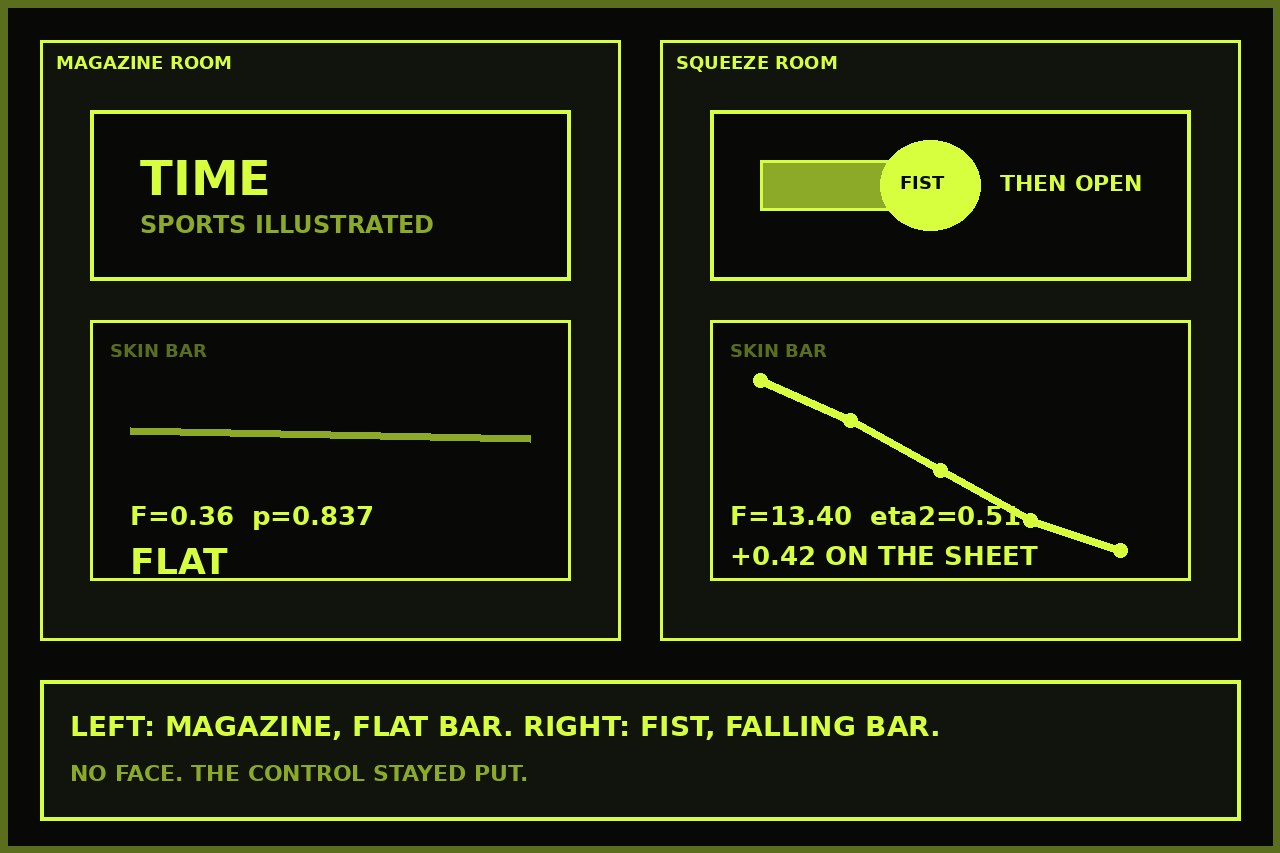
People who squeezed then opened dropped the skin bar in a straight line. The team printed F=13.40, p less than 0.001, and eta squared 0.51. F is the number the team printed for the split. A p value tells you how often a gap this big would show up if nothing had changed. Eta squared tells you how much of the change the group explained.
People with magazines stayed put on that bar. The team printed F=0.36, p=0.837, and eta squared 0.03.
The team found the four rooms split. They printed F=8.18, p less than 0.001, and eta squared 0.31.
You can still want the squeeze-and-open tape to drop the skin bar.
Did people with magazines also feel more relaxed?
People who squeezed then opened rose 0.42 on the SRSI-3 sheet, with p=0.002. People with magazines rose 0.31, with p=0.019. After the tape, people in the PMR room scored 0.43 above people with magazines, with p=0.046. The team printed a group-by-time split of F=2.81, p=0.048, and eta squared 0.14. Group by time means the rooms did not move the same way from start to finish.
People with magazines also felt more relaxed on the sheet. Keep that room too. You can still want the squeeze-and-open tape to drop the skin bar.
Did heart rate change?
The team also looked at heart rate. They printed F=1.65, p=0.084, and eta squared 0.11.
What were the other rooms?
Deep breathing and guided imagery were other rooms in the same paper. The numbers on this page come from the squeeze-and-open tape and the magazine room.
If you feel unusual distress or you need care, talk to a clinician, because this page is educational and not a diagnosis.
If you want a page about tapping that dropped the stress hormone, open the EFT page.
Can you still want the squeeze-and-open tape to drop the skin bar?
You wanted the squeeze-and-open tape to drop the skin bar after a magazine already had twenty minutes. Keep the PMR name.
People who squeezed then opened dropped the skin bar in a straight line and people with magazines stayed put on that bar. You can still want the squeeze-and-open tape to drop the skin bar.
Sources
Toussaint L., Nguyen Q.A., Roettger C., Dixon K., Offenbacher M., Kohls N., Hirsch J., Sirois F. “Effectiveness of Progressive Muscle Relaxation, Deep Breathing, and Guided Imagery in Promoting Psychological and Physiological States of Relaxation.” Evidence-Based Complementary and Alternative Medicine 2021;2021:5924040. DOI 10.1155/2021/5924040. PMID 34306146. Luther College, Decorah IA. n=60 undergraduate psychology extra-credit, 71.4 percent female, mean age 19.64 SD 1.32, range 18 to 23. 20-minute recorded audio by Dr. Jonathon Smith. Control got TIME and Sports Illustrated. Evening 7:00 p.m. to 9:00 p.m. Caffeine withheld 12 hours. Biopac MP35. Electrodermal on first and second fingers of the nondominant hand. Skin conductance magazine control stayed put F=0.36, p=0.837, eta squared 0.03. PMR fell in a straight line F=13.40, p less than 0.001, eta squared 0.51. Four rooms split F=8.18, p less than 0.001, eta squared 0.31. Self-report PMR rose 0.42, p=0.002. Magazine rose 0.31, p=0.019. After the tape PMR scored 0.43 above magazine, p=0.046. Group by time F=2.81, p=0.048, eta squared 0.14. Heart rate F=1.65, p=0.084, eta squared 0.11. SRSI-3, 38 items, 1-to-6, alpha above 0.90. Deep breathing and guided imagery were other rooms in the same paper. doi.org/10.1155/2021/5924040 · pubmed.ncbi.nlm.nih.gov/34306146